3Q23 Global Fund Commentary
Southeastern Asset Management is a Memphis-based deep-value firm founded in 1975 by O. Mason Hawkins to exploit the bargains left by the 1973-74 bear market. Its flagship Longleaf Partners Funds (launched 1987) invest employees' own money alongside clients'. Following Graham's discipline and its "Business, People, Price" framework, it runs concentrated books of 15-25 undervalued stocks held for the long term — famously closing funds to new investors when opportunities were scarce. CEO and Head of Research Ross Glotzbach now leads the firm, which publishes quarterly Longleaf fund commentaries and Research Perspectives notes.
In plain words
This article covers Southeastern's Global Fund results for Q3 2023. Instead of chasing the "Magnificent Seven" tech giants (with an average P/E of 29), the fund bought high-quality companies at a low P/E of just 12.5, betting they will outperform when market enthusiasm fades. The fund lost 3.45%, but holds cheap stocks with real upside. For ordinary investors, it’s a reminder to avoid overpriced darlings and look for undervalued firms where management is buying back shares. It’s worth reading as a case study in disciplined value investing.
Southeastern (Longleaf Partners) Global Fund Q3 2023 Report The fund declined 3.45% in the third quarter of 2023, roughly in line with the FTSE Developed Index (-3.43%). The core view is that the market was influenced by high inflation, persistently elevated interest rates, and a weak Chinese econom
Theme and Background
This chapter discusses the performance and portfolio strategy of the Longleaf Partners Global Fund for the third quarter of 2023. The market was influenced by high inflation, prolonged high interest rates, and a weak Chinese economy, leading to a strong risk-off sentiment, with only the energy and communication services sectors posting positive returns. The fund declined 3.45% during the quarter, roughly in line with the FTSE Developed Index (-3.43%).
Core Thesis
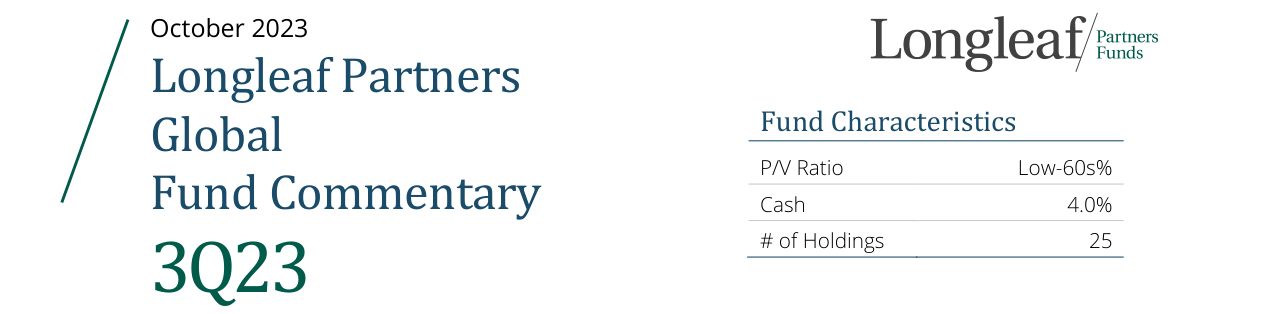
The fund's P/V ratio is at a low 60% level, cash accounts for 4.0%, and it holds 25 stocks
The report's core investment thesis argues that by holding high-quality, undervalued companies, the fund has the potential for excess returns in a market characterized by extreme valuation dispersion. A contrarian judgment is that the fund completely avoids the "Magnificent Seven" and 11 other of the most actively traded U.S. stocks globally (with a market cap exceeding $11 trillion and a weighted average P/E of 29x), instead holding a portfolio at a 12.5x P/E, well below the FTSE Developed's 15.54x. The author believes these mega-cap stocks face pressure from intensifying competition and rising interest rates, while the fund's portfolio companies are executing well operationally, delivering a 26% return over the past 12 months, and are poised to achieve relative outperformance in various market environments going forward.
Key Arguments and Data
- Valuation Comparison: The fund's portfolio P/E is 12.5x, compared to 29.49x for the top 11 S&P 500 stocks and 15.54x for the FTSE Developed.
- Market Performance: In the third quarter, only the energy and communication services sectors posted positive returns. The fund's top five contributors included CNX Resources (+27%), Mattel (+13%), etc., while detractors included IAC (-20%), Delivery Hero (-32%), etc.
- Portfolio Characteristics: The fund's P/V ratio is in the low 60% range, cash accounts for 4.0%, and it holds 25 stocks.
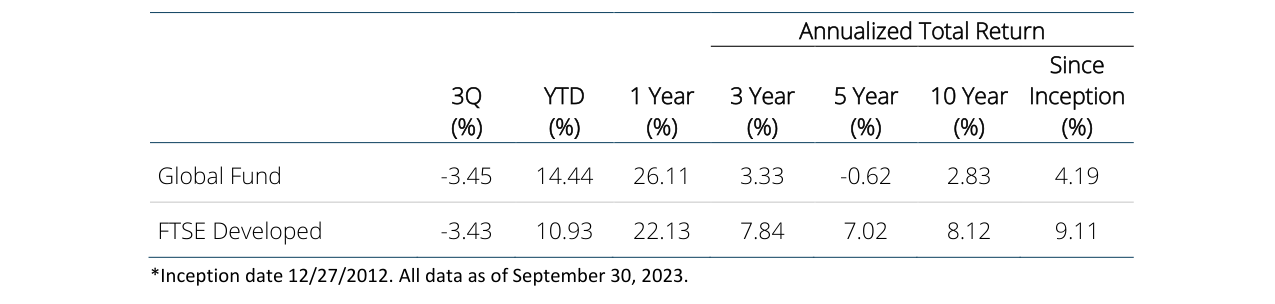
The Global Fund returned -3.45% in Q3, 14.44% year-to-date, 26.11% over one year, and an annualized 4.19% since inception
| Metric | Global Fund | Top 11 S&P 500 Stocks | FTSE Developed |
|---|---|---|---|
| Weighted Average P/E (Next 12 Months) | 12.50 | 29.49 | 15.54 |
| Average P/E (Next 12 Months) | — | 29.46 | — |
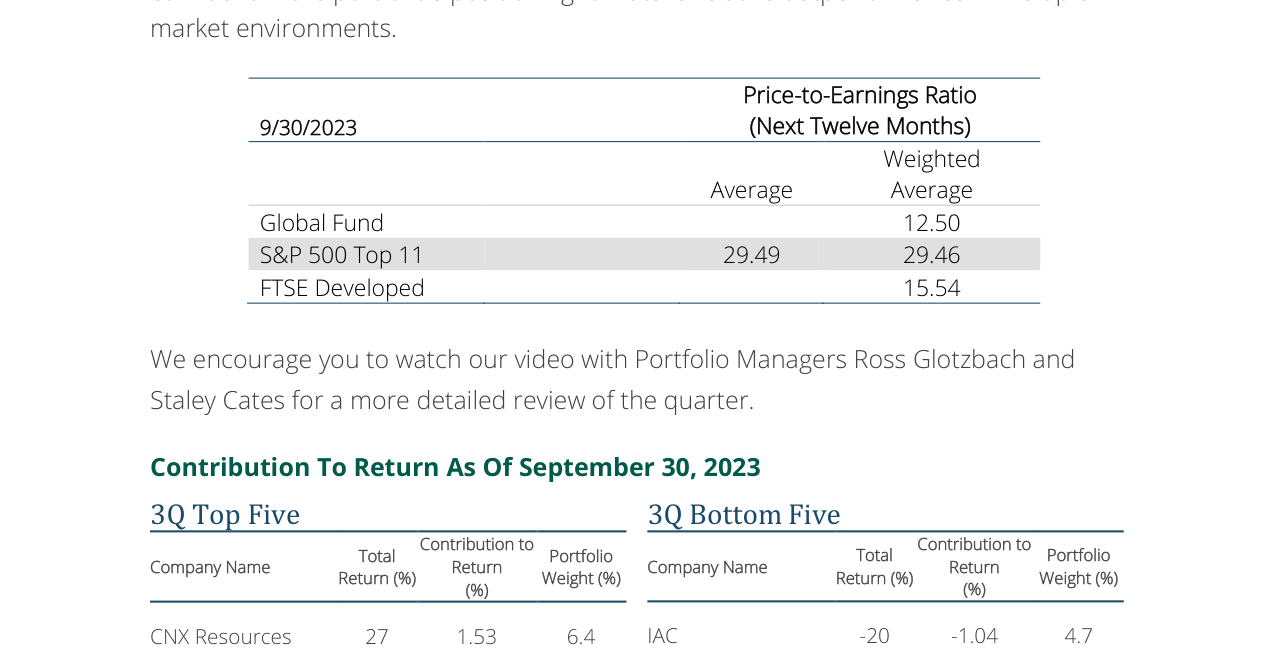
The Global Fund's weighted average P/E of 12.50x is significantly lower than the S&P 500 Top 11's 29.46x and the FTSE Developed's 15.54x
Companies/Assets Involved
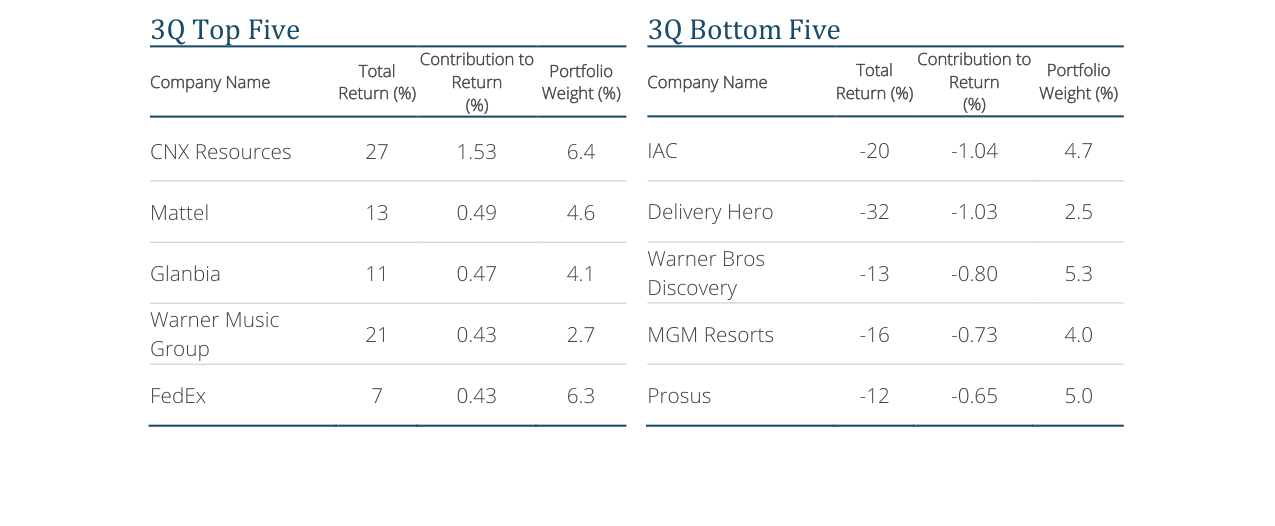
CNX Resources contributed 1.53% to the fund's return with a 27% gain, while Mattel and Glanbia contributed 0.49% and 0.47%, respectively
- CNX Resources (Bullish): A natural gas company benefiting from rising energy prices and operational execution. The market has not assigned value to its long-term undeveloped assets and investments in new technologies (e.g., carbon reduction methods). Management is exploiting the price dislocation through large-scale share buybacks.
- Mattel (Bullish): A global toy and media company benefiting from the success of the Barbie movie. The author believes its intellectual property monetization plan (as described by Ynon Kreiz) will continue to drive brand value.
- IAC (Bearish): A digital holding company dragged down by weak performance at its subsidiary Angi. However, hidden assets such as its direct stake in MGM Resorts and Dotdash Meredith (including Care.com, Turo) have appreciation potential, and its net cash balance sheet provides offensive capability.
- Delivery Hero (Bearish): A German-listed food delivery company, a new position established in Q2 2023. Its stock price fell sharply due to the post-pandemic demand peak decline, but the author believes Prosus (a 30% owner) will ensure capital allocation and operational discipline, with management focused on balancing growth and profitability.
- Warner Bros Discovery (Bearish): A media group affected by the writers' and actors' strikes and the Charter/Disney dispute. However, it generates good free cash flow, and the competitive landscape is improving due to streaming price increases.
- New Positions: Fortune Brands (U.S., housing-related business), Richemont (Switzerland, luxury goods, brands including Cartier and Van Cleef & Arpels).
- Exited Positions: General Electric (valuation already reflected value, no margin of safety remaining), CK Hutchison (lack of value growth and disappointing capital allocation), Hasbro, Kansai Paint, Fiserv (position not fully built due to rapid price increases).
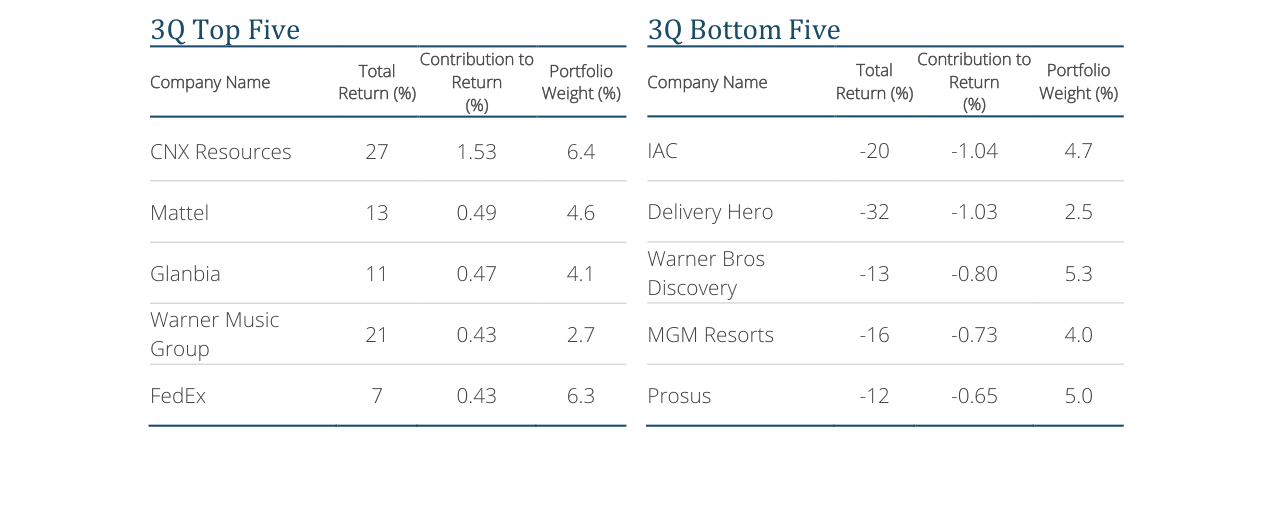
IAC and Delivery Hero detracted 1.04% and 1.03% from the fund's return, respectively, with quarterly returns of -20% and -32%
Investment Implications
- Directional Recommendation: Investors should avoid overvalued mega-cap growth stocks (e.g., the "Magnificent Seven") and instead pivot to high-quality, undervalued companies (P/E around 12.5x) with actively executing management. These companies offer a margin of safety and upside potential in a risk-off market environment.
- Specific Opportunities: Focus on CNX Resources' hidden asset value, Mattel's IP monetization, IAC's hidden assets (e.g., Care.com, Turo), and Delivery Hero's earnings improvement in core markets.
- Risk Warnings: Be mindful of IAC's drag from the Angi business, cybersecurity and strike risks at MGM Resorts, and short-term demand volatility at Delivery Hero.