3Q23 Partners Fund Commentary
Southeastern Asset Management is a Memphis-based deep-value firm founded in 1975 by O. Mason Hawkins to exploit the bargains left by the 1973-74 bear market. Its flagship Longleaf Partners Funds (launched 1987) invest employees' own money alongside clients'. Following Graham's discipline and its "Business, People, Price" framework, it runs concentrated books of 15-25 undervalued stocks held for the long term — famously closing funds to new investors when opportunities were scarce. CEO and Head of Research Ross Glotzbach now leads the firm, which publishes quarterly Longleaf fund commentaries and Research Perspectives notes.
In plain words
This quarterly report explains how a fund beat the market by avoiding popular stocks like Apple and Tesla (the 'Magnificent Seven'), which trade at very high prices (29 times earnings). Instead, it bought cheaper companies (13 times earnings) with strong managers. When the market fell, the fund lost less. The lesson: don't chase overpriced trends. Many ignored stocks offer real value. Also, temporary problems like cyberattacks can create buying opportunities if the company's fundamentals are still solid. Worth a read because it shows that the old idea of 'buying good companies at cheap prices' still works today.
Longleaf Partners Fund declined 1.82% in the third quarter of 2023, outperforming the S&P 500 (-3.27%) and the Russell 1000 Value Index (-3.16%). The report's core argument is that the fund avoided 11 overvalued popular stocks, including the "Magnificent Seven," with a combined market capitalization
Theme and Background
This chapter is the investment review of the Longleaf Partners Fund for the third quarter of 2023. The report notes that against a market-wide "risk-off" backdrop in Q3, the fund declined by 1.82%, outperforming the S&P 500 (-3.27%) and the Russell 1000 Value Index (-3.16%). The author uses this opportunity to articulate the fund's core investment strategy: avoiding overvalued, popular large-cap stocks and focusing on undervalued, high-quality enterprises.
Core Thesis
The author's core investment argument is: By actively avoiding 11 popular stocks, including the overvalued "Magnificent Seven," and instead holding a portfolio of high-quality companies with reasonable valuations and strong management execution, the fund can achieve relative excess returns across various market environments. This is a contrarian view, as current market capital is heavily concentrated in these popular large-cap stocks.
Key Arguments and Data
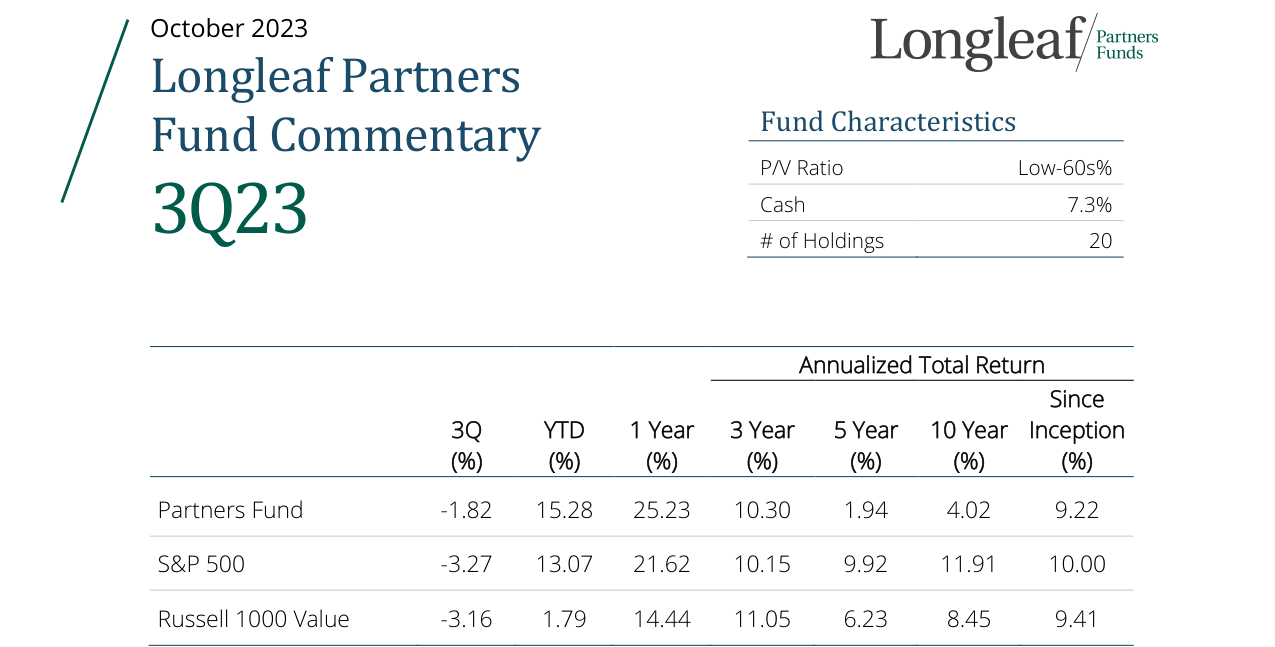
Fund P/V ratio below 60%, cash position 7.3%, portfolio of 20 holdings
1. Valuation Comparison Between the Fund and Benchmarks: The fund's holdings have a price-to-earnings (P/E) ratio significantly lower than that of popular market stocks and the overall index.
- The weighted average P/E ratio of the fund's holdings is only 12.70x.
- The weighted average P/E ratio of the 11 largest popular stocks in the S&P 500 (including the "Magnificent Seven" + AMD, Adobe, Broadcom, Netflix) is as high as 29.49x, with a total market capitalization exceeding $11 trillion.
- Excluding these 11 stocks, the P/E ratio of the remaining S&P 500 stocks is approximately 15.5x.
- The P/E ratio of the entire S&P 500 index is 17.86x.
2. Valuation Comparison Data Table:
| Metric | P/E Ratio (Next Twelve Months) |
|---|---|
| Partners Fund | 12.70x |
| S&P 500 Top 11 | 29.49x |
| S&P 500 | 17.86x |
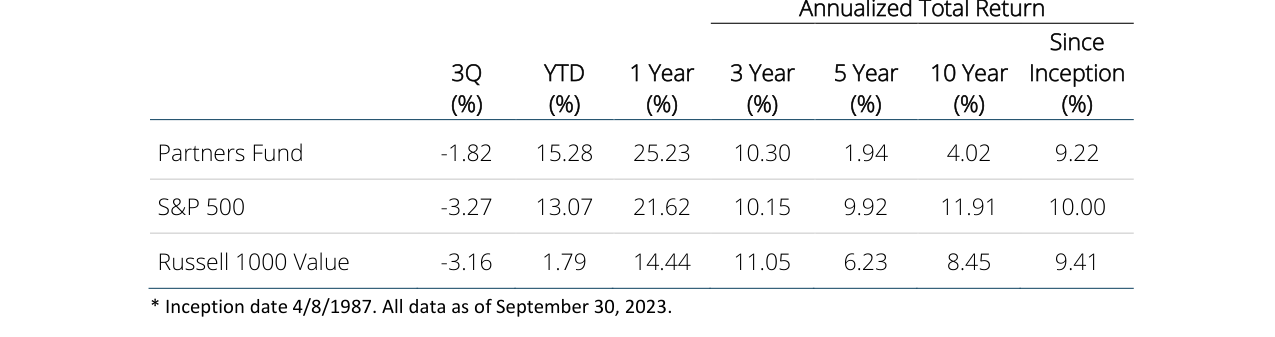
Q3 fund return -1.82%, year-to-date 15.28%, annualized return since inception 9.22%, outperforming the S&P 500's -3.27%
3. Fund Performance and Holding Quality:
- Despite the fund's 25.23% gain over the past 12 months, the P/E ratio of its holdings remains at 13x (based on unoptimized earnings).
- The fund's price-to-value (P/V) ratio is at a low low 60% range, with a cash position of 7.3% and 20 stock holdings.
- The author believes these popular stocks face increasingly intense competition among themselves, and their record-high profit margins were achieved in a rising interest rate environment, posing challenges for future growth.
Companies/Assets Involved
This chapter provides a detailed analysis of the top five best and worst performers for the third quarter.
Top Five Best Performing Stocks in Q3 (Top 5 Contributors):
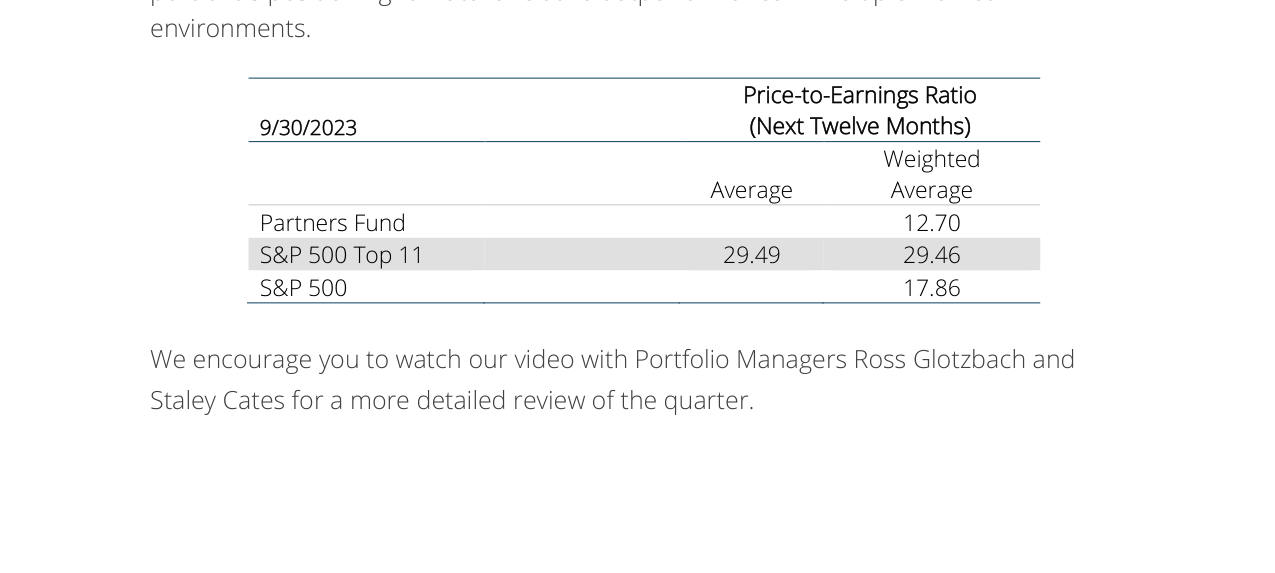
Partners Fund weighted average P/E of 12.70x, significantly lower than the S&P 500 Top 11's 29.46x and the S&P 500's 17.86x
| Company Name | Quarterly Return | Contribution to Portfolio | Weight | Author's View (Bullish/Bearish) |
|---|---|---|---|---|
| CNX Resources | +27% | +1.53% | 6.3% | Bullish. Benefited from rising energy prices and operational execution. The market has not assigned value to its long-term undeveloped assets and investments in new technologies (e.g., carbon reduction), representing "high-quality hidden assets." The company is using the pricing dislocation for large-scale share buybacks. |
| Warner Music Group | +21% | +0.92% | 5.2% | Bullish. Streaming growth rates have recovered to long-term expectations. A key catalyst is that digital service providers (DSPs) like Spotify have finally raised streaming service prices without experiencing user churn. The CEO believes there is significant upside potential in audio streaming pricing. |
| Mattel | +13% | +0.68% | 6.3% | Bullish. Benefited from the success of the Barbie movie. This exemplifies CEO Ynon Kreiz's strategy of monetizing strong intellectual property (IP). The author expects the company to continue monetizing its brands through various means beyond toys. |
| Liberty Broadband | +14% | +0.59% | 5.3% | Bullish. No detailed analysis provided. |
| Fairfax Financial | +9% | +0.47% | 5.1% | Bullish. No detailed analysis provided. |
Top Five Worst Performing Stocks in Q3 (Bottom 5 Detractors):
| Company Name | Quarterly Return | Contribution to Portfolio | Weight | Author's View (Bullish/Bearish) |
|---|---|---|---|---|
| IAC | -20% | -1.04% | 4.7% | Bullish. Weak performance, particularly from its subsidiary Angi (small in value but significant impact on stock price). Core asset MGM Resorts (also directly held by the fund) was affected by a cyberattack and strikes. However, the author believes MGM remains undervalued, and management is using the weak stock price for buybacks. IAC has a net cash balance sheet, allowing it to "go on offense" in any market environment, with the current price offering a margin of safety and upside potential. |
| Warner Bros Discovery | -13% | -0.80% | 5.3% | Bullish. Affected by the writers'/actors' strike and the Charter/Disney dispute, raising market concerns about the profit structure of linear TV and streaming. However, the author believes these situations improved by the end of the quarter, the company's core business execution is solid, free cash flow is strong, and the streaming competitive landscape has become more favorable due to price increases by multiple platforms. |
| MGM Resorts | -16% | -0.70% | 3.9% | Bullish. Same as above, impacted by the cyberattack and the Las Vegas strike. The author believes the company remains highly undervalued even considering these factors, and management is using the price weakness for large-scale share buybacks. |
| Affiliated Managers Group | -13% | -0.66% | 4.8% | Bullish. No detailed analysis provided. |
| CNH Industrial | -16% | -0.66% | 3.7% | Bullish. No detailed analysis provided. |
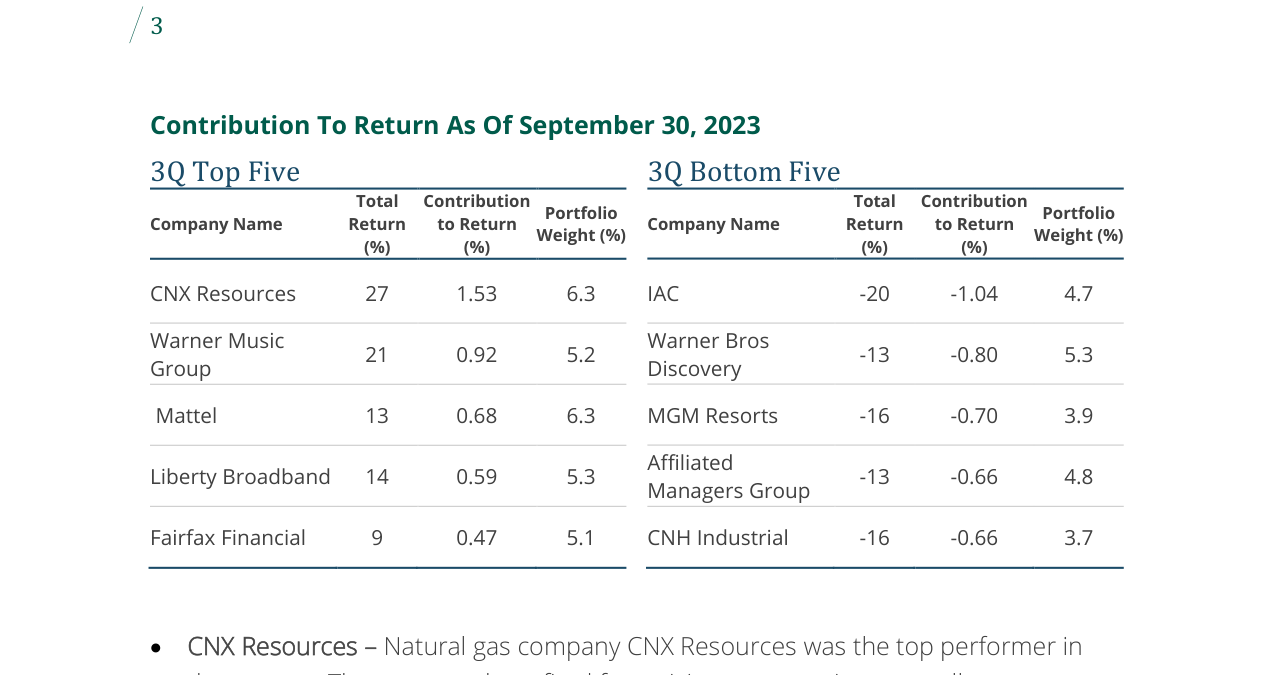
In Q3, CNX Resources contributed the most (1.53%), IAC detracted the most (-1.04%), with the Top Five contributing a total of 4.19% and the Bottom Five detracting a total of -3.86%
Other Actions:
- New Purchase: A company previously invested in successfully, now available at a discount under a new corporate structure.
- Liquidation: Sold General Electric (GE).
Investment Implications
- Avoid Valuation Bubbles: Investors should be wary of the current market's excessive enthusiasm for a few mega-cap growth stocks. The high valuations (29x P/E) and increasingly competitive environment of these companies may lead to future returns falling short of expectations.
- Focus on Value Opportunities: The fund's low P/E ratio (12-13x) and strong management execution indicate abundant undervalued investment opportunities outside of popular stocks. Look for companies with "hidden assets" (e.g., CNX's undeveloped assets, IAC's Care.com and Turo) or strong IP monetization capabilities (e.g., Mattel).
- Capitalize on Market Panic: For companies like MGM Resorts and Warner Bros Discovery, whose stock prices are pressured by short-term negative events (cyberattacks, strikes) but have solid fundamentals, it may be an opportune time for contrarian buying. Management conducting share buybacks during periods of low stock prices is a significant signal of value creation.