3Q23 Small-Cap Fund Commentary
Southeastern Asset Management is a Memphis-based deep-value firm founded in 1975 by O. Mason Hawkins to exploit the bargains left by the 1973-74 bear market. Its flagship Longleaf Partners Funds (launched 1987) invest employees' own money alongside clients'. Following Graham's discipline and its "Business, People, Price" framework, it runs concentrated books of 15-25 undervalued stocks held for the long term — famously closing funds to new investors when opportunities were scarce. CEO and Head of Research Ross Glotzbach now leads the firm, which publishes quarterly Longleaf fund commentaries and Research Perspectives notes.
In plain words
This is a quarterly update for Southeastern's small-cap fund. Small-company stocks are currently much cheaper than giant ones, and the fund sees this as a big opportunity. The fund eked out a small gain in Q3, beating the Russell 2000 index (a benchmark for small stocks). Winners included natural gas firm CNX Resources (benefiting from higher energy prices), Boston Beer (strong Twisted Tea sales), and Mattel (thanks to the Barbie movie). Losers included health insurer Oscar, which fell just because early investors sold shares—not because the business worsened. For regular investors, the takeaway is that cheap, well-run small companies might be worth a look, but expect bumps along the way.
Longleaf Partners Small-Cap Fund rose 0.26% in the third quarter of 2023, significantly outperforming the Russell 2000 (-5.13%) and the Russell 2000 Value (-2.96%), standing out in a "risk-off" environment. The fund's P/V ratio is in the low 60% range, with a cash position of 7.7% and holdings in 21
Theme and Background
This section reviews the performance and portfolio dynamics of the Longleaf Partners Small-Cap Fund in the third quarter of 2023. The report notes that small-cap stocks continue to fall out of favor, perceived as volatile and cyclical, while a handful of U.S. mega-cap stocks (trading at historical valuation multiples) dominate global markets. This valuation gap has created an opportunity to acquire high-quality small-cap stocks at deep discounts.
Core Thesis
The author's core investment argument is that the current valuation gap between small-cap and mega-cap stocks has created a "compelling opportunity" to own high-quality small-cap businesses with strong balance sheets and capable management teams. The fund outperformed the broader market in a "risk-off" environment, validating its strategy of building a "unique, diversified, and relatively defensive" portfolio.
Key Arguments and Data
- Performance: The fund rose 0.26% in the third quarter, significantly outperforming the Russell 2000 (-5.13%) and the Russell 2000 Value (-2.96%). Within the Russell 2000, only the energy and financial sectors posted positive returns.
- Valuation: The fund's P/V ratio is in the low 60% range, with cash at 7.7% and holdings in 21 stocks.
- Long-Term Returns: Since inception (February 21, 1989), the fund has achieved an annualized return of 9.50%, outperforming the Russell 2000's 8.81%.
- Top Five Contributors and Detractors:
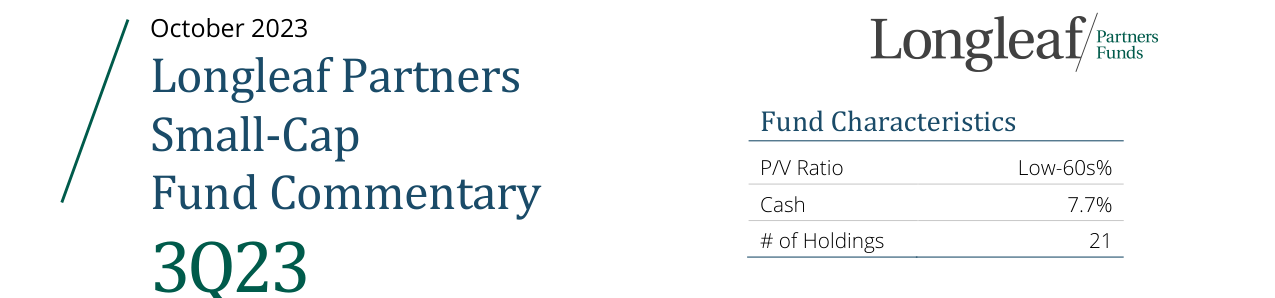
Fund P/V ratio in the low 60% range, cash at 7.7%, and 21 holdings
| Category | Company Name | Quarterly Return (%) | Contribution to Total Portfolio Return (%) | Portfolio Weight (%) |
|---|---|---|---|---|
| Top Five Contributors | CNX Resources | 27 | 1.55 | 6.3 |
| Boston Beer Company | 26 | 1.14 | 4.9 | |
| Mattel | 13 | 0.78 | 6.6 | |
| White Mountains | 8 | 0.51 | 5.0 | |
| Empire State Realty | 8 | 0.50 | 4.7 | |
| Top Five Detractors | Oscar | -31 | -1.98 | 4.9 |
| Westrock Coffee | -19 | -1.18 | 5.7 | |
| Lumen | -33 | -0.68 | 1.2 | |
| Atlanta Braves Holdings | -10 | -0.43 | 4.2 | |
| Masonite | -9 | -0.32 | 3.6 |
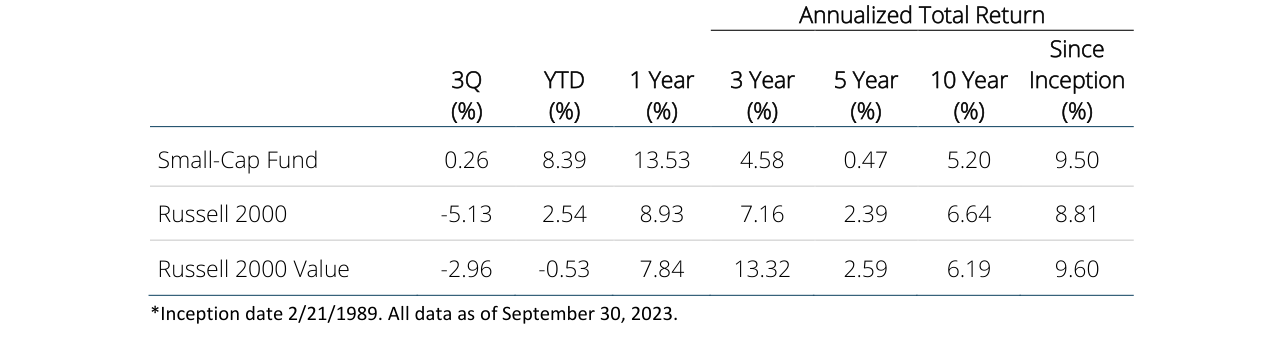
Small-cap fund returned 0.26% in Q3, 8.39% year-to-date, and 9.50% annualized since inception, all outperforming the Russell 2000 over the same periods
- CNX Resources: Benefited from rising energy prices and operational execution, but the market has not yet recognized the value of its long-term undeveloped assets and "new technology investments" (including net carbon reduction methods). Management views these as "high-quality hidden assets," and the company is exploiting the price dislocation through large-scale share buybacks.
- Boston Beer Company: Strong growth in the Twisted Tea brand has begun to offset the ongoing decline of Truly Seltzer (which peaked in 2020 and has been declining but is now stabilizing). The company is in the early stages of rationalizing Truly's costs, has a net cash balance sheet, and founder Jim Koch's team is opportunistically buying back discounted shares.
- Mattel: Benefited from the success of the Barbie movie, which exemplifies CEO Ynon Kreiz's strategy of monetizing the company's strong intellectual property. The report cites a 2020 interview where Kreiz stated, "Barbie is far more than a toy; it is a cultural phenomenon."
- Oscar Health: The largest quarterly detractor but still the best performer year-to-date. The decline was driven by early-stage venture capital investors reducing their stakes, but the company's fundamentals remain unchanged, and it reaffirmed its guidance. The fund reduced its position in Oscar after its strong first-half performance but added to it during the quarter's price decline.
- Westrock Coffee: Faces challenges from inflation, heatwaves (affecting hot coffee demand), and high fuel prices (impacting traffic at convenience stores and rest stops). However, the long-term investment thesis relies more on a potentially transformative new plant set to begin operations in 2024, which will support a shift toward higher-value beverages.
Companies/Assets Involved
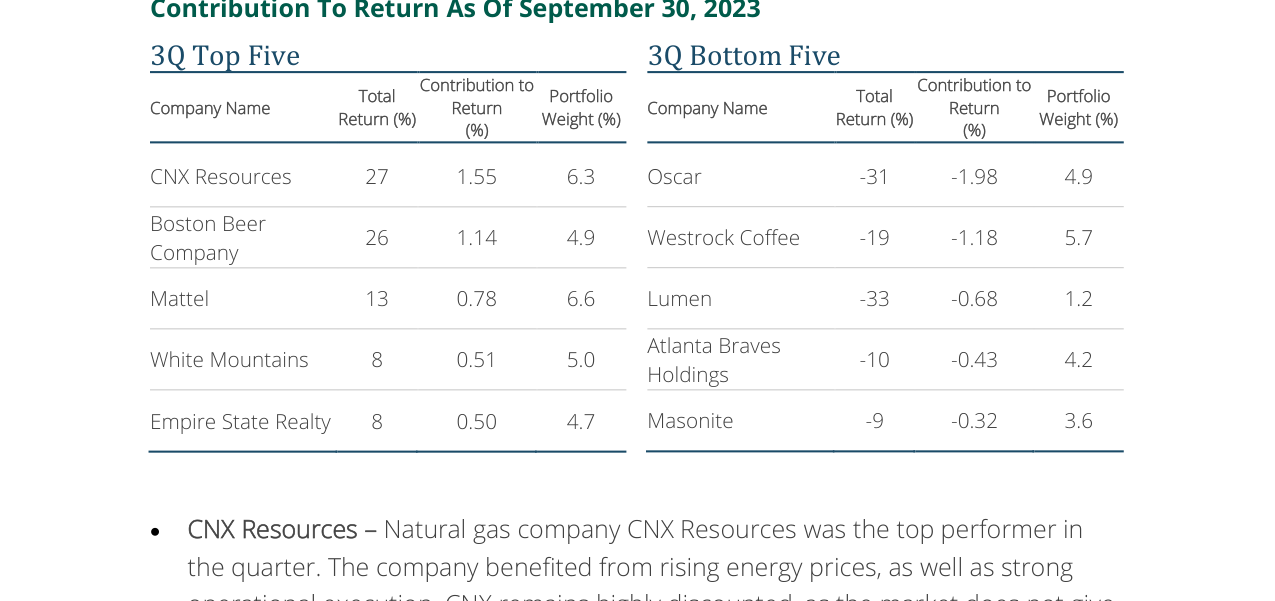
CNX Resources was the largest contributor in Q3 with a 1.55% contribution, while Oscar Health was the largest detractor with a -1.98% contribution
- CNX Resources (Bullish): A natural gas company and the quarter's best performer. The author believes its long-term assets and new technology investments are undervalued by the market, and the company is exploiting the price dislocation through buybacks.
- Boston Beer Company (Bullish): Strong growth in the Twisted Tea brand is offsetting the decline of Truly Seltzer. It has a net cash balance sheet, and the founder is buying back discounted shares.
- Mattel (Bullish): The success of the Barbie movie validates the IP monetization strategy, and the company is expected to continue leveraging its strong brands for non-toy monetization.
- Oscar Health (Bullish, but short-term volatility): Fundamentals remain unchanged; venture capital selling is short-term noise. The fund added to its position during the price decline.
- Westrock Coffee (Bullish, but under short-term pressure): Long-term value depends on the new plant in 2024, while short-term performance is weighed down by macro factors.
Investment Implications
- Small-Cap Opportunity: The current valuation gap between small-cap and mega-cap stocks is historically rare. Investors should focus on small-cap businesses with strong balance sheets, stable operations, and capable management teams, particularly those with overlooked "hidden assets" (e.g., CNX Resources' undeveloped assets and new technologies).
- Contrarian Approach: For companies with unchanged fundamentals but under short-term pressure from capital flows or macro factors (e.g., Oscar Health, Westrock Coffee), price declines offer opportunities to add to positions.
- Focus on IP Monetization: The success of Mattel's Barbie movie shows that companies with strong intellectual property can achieve value revaluation through non-traditional means (e.g., media, cultural phenomena), which may be a long-term trend in the toy and media industries.
- Energy and Defensive Allocation: In a "risk-off" environment, the energy and financial sectors were the only positive sectors in the Russell 2000. Holdings like CNX Resources (energy) and White Mountains (insurance) in the fund's portfolio reflect the value of defensive positioning.