3Q23 International Fund Commentary
Southeastern Asset Management is a Memphis-based deep-value firm founded in 1975 by O. Mason Hawkins to exploit the bargains left by the 1973-74 bear market. Its flagship Longleaf Partners Funds (launched 1987) invest employees' own money alongside clients'. Following Graham's discipline and its "Business, People, Price" framework, it runs concentrated books of 15-25 undervalued stocks held for the long term — famously closing funds to new investors when opportunities were scarce. CEO and Head of Research Ross Glotzbach now leads the firm, which publishes quarterly Longleaf fund commentaries and Research Perspectives notes.
In plain words
This report looks at how the Longleaf Partners International Fund performed in the third quarter of 2023. The fund lost about 4%, similar to the overall market, because of high interest rates and China's weak economy. But the fund managers bought more shares of luxury companies like Richemont (owner of Cartier) when they were cheap. Why? They think these companies can create value themselves—by buying back their own stock, selling off weak businesses, or splitting up—instead of waiting for the economy to improve. For regular investors, the lesson is: sometimes what a company does matters more than the news headlines.
Longleaf Partners International Fund Q3 2023 Performance The Longleaf Partners International Fund declined 3.94% in the third quarter of 2023, roughly in line with the FTSE Developed ex-North America Index's -3.98%. The report notes that markets were driven by risk aversion due to high inflation, pr
Theme and Background
This chapter reviews the performance and operations of the Longleaf Partners International Fund in the third quarter of 2023. The market exhibited a risk-averse sentiment overall, driven by high inflation, persistently high Western interest rates, and a weak Chinese economy, causing the fund to decline by 3.94%, roughly in line with the benchmark index (-3.98%). The Consumer Discretionary sector was the worst performer, hampered by luxury holdings.
Core Thesis
The author’s core investment argument is that, despite the challenging macro environment, companies in the portfolio can create their own value through active management actions (such as share buybacks, asset divestitures, business spin-offs, and even outright sales), and current negative sentiment has been overpriced. The counterintuitive judgment is that the fund increased its positions in luxury companies (Richemont, Kering) when their valuations were at long-term troughs (e.g., Richemont), believing that structural themes such as China’s emerging middle class and the branding trend remain solid.
Key Arguments and Data
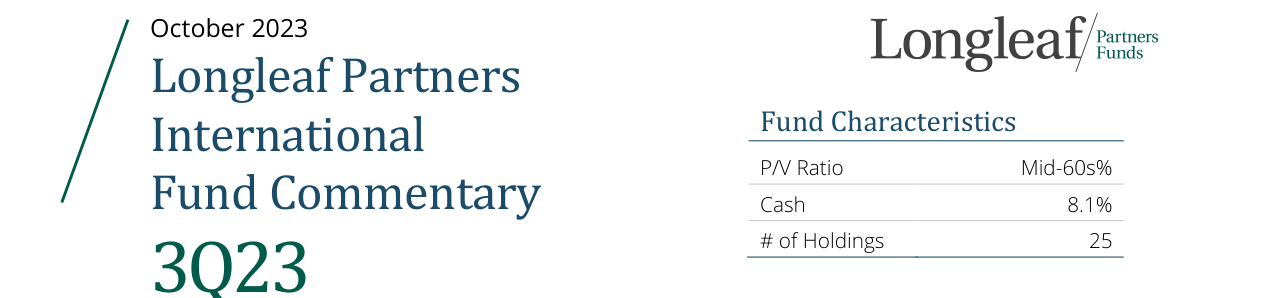
The fund’s P/V ratio is in the mid-60% range, with a cash position of 8.1%, holding a total of 25 stocks
- Fund Performance: The fund declined 3.94% in the third quarter, roughly in line with the benchmark index (-3.98%); year-to-date return was 9.33%, and the one-year return was 29.45%. However, the 3-year, 5-year, and 10-year annualized returns were 2.64%, -1.21%, and 1.27%, respectively, all below the benchmark (5.31%, 3.04%, and 3.85%).
- Valuation Level: The fund’s P/V ratio is in the mid-60% range, with cash accounting for 8.1%, holding 25 stocks.
- Management Actions: Companies are narrowing the gap between price and value through large-scale share buybacks (e.g., Alibaba, Prosus, Kansai Paint, Man Wah, Glanbia, EXOR, Domino's Pizza Group, Accor), divesting non-core assets or spinning off businesses (e.g., Accor, Glanbia, Delivery Hero, Alibaba, Lanxess), and outright sales (e.g., Applus).
- Comparative Data: In a quarter where only Energy and Financials posted positive returns, some large positions recorded positive gains.
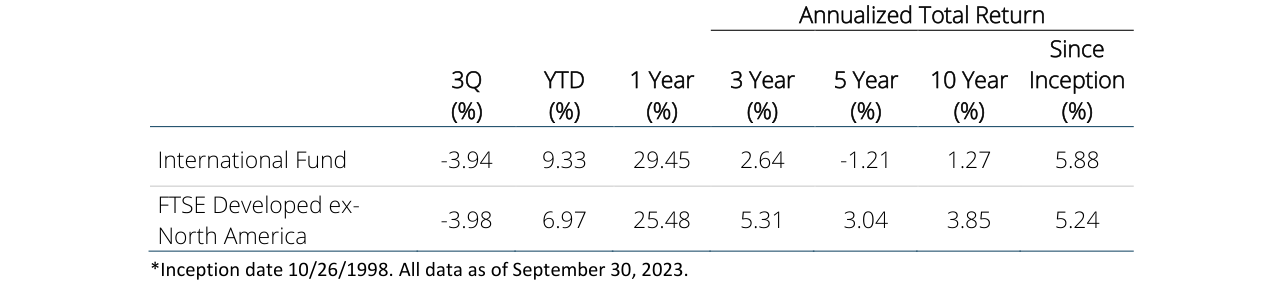
The International Fund returned -3.94% in Q3, 9.33% year-to-date, and an annualized return of 5.88% since inception, slightly outperforming the benchmark
| Metric | Fund | Benchmark Index |
|---|---|---|
| 3Q Return | -3.94% | -3.98% |
| YTD Return | 9.33% | 6.97% |
| 1-Year Return | 29.45% | 25.48% |
| 3-Year Annualized Return | 2.64% | 5.31% |
| 5-Year Annualized Return | -1.21% | 3.04% |
| 10-Year Annualized Return | 1.27% | 3.85% |
| Annualized Return Since Inception | 5.88% | 5.24% |
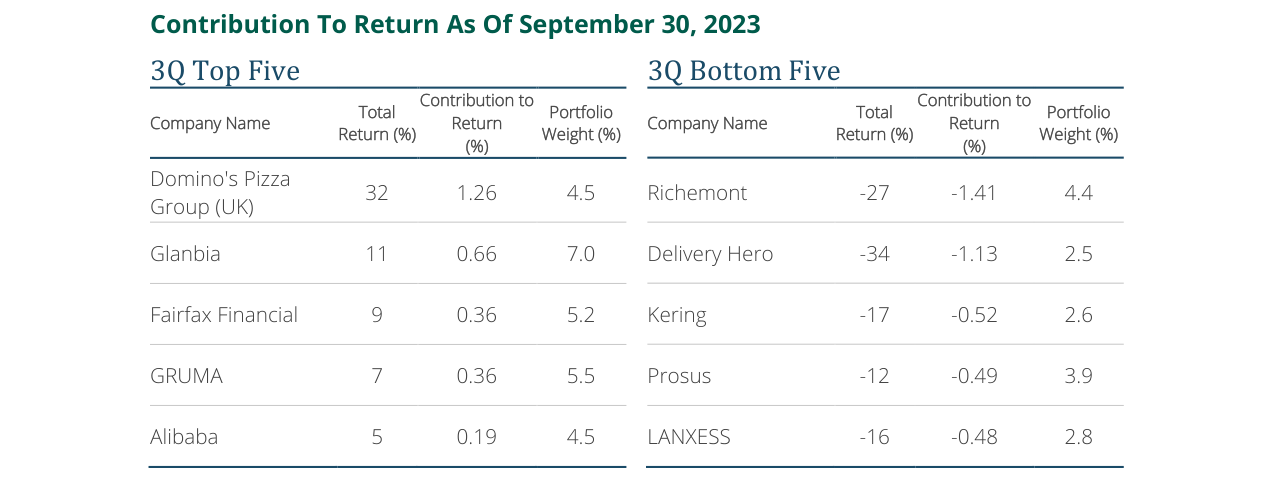
Domino's Pizza Group led with a 32% gain and a 1.26% contribution, followed by Glanbia and Fairfax Financial
Companies/Assets Involved
- Domino's Pizza Group (UK): Best performer in Q3, contributing 1.26% to total return with a 4.5% weight. New CEO Andrew Rennie took office, the company completed the sale of its German joint venture stake, and announced $70 million for buying back discounted shares. The author believes management is in place and poised to unlock business value.
- Glanbia: Positive performer, contributing 0.66% to total return with a 7.0% weight. The company sold its European and UK cheese joint venture, focusing on the higher-margin performance nutrition business (Optimal Nutrition reported double-digit revenue growth), and used a strong balance sheet to buy back discounted shares.
- Richemont: Worst performer, contributing -1.41% to total return with a 4.4% weight. Holds top brands like Cartier and Van Cleef, benefiting from a structural trend in branded jewelry (penetration still below most consumer goods sectors). Current valuation is at a long-term trough, and the fund increased its position during the quarter.
- Kering: Poor performer, contributing -0.52% to total return with a 2.6% weight. Owns high-quality brands but with more fashion exposure; the author views it as an undervalued self-improvement story (via Gucci’s revival and group synergies).
- Delivery Hero: Poor performer, contributing -1.13% to total return with a 2.5% weight. A German-listed food delivery company with operations primarily in Asia, the Middle East, and North Africa (market share leader in South Korea, Saudi Arabia, and the UAE). Post-pandemic demand growth slowdown led to a sharp stock decline; the author believes management is focused on balancing growth and profitability, and Prosus (holding 30%) will ensure capital allocation discipline.
- Prosus: Poor performer, contributing -0.49% to total return with a 3.9% weight. As a 30% shareholder in Delivery Hero, benefits from capital allocation discipline.
- Alibaba: Positive performer, contributing 0.19% to total return with a 4.5% weight. Creating value through share buybacks and business spin-offs.
- Applus: The fund sold half its position as two private equity firms bid for the entire business, making it the best performer in the first half.
Richemont and Delivery Hero dragged returns by 1.41% and 1.13%, respectively, with Kering, Prosus, and LANXESS also contributing negatively
Investment Implications
- Direction for Increasing Positions: When valuations in the luxury sector (Richemont, Kering) are at long-term troughs, consider buying on dips, capitalizing on the market’s overpricing of macro risks. The author believes structural themes such as China’s emerging middle class and the branding trend remain solid, with the long-term benefit logic unchanged.
- Direction for Reducing Positions: Avoid investing in companies lacking value growth and capital allocation discipline (e.g., CK Hutchison), as well as those with management changes and bleak prospects (e.g., Lazard).
- Focus on Management Actions: Prioritize companies that actively narrow the gap between price and value through share buybacks, asset divestitures, business spin-offs, or outright sales, as these actions can create their own value amid macro challenges.