2Q23 Global Fund Commentary
Southeastern Asset Management is a Memphis-based deep-value firm founded in 1975 by O. Mason Hawkins to exploit the bargains left by the 1973-74 bear market. Its flagship Longleaf Partners Funds (launched 1987) invest employees' own money alongside clients'. Following Graham's discipline and its "Business, People, Price" framework, it runs concentrated books of 15-25 undervalued stocks held for the long term — famously closing funds to new investors when opportunities were scarce. CEO and Head of Research Ross Glotzbach now leads the firm, which publishes quarterly Longleaf fund commentaries and Research Perspectives notes.
In plain words
This fund commentary warns that today's stock market is driven by a handful of giant tech stocks, much like the 2000 dot-com bubble. It suggests those stocks could crash soon. But the fund itself avoided those hot names and still beat the market by investing in companies like Live Nation (concert ticketing), IAC (digital holdings), and Millicom (telecom in Latin America) — all improving their own businesses. For everyday investors: don't chase hype; look for bargains where companies are fixing themselves. This report offers a useful contrarian perspective.
Southeastern (Longleaf Partners) July 2023 report shows that the Global Fund returned 3.21% in the second quarter and 18.53% year-to-date in the first half, outperforming the FTSE Developed Index (14.86% in the first half), despite lacking exposure to the information technology sector and being over
Theme and Background
This chapter is the introduction to the quarterly report of Southeastern (Longleaf Partners) Global Fund, released in July 2023. The report reviews the fund's performance in the second quarter and first half of 2023, with a focus on analyzing the current market environment, which is dominated by a handful of mega-cap growth stocks. It draws a parallel to the early stages of the 2000 internet bubble. The report also details the fund's portfolio activity, as well as the key contributors and detractors among individual holdings.
Core Thesis
The author's core investment thesis is that the few mega-cap tech stocks currently driving the market (similar to the early 2000s internet bubble) are at a stage where profit margins are peaking, competition is intensifying, and regulatory risks are rising, potentially leading to a more severe downturn. However, the fund's strong relative performance does not rely on a market correction but is instead based on the operational improvements and robust fundamentals of its portfolio companies. The report also highlights that the fund outperformed the FTSE Developed Index (14.86%) in the first half of 2023 with an 18.53% YTD return, despite having no exposure to the information technology sector and an overweight position in consumer discretionary.
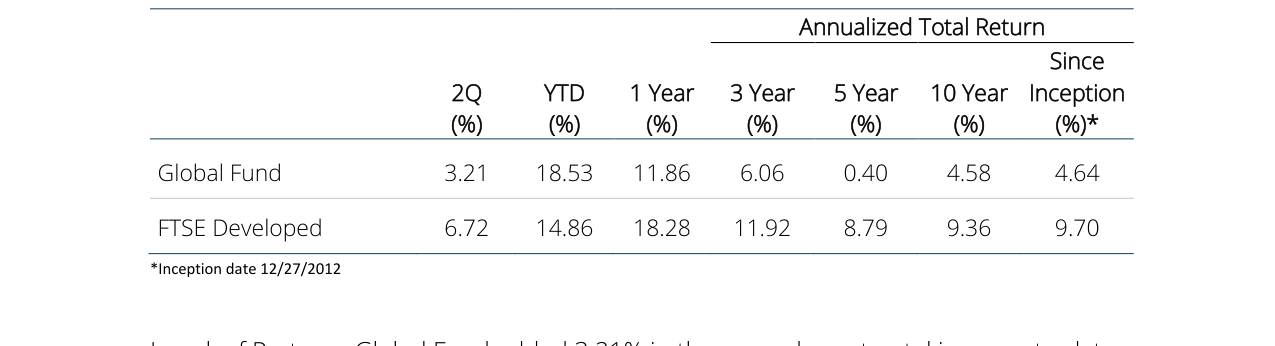
The Global Fund returned 3.21% in Q2 and 18.53% YTD, compared to the FTSE Developed Index's returns of 6.72% and 14.86%, respectively. The fund's returns across all longer-term periods lagged the benchmark.
Key Arguments and Data
- Market Analogy: The report compares the current rally in mega-cap tech stocks to the early stages of the 2000 internet bubble. After the Nasdaq fell over 35% from its peak in March 2000, it briefly rebounded 36% in Q2 2000, only to plunge another 80% over the subsequent 25 months. The author believes these stocks face similar risks today.
- Fund Performance: The Global Fund returned 3.21% in Q2 and 18.53% YTD in the first half, versus 6.72% and 14.86% for the FTSE Developed Index, respectively. The fund underperformed in Q2 but outperformed overall in the first half.
- Portfolio Characteristics: The fund's P/V ratio is in the mid-60% range, with a cash position of 2.7% and holdings in 28 stocks. It has no exposure to the information technology sector and is overweight in consumer discretionary.
- Individual Stock Contributions: The top five contributors (Q2) were Live Nation Entertainment (contribution +1.22%, weight 4.6%), IAC (+1.11%, weight 6.1%), CNX Resources (+0.62%, weight 6.3%), FedEx (+0.54%, weight 6.0%), and EXOR (+0.52%, weight 6.2%). The top five detractors were Millicom (-1.12%, weight 4.4%), Warner Bros Discovery (-0.99%, weight 4.8%), Warner Music Group (-0.62%, weight 2.2%), Melco International (-0.40%, weight 1.6%), and Prosus (-0.40%, weight 5.4%).
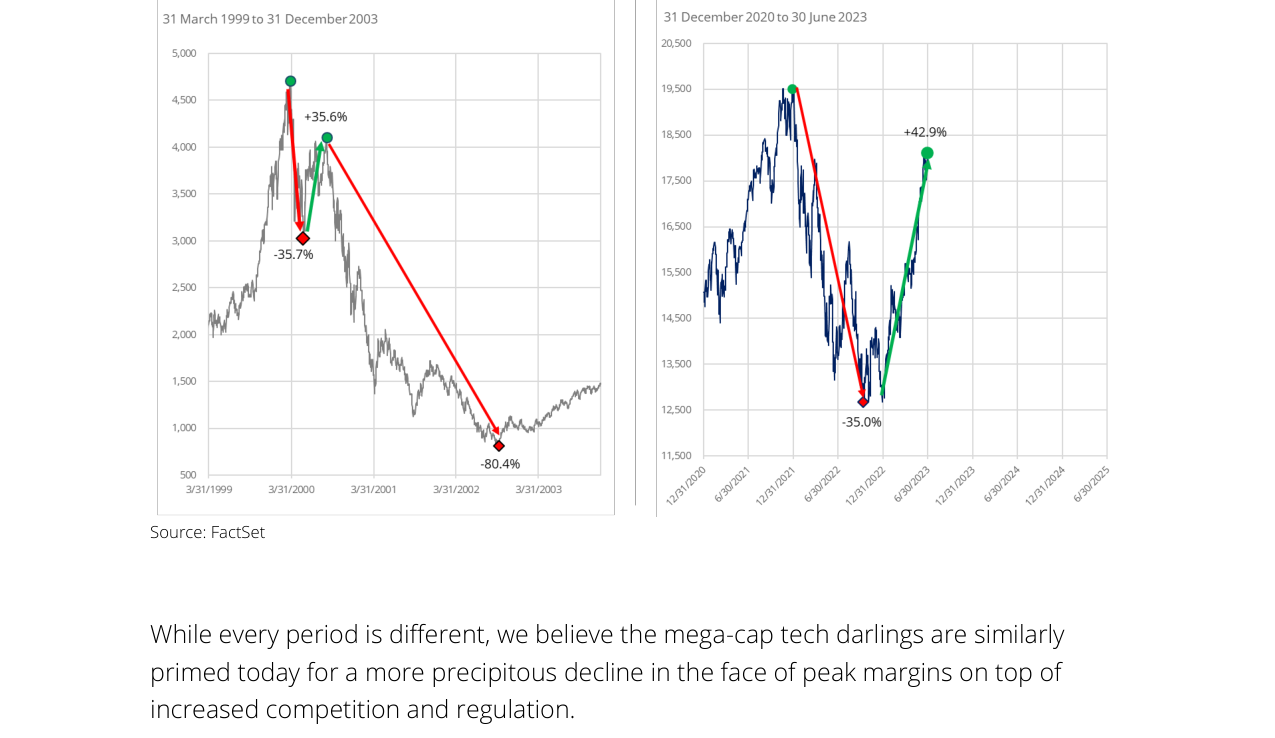
During the 2000 internet bubble, the NASDAQ 100 first fell 35.7%, rebounded 35.6%, and then plunged a further 80.4% over the next 25 months.
Comparative Data Table:
The NASDAQ 100's trajectory from 2020 to 2023 resembles 2000, first falling 35.0% and then rebounding 42.9% over six months.
| Metric | Global Fund | FTSE Developed Index |
|---|---|---|
| Q2 Return | 3.21% | 6.72% |
| 1H YTD Return | 18.53% | 14.86% |
| 1-Year Return | 11.86% | 18.28% |
| 3-Year Annualized Return | 6.06% | 11.92% |
| 5-Year Annualized Return | 0.40% | 8.79% |
| 10-Year Annualized Return | 4.58% | 9.36% |
| Annualized Return Since Inception (12/27/2012) | 4.64% | 9.70% |
Companies/Assets Involved

The top five contributors in Q2 were Live Nation Entertainment (total return 33%, contribution 1.22%), IAC (21%, 1.11%), CNX Resources (10%, 0.62%), FedEx (9%, 0.54%), and EXOR (9%, 0.52%).
- Live Nation Entertainment (Bullish): The largest contributor in Q2. The report notes that despite the controversy surrounding Ticketmaster due to the Taylor Swift presale event, long-term industry demand remains strong, with concerts accelerating further in 2023. Liberty Media still holds over a 30% stake, and future capital allocation is anticipated.
- IAC (Bullish): A digital holding company, a major contributor in both Q2 and the first half. Its portfolio company MGM delivered strong results with double-digit profit growth and significant share buybacks; Angi and Dotdash Meredith businesses are stabilizing. IAC executed its most aggressive buyback in years this quarter, and the parent company still holds net cash.
- Millicom (Bullish but Cautious): A Latin American telecom company, the largest detractor in Q2. Revenue and EBITDA declined due to its Guatemala operations. Acquisition talks with Apollo Global were terminated. However, French billionaire Xavier Niel increased his stake to nearly 25% and publicly stated the company's potential is underappreciated. The author believes Niel's active presence will change the company's future.
- Warner Bros Discovery (Bullish): A media conglomerate, a detractor in Q2 but still a major contributor for the first half. The stock was pressured by uncertainty around the relaunch of the Max streaming service, poor box office performance for The Flash, and management turmoil at CNN. The author believes the company remains significantly undervalued, management is driving FCF growth, and the worst is over.
- Alphabet (Exited): Liquidated in Q2. Purchased in 2022 due to AI competition concerns, but after the market narrative quickly reversed, the author believed the competitive and regulatory outlook had deteriorated and sold at a profit.
- Lumen (Exited): Liquidated. New management presented weak financial targets on Analyst Day with no clear revenue growth path, and the author believes they will not pursue a strategy to monetize the consumer business.
- New Buys: Four new positions were initiated in Q2, including a US healthcare company (still building the position), Eurofins Scientific (French testing lab), Kellogg (consumer goods, planning to spin off its cereal business), Hasbro (toys, benchmarked against Mattel), Fiserv and Fidelity Information Services (payments, purchased after the banking crisis), and Fortune Brands (home-related products).
Investment Implications
- Beware of Mega-Cap Tech Bubble Risk: The report explicitly warns that the valuations and profit margins of a few large-cap tech stocks (e.g., AI-related) are near historical highs, facing competitive and regulatory pressures, and could repeat the post-2000 internet bubble crash. Investors should avoid chasing these stocks.
- Focus on Value Companies with Operational Improvements: The fund's performance does not depend on a market correction but on the pricing power, strong balance sheets, and management execution of its portfolio companies. Investors can look for similar characteristics in names like Live Nation, IAC, and Warner Bros Discovery.
- Contrarian Positioning During Market Panic: The report highlights opportunities to buy during controversies or short-term headwinds (e.g., Live Nation's Ticketmaster issue, Fiserv/FIS after the banking crisis). Investors should focus on such "temporary distress" discounts.
- Emphasize Shareholder Returns and Capital Allocation: Cases like IAC and Millicom (with Xavier Niel's stake increase) show that active management actions (buybacks, spin-offs, activist investor involvement) are key drivers of value realization. Investors should assess a company's capital allocation discipline and shareholder friendliness.