2Q25 Global Fund Commentary
Southeastern Asset Management is a Memphis-based deep-value firm founded in 1975 by O. Mason Hawkins to exploit the bargains left by the 1973-74 bear market. Its flagship Longleaf Partners Funds (launched 1987) invest employees' own money alongside clients'. Following Graham's discipline and its "Business, People, Price" framework, it runs concentrated books of 15-25 undervalued stocks held for the long term — famously closing funds to new investors when opportunities were scarce. CEO and Head of Research Ross Glotzbach now leads the firm, which publishes quarterly Longleaf fund commentaries and Research Perspectives notes.
In plain words
Southeastern (Longleaf Partners) published its Q2 2025 letter. They admit slightly underperforming the market, because they didn't fully buy the dip after tariff shocks. Instead, they hold deeply discounted stocks like Mattel, FedEx, and Regeneron—companies trading below their true worth, with management buying back shares or splitting up the business. For ordinary investors, it's a reminder: ignore meme stocks (hype-driven stocks) and focus on real value and management actions. Worth reading because a veteran value investor's calm logic helps avoid speculative traps.
Southeastern (Longleaf Partners) Q2 2025 Report The fund's P/V ratio is in the high 50% range, with cash holdings at 8.8% and a portfolio of 22 stocks. Core view: The market is short-term driven by earnings per share expectations, but overall fails to properly allocate earnings uncertainty, leading
Theme and Background
This chapter opens Southeastern (Longleaf Partners)'s letter to investors for the second quarter of 2025. The report notes that markets experienced volatility following the "Liberation Day" tariff shock, but the fund did not fully add to positions during the short-term decline, resulting in a slight underperformance relative to the benchmark for both the second quarter and the year-to-date period. The author argues that the market as a whole has not properly priced in earnings uncertainty, speculation in low-quality stocks has intensified, and the fund's holdings remain at deep discounts.
Core Thesis
The author's core investment thesis is: Short-term stock prices are driven by earnings per share expectations, but the market fails to allocate earnings uncertainty appropriately across individual stocks, creating mispricing opportunities. The fund chooses to avoid popular stocks and focuses on those undervalued due to tariffs, policy uncertainty, or sector sentiment. The counterintuitive judgment is that, despite the fund's short-term underperformance (10.50% in Q2 vs. 11.72% for the FTSE Developed), the author believes holding high-quality discounted assets in a volatile market is prudent. Moreover, the fund performed relatively strongly during the more turbulent period from mid-February to April, validating this strategy.
Key Arguments and Data
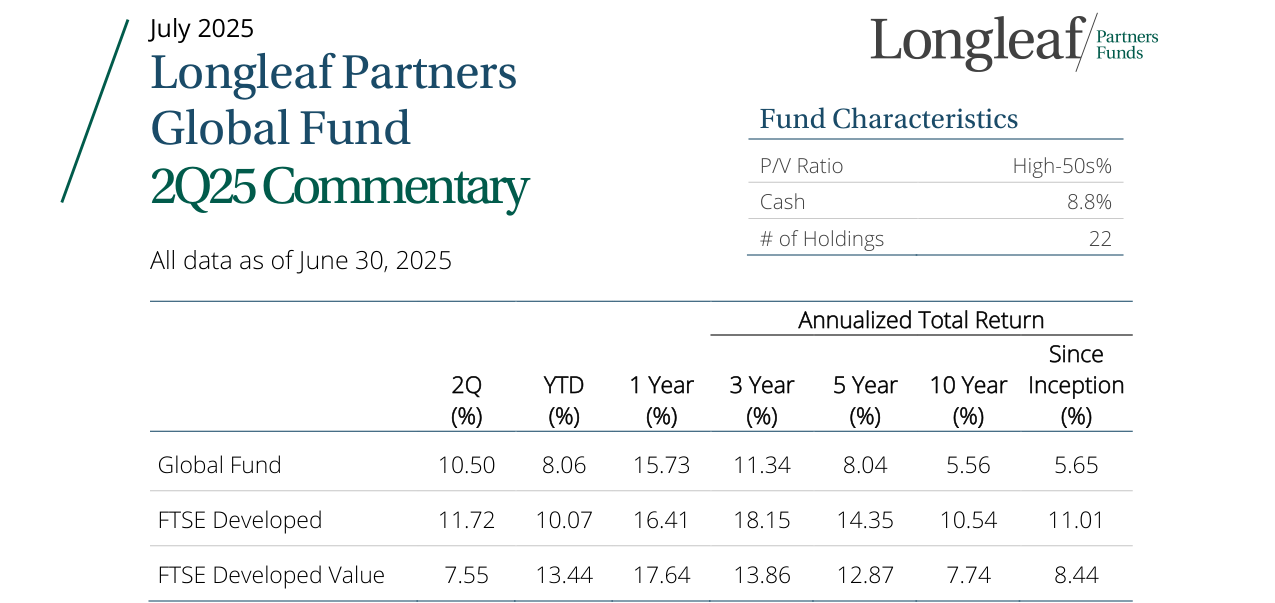
Fund P/V ratio in the High-50s%, cash position at 8.8%, and 22 holdings
- Valuation Comparison: The fund's portfolio has a P/FCF multiple below 10x, while the global market is near 20x, indicating a significant discount.
- P/V Ratio: The fund's P/V ratio is in the high-50s% range, meaning the price is approximately 55-59% of intrinsic value.
- Cash Position: Cash accounts for 8.8%, suggesting the fund still has dry powder but did not fully deploy it during the post-"Liberation Day" market decline.
- Speculative Activity: The author cites a Wall Street Journal headline from early July, "Meme Stocks and YOLO Bets Are Back and Fueling the Market’s Rally," noting increased speculation in low-quality stocks.
- Performance Comparison:
| Metric | 2Q (%) | YTD (%) | 1 Year (%) | 3 Year (%) | 5 Year (%) | 10 Year (%) | Since Inception (%) |
|---|---|---|---|---|---|---|---|
| Global Fund | 10.50 | 8.06 | 15.73 | 11.34 | 8.04 | 5.56 | 5.65 |
| FTSE Developed | 11.72 | 10.07 | 16.41 | 18.15 | 14.35 | 10.54 | 11.01 |
| FTSE Developed Value | 7.55 | 13.44 | 17.64 | 13.86 | 12.87 | 7.74 | 8.44 |
Companies/Assets Mentioned
This chapter mentions the following companies, briefly describing their roles and key data:
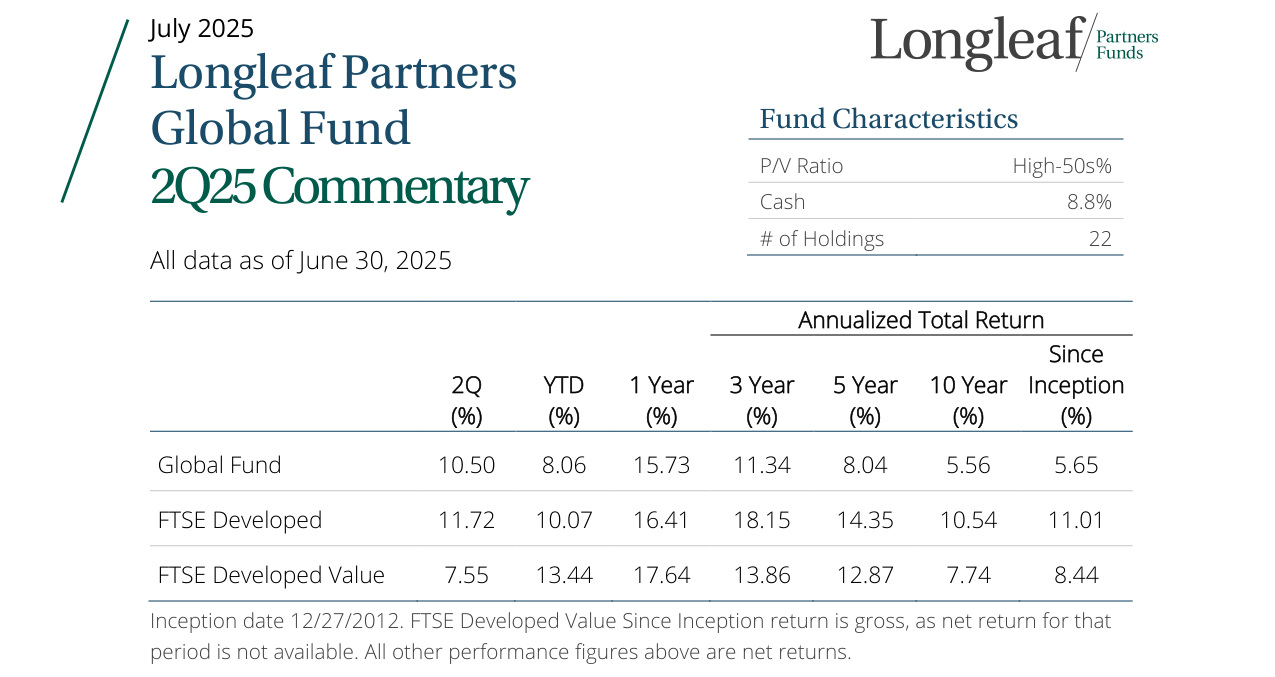
Global Fund returned 10.50% in Q2, 8.06% year-to-date, 15.73% over one year, and 5.65% annualized since inception; the FTSE Developed index returned 11.72%, 10.07%, 16.41%, and 11.01% over the same periods
- Mattel, PVH, FedEx: Affected by tariffs, but management has taken offensive actions (stock buybacks, insider purchases, FedEx's spin-off). The author is bullish.
- Regeneron, Bio-Rad, Philips: Healthcare stocks are suppressed by policy uncertainty ("RFK-care"), but management is creating value through actions like buybacks. The author is bullish. Regeneron is a newer holding with a net cash balance sheet, recently initiated a buyback, and Eylea accounts for less than 20% of its valuation.
- CNX, HF Sinclair: Energy stocks are volatile due to geopolitical factors (Iran war) and U.S. government actions, but management is creating value from a position of strength. The author is bullish.
- Canal+, Glanbia, Louis Hachette: Top contributors in Q2. Canal+ is a spin-off from Vivendi that had a difficult start but has stabilized; Glanbia exceeded expectations, with its Dairy Nutrition business valued at nearly 50% of its market cap but overlooked by the market; Louis Hachette has strong operations and progress on structural simplification.
- Kraft Heinz: A detractor in Q2. Despite industry weakness, the product portfolio is shifting toward premium brands (Heinz, Philadelphia, Ore-Ida), which the market undervalues; rumors that major shareholder Berkshire Hathaway may reduce its stake are considered more complex by the author.
Investment Implications
- Focus on Discounted Assets: Investors should focus on stocks with P/FCF multiples below 10x and P/V ratios in the 55-59% range, rather than chasing popular stocks or speculative targets.
- Leverage Uncertainty: Short-term sentiment swings driven by tariffs, healthcare policy, geopolitics, and other themes may create mispricing opportunities, especially in companies where management is taking proactive actions (buybacks, spin-offs, insider purchases).
- Beware of Low-Quality Speculation: With "Meme Stocks" and YOLO bets returning to the current market, investors should avoid participating and instead hold discounted assets with solid fundamentals and management actively creating value.
- Healthcare and Energy Sectors: Although under short-term pressure, long-term tailwinds such as an aging population remain, and some companies are enhancing value through actions like buybacks. Investors can consider similar targets such as Regeneron and CNX.