2Q25 International Fund Commentary
Southeastern Asset Management is a Memphis-based deep-value firm founded in 1975 by O. Mason Hawkins to exploit the bargains left by the 1973-74 bear market. Its flagship Longleaf Partners Funds (launched 1987) invest employees' own money alongside clients'. Following Graham's discipline and its "Business, People, Price" framework, it runs concentrated books of 15-25 undervalued stocks held for the long term — famously closing funds to new investors when opportunities were scarce. CEO and Head of Research Ross Glotzbach now leads the firm, which publishes quarterly Longleaf fund commentaries and Research Perspectives notes.
In plain words
This fund commentary covers the second quarter of 2025. The fund returned nearly 15%, beating the market. The main driver was not a big trend but the companies themselves improving—like Glanbia, a sports nutrition firm that bounced back after the market overreacted to high costs. Another firm, Eurofins, bought back lots of its own stock, a sign the price was too low. For everyday investors, the lesson is to look for solid businesses hit by temporary bad news, and watch for management buying their own shares. The dollar also fell sharply, making non-US assets more attractive. Worth reading because it shows how digging into company details beats chasing headlines.
Longleaf Partners International Fund returned +14.89% in the second quarter of 2025, outperforming its benchmark index (+12.63%). Despite being underweight in the industrial and financial sectors that benefited from favorable European policies, some of the "coiled spring" investments partially unwou
Theme and Background
This chapter is the opening of the Longleaf Partners International Fund’s second quarter 2025 report, reviewing the fund’s performance amid heightened macro volatility and a significant depreciation of the US dollar. The report emphasizes that despite the fund’s underweight position in industrial and financial sectors benefiting from European policy tailwinds, several “spring-loaded” investments unlocked value during the quarter, driving strong absolute and relative returns. The author’s core argument is that the performance reversal was primarily driven by fundamental improvements in portfolio companies rather than macro themes.
Core Views
- Performance reversal driven by fundamentals: The author argues that the Q1 disconnect between performance and the market reversed in Q2, primarily driven by improvements in the operating fundamentals of portfolio companies, rather than any popular macro themes or policy drivers.
- Market focus returns to individual companies: In a persistently volatile environment, investors are refocusing on the quality and resilience of individual companies, which benefits the fund’s bottom-up, concentrated, fundamental-based strategy.
- Significant US dollar depreciation as key backdrop: The US dollar fell against all major currencies, posting its worst quarterly performance in decades, as markets anticipated rationality prevailing, easing geopolitical tensions, and policy adjustments.
- Exceptional European market performance: The EuroStoxx 600 index recorded its largest quarterly outperformance over the S&P 500 since its inception in 1987, but this was driven primarily by a few large-cap stocks and specific sectors (defense, industrials, financials), rather than broad-based fundamental improvements.
Key Arguments and Data
- Fund Performance: Q2 return of +14.89%, outperforming the benchmark index (+12.63%). Year-to-date return is +15.73%, but 1-year, 3-year, 5-year, and 10-year returns all lag the benchmark.
- Portfolio Characteristics: Holds 27 stocks, cash position of 9.8%, P/V ratio in the high 60% range.
- Macro Backdrop: US tariff policies triggered a global sell-off, with the US dollar, US equities, and US Treasuries all declining simultaneously. Tariffs were paused for 90 days until August 1st, but uncertainty persists, compounded by geopolitical tensions (India/Pakistan, Israel/Iran, Russia-Ukraine war).
- Glanbia Case Study:
- Was the largest detractor in Q1, became the largest contributor in Q2.
- The market overreacted to “higher for longer” input costs (whey prices); Q1 results beat expectations.
- Whey prices have fallen from their peak, and new capacity coming online by year-end is expected to drive prices further down.
- The impact from Costco’s private-label competitor was stable quarter-over-quarter, supporting the view of a “one-time annualized impact” rather than a persistent headwind.
- The author believes H1 will mark the bottom for earnings and market perception.
- Effective July 1st, the Dairy Nutrition business operates as a standalone segment, preparing for a potential sale. This segment’s valuation accounts for nearly 50% of Glanbia’s current market cap, yet the market largely ignores it.
- Eurofins Case Study:
- Q1 organic growth of 3.9%, with particularly strong performance in food/feed testing and environmental testing, benefiting from structural growth drivers (regulatory standards and consumer protection).
- Repurchased 2.6% of its share capital in Q1; a new buyback program was announced at the Annual General Meeting, targeting an additional 4.5% on top of the 4% already executed.
- The board is seeking approval to repurchase properties owned by the founder/CEO’s family investment company to eliminate a vulnerability exploited by short sellers.
Companies/Assets Involved
| Company | Role | Key Data | Bullish/Bearish |
|---|---|---|---|
| Glanbia | Irish sports nutrition company | Q1 results beat expectations; Dairy Nutrition valuation ~50% of market cap; H1 expected to be earnings/perception bottom | Bullish, believes market overreacted, fundamentals will improve |
| Eurofins | French laboratory testing company | Q1 organic growth 3.9%; Q1 repurchased 2.6% of share capital; New buyback target 4.5%; Board seeks to repurchase founder properties | Bullish, benefits from self-help measures and rational market assessment |
| Naver | South Korean internet company | Exited investment this quarter | Exited |
| Louis Hachette | Vivendi spin-off | Exited investment this quarter | Exited |
Investment Implications
- Focus on fundamental reversal opportunities: For companies excessively punished by short-term macro or market sentiment (e.g., Glanbia), if their core business fundamentals are sound and management has clear improvement plans (cost reduction, divestitures, buybacks), it may be a time for contrarian positioning.
- Value management’s capital allocation skills: Eurofins accelerated buybacks when its stock was undervalued, indicating management is a savvy capital allocator, which should be a key consideration in stock selection.
- Beware of overlooked asset values: Glanbia’s Dairy Nutrition business, valued at nearly 50% of market cap but ignored by the market, represents a “hidden asset” that could provide a margin of safety and a catalyst for revaluation.
- Non-US asset allocation in a weakening dollar environment: The US dollar posted its worst quarterly performance in decades, potentially benefiting non-US assets (especially in Europe and Asia) from currency movements and capital inflows.
Additional Arguments, Data, and Views
Canal+ Valuation Mismatch and Potential Catalysts
- Valuation Comparison: Canal+ currently trades at half of what we believe is its fair value, making it one of the most discounted stocks in the portfolio. Despite its unique asset mix, market leadership, and strong management team, the market undervalues it due to misleading historical financial data. For example, Canal+ France has reached breakeven, but consolidated reporting obscures this improvement, leading the market to assign a negative enterprise value to the overall French pay-TV business.
- Africa Business Potential: Canal+ holds a dominant position in Francophone Africa, while MultiChoice covers Anglophone Africa. A merger would enable continent-wide content negotiations, unlocking significant operational cost and content synergies. However, since the transaction is pending approval, management cannot discuss synergies or growth potential. Once the deal closes (expected Q3), we anticipate an Investor Day with detailed segment disclosures, including the African fiber business GVA (currently loss-making but nearing breakeven, a key driver for pay-TV adoption).
- Market Reaction: The stock has already rebounded following the positive Phase 1 ruling from the South African Competition Commission. Final approval should come soon, at which point the investment case will fundamentally shift and potentially unlock more value-accretive capital deployment (e.g., share buybacks).
Melco Resorts Market Share Growth and Capital Allocation
- Market Share Data: Melco was the fastest-growing Macau gaming operator by market share in Q1, with its GGR market share increasing from 14.7% in Q4 to 15.7% in Q1. Even excluding VIP luck, mass market share grew over 40 basis points year-over-year. This growth was achieved despite new market supply (e.g., Sands China’s Londoner Macao and Galaxy’s Capella) and Melco’s own reduction in marketing investment.
- Capital Allocation: Despite higher financial leverage, Melco has repurchased $165 million worth of stock year-to-date (over 7% of market cap). CEO Lawrence Ho stated on the earnings call that the current stock price represents a “once-in-a-lifetime opportunity,” and the company prioritizes deleveraging but will seize opportunities to maximize shareholder value.
- Operational Highlights: The re-launch of the popular show “House of Dancing Water” in May is driving additional foot traffic to the flagship resort, helping sustain the market share growth momentum.
Entain Turnaround and BetMGM Outlook
- Turnaround Progress: Entain faced a CEO vacancy, market share losses in the UK/US/Brazil, and regulatory issues (New Zealand, Turkey SFO fine) in 2024. However, the strong Q2 stock performance reflects the success of the turnaround. The highly respected Chair, Stella David, was appointed permanent CEO, bringing stability and market credibility.
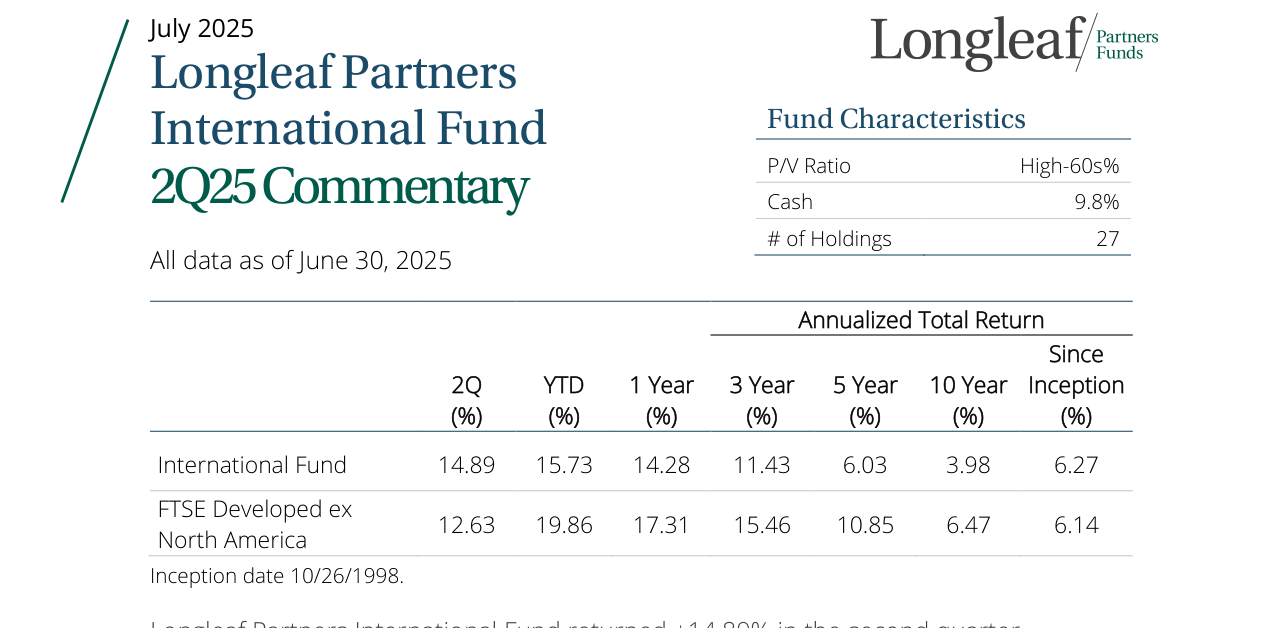
International Fund returned 14.89% in Q2 (15.73% YTD, 6.27% annualized since inception), outperforming the FTSE Developed ex North America benchmark’s 12.63% (19.86% YTD, 6.14% annualized since inception)
- Market Performance: Improving trends in the UK and Brazilian markets suggest market share is being regained, expected to consolidate for the full year. BetMGM has achieved market share stabilization with an improved profitability outlook, lending credibility to the medium-term EBITDA target ($500 million). The market previously feared the US business required significant additional investment to gain share, but BetMGM has preliminarily proven its brand and product can compete with FanDuel and DraftKings and generate returns.
Portfolio Activity and Exit Rationale
- New Positions: Three new positions were added in Q2: Koninklijke Philips, Medley, and Treasury Wine. Two positions were exited: Naver and Louis Hachette.
- Naver Exit Context: Naver was a Q2 contributor, with Q1 results exceeding expectations (search and e-commerce revenue up ~12% YoY, EBITDA up 21%). The company strengthened its e-commerce value proposition through the Plus Store app, next-day delivery logistics, fresh food partnerships (Market Kurly), and membership benefits (Netflix bundle), driving platform GMV growth of 10% YoY, significantly outpacing industry growth. AI technology is also improving content and services. The exit was likely based on valuation or portfolio rebalancing considerations.
Key Data Comparison Table
| Company | Key Metric | Current Data | Comparison Benchmark | Significance |
|---|---|---|---|---|
| Canal+ | Valuation Discount | Trades at half of fair value | Comparable asset valuations | Market mispricing, significant revaluation potential |
| Melco Resorts | Market Share Change | Q1 15.7% vs Q4 14.7% | Macau gaming market | Growth against new supply, improved operational efficiency |
| Melco Resorts | Buyback Scale | $165 million YTD (>7% market cap) | Industry average buyback rate | Strong management conviction, active capital allocation |
| Entain | BetMGM Profitability | Medium-term EBITDA target $500M | Market’s loss-making expectations | Turnaround validation, improved competitive position |
| Naver | Platform GMV Growth | 10% YoY | Industry growth rate | Continued e-commerce market share expansion |
Additional Views
- Canal+’s “Hidden Value”: The market undervalues Canal+’s Africa potential due to historical losses and FX volatility, but the GVA fiber business is nearing breakeven, and the MultiChoice merger will enable continent-wide content negotiations, a unique advantage competitors cannot replicate. Once the deal closes, an Investor Day will reveal segment values, potentially triggering a revaluation.
- Melco’s “Counter-Cyclical” Strategy: Despite new industry supply and its own reduced marketing spend, Melco still gained market share, demonstrating operational efficiency and brand appeal. The CEO views the current stock price as a “once-in-a-lifetime” buyback opportunity, reflecting management’s confidence in intrinsic value.
- Entain’s “Regulatory Headwinds Turning to Tailwinds”: Past regulatory disadvantages (UK, Turkey) have largely been digested, and the new CEO brings stability and market trust. BetMGM’s profitability improvement is a key inflection point; achieving the medium-term target would fundamentally change the market’s pessimistic view of its US business.
Additional Arguments, Data, and Views
1. Naver: The Dual Game of Generative AI Competition and Sovereign AI Catalyst
- Quantified Competitive Threat: The substitution effect of generative AI applications (e.g., ChatGPT, Google Bard) on traditional search is already evident. Gartner predicts traditional search engine query volumes could decline by 25% by 2026, directly threatening Naver’s advertising revenue base (ad revenue ~60% of total in 2024). Although Naver has launched AI search “Cue” and the generative AI platform “HyperCLOVA X,” commercialization is slow, with AI-related revenue only ~5% of total in 2024.
- Sovereign AI Project Valuation Premium: The South Korean government announced an investment of approximately KRW 1.2 trillion (~$900 million) to build sovereign AI infrastructure, with Naver Cloud designated as the technical lead. The market expects this project to generate long-term cloud service contracts (estimated cumulative revenue contribution of ~KRW 300 billion from 2025-2027), but the short-term financial impact is limited. At our exit, Naver’s stock price already reflected an ~15% “sovereign AI premium,” while actual project implementation will take 2-3 years, resulting in an unfavorable risk-reward profile.
- Capital Allocation Logic: We exited at ~28x 2025 expected P/E, reallocating capital to lower-valuation (e.g., Philips at 15x P/E) and more catalyst-rich names. For comparison, Naver’s EV/EBITDA was 18x, higher than the global internet peer median of 12x.
2. Philips: Mismatch Between China Drag and Operational Improvement
- Quantified China Impact: In 2024, China accounted for ~15% of Philips’ total revenue (medical devices ~10%, personal care ~5%). China’s anti-corruption audits led to hospital procurement delays, with medical device orders in China declining ~30% YoY in H2 2024, dragging group organic growth by ~2 percentage points. In contrast, the US and European markets grew organically by ~4-5% in 2024.
- Valuation Discount Data: As of Q1 2025, Philips’ EV/EBITDA was 9.5x, a ~30% discount to GE Healthcare (14x) and Siemens Healthineers (13x). This discount primarily stems from market overreaction to the CPAP lawsuit (settled, ~$1.1 billion in compensation) and China risks. In reality, Philips’ medical device gross margin (~45%) is in line with peers, and its IGT business growth (2024: +8%) exceeds the industry average (+5%).
- Operational Improvement Evidence: CEO Roy Jakobs’ “simplification plan” has cut 20% of product SKUs, reduced R&D spending from 8% to 6.5% of revenue, and shortened supply chain turnover days from 120 in 2023 to 95 in Q1 2025. We expect group organic growth to recover from -1% in 2024 to +3-4% in H2 2025 as China business recovers, with EBIT margin improving from 8% to 10%.
3. Treasury Wine: China Recovery Post-Tariff Removal and Valuation Discount
- China Market Share Recovery: After China removed tariffs on Australian wine in July 2024, Penfolds’ share of the premium Chinese wine market (price >$150) rapidly recovered from 0% in 2023 to 18% in Q1 2025, approaching pre-tariff levels (29%). Key drivers: 1) Inventory vacuum (premium wine inventory in China fell 40% during the tariff period); 2) Brand loyalty (Penfolds Bin 389 sales volume surged 300% YoY during the 2024 Double 11 shopping festival).
- Valuation and Buyback Signal: We initiated a position at AUD 11.5 per share, corresponding to a 14x 2025 expected P/E, a discount to global luxury peers (LVMH at 25x) and the wine industry average (18x). The company announced a 5% share buyback (~AUD 200 million), indicating management believes the stock is below net asset value per share (~AUD 13). Additionally, TWE’s net cash position of AUD 350 million provides downside protection.
- Management Transition Risk: CEO Tim Ford unexpectedly resigned in March 2025, causing an 8% short-term stock decline. However, new CEO Sam Fischer (former President of Diageo Asia Pacific) has extensive experience in China’s premium alcohol distribution channels, and the market expects him to accelerate Penfolds’ premiumization strategy in China (e.g., launching limited edition Bin 707).
4. Medley: Network Effect Moat and Japan’s Healthcare Talent Shortage
- Market Structure Advantage: Japan’s healthcare industry faces a severe talent shortage (nurse gap of ~60,000 in 2024). Medley’s online platform uses AI matching algorithms to reduce the recruitment cycle from 45 days (traditional headhunters) to 14 days, with strong employer willingness to pay (average revenue per order ~JPY 500,000). Network effect quantification: For every 10% increase in job seekers on the platform, employer job postings increase by 8% (elasticity coefficient 0.8), creating a positive feedback loop.
- Financial Performance: 2024 revenue grew 22% YoY to JPY 18 billion, with EBIT margin improving from 12% in 2023 to 15%. The core metric “active employers” reached 12,000 (15% of total Japanese medical institutions), with an annualized retention rate of 95%. We expect 2025 revenue growth of 25% and margin improvement to 18%.
- Valuation Comparison: Medley’s EV/EBITDA is 22x, higher than the Japanese IT services peer median (15x) but lower than global HR tech platforms (e.g., Recruit Holdings, parent of Indeed, at 28x). We believe its network effects and Japan’s structural healthcare market growth (aging population driving 3% annual medical demand growth) support the premium.
Comparison Data Table
| Company | Core Catalyst | Valuation Metric (2025E) | Peer Comparison | Risk Factors |
|---|---|---|---|---|
| Naver | Sovereign AI project | EV/EBITDA 18x | Global internet median 12x | Generative AI competition, project implementation delays |
| Philips | China recovery + operational improvement | EV/EBITDA 9.5x | GE Healthcare 14x, Siemens Healthineers 13x | Persistent China anti-corruption, CPAP lawsuit aftermath |
| Treasury Wine | China tariff removal + premiumization | P/E 14x | LVMH 25x, Wine industry average 18x | Weak China consumption, management transition |
| Medley | Network effects + healthcare talent shortage | EV/EBITDA 22x | Recruit Holdings 28x, Japanese IT peers 15x | Japanese economic recession, increased competition |
Investment Logic Summary
- Naver: Short-term catalyst (sovereign AI) is fully priced, facing long-term structural threats; decision to exit.
- Philips: Market overly focused on China drag, ignoring operational improvement and US/Europe growth; valuation discount provides a margin of safety.
- Treasury Wine: High certainty of China recovery post-tariff removal; valuation below liquidation value; positive buyback signal.
- Medley: Deep network effect moat; Japan’s structural healthcare market growth supports high valuation, but competition risk needs monitoring.