2Q25 Small-Cap Fund Commentary
Southeastern Asset Management is a Memphis-based deep-value firm founded in 1975 by O. Mason Hawkins to exploit the bargains left by the 1973-74 bear market. Its flagship Longleaf Partners Funds (launched 1987) invest employees' own money alongside clients'. Following Graham's discipline and its "Business, People, Price" framework, it runs concentrated books of 15-25 undervalued stocks held for the long term — famously closing funds to new investors when opportunities were scarce. CEO and Head of Research Ross Glotzbach now leads the firm, which publishes quarterly Longleaf fund commentaries and Research Perspectives notes.
In plain words
This small-cap fund commentary shares how the fund performed in Q2 2025 and why it still sees bargains. While the market is expensive (over 20 times cash flow), the fund’s holdings trade at just 10–12 times free cash flow – a measure of how much cash a business generates. The manager avoids hype stocks like “meme stocks” and focuses on overlooked companies. For ordinary investors, the lesson is to look for quality small firms with temporary problems, not just popular names. The report highlights alcohol and real estate as areas where the fund sees value. It’s worth reading because it shows a disciplined approach to finding undervalued stocks.
Southeastern Longleaf Partners Small-Cap Fund 2025 Second Quarter Report The fund's P/V ratio stands in the high 60% range, with cash accounting for 11.0% and holdings in 20 stocks. The fund returned 2.70% for the quarter and 4.24% year-to-date, underperforming the Russell 3000 (10.99%) and the Russ
Theme and Background
This section is the opening part of the Southeastern Longleaf Partners Small-Cap Fund’s second quarter 2025 report. It primarily discusses the fund’s market environment during the quarter, investment strategy adjustments, and core holdings performance. The report notes that short-term stock prices are driven by earnings per share expectations, but the overall market exhibits uneven distribution of earnings uncertainty, alongside a resurgence of speculation in low-quality stocks (e.g., “Meme Stocks”). The fund adheres to an absolute return orientation, focusing on undervalued opportunities created by emotional mispricing.
Core Thesis
The author’s core investment argument is that there is a clear mismatch in the current market: overall market valuations are elevated (P/FCF multiples exceeding 20x), while the fund’s portfolio trades at just 10-12x P/FCF, with a P/V ratio in the high-60% range, offering a favorable buying opportunity for the fund. The counterintuitive judgment is that despite the market hitting all-time highs, the fund believes the overall market is unattractive. Instead, amid low-quality stock speculation and emotional drivers, the fund’s undervalued assets provide a greater margin of safety.
Key Arguments and Data
- Fund Performance: Quarterly return of 2.70%, YTD of 4.24%, but underperforming the Russell 3000 (10.99%) and Russell 2000 (8.50%).
- Valuation Comparison: Fund portfolio P/FCF multiple of 10-12x vs. market above 20x; P/V ratio in the high-60% range.
- Cash Position: Cash accounts for 11.0%, with 20 stocks held.
- Market Phenomenon: The report cites a Wall Street Journal headline, “Meme Stocks and YOLO Bets Are Back and Fueling the Market’s Rally,” pointing to a resurgence of speculation in low-quality stocks.
- Sector Themes:
- Tariffs remain a factor, with holdings like PotlatchDeltic and Mattel potentially impacted, while the fund encourages companies to proactively respond through share buybacks.
- Overweight in the alcohol sector (Boston Beer, Becle); the market debates whether industry trends are cyclical or structural, with the author leaning toward cyclical.
- Overweight in real estate, with holdings optimized through asset sales and buybacks.
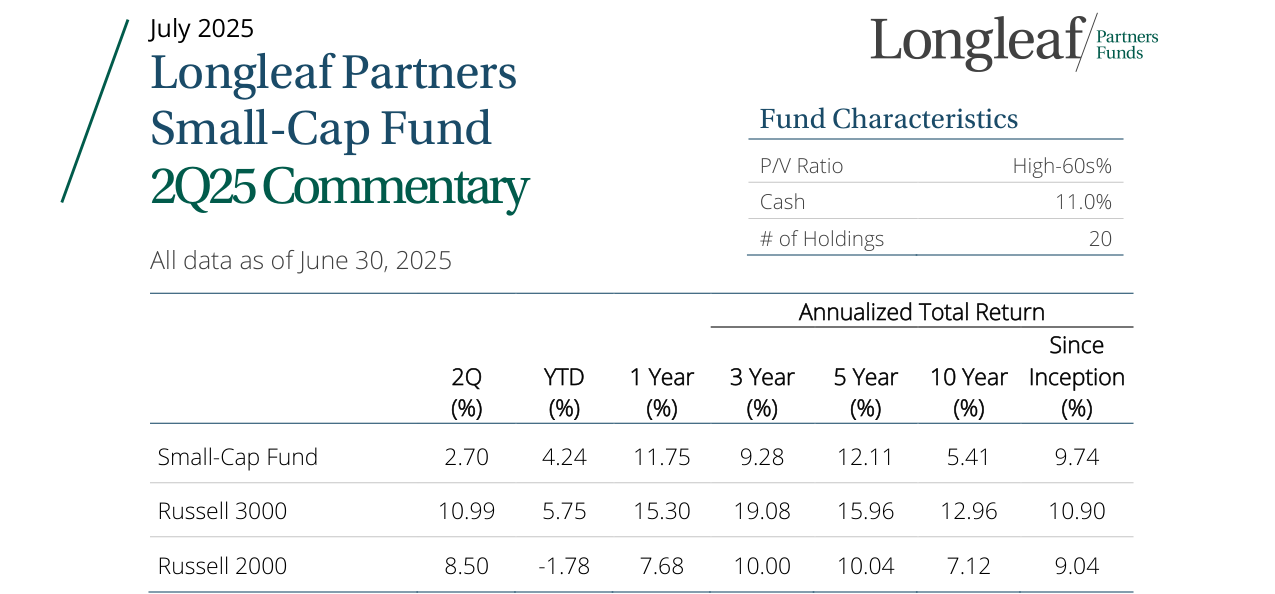
Fund P/V ratio in the high-60s%, cash at 11.0%, and 20 holdings
Comparative Data Table:
| Metric | Fund Portfolio | Market (Russell 3000/2000) |
|---|---|---|
| P/FCF Multiple | 10-12x | Above 20x |
| P/V Ratio | High-60% range | Not disclosed |
| Quarterly Return | 2.70% | 10.99% (Russell 3000) / 8.50% (Russell 2000) |
| YTD Return | 4.24% | 5.75% (Russell 3000) / -1.78% (Russell 2000) |
Companies/Assets Involved
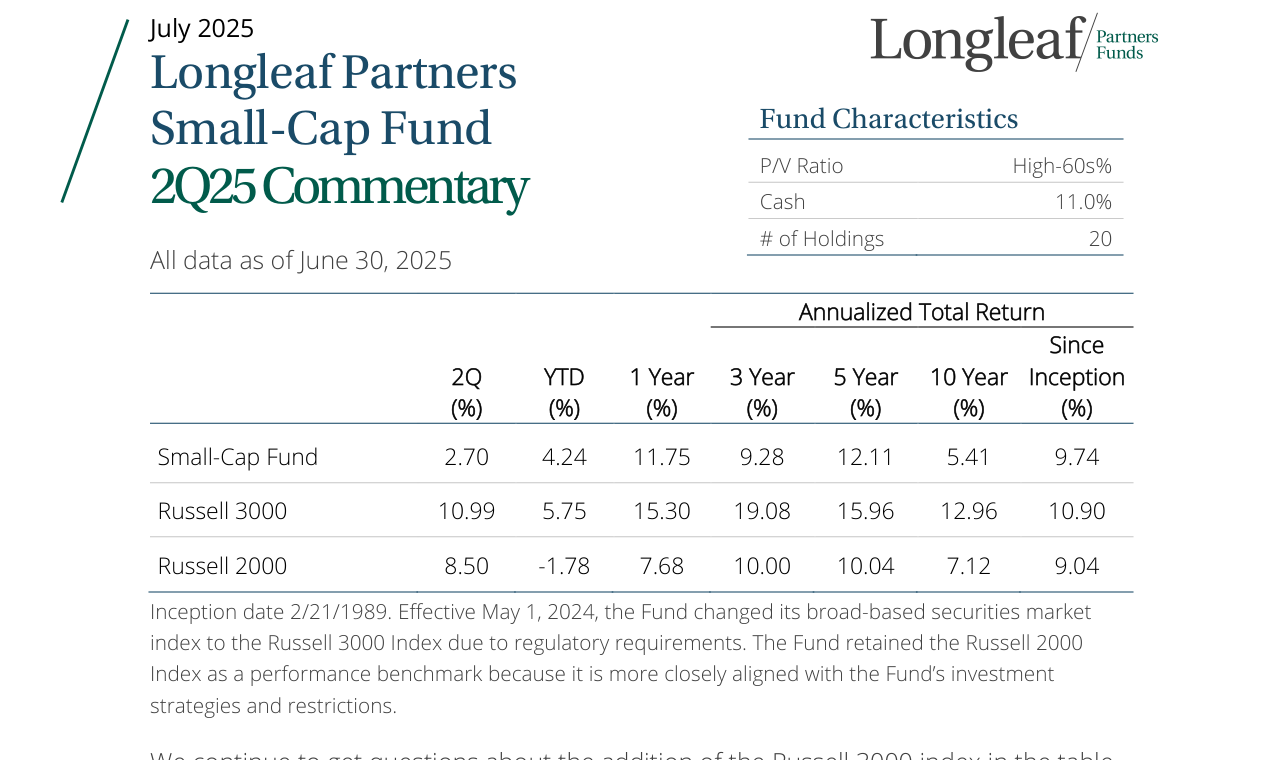
Small-Cap Fund returned 2.70% in Q2, 4.24% YTD, and 11.75% over one year, all trailing the Russell 3000 over the same period
- Oscar Health (Bullish): A major contributor for the quarter, with solid operations, proactive management, and a healthy balance sheet. The fund trimmed its position when sentiment was most favorable.
- Becle (Bullish): A tequila and whiskey manufacturer, a contributor for the quarter. The fund bought during peak US-Mexico trade uncertainty, believing its brand strength (over 200 years of history) and the Beckmann family’s 30% stake provide long-term value.
- Atlanta Braves Holdings (Bullish): Owns the Atlanta Braves baseball team and surrounding real estate, a contributor for the quarter. Expanded its real estate footprint by acquiring Pennant Park office park; Analyst Day emphasized spin-off valuations, with professional sports team valuations continuing to rise.
- Westrock Coffee (Bearish/Cautious): A detractor for the quarter. Faces internal and external challenges, but a new plant (Conway, AR) is nearing completion, expected to improve business diversification and cash flow. Insiders increased their holdings during the quarter.
- Boston Beer Company (Bullish): A detractor for the quarter. Affected by macro concerns over declining alcohol consumption, but reported a solid operational quarter, with a strong net cash balance sheet and ongoing value-accretive share buybacks. Was a takeover rumor target a year ago.
- PotlatchDeltic (Bullish): A timber and mill company, a detractor for the quarter. Shifted from a Q1 tariff beneficiary to a victim of housing market weakness, but its underlying business continues to grow. After trimming in Q1, the fund turned net buyer in Q2, viewing it as an undervalued, reliable dividend payer.
- Howard Hughes (Exited): Exited with a profit after holding for about a year, as the company effectively became part of Pershing Square rather than continuing simplification or a full sale.
Investment Implications
- Directional Recommendations: Investors should focus on opportunities arising from current market sentiment mismatches, particularly assets undervalued due to short-term earnings uncertainty or sector cycle concerns. The fund’s key areas of focus include: the alcohol sector (leaning cyclical rather than structural), real estate (optimized through asset sales and buybacks), and companies impacted by tariffs but with proactive management responses (e.g., through buybacks).
- Risk Warnings: Overall market valuations are elevated (P/FCF >20x), and speculation in low-quality stocks (Meme Stocks) has returned. Investors should be cautious about chasing hot stocks. The fund maintains an 11% cash position, indicating it is still waiting for better buying opportunities, though the pipeline of opportunities is expanding.