2Q25 Partners Fund Commentary
Southeastern Asset Management is a Memphis-based deep-value firm founded in 1975 by O. Mason Hawkins to exploit the bargains left by the 1973-74 bear market. Its flagship Longleaf Partners Funds (launched 1987) invest employees' own money alongside clients'. Following Graham's discipline and its "Business, People, Price" framework, it runs concentrated books of 15-25 undervalued stocks held for the long term — famously closing funds to new investors when opportunities were scarce. CEO and Head of Research Ross Glotzbach now leads the firm, which publishes quarterly Longleaf fund commentaries and Research Perspectives notes.
In plain words
This is a quarterly letter from Southeastern, a fund manager. They admit their fund lagged the market recently. But they think too many investors are chasing risky stocks (like meme stocks) while ignoring how uncertain company profits really are. Their fund holds 18% cash and owns cheap stocks with strong cash flow. The companies they invest in are fighting back—buying back shares, insiders buying more, and splitting up businesses. For regular investors, this is a reminder: when markets get too crazy, staying cautious and focusing on real value might pay off.
This report discusses the investment performance and strategy of Southeastern (Longleaf Partners Fund) in the second quarter of 2025. The core view is that although the fund has underperformed the market in the short term (2Q return of 5.33%, compared to the S&P 500's 10.94%), management believes th
Theme and Background
This section is the opening part of Southeastern (Longleaf Partners Fund)’s investment report for the second quarter of 2025. The report first reviews the fund’s performance in 2Q25 (return of 5.33%, trailing the S&P 500’s 10.94% and the Russell 1000 Value’s 3.79%), and then elaborates on the investment strategy and portfolio logic under the current market environment (a strong market rebound after “Liberation Day” and rampant speculation in low-quality stocks).
Core Thesis
The author’s core investment argument is that, although the fund’s short-term performance lags the market, the market has not correctly priced in widespread earnings uncertainty, and speculation in low-quality stocks (the return of Meme stocks) is prevalent, creating opportunities for value investors. The fund maintains a high cash level (18.2%) and low valuation (P/V in the low-60% range, P/FCF below 10x vs. the market’s over 20x), suggesting that this “underperformance” may be prudent. The counterintuitive judgment is that the author believes market fears of a recession are exaggerated (especially overweighting the 2008 financial crisis as an outlier), while the fund’s holdings (such as Mattel, PVH, and FedEx) are taking offensive actions—such as stock buybacks and insider purchases—to address tariff impacts.
Key Arguments and Data
1. Fund Performance vs. Market:
- Longleaf Partners Fund 2Q return: 5.33%, YTD: -0.08%.
- S&P 500 2Q return: 10.94%, YTD: 6.20%.
- Russell 1000 Value 2Q return: 3.79%, YTD: 6.00%.
- The author notes that the fund performed relatively strongly during the market turmoil from mid-February through April, which reinforced confidence.
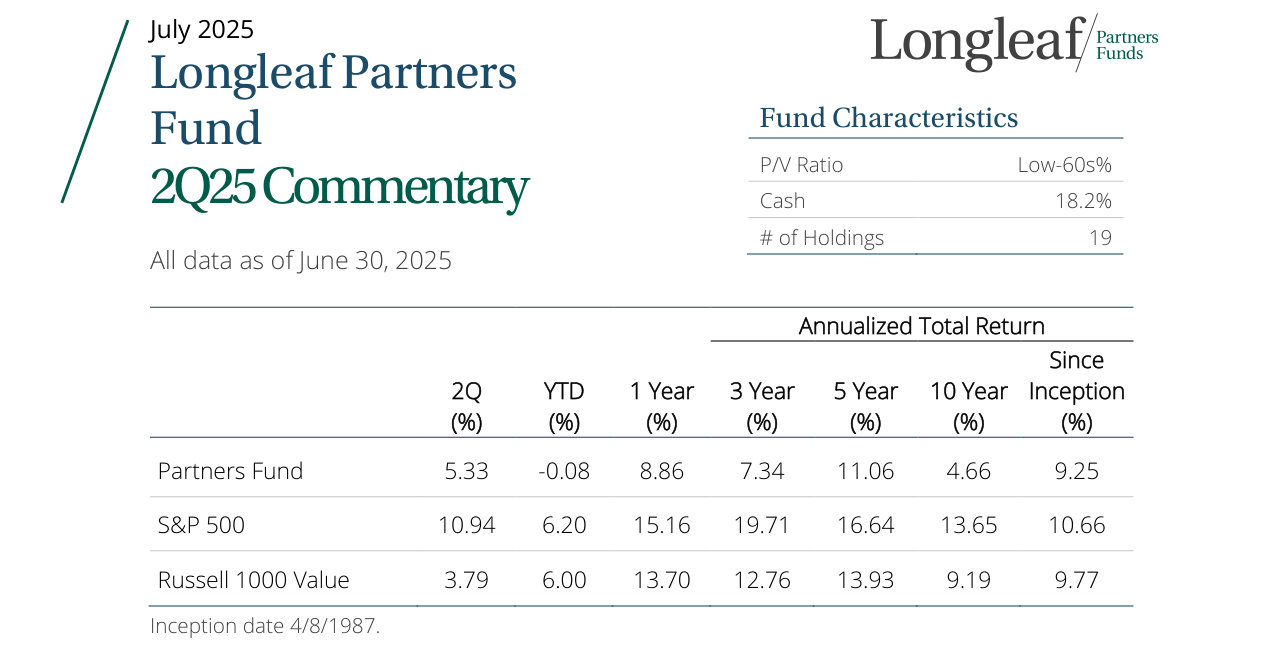
Key fund metrics show P/V ratio in the low-60s%, cash position at 18.2%, and a total of 19 holdings
2. Market Environment and Valuation:
- Widespread earnings uncertainty exists in the market but is not properly priced.
- Speculation in low-quality stocks has returned (citing a Wall Street Journal headline: “Meme Stocks and YOLO Bets Are Back and Fueling the Market’s Rally”).
- The fund’s holdings have a P/V ratio in the low-60% range and a P/FCF multiple below 10x, while the overall market’s P/FCF is well above 20x.
3. Portfolio Themes and Actions:
- Tariff Impact: Mattel, PVH, and FedEx are responding through actions such as stock buybacks, insider purchases, and spin-offs (FedEx).
- Healthcare Policy: “RFK-care” introduces uncertainty, but an aging population provides a long-term tailwind. Regeneron and Bio-Rad are creating value through stock buybacks and other actions. The fund initiated a position in another complementary healthcare company after quarter-end.
- Energy Volatility: CNX and HF Sinclair are taking value-creating actions from positions of strength.
4. Specific Holdings Analysis:
- HF Sinclair: An energy infrastructure company and one of the quarter’s largest contributors. Drivers include Middle East tensions, normalization of refining margins, growth in non-refining assets (accounting for over half of valuation), and an unusually high level of insider purchases over the past year.
- MGM Resorts: A hospitality and gaming company and a contributor. Strong quarterly performance gained market recognition, and it is one of the largest stock repurchasers in the fund. The author believes market recession fears are exaggerated, especially overweighting the 2008 financial crisis, while MGM’s current financial position is stronger.
- Kraft Heinz: A food and beverage company and a detractor. Despite industry weakness, the company is undergoing a quality transformation toward premium products (Heinz, Philadelphia, Ore-Ida), which the market may be overlooking. Rumors of a potential stake reduction by major shareholder Berkshire Hathaway are considered more complex by the author.
- Regeneron: A healthcare company and a detractor. The market is overly focused on Eylea (which accounts for less than 20% of the company’s valuation), and a new product had disappointing clinical trial results during the quarter. The author used the opportunity to increase the position.
Companies/Assets Involved
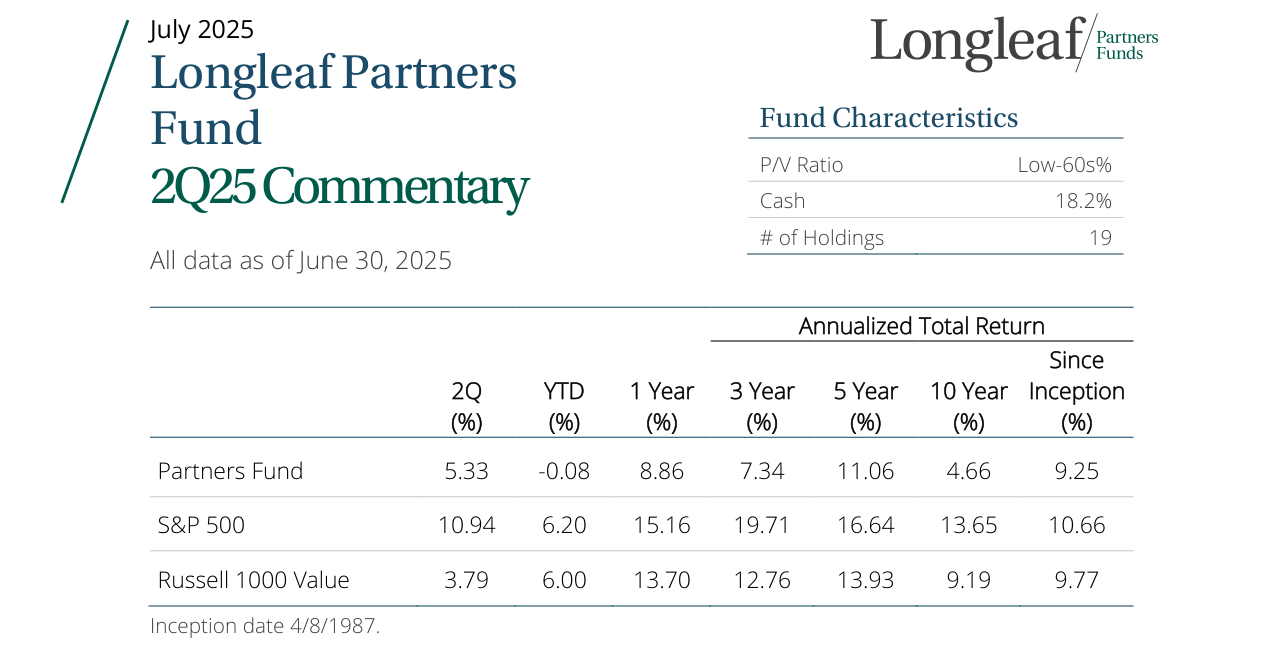
Partners Fund returned 5.33% in Q2, underperforming the S&P 500’s 10.94%, but has a 10-year annualized return of 4.66%
| Company/Asset | Role | Key Data/Actions | Bullish/Bearish |
|---|---|---|---|
| HF Sinclair | Energy Infrastructure | One of the quarter’s largest contributors; non-refining assets account for over 50% of valuation; unusually high insider purchases over the past year. | Bullish |
| MGM Resorts | Hospitality and Gaming | Quarterly contributor; one of the largest stock repurchasers in the fund; financial position stronger than in 2008. | Bullish |
| Kraft Heinz | Food and Beverage | Quarterly detractor; transitioning toward premium brands; rumors of Berkshire Hathaway stake reduction considered more complex by the author. | Bullish |
| Regeneron | Healthcare | Quarterly detractor; net cash balance sheet; Eylea accounts for less than 20% of valuation; disappointing clinical trial results during the quarter; author increased position. | Bullish |
| Mattel, PVH, FedEx | Consumer/Logistics | Responding to tariff impacts through stock buybacks, insider purchases, and spin-offs (FedEx). | Bullish |
| CNX | Energy | Taking value-creating actions from a position of strength. | Bullish |
| Bio-Rad | Healthcare | Creating value through stock buybacks and other actions. | Bullish |
| Undisclosed | Global Entertainment Media | New position added during the quarter, a contributor; the author has held it successfully before. | Bullish |
Investment Implications
1. Focus on Low Valuations and High Cash Positions: In the current environment of rampant speculation and high earnings uncertainty, holding a fund with a high cash ratio (18.2%) and low valuations (P/FCF < 10x) may serve as a defensive strategy. Investors should focus on companies with strong cash flows and clear value-creating actions (such as stock buybacks and insider purchases).
2. Beware of Excessive Recession Fears: The author believes market recession fears are exaggerated, particularly by over-referencing the 2008 financial crisis. For companies like MGM Resorts, whose financial position has significantly improved, the market may be underestimating their resilience.
3. Long-Term Opportunities vs. Short-Term Uncertainty in Healthcare: Despite policy uncertainty from “RFK-care,” an aging population is a long-term tailwind. Investors can look at healthcare companies with net cash and active management stock buybacks (e.g., Regeneron), taking advantage of low prices created by short-term uncertainty.
4. Company Actions Under Tariff Impact: For companies affected by tariffs, focus on whether management is taking concrete actions (such as buybacks or spin-offs) to respond, rather than passively enduring. The actions of Mattel, PVH, and FedEx are viewed as positive signals.