1Q25 Global Fund Commentary
Southeastern Asset Management is a Memphis-based deep-value firm founded in 1975 by O. Mason Hawkins to exploit the bargains left by the 1973-74 bear market. Its flagship Longleaf Partners Funds (launched 1987) invest employees' own money alongside clients'. Following Graham's discipline and its "Business, People, Price" framework, it runs concentrated books of 15-25 undervalued stocks held for the long term — famously closing funds to new investors when opportunities were scarce. CEO and Head of Research Ross Glotzbach now leads the firm, which publishes quarterly Longleaf fund commentaries and Research Perspectives notes.
In plain words
This report from a veteran investment firm explains how its global fund performed in early 2025. Despite market turmoil from tariffs, the fund lost 2.21%, but the managers think the chaos actually favors their style—picking undervalued stocks rather than chasing popular tech giants. They focus on companies like grocery chains, telecoms, and life sciences that they believe are priced below their true worth. For ordinary investors, the key takeaway is to look beyond index swings and find individual businesses with real value, using examples like Albertsons and FedEx to show how to spot opportunities when others panic.
Southeastern (Longleaf Partners) Global Fund Q1 2025 Report The fund reported a net return of -2.21% for the first quarter of 2025, underperforming the FTSE Developed Index (-1.47%) and the FTSE Developed Value Index (5.48%). The core view is that despite short-term stock price volatility, the fund'
Theme and Background
This chapter is the opening section of Southeastern (Longleaf Partners) Global Fund's first-quarter 2025 report, primarily reviewing the fund's performance and strategy adjustments amid a volatile market environment. The report notes that despite significant market fluctuations during the quarter (especially the "Liberation Day" tariff shock), the fund delivered a net return of -2.21%, underperforming the FTSE Developed Index (-1.47%) and the FTSE Developed Value Index (5.48%). However, it has significantly outperformed the index since the market peak on February 19, with per-share intrinsic value growth exceeding stock price performance.
Core Views
- Contrarian Judgment: The report argues that the current environment is shifting in favor of value stock selection, where flexible companies will be rewarded, while the largest companies in the index (such as tech giants) will not sustain their rise. This contrasts with the market's prevailing trend of chasing growth stocks and index ETFs.
- Increased Confidence: Despite short-term stock price volatility, the fund's confidence in the quality and prospects of its holdings has strengthened, believing these companies can demonstrate resilience amid turmoil. The report specifically highlights that the fund's performance after "Liberation Day" significantly outperformed the index, resembling the early stages of the 2000 market turning point, rather than the 2008 financial crisis or 2022 performance.
- Position Adjustments: The fund increased its weight in the healthcare sector during the quarter, but in a targeted manner, focusing on high-quality companies in an offensive stance. Meanwhile, the fund maintained an underweight position relative to the historically high weight of the U.S. index, a move that has proven prudent.
Key Arguments and Data
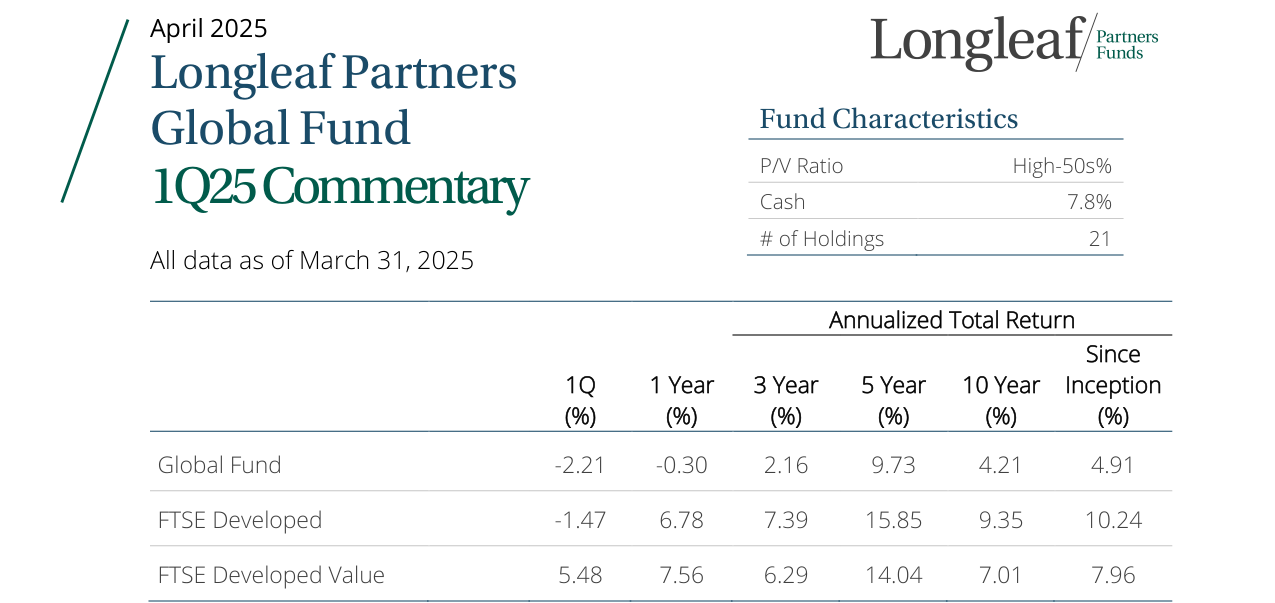
Fund P/V ratio in the high-50% range, cash position at 7.8%, portfolio holding 21 stocks
- Performance Attribution: During the quarter, five stocks—Bio-Rad, CNX, FedEx, Glanbia, and Mattel—experienced price swings exceeding 10%, collectively dragging the fund's performance by approximately 250 basis points (bps). The report believes this impact can be offset by subsequent better performance.
- Market Comparison: The fund significantly outperformed the index after "Liberation Day," differing from its performance during the 2008 financial crisis, the COVID-19 pandemic, or 2022, and more closely resembling the pattern at the beginning of the 2000 market turning point.
- Sector Impact: The index was dragged down by an overweight position in the information technology sector but benefited from the strong performance of "BBOPs" (Big Banks/Oil/Pharma), which created a relative headwind for the fund, especially compared to the value index. The fund's allocation to BBOPs is lower than the index or the average value manager, as the report views these companies as lacking sufficient quality in their businesses or personnel, with two of the sectors (banks and oil) being economically sensitive.
- Valuation and Cash: The fund's P/V ratio is in the high-50% range, with a cash position of 7.8% and a portfolio of 21 stocks.
Companies/Assets Involved
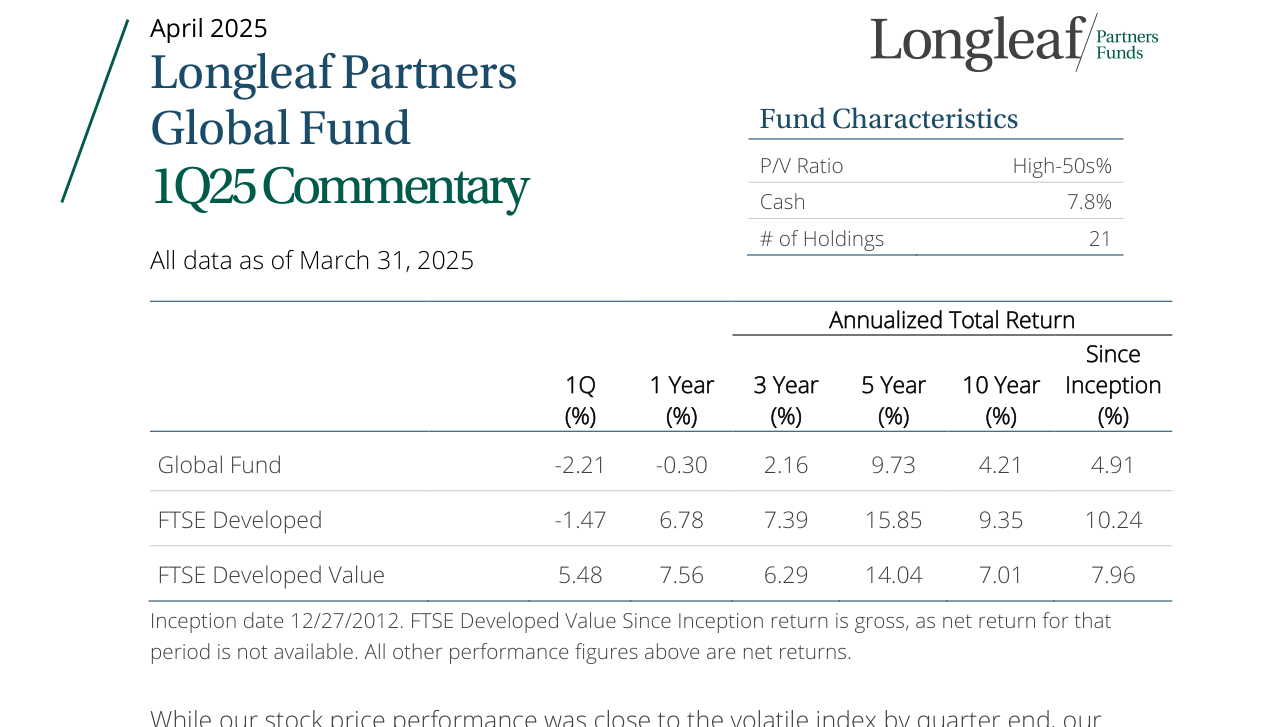
Global Fund's Q1 return of -2.21%, 1-year return of -0.30%, and annualized return since inception of 4.91%, all trailing the FTSE Developed Value Index's 5.48%, 7.56%, and 7.96%, respectively
- Albertsons (U.S. grocery retailer): Quarterly contributor. Newly purchased in 2024, overlooked by the market due to the failed long-term deal with Kroger. The company has moderate growth, financial strength for share buybacks, and multiple strategic options (such as unlocking real estate value or selling non-core markets) to achieve per-share value.
- IAC (digital holding company): Quarterly contributor. Former CEO Joey Levin transitioned to Executive Chairman of Angi, with Barry Diller taking on a larger role. The market initially reacted cautiously, but potential gains became clearer later in the quarter. The report published its first "Research Perspective" note detailing the investment thesis.
- Millicom (Latin American telecom operator): Quarterly contributor. 2024 performance extended into 2025, exceeding the already twice-upgraded 2024 equity FCF guidance (approximately $650 million) and guiding for growth to $750 million in 2025. The company implemented an improved dividend (yield over 10%), completed a U.S.-only listing, and advanced value-enhancing transactions in Colombia. The 40% owner, Iliad Group, is viewed as a like-minded partner. The stock still trades at single-digit multiples of earnings growth.
- Bio-Rad (life sciences company): Quarterly detractor. Industry trends improved after post-pandemic normalization, but government funding cuts and disappointing quarterly results weighed on the stock price. The report notes that U.S. academic and government spending accounts for only a low single-digit percentage of the company's revenue. The company has a net cash balance sheet, significant hidden assets in its Sartorius stake, and a history of prudent capital allocation.
- CNX Resources (natural gas company): Quarterly detractor. Performed strongly in 2024 but was hampered in early 2025 by lower-than-expected government incentives for a coal mine methane capture program, resulting in a per-share value loss of over $10-20. The report believes both the company and the fund can buy more shares at undervalued prices, and CNX remains focused on low-cost and hedging strategies to generate FCF.
- FedEx (global logistics company): Quarterly detractor. Faces macro headwinds such as tariff threats and weak U.S. demand. European operations are gaining market share and margins, while the Express business converts low single-digit revenue growth into double-digit cash flow growth. The Freight business declined due to weak industrial conditions. The company is on track to split into Express and Freight entities, which will enhance financial flexibility and efficiency. The report argues that the market continues to undervalue FedEx's Freight business, and the significant discount of Express relative to UPS is no longer justified.
- Glanbia (Irish nutrition and ingredients company): Quarterly detractor. Unable to fully pass on input cost inflation, leading to a 9% downward revision in consensus expectations, with the stock price decline exceeding three times that impact. The current P/E ratio is 9x, and the entire company's valuation is well below comparable companies in its segments (sports nutrition brands, ingredients).
Investment Implications
- Directional Judgment: The report suggests investors reduce reliance on the largest companies in the index (especially tech stocks) and shift toward flexible, high-quality value stocks in an offensive stance. The fund's underweight in the U.S. index and BBOPs, along with its targeted increase in healthcare sector allocation, provides specific direction.
- Risk Warning: Short-term volatility (e.g., tariffs, government funding cuts) may lead to stock price declines, but the report views these as buying opportunities, especially when per-share intrinsic value growth exceeds stock price performance. Investors should focus on per-share value growth of individual stocks rather than short-term index fluctuations.
- Specific Opportunities: The report offers clear bullish views on companies such as Albertsons, IAC, Millicom, Bio-Rad, CNX, FedEx, and Glanbia, arguing that their current valuations do not fully reflect their potential value.