1Q25 Small-Cap Fund Commentary
Southeastern Asset Management is a Memphis-based deep-value firm founded in 1975 by O. Mason Hawkins to exploit the bargains left by the 1973-74 bear market. Its flagship Longleaf Partners Funds (launched 1987) invest employees' own money alongside clients'. Following Graham's discipline and its "Business, People, Price" framework, it runs concentrated books of 15-25 undervalued stocks held for the long term — famously closing funds to new investors when opportunities were scarce. CEO and Head of Research Ross Glotzbach now leads the firm, which publishes quarterly Longleaf fund commentaries and Research Perspectives notes.
In plain words
This small-cap fund gained 1.5% in early 2025 while the Russell 2000 index fell 9.5%. The manager says today's tariff uncertainty and market fear actually create good chances to buy solid companies cheap — ones with lots of cash, low debt, and flexible business models (like Graham Holdings). Even stocks that slipped temporarily, such as natural gas firm CNX Resources, are worth adding if their basics are still strong. The report shows that ignoring hype and sticking with value picks can protect your money and pay off over time.
Southeastern (Longleaf Partners) Small-Cap Fund First Quarter 2025 Report The report notes that the fund achieved a 1.50% return during a challenging quarter for small-cap stocks, significantly outperforming the Russell 2000 (-9.48%) and the Russell 3000 (-4.72%), demonstrating the downside protecti
Theme and Background
This chapter is the opening section of Southeastern (Longleaf Partners) Small-Cap Fund’s first quarter 2025 report. The report notes that during a challenging quarter for small-cap stocks overall, the fund achieved a return of 1.50%, significantly outperforming the Russell 2000 (-9.48%) and the Russell 3000 (-4.72%). The current market environment is fraught with uncertainty, particularly regarding the impact of Trump 2.0 policies, but the author believes this creates more favorable conditions for value stock selection.
Core Thesis
The author’s core investment argument is that current market volatility and uncertainty (e.g., tariff policies, macroeconomic slowdown) offer opportunities for flexible, offensive-minded companies to outperform the broader market, and the fund portfolio’s significant divergence from small-cap indices will be advantageous over the long term. The counterintuitive judgment is that despite prevailing market pessimism (e.g., analogies to the 1970s OPEC shock), the author views this not as systemic risk but as an opportunity for value stock pickers; meanwhile, the fund’s significant outperformance of the index even after the “Liberation Day” sell-off demonstrates the effectiveness of disciplined stock selection.
Key Arguments and Data
- Fund Performance: 1Q25 return of 1.50%, significantly outperforming the Russell 2000 (-9.48%) and Russell 3000 (-4.72%), demonstrating downside protection.
- Market Environment: The author argues that Trump 2.0 policies differ from Trump 1.0, and current uncertainty may resemble the low-valuation period (single-digit P/E ratios) in the decade following the 1970s OPEC shock. However, the fund portfolio’s differentiated structure (large divergence from the index) is a long-term advantage.
- Holdings Analysis: Quarterly contributor Graham Holdings (GHC) achieved low-to-mid single-digit percentage value growth and holds a net cash balance sheet; laggards such as CNX Resources saw per-share value decline by $10–20 due to lower-than-expected government incentives, but the author used the decline to increase the position.
- Comparative Data:
| Metric | Small-Cap Fund | Russell 3000 | Russell 2000 |
|---|---|---|---|
| 1Q25 Return | 1.50% | -4.72% | -9.48% |
| 1-Year Return | 4.20% | 7.22% | -4.01% |
| 3-Year Annualized Return | 2.34% | 8.22% | 0.52% |
| 5-Year Annualized Return | 14.31% | 18.18% | 13.27% |
| 10-Year Annualized Return | 4.99% | 11.80% | 6.30% |
| Since Inception Annualized Return | 9.73% | 10.65% | 8.86% |
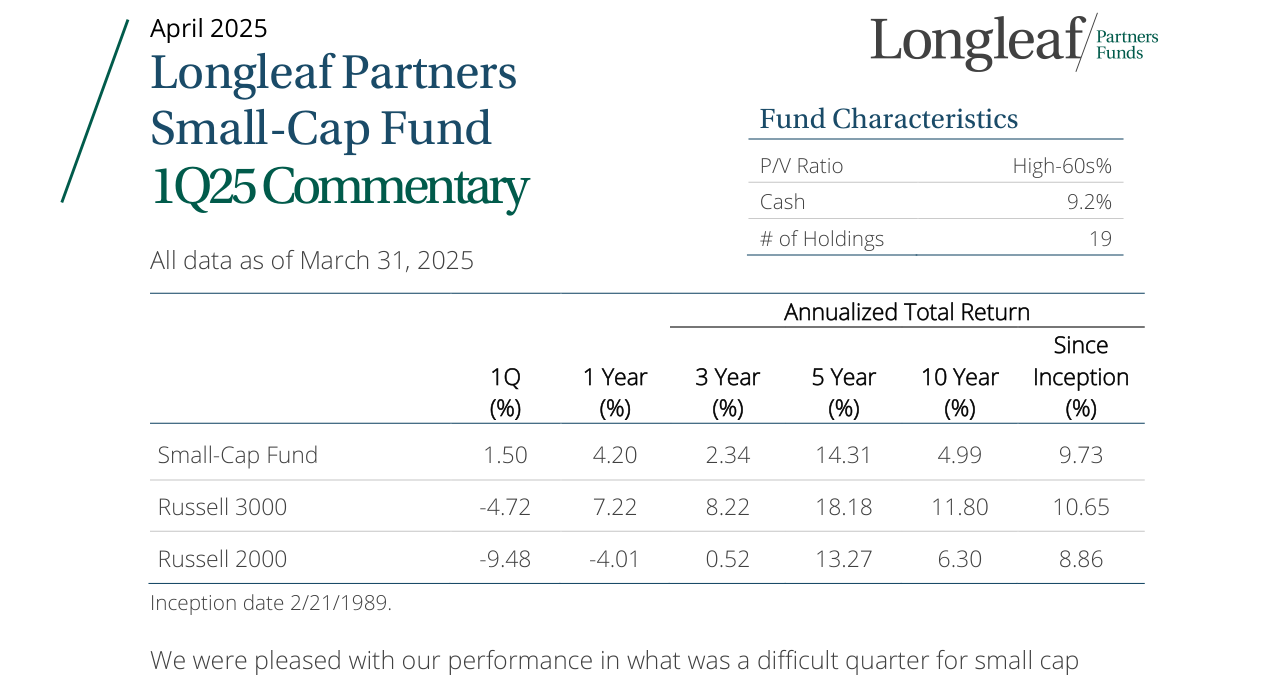
The Small-Cap Fund returned 1.50% in the first quarter, significantly outperforming the Russell 3000 (-4.72%) and Russell 2000 (-9.48%), with a five-year annualized return of 14.31% and a since-inception return of 9.73%
Companies/Assets Involved
- Graham Holdings (GHC): A diversified education, healthcare, and media company. Quarterly contributor with low-to-mid single-digit value growth, net cash balance sheet, bullish.
- Gruma: Global leader in tortillas and corn flour. Quarterly contributor, with U.S. core business EBITDA growing 5% in 2024, bullish.
- PotlatchDeltic: Timberland and wood products company. Quarterly contributor, viewed as a potential tariff beneficiary; the fund slightly reduced its position but still considers it undervalued with reliable dividends, bullish.
- Boston Beer Company: U.S. beverage company. Quarterly laggard due to declining alcohol consumption and the Truly brand’s downturn, but the author believes the company can overcome headwinds through buybacks and growth drivers, bullish.
- CNX Resources: Natural gas company. Quarterly laggard; lower-than-expected government incentives led to a per-share value loss of $10–20, but the author used the decline to increase the position, bullish.
- Park Hotels: Hotel owner and operator. Quarterly laggard; RevPAR grew over 3% but declined due to macro factors; financials are improving and the company may become an acquisition target, bullish.
- New Buys: A telecommunications company (stable, recurring revenue growth), a digital distribution company (previously held), and a beverage company (familiar), not specifically disclosed.
- Exits: Anywhere Real Estate and Liberty Live, due to valuation reasons.
Investment Implications
- Directional Advice: Amid current market uncertainty, focus on companies with net cash balance sheets, low valuations, and the flexibility to navigate macro volatility (e.g., Graham Holdings); for companies facing short-term setbacks but with solid fundamentals (e.g., CNX Resources, Boston Beer), use declines to increase positions.
- Risk Warning: Avoid chasing index-heavy stocks; the fund portfolio’s divergence from small-cap indices implies long-term outperformance potential but requires tolerance for short-term volatility; tariffs and macroeconomic slowdown may continue to pressure cyclical sectors (e.g., hotels, timber), but disciplined value stock selection provides downside protection.