1Q25 Asia Pacific Commentary
Southeastern Asset Management is a Memphis-based deep-value firm founded in 1975 by O. Mason Hawkins to exploit the bargains left by the 1973-74 bear market. Its flagship Longleaf Partners Funds (launched 1987) invest employees' own money alongside clients'. Following Graham's discipline and its "Business, People, Price" framework, it runs concentrated books of 15-25 undervalued stocks held for the long term — famously closing funds to new investors when opportunities were scarce. CEO and Head of Research Ross Glotzbach now leads the firm, which publishes quarterly Longleaf fund commentaries and Research Perspectives notes.
In plain words
This report explains why Chinese tech and consumer companies—like DeepSeek (a startup making cheap AI models) and BYD (an electric vehicle giant)—are challenging U.S. giants. For ordinary investors, it suggests looking beyond U.S. tech stocks: Chinese domestic-focused firms (e.g., Luckin Coffee) are less affected by tariffs and may offer value. It's worth reading because it uses concrete data (BYD’s revenue surpasses Tesla’s, DeepSeek’s low-cost model hit Nvidia’s stock) to show shifting global opportunity, urging diversification.
Southeastern (Longleaf Partners) Asia Pacific UCITS Fund – Q1 2025 The fund posted a net return of 4.36% in the first quarter of 2025, outperforming the FTSE Asia Pacific Index by approximately 3.5 percentage points, extending its outperformance since the second half of 2024. Chinese investments wer
Theme and Background
This section primarily discusses the performance of the Southeastern (Longleaf Partners) Asia Pacific UCITS Fund in the first quarter of 2025, with a focus on investment opportunities in China's technology, consumer, and electric vehicle sectors. The report notes that the market narrative is shifting from "American exceptionalism" dominated by US tech stocks to a strong rebound in Chinese tech stocks.
Core Thesis
The author's core investment thesis is that China's technology and consumer sectors are undergoing structural breakthroughs, particularly in AI and electric vehicles, offering significant excess return opportunities for value investors. The counterintuitive judgment is that despite US chip export restrictions on China, Chinese startup DeepSeek has developed AI models comparable to ChatGPT at a lower cost, challenging the monopoly of US tech giants.
Key Arguments and Data
- Fund Performance: The fund delivered a net return of 4.36% in the first quarter, outperforming the FTSE Asia Pacific Index by approximately 3.5 percentage points. Chinese investments outperformed the China Index by about 900 basis points, while Japanese investments underperformed the Japan Index by roughly 130 basis points.
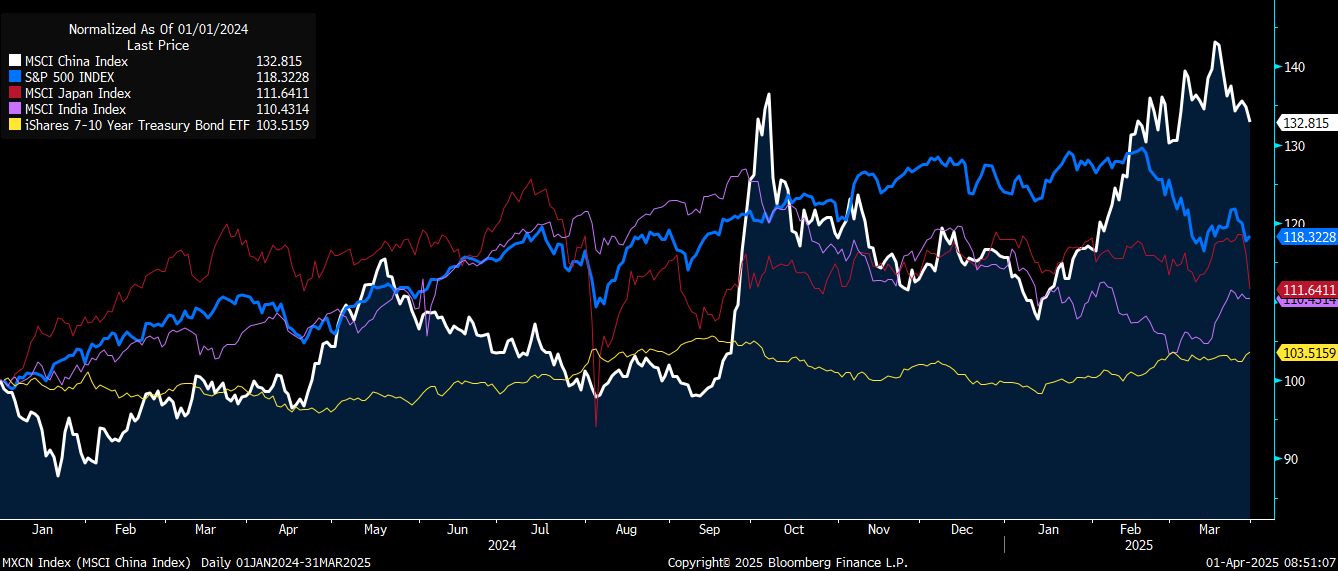
- Market Comparison: Chinese tech stocks staged a strong rebound, with the KraneShares CSI China Internet ETF (KWEB) rising 19% in the first quarter, while the Nasdaq fell approximately 10% and the Magnificent Seven (Mag7) declined by 16% cumulatively.
- Consumer Brands: Luckin Coffee and Domino's Pizza China (DPC) posted quarterly returns exceeding 25%, with revenue growth of over 38% year-over-year.
- AI Breakthrough: DeepSeek released its AI model R1 in January, boosting the Hang Seng Tech Index by 21% in the quarter and causing Nvidia to plummet nearly 17% in a single day. After a 171% gain in 2024, Nvidia's stock faced sustainability concerns due to DeepSeek's low-cost model.
- EV Comparison: BYD's 2024 revenue exceeded $100 billion, with automotive revenue growing 27%; Tesla's automotive revenue declined for the first time by 3%. BYD's battery electric vehicle sales grew 39% year-over-year in the first quarter, while Tesla deliveries fell 13%. BYD launched 1,000 kW charging technology, twice the speed of Tesla's Superchargers.
| Metric | BYD | Tesla |
|---|---|---|
| 2024 Revenue | Over $100 billion | Not directly provided |
| Automotive Revenue Growth | +27% | -3% (first decline) |
| 2024 Sales Volume | 4.27 million units | Approximately 2 million units (estimated) |
| Q1 Sales Growth | +39% | -13% |
| Charging Technology | 1,000 kW | Approximately 500 kW (Supercharger) |
Companies/Assets Involved
- Alibaba: Largest quarterly contributor, released the Qwen 2.5 model, claiming to surpass GPT-4o and DeepSeek-V3 on key benchmarks. Apple selected its Qwen LLM for AI features on iPhones in China, and the BMW Group expanded its partnership. Bullish.
- BYD: 2024 revenue surpassed Tesla, with sales doubling. Launched the "God's Eye" advanced driver-assistance system and 1,000 kW charging technology. Bullish.
- Luckin Coffee & Domino's Pizza China (DPC): Value-oriented consumer brands, with quarterly returns exceeding 25% and revenue growth over 38%. Bullish.
- DeepSeek: AI startup, released the low-cost model R1, challenging US tech giants. Bullish (indirectly positive for China's tech ecosystem).
- Tencent, Baidu: Benefiting from the open-source AI trend, offering free AI models. Bullish.
- Nvidia: Stock plunged nearly 17% in a single day due to DeepSeek's low-cost model. Bearish (short-term pressure).
Investment Implications
- Overweight Chinese Tech and Consumer: The report argues that innovation in China's AI and EV sectors is breaking the US monopoly. Investors should focus on leading companies like Alibaba and BYD, as well as value consumer brands like Luckin Coffee.
- Beware of US Tech Stock Risks: The decline of the Mag7 and the rise of DeepSeek suggest that the high valuations of US tech stocks may face challenges from low-cost Chinese competitors.
- Monitor Policy Signals: The Chinese government's support for private enterprises (e.g., Xi Jinping's meeting with tech CEOs) and stimulus measures have boosted market confidence. Investors can position themselves in assets benefiting from policy easing.
Continuation Analysis: Resilience of the Chinese Market, Shifts in the Global Landscape, and Investment Strategy Adjustments
I. Stability and Structural Shift of the Chinese Market
Despite the US imposing an additional 20% tariff on Chinese exports in March 2025, followed by another 34% in April, bringing the total tariff rate to approximately 54%, the Chinese market has remained relatively stable. This phenomenon is supported by multiple factors:
- Policy Shift: Chinese leadership viewed the chip ban as the start of an economic conflict, proactively reducing credit support for the real estate sector and reallocating resources to key industries such as semiconductors and electric vehicles. This strategic adjustment has enabled China to achieve industrial upgrading under the pressure of the trade war.
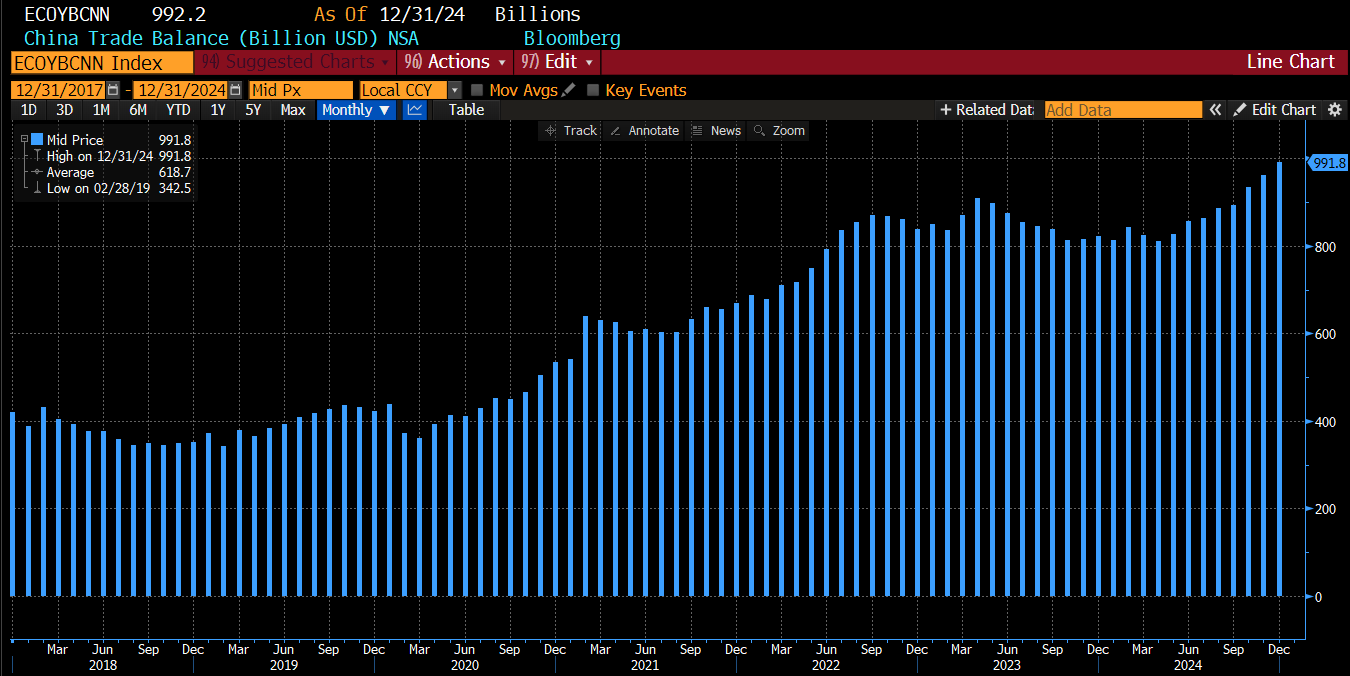
- Trade Surplus Doubled: China's trade surplus has approached $1 trillion, more than double the level at the start of the trade war in 2018. This indicates that China's export competitiveness has not been weakened by tariffs; instead, it has achieved a higher value-added export structure through industrial upgrading.
- Qualitative Change in Export Structure: China has transformed from an exporter of cheap plastic toys and textiles to the world's largest exporter of electric vehicles, wind turbines, solar panels, auto parts, semiconductors, integrated circuits, renewable energy storage batteries, and rare earth minerals. At the same time, China has become a global leader in AI and electric vehicles.
Comparative Data: Changes in China's Trade Surplus and Export Structure
| Metric | 2018 (Trade War Start) | 2025 (Current) | Change |
|---|---|---|---|
| Trade Surplus (Trillions USD) | Approximately 0.4 | Close to 1.0 | Growth of 150%+ |
| EV Export Status | Not a major exporter | World's largest exporter | Qualitative change |
| Semiconductor/IC Exports | Reliant on imports | Major global exporter | Significant improvement |
II. Erosion of American "Exceptionalism" and Reshaping of the Global Landscape
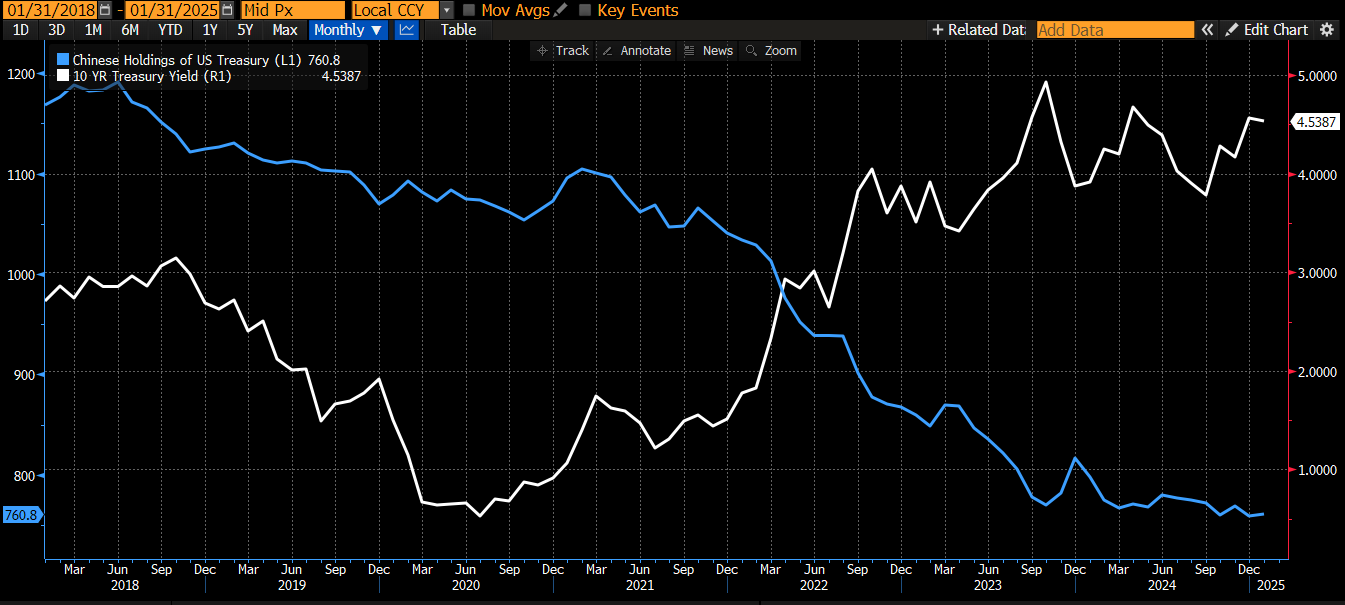
The premium of the US as a "rule-of-law nation" is rapidly diminishing. After the Russia-Ukraine conflict in 2022, the US seizure of Russian foreign reserves sent a clear signal to other countries: the "risk-free" status of US Treasuries depends on political alignment with the US. This has led to:
- Asset Substitution Trend: Some countries have begun seeking alternative safe-haven assets such as gold, Bitcoin, or Chinese government bonds. Data shows that after Russia's invasion of Ukraine, China accelerated its selling of US Treasuries, while gold prices hit record highs and Chinese government bond yields hit record lows.
- Alienation of Allies: The Trump administration alienated allies through threats of tariff hikes and annexation of territories. Europe was marginalized in key global issues such as Ukraine peace talks, and the Signal leak incident exposed the Trump administration's disdain for European partners. This has prompted European leaders to call for greater autonomy and a more balanced foreign policy, seeking deeper engagement with China.
- Geopolitical Opportunity for China: The image of the US as an unreliable ally has inadvertently strengthened China's position on the global stage. China is seizing the opportunity to improve economic and political relations with European countries.
Comparative Data: US Treasury Holdings and Alternative Asset Prices
| Asset Class | Early 2022 (Pre-Russia-Ukraine Conflict) | 2025 (Current) | Trend |
|---|---|---|---|
| China's Holdings of US Treasuries (Billions USD) | Approximately 1,060 | Approximately 770 (End of 2024) | Decline of ~27% |
| Gold Price (USD/oz) | Approximately 1,800 | Approximately 2,300+ | Increase of ~28% |
| China 10-Year Government Bond Yield (%) | Approximately 2.8 | Approximately 1.7 | Decline of ~1.1 percentage points |
III. Portfolio Adjustment: Focusing on Domestic Consumption and Structural Opportunities
Portfolio adjustments this quarter were limited, but the focus was on evaluating opportunities in the Asian semiconductor and consumer tech sectors, including countries not previously considered. The main focus was on Japanese small-cap stocks and Chinese companies.
New Investment Case: Luckin Coffee
- Background: Luckin Coffee was delisted from Nasdaq in 2020 due to an accounting fraud scandal (inflating 2019 sales by approximately $310 million). However, under private equity control, Luckin has transformed into the dominant player in China's coffee market, with over 22,000 stores—more than four times the number in 2019 and nearly three times that of Starbucks China.
- Unit Economics: Luckin stores achieved a 19% store-level operating profit margin in FY2024, with a payback period of only 1.5-2.0 years. Despite intense price wars with competitors like Cotti Coffee (9.9 RMB per cup), Luckin maintained strong profitability.
- Competitive Landscape Changes: Cotti Coffee, founded by Luckin's founder, has been aggressively discounting since February 2023 and opening stores an average of 241 meters from Luckin stores, triggering a price war. However, Cotti faces financing difficulties in the capital markets, and a Beijing court has ordered its founder to surrender assets worth over 1.89 billion RMB (approximately $262 million). In the first half of 2024, Cotti's store network expansion slowed significantly (only 3% year-over-year growth), with increasing franchisee complaints. Luckin's same-store sales growth (SSSG) narrowed to -3.4% in Q4 2024, a significant improvement from -13.1% in Q3, and turned positive in December.
- Growth Potential: China's coffee consumption remains far below that of other developed economies. In 2023, per capita coffee consumption in China was approximately 16 cups per year, compared to about 289 cups in the US. Even in Shanghai (150 cups/year), it is lower than Hong Kong (200 cups/year). Given coffee's addictive nature and increased consumer exposure, structural growth in Chinese coffee consumption is expected. Luckin achieved a 37.4% return in Q1 2025, making it one of the top five contributors.
Comparative Data: Global Coffee Consumption Comparison
| Region | Per Capita Annual Coffee Consumption (Cups) | Gap with China |
|---|---|---|
| China (National Average) | 16 | Baseline |
| United States | 289 | 17x |
| Shanghai | 150 | 9.4x |
| Hong Kong | 200 | 12.5x |
| China (2021) | 9 | Historical low |
IV. Impact of Trump's "Reciprocal Tariffs" and Portfolio Defensiveness
On April 2, 2025, President Trump announced new "reciprocal tariffs," bringing the total tariff rate on China to 54%. However, the Chinese companies in the portfolio—Luckin Coffee, Tencent, Domino's China, Alibaba, Baidu, Tongcheng Travel, H World Group, MGM China/Melco Resorts—are primarily focused on domestic consumption. These companies are largely unaffected by US tariffs and are expected to continue growing with Chinese consumption, benefiting from anticipated government stimulus measures.
Key Conclusion: Since the start of the US-China trade war in 2018, the portfolio has proactively reduced exposure to affected multinational companies, shifting towards companies with primarily domestic revenue. This strategy provides natural protection in an environment of escalating tariffs.
Additional Arguments, Data, and Perspectives
1. Deepening Investment Strategy Amid Trade War Volatility
- Defensiveness of Japanese Portfolio: Japanese investments account for approximately 30% of the portfolio, almost entirely focused on domestic consumption. Only Hitachi derives 15% of its revenue from the US. Hitachi mitigates tariff risk through Mexican production under the USMCA framework and localized content, demonstrating the resilience of supply chain regionalization (nearshoring).
- Quantitative Analysis of Tariff Impact: SharkNinja, Techtronic, and Samsonite together account for approximately 9% of the portfolio and are the holdings most affected by US tariffs. Specific data is as follows:
| Company | US Revenue Share | Key Supply Chain Dependence | Tariff Impact Level |
|---|---|---|---|
| SharkNinja | 63% | Shifting from China to Vietnam, Vietnam tariff raised from 9.4% to 46% | High (Short-term shock) |
| Techtronic | 76% | China 35%, Vietnam 35%, Mexico 15%, US 13-14% | High (Vietnam capacity hit) |
| Samsonite | 36% | China 15%, ASEAN 85% (Thailand, Cambodia, etc.) | Medium (Diversification mitigates) |
- Management Adaptability: All three companies have optimized their supply chains multiple times since the 2018 US-China trade war and possess the ability to adjust quickly. For example, SharkNinja plans to reduce its reliance on China to 10% by the end of Q2 2025, but the surge in Vietnam tariffs (9.4% to 46%) complicates the plan. Nevertheless, its non-US business (40% of revenue) has grown at a 36% four-year CAGR, partially offsetting pressure from the US market.
2. Empirical Evidence of Volatility as Opportunity
- Historical Experience: Since the launch of the Asia Pacific strategy in 2014, the team has repeatedly used negative sentiment-driven volatility to buy high-quality companies at a discount. For example, during the 2018 trade war, the portfolio achieved excess returns by increasing holdings in domestic consumer stocks (e.g., Japan) and adjusting supply chain exposure.
- Value Investing Perspective: Volatility is viewed as "temporary value erosion" rather than structural loss. Under the current tariff shock, the valuations of affected companies in the portfolio (e.g., SharkNinja) may be undervalued, presenting opportunities to add positions.
3. In-depth Analysis of Major Contributors and Detractors
- Alibaba: Strong performance in Q3 FY25, with CMR growth of +9% YoY and cloud business EBITDA margin reaching 10% (above expectations). The Qwen 2.5 model surpassed GPT-4o and DeepSeek-V3 on key benchmarks and was selected by Apple for AI features on iPhones in China, reinforcing its technological leadership.
- Tencent: Q4 revenue grew 11% YoY, with adjusted net profit up 30%. AI investment was significant: operating capital expenditure increased 138% QoQ to 34.9 billion RMB, and the Hunyuan model has been integrated into products. WeChat's 1.3 billion monthly active users provide a data advantage, expected to yield high AI investment returns.
- DPC Dash (Domino's Pizza China): Achieved 30 consecutive quarters of positive same-store sales growth, with adjusted net profit up 1,394% YoY in 2024. The membership program contributed 64.5% of revenue, with member consumption frequency (3 times/year vs. 2.5 times) and retention rates (60% vs. 50%) outperforming regular customers. Plans to add 300 new stores in 2025 (30% network expansion).
- Hikari Tsushin: Q4 operating profit grew 21% (excluding one-time items), with FY2025 (ending March) operating profit expected to reach 105 billion yen (up 5%). The investment portfolio trades at 0.8x P/B and 3x EV/FCF, significantly undervalued.
- Detractor Jollibee: China business EBITDA fell 57% YoY, and Smashburger EBITDA turned negative. However, the North American Jollibee brand saw same-store sales growth of 8%, with average daily sales of $13,300 (3x KFC, 2x Popeyes), and a franchising plan launched in March 2025 is expected to improve performance.
- Detractor Medley: Q4 revenue grew 52% YoY, but profit fell short of expectations due to the HR platform's tilt towards lower-paid medical staff. FY2025 guidance was conservative, but early success in key position placements in the first two months and continued market share gains from traditional headhunters are positive signs.
4. Comparative Data: Key Financial Metrics
| Company | Revenue Growth (YoY) | Profit Growth (YoY) | Key Risk/Opportunity |
|---|---|---|---|
| Alibaba | CMR +9%, Cloud +13% | Cloud EBITDA Margin 10% | Leading AI model, Apple partnership |
| Tencent | +11% | Adjusted Net Profit +30% | Surge in AI capex, WeChat ecosystem |
| DPC Dash | +41% (Adjusted) | Adjusted Net Profit +1,394% | Membership program driving growth, store expansion |
| Hikari Tsushin | Operating Profit +21% | Dividend +1.8% to 651 yen | Small-cap portfolio undervalued |
| Jollibee | Philippines SSSG +7.4% | China EBITDA -57% | Strong North American brand, franchise launch |
| Medley | +52% | EBITDA +21% | Low-wage positions drag, market share growth |
5. Macro and Strategic Implications
- Supply Chain Resilience: Despite the surge in Vietnam tariffs, companies have reduced single-source dependency through diversified production (e.g., Techtronic's Mexican and US capacity) and regionalized sourcing (e.g., Samsonite's ASEAN sources).
- AI Investment Returns: AI investments by Tencent and Alibaba (e.g., Qwen, Hunyuan) have already generated practical applications (Apple partnership, WeChat integration), and high ROI is expected at the application layer, particularly for Tencent given its WeChat data advantage.
- Consumer Resilience: DPC Dash and Jollibee's North American brand demonstrate that consumer companies with strong brands and membership loyalty can still achieve growth amid macro volatility.