1Q24 Global Fund Commentary
Southeastern Asset Management is a Memphis-based deep-value firm founded in 1975 by O. Mason Hawkins to exploit the bargains left by the 1973-74 bear market. Its flagship Longleaf Partners Funds (launched 1987) invest employees' own money alongside clients'. Following Graham's discipline and its "Business, People, Price" framework, it runs concentrated books of 15-25 undervalued stocks held for the long term — famously closing funds to new investors when opportunities were scarce. CEO and Head of Research Ross Glotzbach now leads the firm, which publishes quarterly Longleaf fund commentaries and Research Perspectives notes.
In plain words
This report looks at a global fund's performance in early 2024, when US AI stocks dominated the market. The fund still made money by investing in non-US companies whose managers cut costs and bought back shares. For regular investors, the takeaway is: don't chase only hot AI stocks—high market concentration may signal a shift toward value investing. Japan's reforms are priced in, so it's no longer a bargain. Worth reading because it shows how to find real returns when everyone else is chasing hype.
Longleaf Partners Global Fund Q1 2024 Return The Longleaf Partners Global Fund returned 8.39% in the first quarter of 2024, slightly underperforming the FTSE Developed Index's 8.63% but outperforming the FTSE Developed Value Index (6.75%) and achieving its absolute annualized target of inflation plu
Theme and Background
This chapter reviews the performance of the Longleaf Partners Global Fund in the first quarter of 2024 and analyzes the market environment. The report notes that US mega-cap stocks (especially a few AI-focused companies) continued to dominate the market, putting relative pressure on value investing strategies, though the fund still achieved its absolute return target. The author views the rising market concentration as a potential signal of a shift toward value investing.
Core Thesis
The author's core investment argument is that despite the market being driven by a few AI-related mega-cap stocks, the fund can still outperform value indices and achieve absolute return targets by holding non-US companies with strong operational and financial performance, as well as management teams actively realizing value. The counterintuitive judgment is that the higher the market concentration, the more likely it signals a shift toward more rational value investing; structural improvements in Japan (corporate governance, shareholder activism) are already fully reflected in valuations and no longer appear attractive.
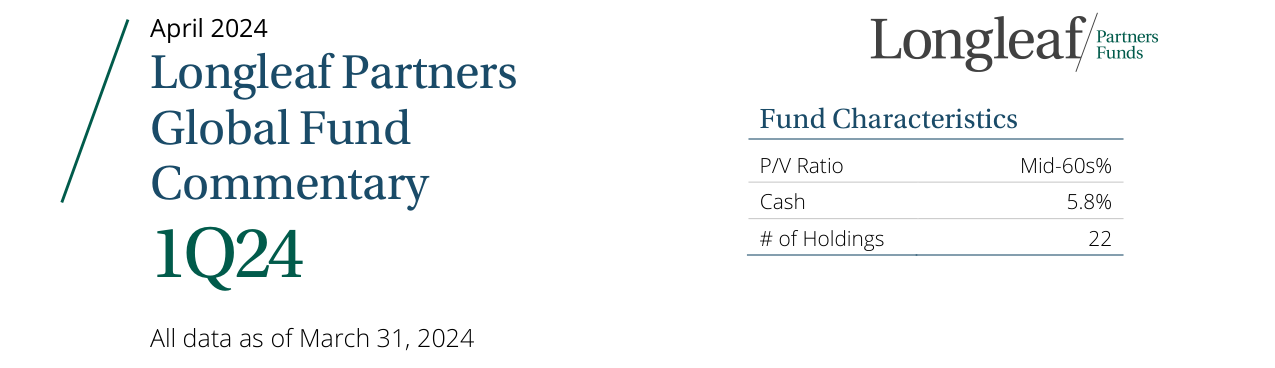
The fund's P/V ratio is in the mid-60% range, cash accounts for 5.8%, and the portfolio holds 22 positions
Key Arguments and Data
- Fund Performance: The fund returned 8.39% in the first quarter, underperforming the FTSE Developed Index (8.63%) but outperforming the FTSE Developed Value Index (6.75%), while achieving the absolute annualized target of inflation plus 10%.
- Market Concentration: The "Magnificent 7" of 2023 has narrowed to a few AI-focused companies; rising market concentration may signal a shift toward value investing.
- Japan Market: Japanese indices performed well, but structural improvements (corporate governance, shareholder activism) are already widely reflected in valuations, especially for companies within the author's investment universe.
- Portfolio Management: The portfolio's P/V ratio is in the mid-60% range, cash accounts for 5.8%, and it holds 22 stocks. Management teams continue to realize value through actions such as discounted share buybacks.
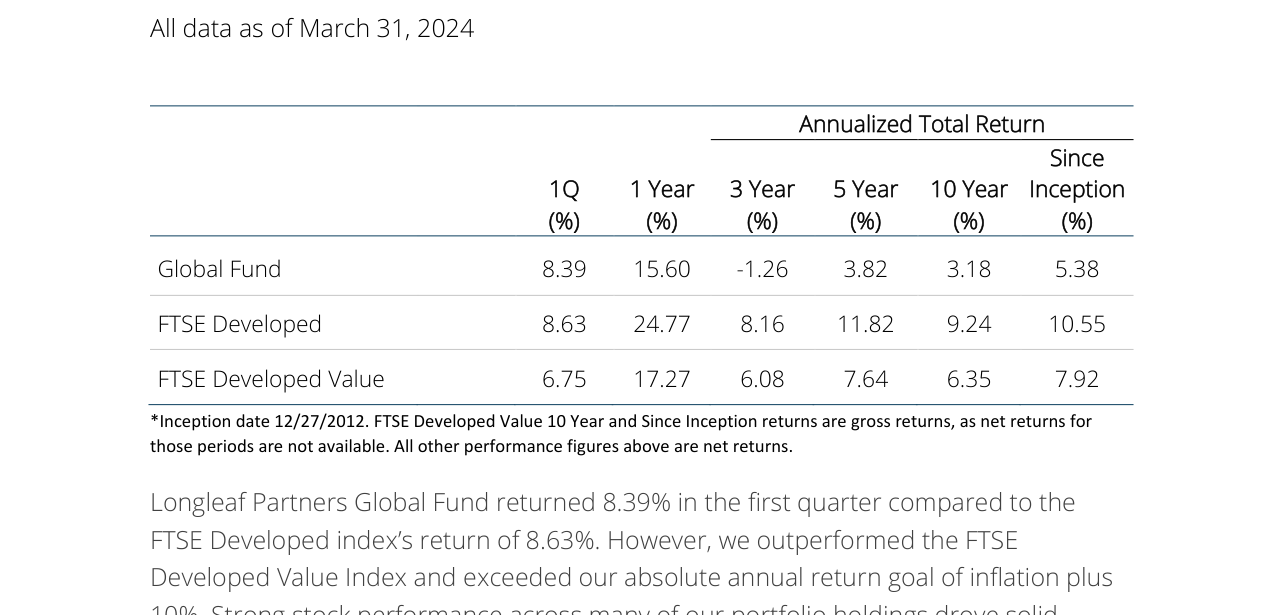
The Global Fund returned 8.39% in 1Q24, 15.60% over one year, -1.26% over three years, and 5.38% annualized since inception
| Metric | 1Q24 | 1 Year | 3 Years | 5 Years | 10 Years | Since Inception |
|---|---|---|---|---|---|---|
| Global Fund | 8.39% | 15.60% | -1.26% | 3.82% | 3.18% | 5.38% |
| FTSE Developed | 8.63% | 24.77% | 8.16% | 11.82% | 9.24% | 10.55% |
| FTSE Developed Value | 6.75% | 17.27% | 6.08% | 7.64% | 6.35% | 7.92% |
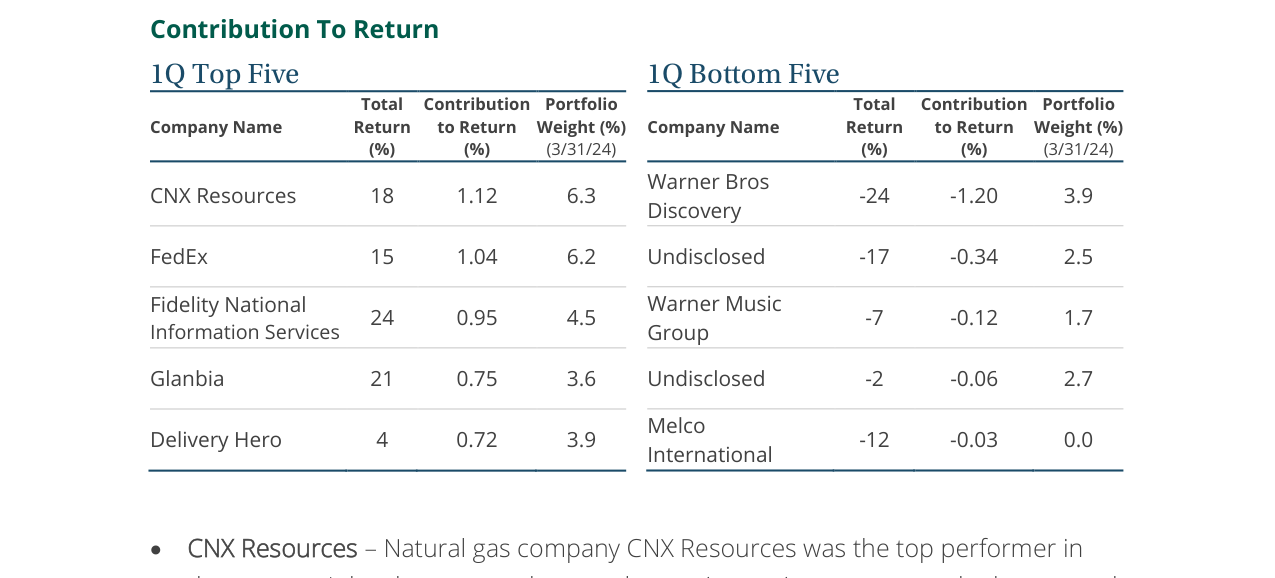
Among the top five contributors in the first quarter, CNX Resources led with a contribution of 1.12%, followed by FedEx at 1.04%
Companies/Assets Involved
- CNX Resources (Bullish): Returned +18% in the first quarter, contributing 1.12%. Despite a challenging natural gas price environment, the company has strong hedging and a robust balance sheet, consistently repurchasing shares at a double-digit annualized rate. The CEO and Chairman focus on growing long-term free cash flow and per-share value. The report believes the stock remains deeply discounted and is one of the strongest value growth stocks of recent years.
- FedEx (Bullish): Returned +15% in the first quarter, contributing 1.04%. The company exceeded market expectations, made substantial progress on the DRIVE cost-cutting plan, repurchased shares at a 6% annualized rate, and authorized an additional $5 billion buyback program. Capital expenditure guidance was lowered, further improving free cash flow. The report argues that the cost-cutting plan is only about halfway complete, and the market has not yet fully recognized this.
- Fidelity National Information Services (FIS) (Bullish): Returned +24% in the first quarter, contributing 0.95%. The core banking software business resumed steady growth, and the CEO has proven to be an excellent partner. The company recently divested non-core businesses at reasonable prices and used the proceeds to repurchase 10% of its shares. The report believes the company is stable and on the offensive, yet its free cash flow multiple remains reasonable.
- Warner Bros Discovery (WBD) (Bearish): Returned -24% in the first quarter, dragging performance by 1.20%. The market disliked the company's lack of 2024 guidance. Although the advertising market shows initial signs of recovery, overall performance was weak.
Investment Implications
- Focus on Value Realization: Investors should focus on companies where management actively enhances per-share value through discounted buybacks, cost cuts, and asset divestitures, rather than chasing market trends.
- Beware of Market Concentration Risk: The current market is dominated by a few AI-related mega-cap stocks with extremely high concentration, which may signal a style shift. Investors should consider diversifying and increasing exposure to value stocks.
- Caution on Japan Market: Positive factors such as corporate governance improvements in Japan have already been priced in, reducing valuation appeal. Investors should not blindly chase highs.
- Opportunities in Non-US Companies: Non-US companies drive returns through their own operational and financial performance rather than macro trends, offering a direction for finding investment opportunities independent of US market hotspots.