1Q24 Partners Fund Commentary
Southeastern Asset Management is a Memphis-based deep-value firm founded in 1975 by O. Mason Hawkins to exploit the bargains left by the 1973-74 bear market. Its flagship Longleaf Partners Funds (launched 1987) invest employees' own money alongside clients'. Following Graham's discipline and its "Business, People, Price" framework, it runs concentrated books of 15-25 undervalued stocks held for the long term — famously closing funds to new investors when opportunities were scarce. CEO and Head of Research Ross Glotzbach now leads the firm, which publishes quarterly Longleaf fund commentaries and Research Perspectives notes.
In plain words
This is a quarterly letter from Longleaf Partners Fund. It explains how they earned 6.6% in a market where only a few AI stocks were soaring. For regular investors, the key takeaways are: they favor companies that buy back their own stock cheaply (like FIS and FedEx), which boosts per-share value; they think extreme market concentration may signal a shift back to value investing; and that a natural gas firm (CNX Resources) can still profit during a downturn by hedging and buybacks. Worth reading because it shows real positions and logic for finding opportunities outside the hot AI names.
Southeastern (Longleaf Partners) Fund returned 6.60% in the first quarter of 2024, underperforming the S&P 500's 10.56% and the Russell 1000 Value's 8.99%, but exceeding its absolute annualized return target (inflation + 10%). Core view: The intensifying market concentration (dominated by a few AI-d
Theme and Background
This chapter discusses the investment performance and market environment of the Longleaf Partners Fund in the first quarter of 2024. The report notes that market concentration has further intensified—shrinking from the "Magnificent 7" (seven major tech giants) in 2023 to a few stocks focused on artificial intelligence (AI) dominating the market, with value investing strategies facing headwinds relative to growth strategies during the quarter.
Core Thesis
The author's core investment argument is: the more concentrated the market, the more likely it signals a shift in investment style toward more rational value investing. The fund adheres to "controlling what it can control"—generating returns through management partners' discounted share repurchases and actions that enhance per-share value, rather than chasing market trends.
Counterintuitive judgment: Although a few AI-driven stocks dominate the market, the fund believes this may signal a return to value investing, rather than a signal to continue chasing growth stocks.
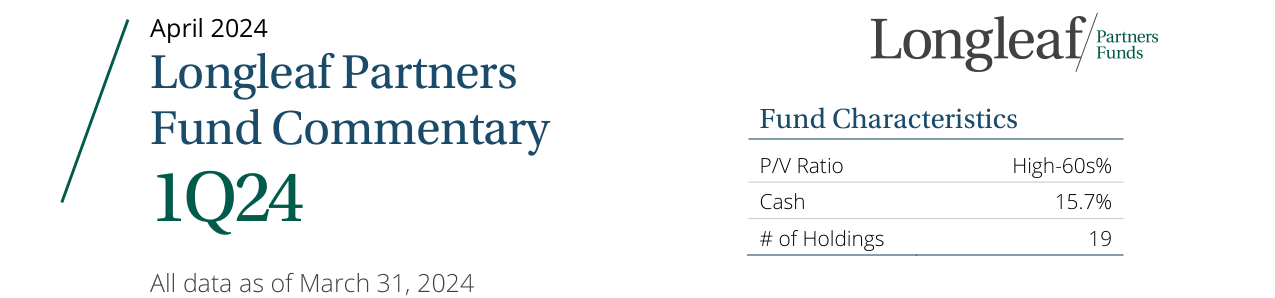
The fund holds 15.7% cash, 19 positions, with a P/V ratio at a high level above 60%
Key Arguments and Data
- Fund Return: The Longleaf Partners Fund returned 6.60% in the first quarter, exceeding its absolute annualized return target (inflation +10%), but underperforming the S&P 500's 10.56% and the Russell 1000 Value's 8.99%.
- Drag Factors: The portfolio's relative overweight in Communication Services, an above-normal cash level (15.7%), and a lack of exposure to the Information Technology (IT) sector weighed on relative performance.
- Portfolio Characteristics: The P/V ratio is in the high 60% range, holding 19 stocks, with a cash allocation of 15.7%.
Quarterly Contribution Comparison Table:
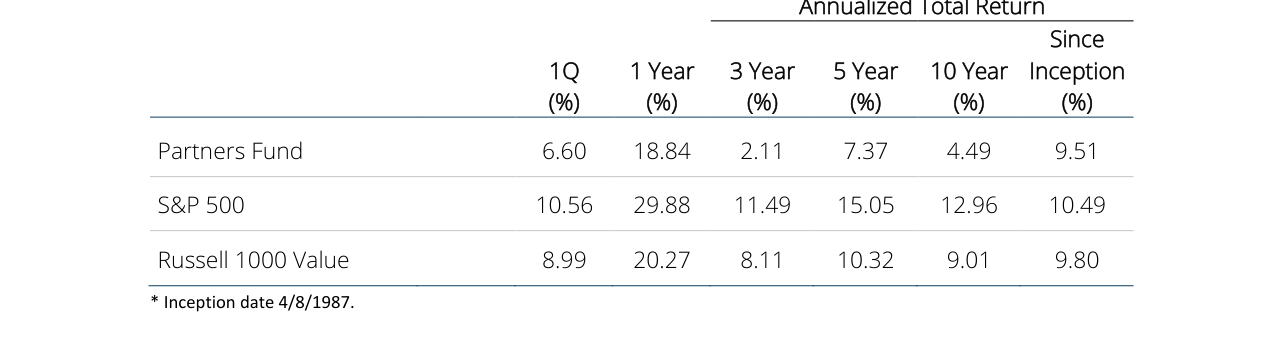
Partners Fund returned 6.60% in Q1, 18.84% over one year, and an annualized return of 9.51% since inception
| Top Five Contributors | Quarterly Return | Contribution to Total Return | Portfolio Weight (3/31/24) | Bottom Five Detractors | Quarterly Return | Contribution to Total Return | Portfolio Weight (3/31/24) |
|---|---|---|---|---|---|---|---|
| Fidelity National Info Services | 24% | 1.20% | 4.9% | Liberty Broadband | -29% | -1.37% | 3.1% |
| CNX Resources | 18% | 1.12% | 6.4% | Warner Bros Discovery | -24% | -1.18% | 4.1% |
| FedEx | 15% | 1.04% | 6.2% | Warner Music Group | -7% | -0.31% | 3.6% |
| Hyatt | 22% | 0.72% | 2.6% | Fortune Brands | 2% | 0.03% | 0.0% |
| RTX | 17% | 0.68% | 4.4% | IAC | 2% | 0.16% | 5.6% |
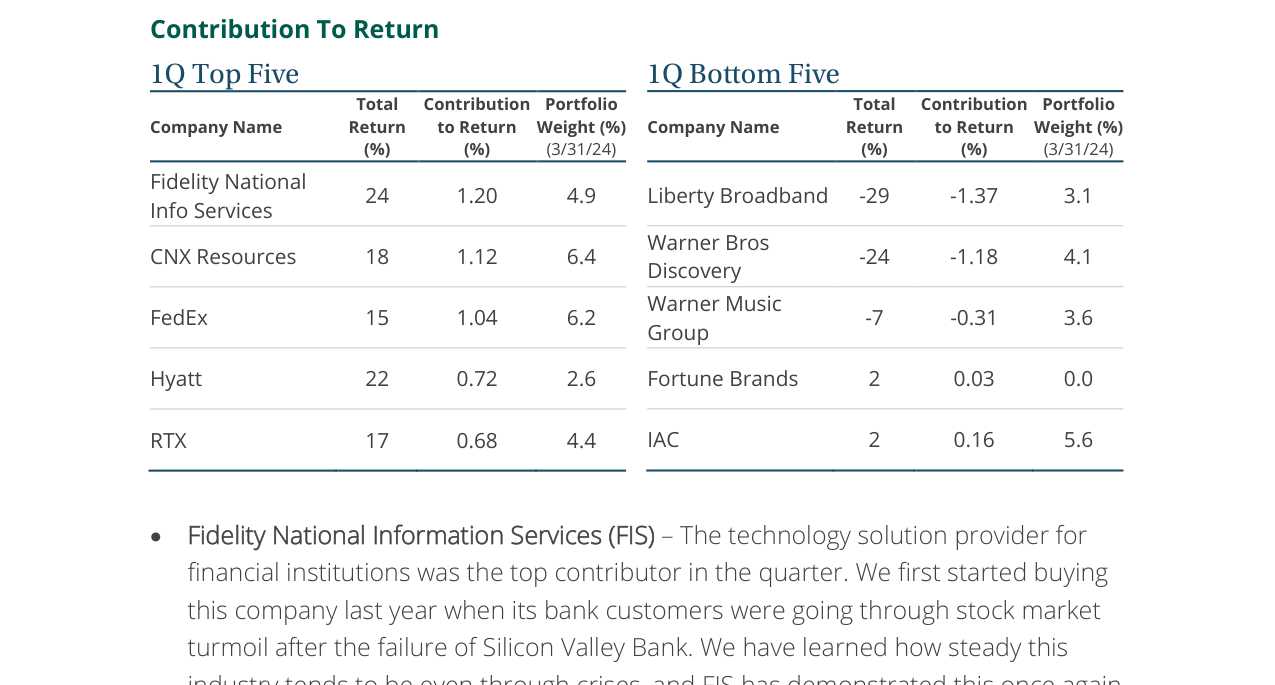
Among the top five contributors in Q1, Fidelity National Info Services ranked first with a total return of 24% and a contribution of 1.20%
Companies/Assets Involved
- Fidelity National Info Services (FIS) (Bullish): A technology solutions provider, with a quarterly return of +24%, contributing 1.20%. CEO Stephanie Ferris has been in office for less than a year and a half. The company trades at a reasonable free cash flow multiple, recently sold non-core businesses, and used the proceeds to repurchase 10% of its shares. The author describes it as a "stable and on the offensive" company.
- CNX Resources (Bullish): A natural gas company, with a quarterly return of +18%, contributing 1.12%. In a low natural gas price environment, the company has more hedging protection than peers and repurchases shares at a double-digit annualized rate. The author increased the position when the discount was larger at the start of the quarter.
- FedEx (Bullish): A global logistics company, with a quarterly return of +15%, contributing 1.04%. The DRIVE cost-cutting program has made substantial progress. During the quarter, the company authorized a new $5 billion share repurchase program and lowered its capital expenditure guidance. The author believes the cost-cutting program is only about half complete and the market has not fully priced it in.
- Liberty Broadband (Bearish): A cable and media holding company, with a quarterly return of -29%, dragging -1.37%. Its investment in Charter Communications underperformed on key metrics such as subscriber and cash flow growth. The author acknowledges that "value did not grow as expected," and the position has been reduced to a smaller size.
- Warner Bros Discovery (WBD) (Bearish): A media conglomerate, with a quarterly return of -24%, dragging -1.18%. The market expressed dissatisfaction with the company's lack of guidance.
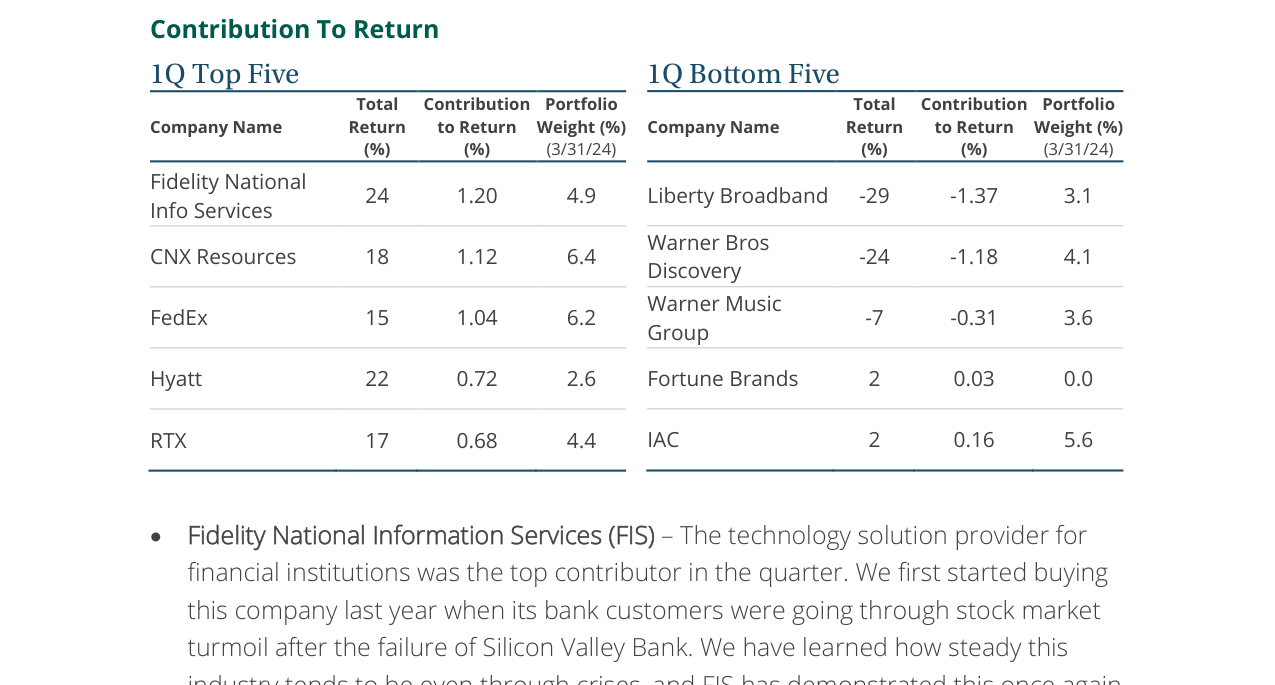
Among the top five detractors in Q1, Liberty Broadband ranked first in negative impact with a total return of -29% and a negative contribution of -1.37%
Investment Implications
1. Focus on Management Partners' Buyback Behavior: The fund emphasizes that management partners' actions to enhance per-share value, such as discounted share repurchases, are a core source of returns. Investors should prioritize companies that actively use cash flow for large-scale, disciplined buybacks (e.g., FIS repurchasing 10%, FedEx authorizing an additional $5 billion).
2. Value Investing May Be at an Inflection Point: Increasing market concentration (shrinking from the "Magnificent 7" to a few AI stocks) may signal a style shift. Stable companies trading at reasonable free cash flow multiples (such as FIS) are currently on the offensive and worth attention.
3. Beware of Deteriorating Industry Competition: The broadband industry (Liberty Broadband/Charter Communications) faces competitive pressure from fixed wireless access, presenting a "one step forward, one step back" dynamic. Investors should assess whether industry moats are being eroded.
4. Opportunities Exist in the Natural Gas Sector: CNX Resources can still create value through hedging and buybacks in a low-price environment, and its valuation remains in deep discount territory. This suggests that positioning in companies with cost advantages and capital discipline at cyclical bottoms may generate excess returns.