1Q24 International Fund Commentary
Southeastern Asset Management is a Memphis-based deep-value firm founded in 1975 by O. Mason Hawkins to exploit the bargains left by the 1973-74 bear market. Its flagship Longleaf Partners Funds (launched 1987) invest employees' own money alongside clients'. Following Graham's discipline and its "Business, People, Price" framework, it runs concentrated books of 15-25 undervalued stocks held for the long term — famously closing funds to new investors when opportunities were scarce. CEO and Head of Research Ross Glotzbach now leads the firm, which publishes quarterly Longleaf fund commentaries and Research Perspectives notes.
In plain words
This is a quarterly report from an international fund that slightly underperformed its benchmark. The main reason: they overweighted Hong Kong and Chinese stocks (out of favor) and underweighted Japan (in vogue). But they argue Japan's good news is already priced in, while fears about China may be overblown. They focus on companies like Glanbia (a protein-powder maker) and Accor (a hotel group) that have strong cash flows and managers who are buying back shares aggressively—a sign they think the stock is cheap. For regular investors, the takeaway: don't chase hot markets blindly; look for companies where insiders put their money where their mouth is.
The Longleaf Partners International Fund returned 3.64% in the first quarter of 2024, underperforming the FTSE Developed ex-North America Index's 5.47%. European companies drove positive returns through strong operational and financial performance, but the regional allocation to Asia (overweight Gre
Theme and Background
This section is the investment review of the Longleaf Partners International Fund for the first quarter of 2024. The report notes that the fund returned 3.64% for the quarter, underperforming the benchmark FTSE Developed ex-North America Index's 5.47%. The author argues that strong operational and financial performance from European companies drove the portfolio's positive returns, but the allocation to Asia (overweight Greater China, underweight Japan) was the primary reason for the relative underperformance.
Core Thesis
The author's core investment thesis is: Adhere to a bottom-up stock selection strategy, focusing on companies with strong balance sheets and pricing power that can consistently generate free cash flow in a complex environment, and whose management is actively taking steps to create value and drive market recognition of that value. The report's implicit contrarian view is that the market has fully priced in Japan's structural improvements (e.g., corporate governance), while pessimism towards undervalued markets like Greater China may be excessive.
Key Arguments and Data
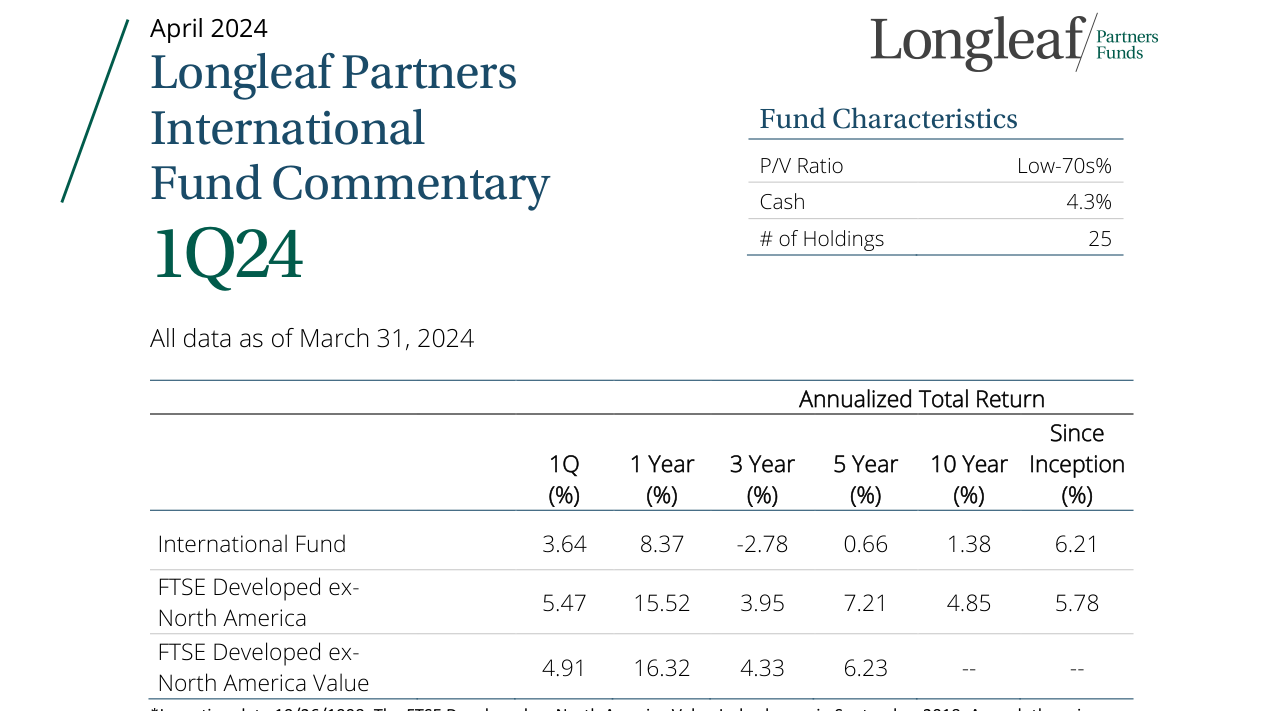
Fund P/V ratio in the Low-70s%, cash position 4.3%, portfolio holdings of 25 stocks
- Fund Performance: 1Q24 return of 3.64%, underperforming the benchmark by 1.83 percentage points.
- Regional Drag: Japan benefited from capital inflows and yen depreciation, but valuations already reflect these factors; the overweight position in Greater China (Hong Kong + China) was the primary drag on relative performance.
- Stock Contributions: The top five contributors added a total of 4.54%, while the bottom five detractors subtracted a total of -2.57%.
- Valuation Level: The portfolio's P/V ratio (price/value) is in the low 70% range, with a cash position of 4.3% and holdings in 25 stocks.
Comparative Data Table:
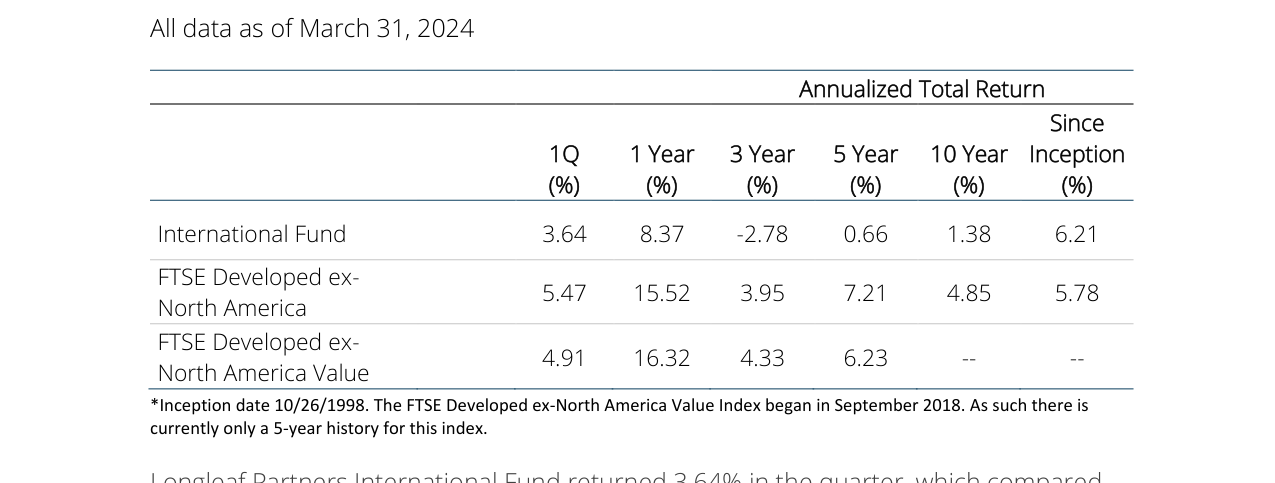
International Fund 1Q return 3.64%, one-year return 8.37%, three-year return -2.78%, annualized return since inception 6.21%
| Metric | Fund | Benchmark Index | Difference |
|---|---|---|---|
| 1Q24 Return | 3.64% | 5.47% | -1.83% |
| 1-Year Return | 8.37% | 15.52% | -7.15% |
| 3-Year Annualized Return | -2.78% | 3.95% | -6.73% |
| 5-Year Annualized Return | 0.66% | 7.21% | -6.55% |
| 10-Year Annualized Return | 1.38% | 4.85% | -3.47% |
| Annualized Return Since Inception | 6.21% | 5.78% | +0.43% |
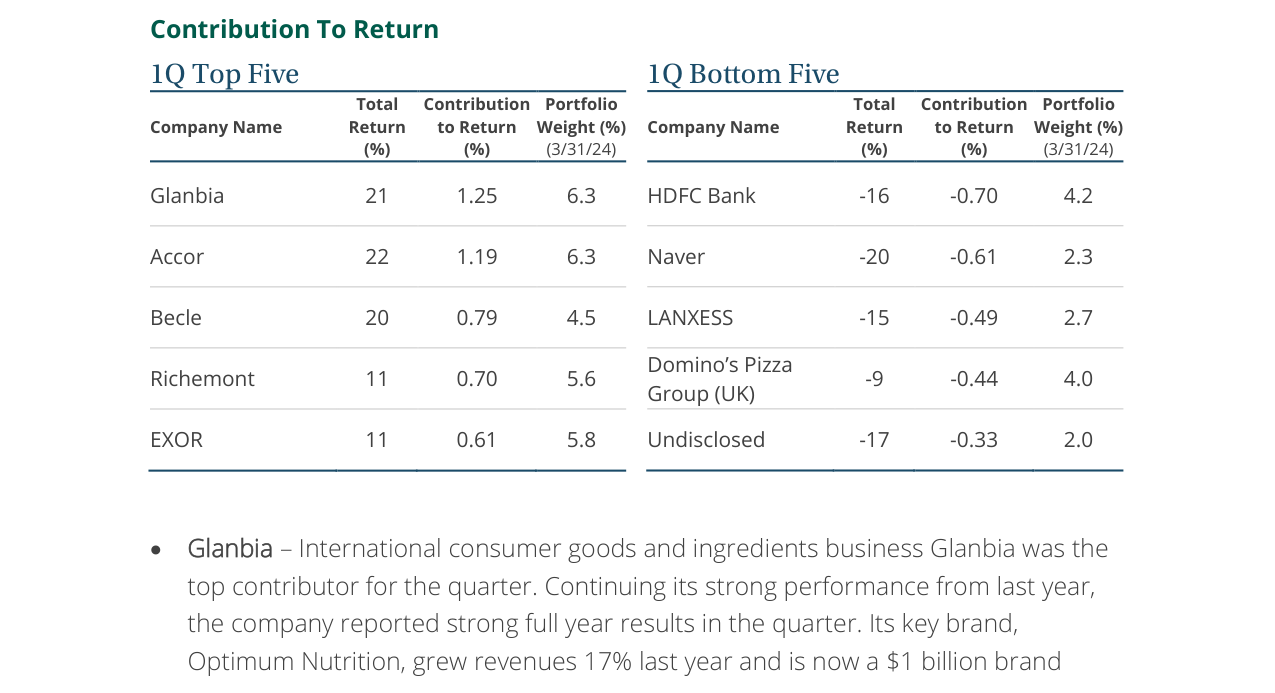
Among the top five contributors for the quarter, Glanbia led with 1.25%, Accor contributed 1.19%, and Becle contributed 0.79%
Companies/Assets Involved
- Glanbia (Bullish): Irish consumer goods and ingredients company. 1Q24 return of 21%, contribution of 1.25%, weight of 6.3%. Core brand Optimum Nutrition saw revenue grow 17% to $1 billion. Management executed significant buybacks and announced an additional €100 million in repurchases for 2024 (initial €50 million). The author believes it is misperceived by the market as a low-margin company, with upside potential in valuation.
- Accor (Bullish): French hotel group. 1Q24 return of 22%, contribution of 1.19%, weight of 6.3%. Local currency return exceeded 25%. Possesses a strong brand portfolio with a leading geographic presence in Asia, Latin America, and the Middle East. An investment-grade balance sheet allows for buybacks: a €400 million repurchase was executed at the end of 2023, and another €400 million was authorized in early 2024 and fully executed.
- Becle (Bullish): Mexican tequila and whiskey producer. 1Q24 return of 20%, contribution of 0.79%, weight of 4.5%. The headwind from high agave prices is receding, which is expected to improve margins. The author believes the stock remains undervalued, and management (the Beckmann family) is aligned with shareholder interests.
- HDFC Bank (Bullish, but under short-term pressure): India's largest private bank. 1Q24 return of -16%, drag of -0.70%, weight of 4.2%. Post-merger, net interest margin and ROA have reset, and the loan-to-deposit ratio is elevated. The company is working to lower this ratio by slowing loan growth. The author is bullish on its long-term compounding potential (~15% share of India's loan market, ~11% deposit share) and added to the position during the quarter.
- Naver (Bullish): South Korea's leading search and e-commerce platform. 1Q24 return of -20%, drag of -0.61%, weight of 2.3%. Market concerns about the entry of Chinese competitors (Alibaba, PDD) are noted, but the author points out their market share is below 3%. Naver is focusing on profitable growth, increasing take rates, with revenue growth significantly outpacing GMV growth. New entrants are expected to increase digital ad spending, which benefits Naver.
- LANXESS (Bullish): German specialty chemicals company. 1Q24 return of -15%, drag of -0.49%, weight of 2.7%. 2023 was impacted by high energy prices and weak demand. Management has cut structural costs, and a demand recovery is expected to bring high operating leverage, driving a strong rebound in EBITDA and cash generation. The author believes the market has yet to recognize its value growth potential.
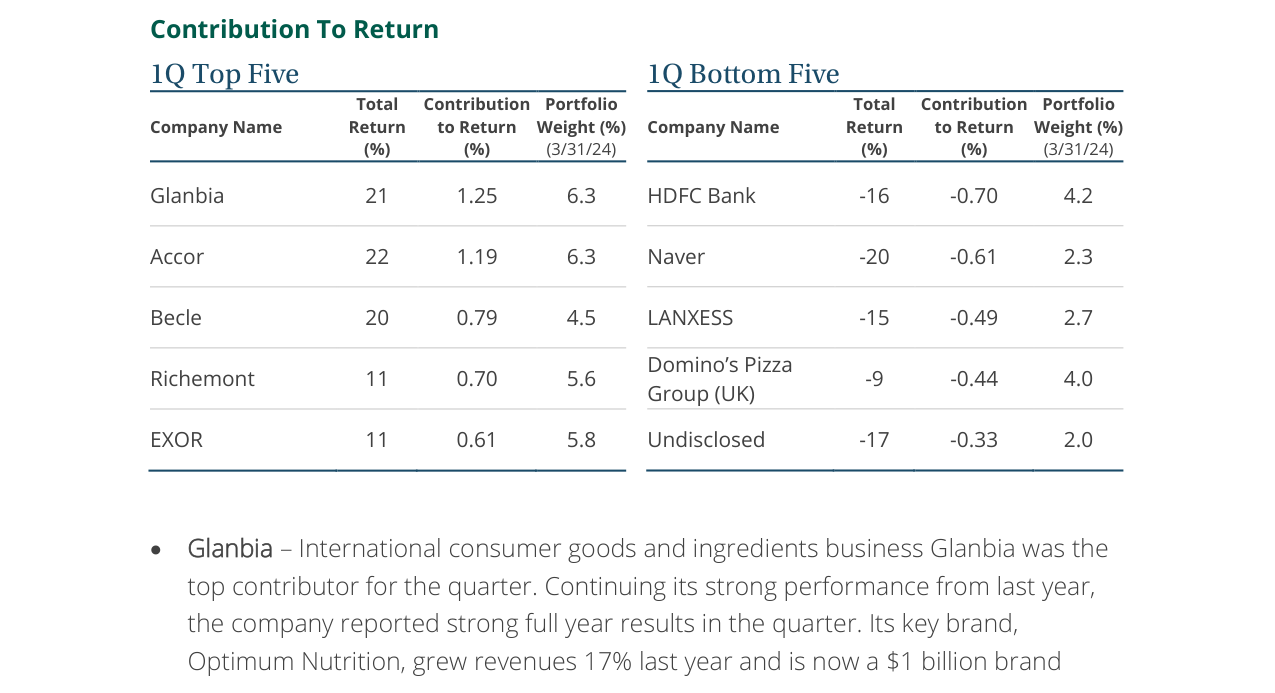
Among the top five detractors for the quarter, HDFC Bank detracted -0.70%, Naver detracted -0.61%, and LANXESS detracted -0.49%
Investment Implications
- Overweight Undervalued Markets: The report suggests investors should focus on markets like Greater China, which are experiencing capital outflows, rather than chasing Japan, which is already fully priced. Japan's structural improvements are reflected in valuations, while pessimism towards Greater China may be excessive.
- Focus on Management Actions: Select companies where management is actively creating value through buybacks, simplification, cost-cutting, etc. The buyback cases of Glanbia and Accor demonstrate that when management repurchases shares at undervalued prices, it is a strong value signal.
- Focus on Long-Term Opportunities Amid Short-Term Headwinds: HDFC Bank and LANXESS face short-term financial metric pressure, but the author believes their long-term competitiveness and value growth path are clear. Investors should distinguish between temporary headwinds and permanent value destruction.
- Be Wary of Competitive Landscape Changes: The Naver case shows that the market may overreact to new Chinese e-commerce entrants. Investors need to assess the actual market share and impact of new competitors, rather than judging based solely on sentiment.