2Q23 Small-Cap Fund Commentary
Southeastern Asset Management is a Memphis-based deep-value firm founded in 1975 by O. Mason Hawkins to exploit the bargains left by the 1973-74 bear market. Its flagship Longleaf Partners Funds (launched 1987) invest employees' own money alongside clients'. Following Graham's discipline and its "Business, People, Price" framework, it runs concentrated books of 15-25 undervalued stocks held for the long term — famously closing funds to new investors when opportunities were scarce. CEO and Head of Research Ross Glotzbach now leads the firm, which publishes quarterly Longleaf fund commentaries and Research Perspectives notes.
In plain words
This commentary from a small-cap fund says their portfolio returned 3.7% in the second quarter. The manager warns that mega-cap tech stocks (like Apple, Microsoft) may be in a bubble similar to the 2000 dot-com crash: profit margins are peaking, competition and regulation are rising. Instead, they own small- and mid-cap companies (tortillas, beer, insurance, sports teams) with strong balance sheets and pricing power, trading at just 60% of estimated value. They also highlight bonds of Lumen, backed by hard assets, as a better risk-reward than its stock. Takeaway: don't chase big tech; look for unloved small caps or distressed debt with a margin of safety.
Longleaf Partners Small-Cap Fund 2023 Second Quarter Report The fund posted a return of 3.70% for the quarter, bringing its year-to-date gain to 8.10% as of the first half of 2023. This performance outpaced the Russell 2000 Value Index (up 2.50% in the first half) but slightly lagged the Russell 200
Theme and Background
This section is the opening part of the Longleaf Partners Small-Cap Fund's second quarter 2023 report, primarily reviewing the fund's performance for the quarter and the first half of the year, and articulating the fund manager's assessment of the current market environment. The report notes that investors are rotating from small- and mid-cap stocks into mega-cap growth stocks, but the author believes this trend may mirror the early stages of the 2000 dot-com bubble, with mega-cap tech stocks facing peak profit margins, intensifying competition, and regulatory risks, potentially leading to significant declines.
Core Thesis
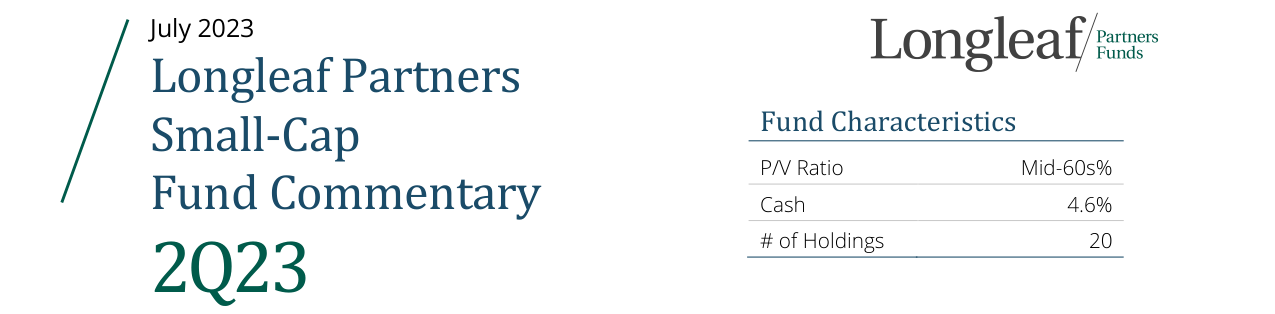
Fund P/V ratio approximately 60%, cash position 4.6%, portfolio of 20 holdings
The author's core investment thesis is that the fund has achieved absolute and relative returns in the current market environment through differentiated holdings (e.g., financials and real estate) and defensive allocations (stable brand companies in tortillas, beverages, insurance, sports, etc.), and this differentiated positioning will serve as a source of future outperformance. The counterintuitive judgment is that the author believes mega-cap tech stocks are not a safe haven but rather resemble the early stages of the 2000 dot-com bubble, potentially experiencing more severe declines; meanwhile, the fund's small- and mid-cap holdings, though viewed by the market as more volatile cyclical companies, possess strong balance sheets and pricing power, enabling value creation in challenging markets.
Key Arguments and Data
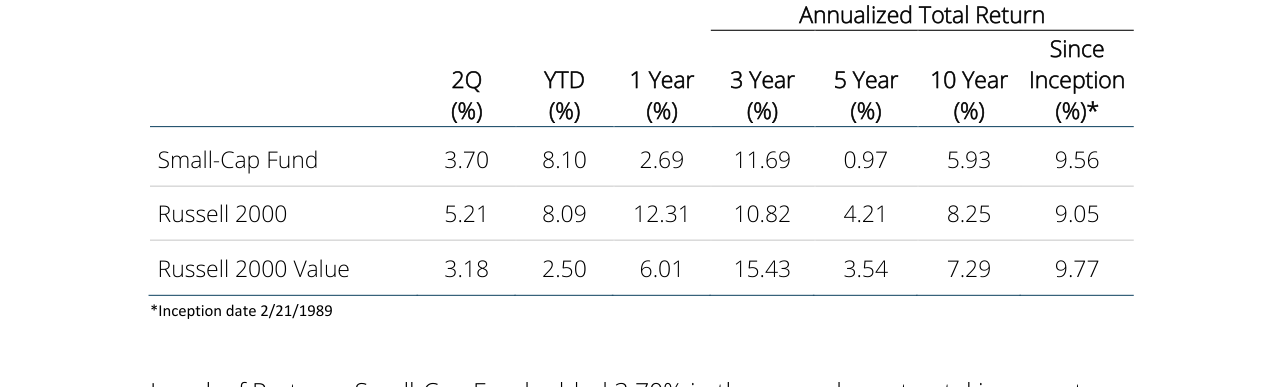
Small-Cap Fund returned 3.70% in Q2, 8.10% year-to-date, and 9.56% annualized since inception
- Performance Comparison: The fund returned 8.10% in the first half, outperforming the Russell 2000 Value (2.50%) but slightly trailing the Russell 2000 (8.09%). In Q2, the fund returned 3.70%, versus 5.21% for the Russell 2000 and 3.18% for the Russell 2000 Value.
- Historical Analogy: The report cites data from the 2000 dot-com bubble—the Nasdaq fell over 35% from its March 2000 peak, then temporarily rebounded 36% in Q2 2000, only to decline another 80% over the subsequent 25 months. The author believes mega-cap tech stocks face similar risks today.
- Portfolio Characteristics: The fund's P/V ratio is in the mid-60% range, with a 4.6% cash position and 20 holdings. The portfolio lacks exposure to healthcare, is relatively overweight consumer staples, but differentiated holdings in financials and real estate contributed to absolute and relative returns.
- Individual Stock Performance: Top five Q2 contributors included Oscar Health (+23%), Liberty Braves Group (+17%), Anywhere Real Estate (+26%), etc.; bottom five detractors included Lanxess (-25%), Westrock Coffee (-11%), Lumen (-21%), etc.
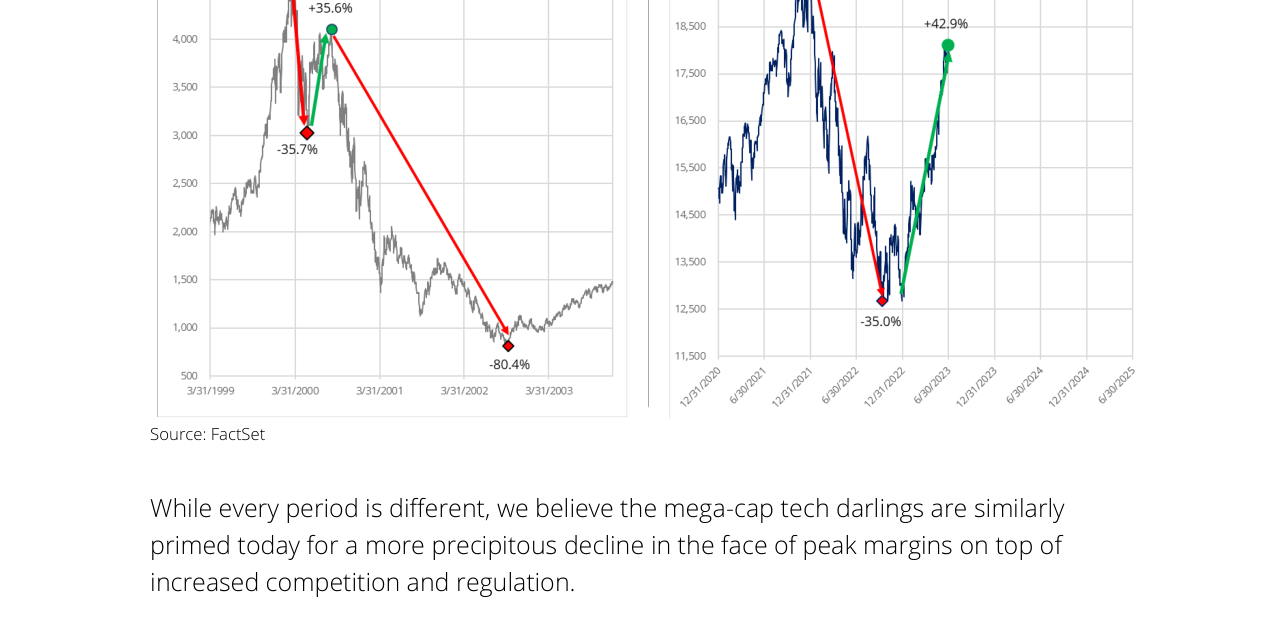
The NASDAQ 100 first rebounded 35.6% during the 2000-2002 bear market, then fell 80.4%
Companies/Assets Involved
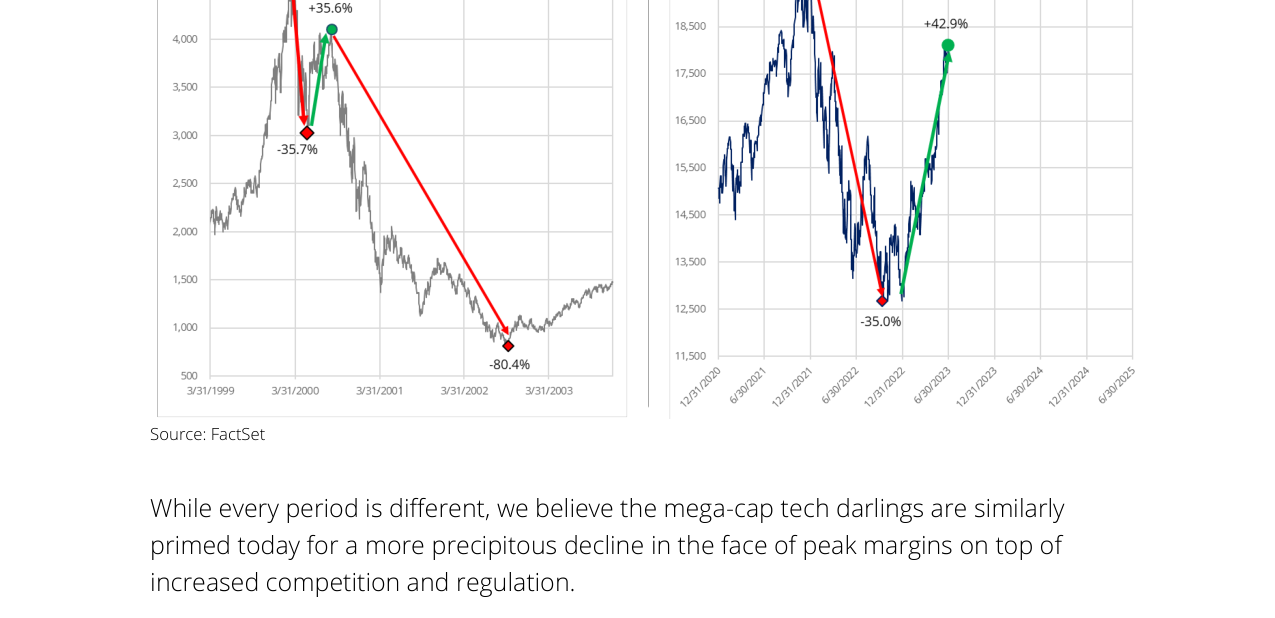
The NASDAQ 100 first fell 35.0% during 2020-2023, then rebounded 42.9%
| Company/Asset | Role/Key Data | Bullish/Bearish |
|---|---|---|
| Oscar Health | Health insurance and software platform; Q2 return +23%; new CEO Mark Bertolini brings operational expertise, compensation aligned with shareholder interests | Bullish |
| Liberty Braves Group | Owns the Atlanta Braves baseball team and surrounding real estate; Q2 return +17%; expected to spin off as an independent company in Q3, potentially triggering a price revaluation | Bullish |
| Anywhere Real Estate | Real estate brokerage franchisor; Q2 return +26%; benefiting from "green shoots" in the U.S. housing market, generating positive free cash flow even amid the current downturn | Bullish |
| Boston Beer Company | Beer brands (Samuel Adams, Twisted Tea, etc.); stock price exceeded $1,200 in 2020 before declining due to the fading "hard seltzer craze"; long-term compound growth rate in the double digits | Bullish (new position) |
| Lanxess | German specialty chemicals company; Q2 return -25%; due to a larger-than-expected profit warning, facing a triple hit from industry destocking, delayed Chinese demand, and operational cleanup costs | Bearish (liquidated) |
| Lumen | Telecommunications company; Q2 return -21%; new management failed to pursue monetization of consumer business, weak financial targets; equity liquidated but bonds purchased | Bearish on equity, Bullish on bonds |
| Vimeo | Video platform; COVID benefit misjudged, segment valuation too high; liquidated | Bearish (liquidated) |
| Kodak | Position exceeded the 6.5% cap at quarter-end; plan to gradually reduce | Neutral (position adjustment needed) |

Among the top five best-performing stocks in Q2, Oscar Health ranked first with a 23% return contributing 1.26%
Investment Implications

Among the five worst-performing stocks in Q2, Lanxess ranked first with a -25% return dragging -0.94%
- Beware of Mega-Cap Tech Bubble Risk: The author believes current mega-cap tech stocks face peak profit margins, competitive and regulatory pressures, similar to the early stages of the 2000 dot-com bubble, potentially leading to significant declines. Investors should avoid chasing these stocks and consider reducing exposure or hedging.
- Focus on Defensive Opportunities in Small- and Mid-Cap Value Stocks: The fund's holdings concentrate on companies with strong brands, stable cash flows, and pricing power (e.g., tortillas, beverages, insurance, sports), which are more resilient during economic downturns and trade at low valuations (P/V ratio in the mid-60% range), offering a margin of safety.
- Special Opportunities in the Bond Market: Lumen bonds, due to extremely depressed prices, are backed by hard assets (the company's estimated $150 billion replacement cost), implying a valuation of only 3x EBITDA, offering a superior risk-reward profile compared to equity. Investors can look for similar distressed bond opportunities.
- Tax Optimization Using Capital Losses: The fund has accumulated tax advantages from liquidating loss-making investments (e.g., Vimeo, Lumen), enabling future capital gains without generating distributions. Individual investors may also consider similar strategies, reallocating to assets with higher margins of safety after realizing losses.