2Q23 International Fund Commentary
Southeastern Asset Management is a Memphis-based deep-value firm founded in 1975 by O. Mason Hawkins to exploit the bargains left by the 1973-74 bear market. Its flagship Longleaf Partners Funds (launched 1987) invest employees' own money alongside clients'. Following Graham's discipline and its "Business, People, Price" framework, it runs concentrated books of 15-25 undervalued stocks held for the long term — famously closing funds to new investors when opportunities were scarce. CEO and Head of Research Ross Glotzbach now leads the firm, which publishes quarterly Longleaf fund commentaries and Research Perspectives notes.
In plain words
This fund commentary reviews a global fund’s 2023 first half: up 13.8% but lagging the index. The manager says China’s slow rebound (housing drag) hurt some holdings, but European businesses were strong, and management actions like buybacks (companies buying their own shares) and spin-offs (separating a business unit) added value without relying on the economy. For everyday investors: focus on companies with active managers, strong balance sheets, and prices well below true worth. The fund’s holdings trade at just over 60% of estimated intrinsic value, offering a solid safety margin.
The Longleaf Partners International Fund rose 1.35% in the second quarter of 2023, bringing its year-to-date return to 13.82%, outperforming the FTSE Developed ex-North America Index. The report's core argument: although the lack of exposure to the information technology sector and an overweight pos
Theme and Background
This chapter is the fund commentary for the Longleaf Partners International Fund for the second quarter of 2023. It primarily reviews the fund's performance during the quarter and the first half of the year, the drivers of its holdings, the market environment (notably the slow recovery of Chinese consumption and strong European operations), and portfolio adjustments. The report emphasizes that the fund does not rely on a recovery in the Chinese market but instead depends on the fundamental strength of individual companies and management actions to create value.
Core Views
- Fund Performance: The fund rose 1.35% in the second quarter, with a year-to-date (YTD) return of 13.82%, outperforming the FTSE Developed ex-North America Index (which had a YTD return of 11.39% for the first half).
- Counter-Intuitive Judgment: Despite the fund lacking exposure to the information technology sector and being overweight in Asian consumer discretionary stocks (which dragged on performance), strong operational and financial progress in European businesses drove positive returns. The author argues that the consumption recovery from China's reopening is insufficient to achieve the 5% growth target, but weak stock prices provide management with offensive opportunities (e.g., buybacks, spin-offs).
- Core Investment Thesis: The fund does not rely on a recovery in the Chinese market for relative returns; its holdings have strong balance sheets and pricing power, can consistently generate free cash flow, and are narrowing the gap between price and intrinsic value through buybacks, spin-offs, and other actions.
Key Arguments and Data
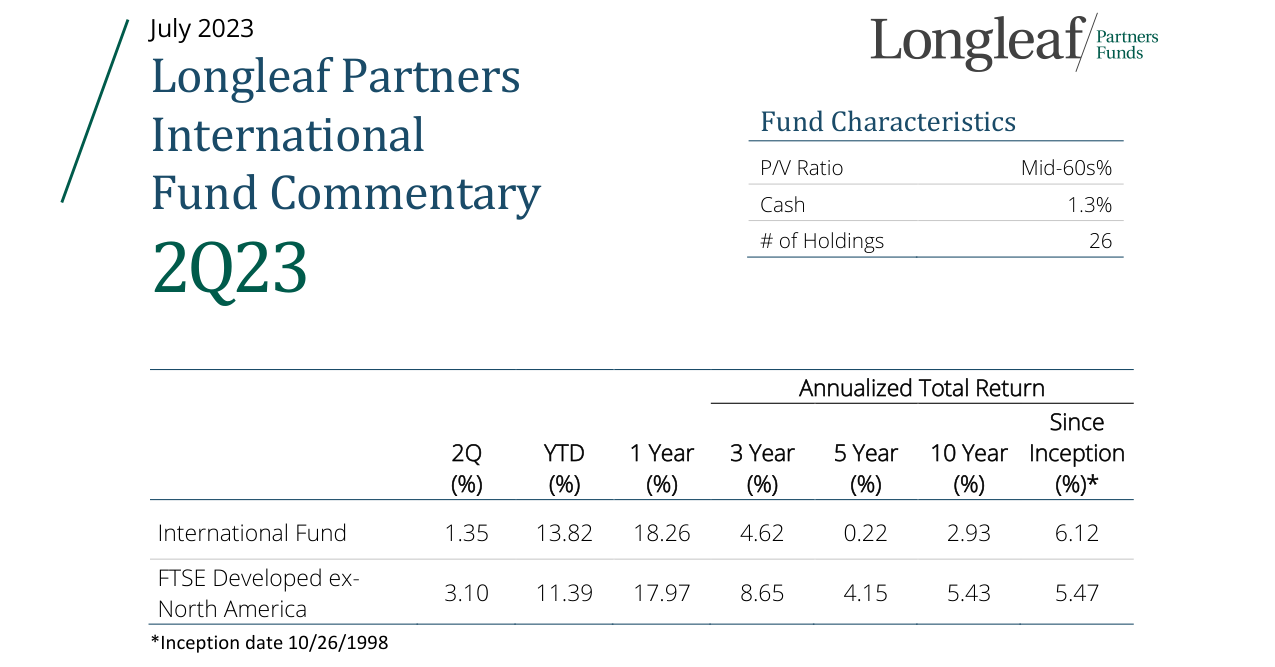
The fund holds 1.3% cash, 26 stocks, with a P/V ratio in the mid-60s%
- Chinese Real Estate Drag: 70% of Chinese household assets are exposed to real estate, and property sales are only 60% of pre-pandemic levels. The reopening is insufficient to meet the 5% growth target, but Beijing is expected to introduce policies to address this.
- Management Actions Creating Value:
- Alibaba: Repurchased $14 billion in stock over the past 14 months, with an additional $17 billion authorized, and plans to spin off into six businesses.
- Prosus: Simplified its cross-shareholding structure with Naspers and repurchased approximately 25% of its free float over the past 12 months.
- Strong European Operations: Most European companies delivered robust financial performance after a difficult 2022, with management creating value through capital allocation and strategic actions.
- Portfolio Valuation: The fund's overall P/V Ratio (Price/Intrinsic Value) is in the mid-60s% (i.e., stock prices are only slightly over 60% of intrinsic value), with a cash position of 1.3% and 26 stocks held.
Comparative Data Table:
| Metric | Fund | Index (FTSE Developed ex-North America) |
|---|---|---|
| 2Q Return | 1.35% | 3.10% |
| YTD Return | 13.82% | 11.39% |
| 1-Year Return | 18.26% | 17.97% |
| 3-Year Annualized Return | 4.62% | 8.65% |
| 5-Year Annualized Return | 0.22% | 4.15% |
| 10-Year Annualized Return | 2.93% | 5.43% |
| Since Inception Annualized Return | 6.12% | 5.47% |
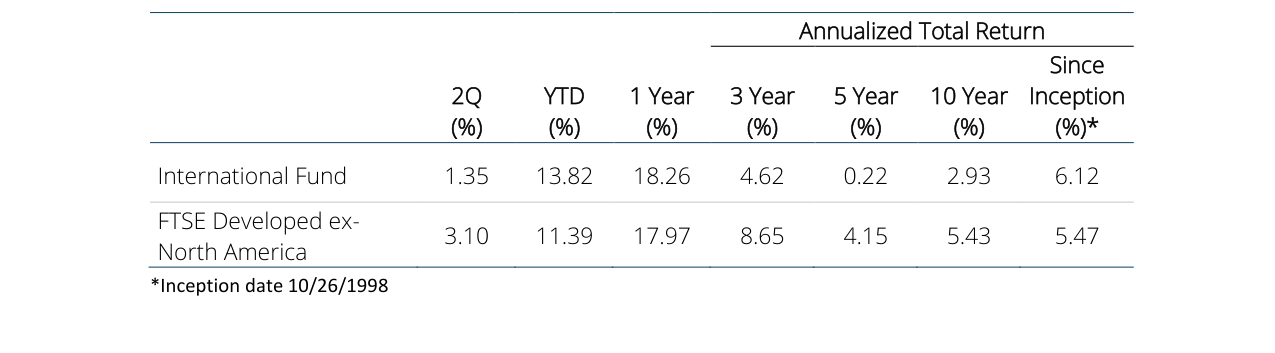
The International Fund returned 1.35% in Q2, 13.82% YTD, and 6.12% since inception, compared to the FTSE Developed ex-North America Index's 3.10%, 11.39%, and 5.47%, respectively
Top Five/Bottom Five Quarterly Contributors:
| Top Five Contributors | Contribution to Return (%) | Portfolio Weight (%) | Bottom Five Detractors | Contribution to Return (%) | Portfolio Weight (%) |
|---|---|---|---|---|---|
| Applus Services | 2.01 | 7.4 | LANXESS | -1.03 | 3.1 |
| Accor | 0.93 | 6.2 | Alibaba | -0.88 | 4.1 |
| Fairfax Financial | 0.49 | 4.5 | Melco International | -0.76 | 3.0 |
| EXOR | 0.47 | 5.1 | Millicom | -0.70 | 2.6 |
| GRUMA | 0.45 | 5.7 | Kering | -0.50 | 3.0 |

Among the top five contributors in Q2, Applus Services contributed 2.01% with a total return of 37%, and Accor contributed 0.93% with a total return of 17%
Companies/Assets Involved
- Applus Services (Spanish TIC company): Largest quarterly contributor (+37%). Apollo Global launched a $1.33 billion acquisition offer, with other PE interest. The author believes Apollo's bid undervalues the company, but PE interest highlights its strategic value. The company repurchased 10% of its market cap over the past year.
- Accor (French hotel operator): Strong quarterly performance (+17%). REVPAR has exceeded pre-pandemic levels. Management saved €200 million in structural costs during the pandemic and restructured into two segments—Luxury & Lifestyle and Midscale & Economy—disclosing financial data for each.
- LANXESS (German specialty chemicals): Largest quarterly detractor (-25%). A profit warning exceeded expectations, hit by industry destocking, delayed recovery in Chinese demand, and high energy costs last year. The author views the warning as a one-time cleanup, potentially leading to outperformance in the second half, but is more optimistic about demand normalization in the first half of 2024.
- Alibaba: Quarterly detractor (-18%). However, buybacks are active ($14 billion completed, $17 billion authorized), and it plans to spin off into six businesses to unlock value.
- Melco International (Macau gaming): Quarterly detractor (-20%).
- Millicom (Latin American telecom): Quarterly detractor (-20%).
- Kering (French luxury goods): Quarterly detractor (-14%).
- Fairfax Financial (Canadian insurance): Quarterly contributor (+12%).
- EXOR (Italian investment company): Quarterly contributor (+8%).
- GRUMA (Mexican corn flour company): Quarterly contributor (+9%).
- Man Wah (Chinese functional sofa manufacturer): New purchase. China's largest recliner sofa manufacturer with over 50% market share. Stock price dragged by weak real estate, but founder and CEO Man Li Wong holds over 60% of shares, continuously expanding market share and scale advantages. Dividend yield is 6%, and PE was only 8x at the time of buybacks.
- Kansai Paint (Japanese paint manufacturer): Increased position. Leading in Japan and India with oligopolistic pricing power.
- Gree (Chinese Gree Electric Appliances): Sold. Profit-taking after positive YTD performance driven by heatwaves in China.

Among the bottom five detractors in Q2, LANXESS dragged 1.03% with a total return of -25%, and Alibaba dragged 0.88% with a total return of -18%
Investment Implications
- Focus on Management Actions Over Macros: Against the backdrop of slow Chinese consumption recovery and persistent real estate weakness, the fund prioritizes companies that unlock value through buybacks, spin-offs, and strategic restructuring. Investors should favor companies with proactive management and strong balance sheets.
- European Operations as a Short-Term Driver: European companies have shown a strong rebound after a difficult 2022, with management enhancing value through cost cuts and business restructuring. Companies like Accor and Applus Services, with structural growth or asset revaluation potential, are worth attention.
- Caution on China Exposure: Although some China-related assets (e.g., Alibaba, Man Wah) are cheap with active management, real estate drag and slow consumption recovery remain key risks. The fund does not rely on a Chinese market recovery, and investors should assess their own risk tolerance.
- Valuation Margin of Safety: The fund's overall P/V Ratio is in the mid-60s%, indicating a significant discount of stock prices relative to intrinsic value. In a low-valuation environment, buybacks and spin-offs are important catalysts for value realization.