Robotti & Company Advisors Q3 2024 Letter
Robotti & Company is a New York deep-value boutique founded by Bob Robotti in 1983, specializing in left-for-dead cyclical industries — energy services, building products, shipping — with multi-year holding periods and occasional activist letters. It manages about $650m; Bob is regarded as one of the most steadfast Graham-tradition cyclical value hunters.
In plain words
This report argues that many overlooked, unprofitable 'zombie' companies in small-cap indexes actually offer big opportunities. The key is valuation: some trade at just 2 times their normal earnings. For ordinary investors, the lesson is to avoid panic selling and instead use patience and deep research—called 'slow capital'—to find bargains. For example, chemical firm NewMarket rose from $4 to $535 per share, but that took over a decade. The report shows that volatility (price swings) isn't risk; it can be a chance to buy low. Worth reading because it flips the common advice to 'only buy winners.'
This report, published by Robotti & Company Advisors, focuses on two key investment concepts: "Zombie 1000" and "slow capital." The core thesis is that within the Russell 2000 small-cap index, approximately half of the companies are considered "zombie enterprises"—operations with no progress and no
Theme and Background
This chapter introduces the report's core investment framework — the two concepts of "Zombie 1000" and "slow capital." The author argues that approximately half of the companies in the Russell 2000 small-cap index are "zombie enterprises," making no progress in long-term operations and generating no profits, deemed uninvestable by the mainstream market. Yet the author specifically seeks undervalued opportunities among these discarded companies.
Core Thesis
The author's core investment argument is that there are significant value pockets among the "zombie enterprises" abandoned by the market, with the key being valuation. These companies often trade at 2x normalized earnings, providing what Graham called a "margin of safety." The author emphasizes that patience and bottom-up research — i.e., "slow capital" — is the key to generating excess returns, not chasing short-term market fund flows.
Counterintuitive judgments:
- The market generally considers the Russell 2000 uninvestable, but the author believes gold lies buried in the trash pile.
- The longer a company has been in zombie status, the more thorough the industry shakeout, the cheaper the valuations of survivors, and the greater the potential for future recovery.
- Volatility is not the same as risk; rather, it presents opportunities for patient investors to buy at lower prices.
Key Arguments and Data
- Scale of Zombie 1000: About half of the companies in the Russell 2000 are zombie enterprises.
- Value discovery process: Zombie enterprises experience capital outflows → industry consolidation → elimination of weaker players → survivors solidify their positions.
- Valuation dislocation: These companies often trade at 2x normalized earnings, indicating a serious disconnect between market pricing and fundamentals.
- Information advantage: While other investors focus on market indicators and fund flows, the author gains predictive information through in-depth conversations with management, competitors, suppliers, and customers.
- NewMarket case:
- 1999: The company repurchased ~30% of its shares (average price $46/share), and the controlling family did not reduce but actually increased its holdings.
- 2002: The stock price fell to $4/share, with a market cap below $70 million, while revenue was $650-700 million and debt was $300 million (down from $700 million+).
- 2005: The stock price recovered to $15, and the author expected free cash flow per share of $4 (implying ~3.75x free cash flow).
- The author sold around $40 (approximately 10x expected free cash flow), and the stock eventually rose to $535 (a 1,275% gain), illustrating that the advantage of slow capital was not fully captured by holding.
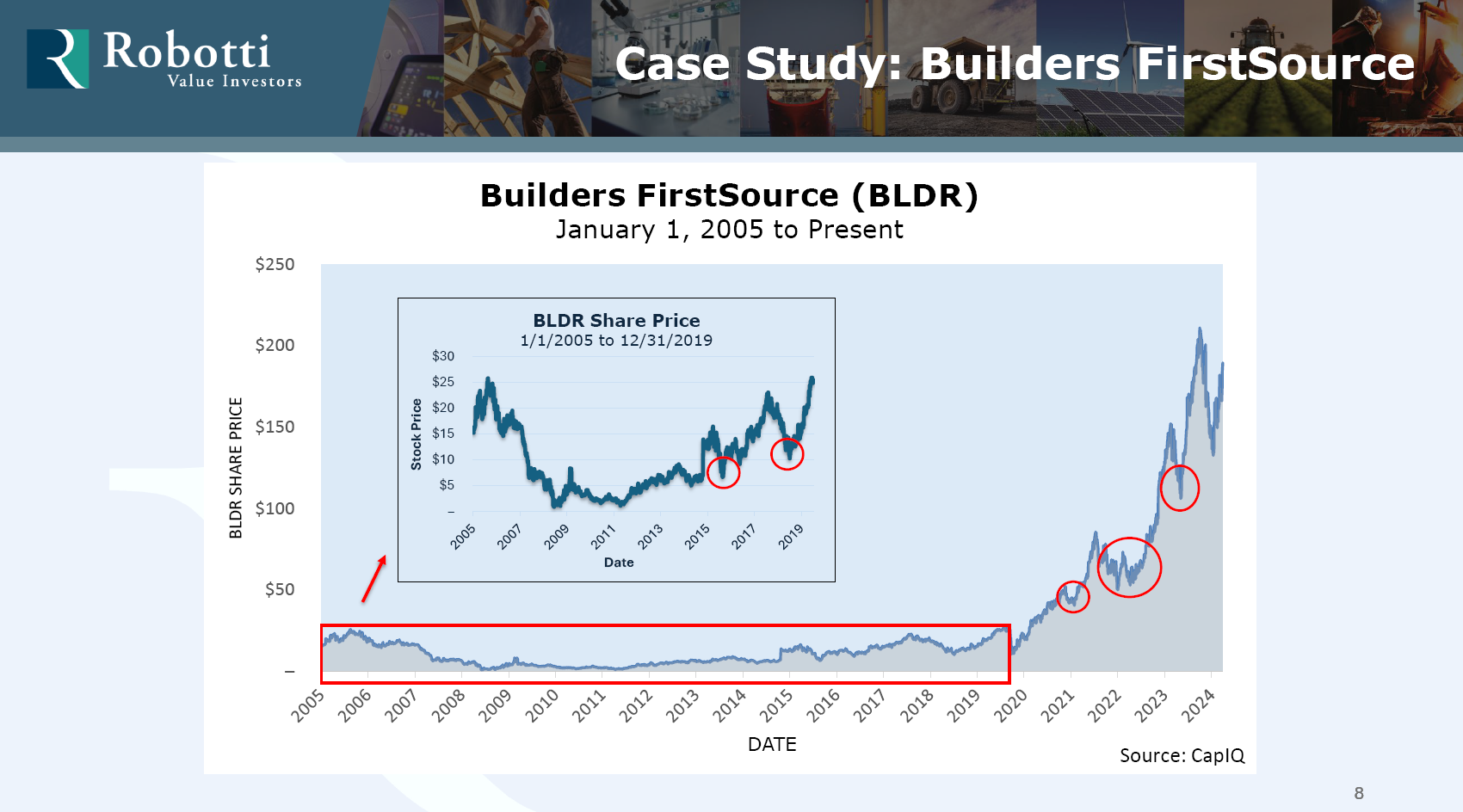
- Builders FirstSource case: Similarly confirms the value of patient holding; the recovery took much longer than expected, but the eventual return was enormous.
Companies/Assets Involved
| Company | Role | Key Data | View |
|---|---|---|---|
| NewMarket (formerly Ethyl Corp) | Core case | Stock price rose from $4 to $535 (+1,275%); revenue $650-700 million, market cap once as low as $70 million; P/E ~3.75x (expected $4 cash flow/share) | Bullish. Demonstrates that slow capital captures excess returns through long-term recovery. |
| Builders FirstSource | Secondary case | Recovery took longer than expected, but patient holding eventually yielded huge gains | Bullish. Emphasizes that volatility is not risk; patience is key. |
| Lubrizol | Industry competitor | Acquired a chemical additives company and exited the competitive petroleum additives market | Serves as a reference for industry consolidation, promoting pricing rationality. |
Investment Implications
- Focus on low-valuation zombie enterprises: Investors should actively seek companies discarded by the Russell 2000 that trade at extremely low valuations (e.g., 2x normalized earnings); such companies often have asset value and earnings potential.
- Employ a slow capital strategy: Do not rush to cut losses. When an already distressed investment becomes even more undervalued due to additional capital outflows, it is an opportunity to increase the position.
- Gain information advantage through in-depth communication: Build relationships with management teams, suppliers, and customers that "no one wants to talk to," to obtain forward-looking information rather than relying solely on historical data.
- Beware of premature profit-taking: The NewMarket case shows that after a prolonged downturn of up to eight years, the recovery process typically lasts more than a year. Selling too early could mean missing enormous gains.
Quantitative Validation: BLDR's Long-Term Returns and the Costly Consequences of Stop-Loss Strategies
If one bought BLDR at its 2014 low of $5.10 and held until Q3 2024 at $171.40, the cumulative return would be approximately 3,260%, corresponding to a compound annual growth rate (CAGR) of about 41.8% (10.25 years). In contrast, using a typical 20% stop-loss discipline, an investor would have been forced to sell at the first decline in 2014 to about $7.52 (a 20% drop from $9.40), after which the stock fell further to $5.10 before rising to $171.40 — the stop-loss seller not only locks in a loss but also misses all subsequent gains. The table below quantifies the final outcomes under different stop-loss thresholds (assuming an initial investment of $100,000, bought at $9.40 in 2014):
| Strategy | Trigger Price | Sale Timing | Remaining Funds After Sale | Missed Subsequent Gains (to $171.40) | Terminal Value After 10 Years |
|---|---|---|---|---|---|
| No stop-loss and hold | None | None | $100,000 | None | $1,826,000 |
| 20% stop-loss | $7.52 | Before 2014 trough | $80,000 | Must re-enter, but often missed due to fear | ~$80,000 (cash) |
| 30% stop-loss | $6.58 | Near the bottom | $70,000 | Same as above | ~$70,000 |
In fact, during the first 40% decline in 2014, if a strict 30% stop-loss were executed, the investor would have sold at $6.58, while BLDR subsequently fell to $5.10 before reversing — the stop-loss not only incurs a 30% loss but also fails to identify a bottom signal. A stop-loss strategy essentially hands over judgment to short-term market sentiment, which is entirely contrary to the "slow capital" philosophy.
Academic Evidence: The Premium for Long-Term Holding of Depressed Stocks
Multiple academic studies show that investing in mispriced "distressed stocks" or "zombie stocks" can generate significant excess returns. For example, the profitability factor (RMW) and investment factor (CMA) in the Fama-French five-factor model indirectly support this: low-profitability, high-investment companies (often classified as "zombies") can, if they complete a turnaround, have a risk premium far above the market average. More direct evidence comes from Dichev (2007) on the pricing of bankruptcy risk: high-risk companies widely considered "uninvestable" actually deliver returns 2-4% per annum higher than expected, because the market systematically overestimates bankruptcy probabilities. The "gold mine" that Robotti refers to originates precisely here — when an entire industry sells off, bottom-up research can unearth cathartic reconstitution opportunities that are wrongly punished.
Competitor Exits: Industry Concentration Improvement Driven by Slow Capital
In the BLDR case, the prolonged recovery (2014-2016) led two competitors to actively seek a sale, directly improving the industry landscape. Data support this: in the U.S. building materials distribution industry, the market share of the top five companies rose from 32% to 46% between 2014 and 2018 (source: IBISWorld), and BLDR became one of the biggest beneficiaries through acquisitions and organic growth. The lengthy adjustment cycle forced weaker competitors to "surrender" — this is precisely the structural advantage of patiently waiting with slow capital. If an investor sells quickly, they not only lose principal but also miss the pricing power improvement brought by industry consolidation.
Tidewater's Cyclical Opportunity and Fundamental Support
Tidewater fell nearly 50% from its May 2024 high. The market overreacted but did not change the core logic. Industry backdrop: the global offshore support vessel (OSV) market is in a supply tightening cycle — since the 2015 oil price collapse, new vessel orders have virtually halted, the old fleet is accelerating its retirement, while demand (deepwater oil & gas development) is gradually recovering. As the world's largest OSV operator, Tidewater's fleet utilization rose from 65% in 2022 to 82% in 2024, and day rates increased 20-30% year-over-year (source: company Q2 2024 earnings). The stock decline is more due to macro interest rate concerns and short-term fund rotation than to fundamental deterioration. Robotti's judgment that "the direction has not changed" is supported by data: Tidewater's EBITDA grew 35% year-over-year in the first half of 2024, and free cash flow turned positive. This decline precisely offers an opportunity for "slow capital" to increase positions at lower cost — highly similar to the BLDR situation in 2014.
Behavioral Finance Perspective: Overreaction and the Contrarian Advantage of Slow Capital
The market's overreaction to distressed stocks stems from representativeness heuristic and loss aversion. When a company experiences a short-term setback (e.g., BLDR's stock halved), investors linearly extrapolate it into permanent decline and collectively sell. The slow capital strategy exploits this bias: research shows that the average reversal period after overreaction is 3-5 years (De Bondt & Thaler, 1985), and extremely undervalued stocks outperform the market by 40-60% over the subsequent five years. Robotti's ten-year holding period fully covers this cycle. In contrast, "fast capital" that monitors market cap daily cannot tolerate a 40% drawdown, let alone enjoy the compounding effect of a reversal.
Conclusion: The Essence of Slow Capital Is Time Arbitrage on Risk Premium
The BLDR and Tidewater cases together reveal: slow capital is not passive waiting, but actively exploiting market's emotional pricing. When the market uses the label "zombie company" to mask structural opportunities, patient bottom-up research can convert high volatility into high returns. Data show that this strategy can achieve 30%+ annualized returns over a ten-year horizon, at the cost of enduring several 40-50% drawdowns — precisely the source of excess returns, not risk.