Robotti & Company Advisors Q2 2024 Letter
Robotti & Company is a New York deep-value boutique founded by Bob Robotti in 1983, specializing in left-for-dead cyclical industries — energy services, building products, shipping — with multi-year holding periods and occasional activist letters. It manages about $650m; Bob is regarded as one of the most steadfast Graham-tradition cyclical value hunters.
In plain words
This letter argues that markets are often irrational in the short term: fear and greed drive prices, not true value. Using steel industry takeovers, the author shows insiders pay far more than public markets suggest companies are worth. For regular investors, the takeaway is simple—don't panic during selloffs; instead, use them to buy solid, undervalued businesses with long-term advantages.
The Robotti research report discusses the contradiction between the market efficiency hypothesis and short-term emotional fluctuations. The core argument is that fear and greed (e.g., F.O.M.O.) drive short-term market volatility, while markets may be more efficient under long-term analysis. Taking e
Theme and Background
This chapter explores the tension between the market efficiency hypothesis and investors' short-term emotional fluctuations. The author uses the global market turmoil in early August 2024 (Japan's stock market plunging 12% in a single day, the VIX index recording its largest-ever increase, and the S&P 500 falling about 3% on the day) as a starting point, arguing that short-term markets are dominated by fear and greed (such as F.O.M.O., or "fear of missing out"), while over the long term, markets may return to rationality. The author believes that this short-term inefficiency precisely creates opportunities for analysts with sound judgment.
Core Arguments
- In the short run, the market is a voting machine; in the long run, it is a weighing machine: Short-term fluctuations are driven by emotions and fund flows (the "voting" mechanism), while long-term stock prices revert to intrinsic value (the "weighing" mechanism). Therefore, markets are often highly inefficient in the short term, especially during extreme fear or greed.
- Overvalued stocks can fall without reason, while undervalued stocks are often dragged down indiscriminately: During panic, the market pricing mechanism breaks down, and high-quality, undervalued assets also suffer indiscriminate selling, creating buying opportunities for contrarian investors.
- The steel industry is a classic case of market pricing inefficiency: The author demonstrates through acquisition premiums for U.S. and Canadian steel companies (e.g., Nippon Steel's 150% premium bid for U.S. Steel, Cleveland-Cliffs' 87% premium bid for Stelco) that public market pricing is far below the "true value" recognized by industry insiders.
Key Arguments and Data
- Market panic event in early August 2024:
- U.S. unemployment rate rose to its highest since October 2021, sparking recession fears.
- Japan's stock market plunged 12% in a single day, its biggest drop in 37 years.
- The VIX index recorded its largest single-day increase in history.
- Warren Buffett's Berkshire Hathaway sold more than half of its Apple stake (holdings fell from $174.3 billion to $84.2 billion).
- The S&P 500 fell about 3% on the day, with NVIDIA briefly down 15%.
- The next day, Japan's market rebounded over 10%, the S&P 500 recovered 1%, and panic quickly subsided.
- Steel industry acquisition premiums (comparative data):
| Transaction | Target Company | Pre-Acquisition Market Price | Acquisition Offer | Premium |
|---|---|---|---|---|
| Cleveland-Cliffs' initial bid for U.S. Steel | U.S. Steel | $22/share | $35/share (cash + stock) | ~59% |
| Nippon Steel's bid for U.S. Steel | U.S. Steel | ~$22/share | $55/share | 150% |
| Cleveland-Cliffs' acquisition of Stelco | Stelco | Not disclosed | $2.5 billion | 87% |
Data conclusion: Acquirers (industry insiders) are willing to pay 59%–150% above public market prices for steel assets, indicating a systematic mispricing of these companies by the public market. The author argues that even after the acquisition premiums, these companies' stock prices remain below their intrinsic value.
Companies/Assets Involved
- Insteel Industries, Inc. (IIIN): A company the author already holds, directly affected by changes in the steel industry and tariffs. The text does not specify a bullish or bearish stance but indicates the author's long-term tracking.
- ArcelorMittal S.A. (MT): A recent strategic investment by the author. Bullish. Reasons:
- Adopting a more environmentally friendly EAF (electric arc furnace) steelmaking method, aligning with industry trends.
- Attractive valuation.
- Fits the "ugly duckling" strategy: The company has recently faced one-time events (e.g., operational issues in Kazakhstan) and industry headwinds, but has significant future potential.
- Cleveland-Cliffs / U.S. Steel / Nippon Steel / Stelco: Used as case studies for acquirers or targets to demonstrate market pricing inefficiency. The author has no direct position in these but leans bullish on the overall value revaluation of the steel industry.
Investment Insights
- Buy undervalued assets during panic: The report explicitly states that when short-term markets are extremely volatile due to emotions and algorithmic trading, investors should "do nothing, unless it is to buy more of the undervalued stocks they like." History shows (e.g., after the 1987 "Black Monday," the market ended the year higher) that panic selling is a buying opportunity for long-term investors.
- Focus on asset revaluation logic: The author argues that industry insiders in traditional cyclical sectors like steel are willing to pay high premiums for acquisitions, indicating that public market pricing is undervalued. Investors should look for industries and companies where there is a "large gap between market pricing and industry insiders' perception of intrinsic value."
- Ignore short-term noise, focus on long-term fundamentals: The report advises investors to disregard short-term news amplified by media and algorithmic trading (e.g., a single month's unemployment rate, geopolitical rumors) and instead concentrate on 3-5 year enterprise value judgments.
- Allocate to contrarian "ugly duckling" stocks: Such as ArcelorMittal—companies currently facing short-term difficulties (one-time issues, industry headwinds) but with clear long-term competitive advantages and low valuations.
Unsustainability of Lumber Pricing: Core Data and Recovery Logic
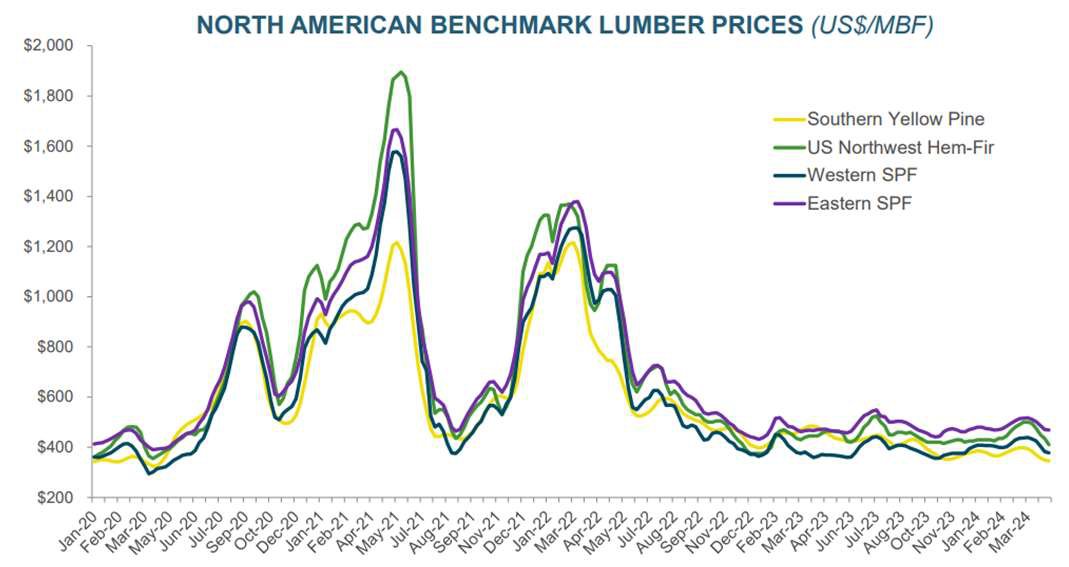
The letter clearly states that the current lumber price (~$350/thousand board feet) is below the industry breakeven point and has persisted for over a year. This price level forces even companies with the optimal cost structure and strongest balance sheet (such as Interfor) to incur losses, proving that the industry has entered a phase of irrational liquidation. Historical experience shows that when industry leaders cannot make a profit, supply-side capacity exits inevitably occur (e.g., bankruptcies of financially weaker competitors), pushing prices back toward equilibrium. The Robotti team estimates that a recovery to about $500/thousand board feet (still below pre-pandemic highs) would bring Interfor's annualized profit close to its current market capitalization—meaning that if prices normalize, the company could earn back its entire market cap in one year, highlighting the extreme undervaluation.
| Metric | Current Value | Equilibrium Value (Est.) | Recovery Magnitude |
|---|---|---|---|
| Lumber price ($/thousand board feet) | ~350 | ~500 | +43% |
| Corresponding Interfor annual profit (relative to market cap) | Loss or minimal profit | Close to current market cap | Multiple times growth |
Off-Balance Sheet Assets: Overlooked Tax Refund Leverage
The letter reveals a key detail in Interfor's balance sheet: The company has accumulated lumber tariffs of up to $570 million, but its books only show a liability of $160 million, with the difference being deposits (recoverable assets) held by the U.S. government. In extreme scenarios (e.g., selling the rights), these deposits can be cashed in at a 35% discount while retaining the right to claim additional recovery in the future. This means the company has approximately $410 million in hidden liquidity reserves ($570 million - $160 million), representing a very significant proportion of its current market cap. This information had not been analyzed before, showing that Robotti identifies the gap between accounting treatment and actual value, constituting one margin of safety.
Management and Field Research: Asset Quality Verification
The Robotti team not only relies on financial data but also used on-site inspections by colleague Mike DeRop of several of Interfor's southern mills to verify the company's asset quality and personnel caliber. In a downturn, companies can easily fall into an "asset desert," but Interfor's mills are located close to major timber-producing regions (e.g., the U.S. South, Canada), with well-maintained capital equipment, and management, after multiple meetings, was described as "savvy capital allocators." This "soft power" is particularly important in distressed investing—only management that can weather the downturn and seize opportunities can achieve the "rubber band bounce."
The Power of Compounding: The Contrarian Value of Price Declines
The conclusion distills the mathematical logic of distressed investing into: Buying at one-third of replacement cost, even if the price does not recover for five years, can still yield a compound annual return of 25%. More critically, price declines do not destroy intrinsic value but instead provide higher return potential for continued accumulation (dollar-cost averaging). Robotti candidly states: "I cannot recall a major investment that only went up after I bought it." This calm acceptance of short-term volatility is at the core of the strategy—turning the market's temporary irrationality into long-term certain returns.
Conclusion: Value Will Out
The letter concludes by citing "Value will out," emphasizing the eternal struggle between the market's voting machine (short-term emotions) and weighing machine (long-term value). For cases like Interfor, the current distress is "temporary," while fundamental factors such as replacement cost, necessity (North America still needs lumber), and management capability are the decisive variables. Robotti's strategy: Buy when price is below intrinsic value, use the distress period to add to positions, and wait for the "rubber band bounce" from industry consolidation and price recovery.