3Q25 Portfolio Activity & Attribution
Patient Capital Management is a Baltimore asset manager founded in 2020 by Samantha McLemore, CFA — Bill Miller's long-time co-manager (working together since 2002, running the flagship Opportunity Equity strategy since 2014). Continuing the Miller-school contrarian tradition, it practices "time arbitrage": exploiting behavioral mispricing to concentrate in controversial growth names (tech, healthcare, Bitcoin-related) at deep discounts to intrinsic value. Its site preserves Bill Miller's complete 1995-2022 market letters, alongside ongoing quarterly letters and webinars.
In plain words
This is a report on Patient Capital's investment fund for the third quarter of 2025. It returned 14.1%, beating the S&P 500's 8.1%. The key was buying unloved stocks like Google and Alibaba when sentiment was low, then benefiting from their AI-driven rallies. They also added to Delta Air Lines and UnitedHealth during temporary dips, which later recovered. The biggest losers were Dave & Buster's, QXO, and Crocs, but the manager believes these are just short-term setbacks and the stocks are cheap with long-term potential. For ordinary investors: it shows the value of buying quality companies when others are fearful, and being patient. It's worth reading for real-world examples of contrarian investing, like Precigen, a biotech stock that surged 194% after a new drug approval.
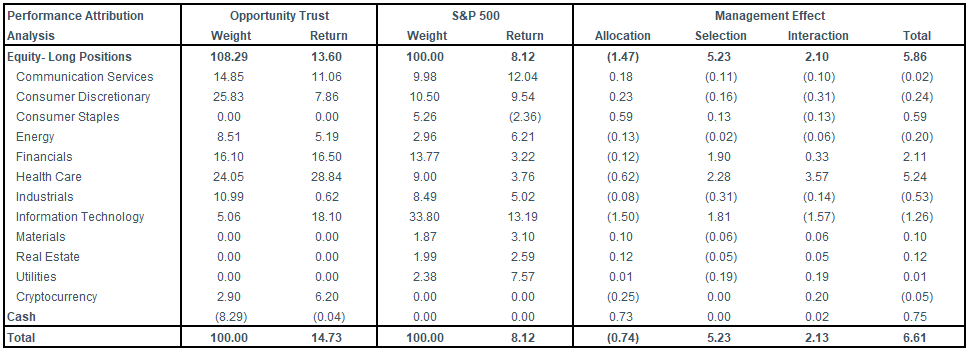
Patient Capital's Patient Opportunity Equity Strategy delivered a net return of 14.1% in the third quarter of 2025, outperforming the S&P 500 Index (8.1%). The excess return was primarily driven by stock selection and interaction effects, partially offset by allocation effects. The largest contribut
Theme and Background
This chapter focuses on the investment performance and operational logic of the Patient Opportunity Equity Strategy in the third quarter of 2025. The market continued its upward trend, driven by resilient consumer spending, Federal Reserve rate cuts, and sustained AI investment. The portfolio delivered a net return of 14.1%, significantly outperforming the S&P 500's 8.1%. The author highlights the value recovery process of long-held holdings after negative sentiment subsided.
Core Thesis
The author's core investment thesis is: Identify companies where fundamentals and market expectations are severely misaligned, build or add positions during periods of negative sentiment, and wait for value to revert. Counterintuitive judgments include:
- Alphabet and Alibaba, long viewed by the market as "uninvestable," became the top contributors after regulatory clarity and the announcement of AI investment plans.
- Using short-term volatility in travel-related stocks to significantly increase positions in Delta Air Lines and Norwegian Cruise Line, rather than avoiding them.
- Doubling down on UnitedHealth Group during its pullback, rather than reducing exposure.
Key Arguments and Data
- Performance Attribution: Excess returns came from stock selection effects and interaction effects, partially offset by allocation effects.
- Precigen (PGEN): The FDA approved Papzimeos in early August, with a label better than expected; the drug became the first "off-the-shelf" immunotherapy targeting RRP patients with no other treatment options. The stock is up 194% year-to-date, but the author believes there is still upside, given multiple promising pipeline assets.
- Alibaba (BABA): Up 58% in Q3. Cloud revenue grew 26% year-over-year, with AI-related product revenue achieving triple-digit growth for eight consecutive quarters; the company committed to investing over $50 billion over the next three years; the latest model, Qwen-3-Max, outperformed GPT-5 and Claude Opus 4. It also maintains a 1% dividend yield and a strong buyback program.
- Alphabet (GOOGL): Up 38% in Q3. Waymo expanded its market share and entered new cities; Gemini maintained its status as a top-tier AI model; YouTube dominated user time; the search antitrust case yielded a near-best outcome. Current valuation is 23x 2026 earnings, and excluding loss-making businesses, the core business valuation is below the market multiple.
- Portfolio Characteristics: 36 holdings at period end, with the top ten accounting for 51.1% of assets (index: 38.9%), and an active share of approximately 92.5%. Overweight in consumer discretionary, communication services, financials, energy, industrials, and healthcare; zero allocation to real estate, utilities, materials, and consumer staples.
Contribution and Detraction Comparison Table
| Top Contributors | Ticker | Net Contribution (bps) | Top Detractors | Ticker | Net Contribution (bps) |
|---|---|---|---|---|---|
| Precigen Convertible Preferreds | PGEN | 201 | Dave & Buster’s Entertainment | PLAY | -110 |
| Alphabet Inc. | GOOGL | 196 | QXO Inc. | QXO | -77 |
| Precigen Warrants | PGEN | 182 | Crocs Inc. | CROX | -45 |
| Alibaba Group Holdings | BABA | 140 | IAC Inc. | IAC | -29 |
| Precigen Inc. | PGEN | 120 | Mattel Inc. | MAT | -21 |
Companies/Assets Involved
- Precigen (PGEN): The top contributor, achieving leading returns through convertible preferreds and warrants. After FDA approval of Papzimeos, the convertible preferreds were converted into common stock, retaining significant exposure. CEO Dr. Helen Sabzevari has extensive experience in immunotherapy. Bullish.
- Alphabet (GOOGL): Held since 2020, contributed 196 bps in Q3. The antitrust case outcome was favorable, and the core business valuation is below the market multiple. Bullish.
- Alibaba (BABA): Held since 2019, contributed 140 bps in Q3. AI investment plan exceeds $50 billion, with leading positions in cloud and e-commerce. Bullish.
- Delta Air Lines (DAL): Significantly increased positions during the Q2 travel stock pullback, with strong performance in Q3. Bullish.
- Norwegian Cruise Line Holdings (NCLH): Also added positions during the Q2 pullback, contributing positive returns in Q3. Bullish.
- UnitedHealth Group (UNH): Doubled the position during the Q3 pullback, establishing a foundation for long-term returns. Bullish.
- Dave & Buster’s Entertainment (PLAY): The top detractor, with a net contribution of -110 bps. No specific reason provided.
- QXO Inc. (QXO): Detracted -77 bps. No specific reason provided.
- Crocs Inc. (CROX): Detracted -45 bps. No specific reason provided.
- IAC Inc. (IAC): Detracted -29 bps. No specific reason provided.
- Mattel Inc. (MAT): Detracted -21 bps. No specific reason provided.
- Exited Positions: Canada Goose (GOOS), Kosmos Energy (KOS) (to harvest tax losses); Precigen Convertible Preferreds (converted to common stock); Costco Put Option (COST 1/16/26 P965) (closed); Clear Secure (YOU) (small position exited).
Investment Insights
- Hold undervalued AI and tech leaders for the long term: Alphabet and Alibaba experienced value recovery after negative sentiment faded. Current valuations remain attractive, especially Alphabet's core business valuation, which is below the market multiple after excluding loss-making operations.
- Use volatility to add positions counter-cyclically: Travel stocks (Delta, Norwegian Cruise) and healthcare (UnitedHealth) present opportunities to add during short-term pullbacks, rather than to avoid.
- Monitor Precigen's upcoming catalysts: With Papzimeos on the market, the company is approaching self-sustainability. Early-stage pipeline assets (Phase 2 and Phase 1/1b) may replicate this success, though the high risk of drug development should be noted.
- Avoid short-term detractors: Dave & Buster’s, QXO, Crocs, IAC, and Mattel underperformed in Q3; their fundamental deterioration warrants attention.
Theme and Background
This chapter focuses on the three worst-performing holdings in the portfolio for the third quarter of 2025: Dave & Buster's Entertainment (PLAY), QXO Inc. (QXO), and Crocs Inc. (CROX). The report analyzes the specific reasons for each stock's short-term pressure, while emphasizing management's long-term transformation plans, industry consolidation strategies, or brand revitalization efforts, arguing that current valuations have already over-discounted negative factors.
Core Thesis
The author believes that the decline in these three stocks reflects short-term volatility rather than fundamental deterioration. Management is executing clear long-term strategies, and current valuations offer a significant margin of safety. The core judgment is: The market has overreacted to short-term negative news, underestimating management's execution capability and long-term value creation potential.
Counterintuitive judgments:
- For PLAY: Although same-store sales improvement is not linear, the new CEO aims to restore EBITDA to $675 million. The current valuation is only 5.6x EV/EBITDA, far below the historical average of 13.4x, leaving substantial room for valuation recovery.
- For QXO: The market is concerned about a slowdown in construction activity, but the company is executing a proven consolidation strategy, and management demonstrated price discipline in the GMS bidding process. The long-term target is annual revenue exceeding $50 billion.
- For CROX: The HEYDUDE brand continues to underperform, but the company has strong cash flow, a buyback program covering 25.6% of outstanding shares, and a favorable long-term risk-reward profile.
Key Arguments and Data
Dave & Buster's (PLAY)
- Disappointing 2024 results led to the abrupt departure of former CEO Chris Morris. The chairman served as interim CEO and implemented a "back-to-basics" strategy, with second-quarter same-store sales improvement driving a stock price increase.
- Third-quarter trends weakened again, but new CEO Tarun Lal (a 25+ year veteran of Yum! Brands) targets restoring EBITDA to $675 million.
- Current valuation of 5.6x EV/EBITDA versus a historical average of 13.4x, a gap of more than double.
QXO (QXO)
- Acquired Beacon Roofing in April, the first step in a consolidation plan for the building products distribution industry.
- Management voluntarily withdrew from the GMS bidding process (ultimately acquired by Home Depot), demonstrating price discipline.
- Long-term target: annual revenue exceeding $50 billion.
Crocs (CROX)
- Wholesalers are cutting orders, the company is reducing DTC promotions, and the HEYDUDE brand continues to perform poorly.
- New HEYDUDE President Terence Reilly previously successfully revitalized the Stanley brand.
- Buyback program covers 25.6% of outstanding shares.
| Company | Current Valuation Metric | Historical/Target Valuation | Gap |
|---|---|---|---|
| PLAY | 5.6x EV/EBITDA | 13.4x EV/EBITDA (historical average) | ~2.4x |
| QXO | Not disclosed | Target annual revenue >$50 billion | Long-term growth |
| CROX | Not disclosed | Buyback covers 25.6% of outstanding shares | Shareholder returns |
Companies/Assets Involved
- Dave & Buster's Entertainment (PLAY): Bullish. The new CEO has a Yum! Brands background, with an EBITDA target of $675 million, offering significant valuation recovery potential.
- QXO Inc. (QXO): Bullish. Management has a proven track record of successful integration and strong price discipline, with a long-term plan to consolidate the building products distribution industry.
- Crocs Inc. (CROX): Bullish. The HEYDUDE brand has potential for a turnaround under Reilly's leadership, and the buyback program provides downside protection.
- GMS Inc.: Mentioned as a case study of QXO management's price discipline (abandoned the bid, ultimately acquired by Home Depot).
Investment Implications
- For PLAY: Current valuations already reflect the most pessimistic expectations. If the transformation under the new CEO gains traction, a valuation recovery from 5.6x to 13.4x could generate significant excess returns. Investors should monitor same-store sales trends and EBITDA recovery progress.
- For QXO: A slowdown in construction activity is a macro risk, but the company's consolidation strategy and capital advantages make it more competitive during industry downturns. Long-term investors can focus on M&A execution and revenue growth milestones.
- For CROX: The HEYDUDE brand represents the greatest uncertainty, but the company's cash flow and buyback program provide a safety cushion. If Reilly successfully replicates his Stanley experience, there is substantial room for brand value revaluation. In the short term, investors need to wait for signs of a brand recovery.