“There is nothing so stable as change.” Bob Dylan
Patient Capital Management is a Baltimore asset manager founded in 2020 by Samantha McLemore, CFA — Bill Miller's long-time co-manager (working together since 2002, running the flagship Opportunity Equity strategy since 2014). Continuing the Miller-school contrarian tradition, it practices "time arbitrage": exploiting behavioral mispricing to concentrate in controversial growth names (tech, healthcare, Bitcoin-related) at deep discounts to intrinsic value. Its site preserves Bill Miller's complete 1995-2022 market letters, alongside ongoing quarterly letters and webinars.
In plain words
This annual letter reviews 2024—the stock market surged over 25% for two years straight, but the author warns not to expect a repeat. She predicts the S&P 500 will return only 6-8% annually over the next decade, much lower than the past. Sentiment has shifted from pessimism to optimism, raising risk. However, she sees overlooked opportunities: energy, healthcare, China assets, Bitcoin, and top AI stocks (like Google, Amazon, Meta, Nvidia). Avoid overpriced stocks like Costco (51x earnings). For ordinary investors: lower expectations, focus on cheap but strong companies, and be patient.
This report, authored by Kathleen Raine of Patient Capital, is themed around "Change," reviewing market performance in 2024 and offering a forward-looking perspective. The core argument is that change is inevitable. Although the S&P 500 delivered returns of over 25% for two consecutive years in 2023
Theme and Background
This chapter takes "change" as its theme, reviewing market performance in 2024 and looking ahead. The author notes that the S&P 500 has posted returns of 25%+ for two consecutive years (the first time since 1998), but change is inevitable, and investors should not expect a repeat. Market sentiment has shifted from the pessimism of late 2022 (predicting a decline in 2023) to the optimism of 2025 (forecasting an average return of 10.4%).
Core Views
- Market in mid-bull phase, but rising optimism increases risk: The author believes the market remains in a bull cycle, but sentiment is more optimistic than a year ago, raising the risk of fundamentals falling short of expectations. The best returns often occur in the late stages of a bull market, but caution is warranted against the "euphoria" phase.
- Contrarian judgment: The author disagrees with classifying Bitcoin, the Mag 7, and AI as "euphoric" assets. She argues that Bitcoin is still in its early lifecycle, the Mag 7's fundamentals (high ROIC, growth) support their valuation premiums, and the AI revolution provides structural advantages for large-cap tech companies.
Key Arguments and Data
1. Market sentiment shift:
- End of 2022: Strategists predicted a market decline in 2023 (the S&P 500 actually rose 26% that year).
- End of 2023: Strategists predicted a flat market in 2024 (the index again posted 25%+ returns).
- 2025 forecast: Average return of 10.4%, close to the long-term average.
- December 2023: ETFs recorded the largest monthly net outflows, put/call ratio >1, and the Citigroup Levkovich index remained negative.
- 2024: ETFs saw record annual net inflows, November was the best month on record, and the Levkovich index was in "greed" territory for several months.
2. Valuation changes:
- The S&P 500's forward 1-year P/E ratio rose from 19.7x a year ago to 21.7x (still below the 2000 peak of 25.2x).
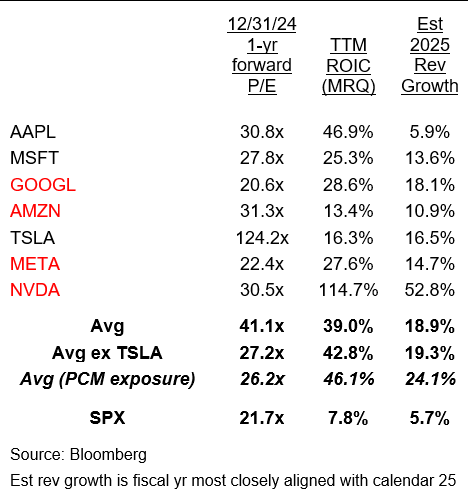
3. Mag 7 fundamentals (excluding Tesla):
- Average 2025 P/E of 27x, ROIC of 43%, and expected revenue growth of 19%.
- Valuation premium (25%) is far lower than the premium in ROIC, revenue growth, and free cash flow margin.
- The Mag 7 subset held by Patient Capital (GOOGL, AMZN, META, NVDA) has lower valuations and stronger fundamentals.
| Metric | Mag 7 (ex-TSLA) | Patient Capital Holdings |
|---|---|---|
| 2025 P/E | 27x | Lower |
| ROIC | 43% | Higher |
| Expected Revenue Growth | 19% | Higher |
4. Precigen case:
- Stock price rose 60% after a private placement (starting from $1.18).
- Expected to receive FDA approval this year for a respiratory papillomatosis therapy.
- The potential of the cell and gene therapy platform is not yet priced in; the transaction resolved cash needs, extending the runway to commercialization.
Companies/Assets Involved
- Precigen (PGEN $1.18): A cell and gene therapy company, the author is bullish. The stock rose 60% after a private placement and is expected to receive FDA approval this year. Platform IP is not yet priced in, and the cash issue has been resolved, reducing risk.
- OneMain Financial (OMF $52.46): In fall 2023, the author believed the stock priced in a recessionary earnings scenario, but a recession would bring further losses. Since the end of Q3 2023, the stock has returned 45%.
- Costco Wholesale (COST $927.37): The author considers its valuation excessive (51x P/E), meeting one of the conditions for "euphoria."
- Fidelity Wise Origin Bitcoin ETF (FBTC $82.02): The author is bullish, arguing that Bitcoin is still in its early lifecycle, with a historical 1-year gain of 127% similar to past cycles, and it will take years to form a medium-term top.
- Mag 7 subset (GOOGL, AMZN, META, NVDA): The author is bullish, believing that fundamentals (high ROIC, growth) support valuations and that the AI revolution provides structural advantages for these companies.
Investment Implications
- Beware of risks from rising optimism: Market sentiment has shifted from pessimism to optimism, increasing the risk of fundamentals falling short of expectations. Investors should monitor potential disruptors such as interest rates, inflation, and economic growth.
- Focus on structural growth areas: The AI revolution and Bitcoin are still in their early stages. Large-cap tech companies (Mag 7) and Bitcoin ETFs (e.g., FBTC) may offer long-term opportunities, but short-term volatility must be accepted.
- Avoid chasing "euphoric" assets: Quality compounders like Costco (51x P/E) are overvalued and warrant caution. Instead, focus on companies with strong fundamentals but reasonable valuations (e.g., the Mag 7 subset held by Patient Capital).
- Use market pullbacks to position: The current correction has partially digested optimism, offering better entry points for investors.
Theme & Background
This chapter discusses whether the market has entered a "Tech Bubble 2.0" phase and the adjustment logic for the Patient Capital portfolio in 2024. The author believes current market valuations are elevated but not yet frenzied, with a 10% correction more likely in 2025. The core backdrop is the S&P 500 posting 25%+ returns for two consecutive years, with the Mag 7 dominating the market, yet the author still sees numerous sectors priced with excessive pessimism.
Core Views
- Market Not at Bubble Peak: The author cites Howard Marks' assessment that the S&P 500's forward P/E is "high but not crazy," without extreme rhetoric like "no price is too high." However, a notable correction is highly probable in 2025 (most years see a 10% pullback).
- Contrarian Overweight in "Cyclical Value": Cyclical value stocks account for 48% of the portfolio (down 20% over the past year). The author argues that the market's pricing of cyclical risks is overly pessimistic, which in turn creates opportunities.
- Active Addition to Laggard Sectors: Healthcare, energy, and Chinese assets significantly underperformed the market in 2024, but the author believes these sectors offer the largest discounts to intrinsic value.
Key Arguments & Data
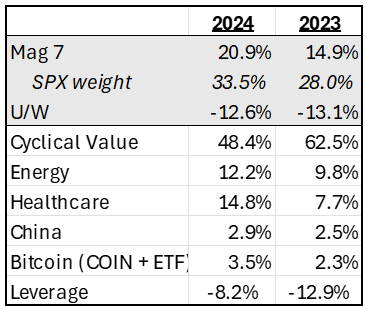
1. Portfolio Structure Changes (End of 2023 → End of 2024)
| Metric | Change | Explanation |
|---|---|---|
| Mag 7 Exposure | 20.9% (Increased) | Primarily due to buying Nvidia in January 2024, partly from market cap appreciation |
| Relative Market Underweight | -12.6% (Narrowed) | Underweight degree moderately reduced |
| Cyclical Value Exposure | 48% (Down 20%) | Reduced due to price appreciation, proceeds rotated into more undervalued names |
| Leverage Ratio | Down 36% | Actively deleveraged as market conditions normalized |
2. Energy Sector Valuation Case
| Company | Current Price | Author's Estimated Intrinsic Value | Discount |
|---|---|---|---|
| Kosmos Energy (KOS) | $3.75 | 3x Current Price | 66%+ |
| Seadrill (SDRL) | $37.80 | 2x Current Price | 50% |
The author uses a mid-cycle WTI oil price assumption of $60-65/bbl, arguing that current market fears of an oil supply glut are overblown.
3. Healthcare Sector Valuation Case
| Company | Current Price | Key Valuation Metric | Author's View |
|---|---|---|---|
| Royalty Pharma (RPRX) | $26.20 | 5.9x 2025 P/E, 3.3% Dividend Yield | Expects high-single-digit to low-double-digit EPS growth, potential for increased buybacks |
| CVS Health (CVS) | $46.01 | 5.8% Dividend Yield | Expects mid-teens annualized returns over the next several years |
| Biogen (BIIB) | $150.75 | Below Value of Existing Drugs | Intrinsic value is over 2x current price; Alzheimer's and pipeline value not priced in |
4. Travel Sector Reversal Case
In Q4 2024, after the market reassessed recession probabilities, travel stocks in the portfolio (EXPE, UAL, NCLH, DAL) rose an average of 35%, while the S&P 500 gained only 2%. Full-year returns were 60% and 25%, respectively.
5. Ten-Year Performance Review (Patient Strategy)
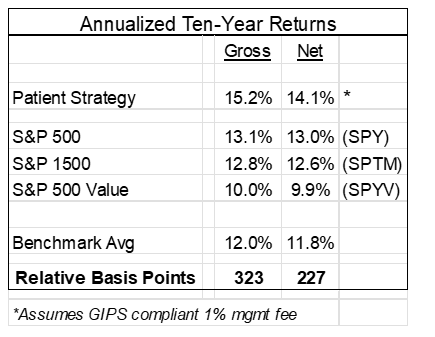
- Annualized Return: Gross 15.2%, Net 14.1% (assuming 1% management fee)
- Excess Return vs. S&P 500: Approximately 100bps/year
- Excess Return vs. Blended Benchmark (S&P 500/S&P 1500/S&P 500 Value): +227bps
- Biggest Regret: Poor performance during the 2021-2022 bear market; risk monitoring mechanisms have been improved.
Companies/Assets Covered
| Company | Role | Key Data | View |
|---|---|---|---|
| Nvidia | Primary driver of Mag 7 exposure increase | Bought in January 2024 | Not explicitly bullish/bearish, but acknowledges its dominant position |
| Dave & Buster's (PLAY) | Cyclical value rotation target | $29.38 | Excessively punished by the market; author believes it is more undervalued |
| Kosmos Energy (KOS) | Core energy holding | $3.75, 3x intrinsic value | Bullish, expects significant free cash flow growth in 2025 |
| Seadrill (SDRL) | Core energy holding | $37.80, 2x intrinsic value | Bullish, views it as an acquisition target |
| Royalty Pharma (RPRX) | Core healthcare holding | $26.20, 5.9x P/E, 3.3% dividend yield | Bullish, expects high-single-digit to low-double-digit EPS growth |
| CVS Health (CVS) | Core healthcare holding | $46.01, 5.8% dividend yield | Bullish, Aetna underwriting issues are fixable, expects mid-teens annualized returns |
| Biogen (BIIB) | Core healthcare holding | $150.75, below value of existing drugs | Bullish, intrinsic value over 2x, Alzheimer's and pipeline overlooked |
| Expedia (EXPE) | Travel sector | $182.62 | Bullish, up 35% in Q4 |
| United Airlines (UAL) | Travel sector | $103.72 | Bullish, up 35% in Q4 |
| Norwegian Cruise (NCLH) | Travel sector | $25.92 | Bullish, up 35% in Q4 |
| Delta Air Lines (DAL) | Travel sector | $61.42 | Bullish, up 35% in Q4 |
Investment Implications
1. Do Not Bet on an Immediate Bubble Burst: While valuations are high, they are not at extreme levels. 2025 is more likely to see a 10% correction than a crash. Investors should maintain some portfolio flexibility but need not retreat entirely.
2. Systematic Undervaluation Opportunity in Cyclical Value: The market often prices cyclical risks too pessimistically. The author's $60-65/bbl oil price assumption for energy companies suggests 200%-300% upside for KOS and SDRL. Investors can look for similar cyclical stocks that have been abandoned by the market.
3. Healthcare Offers a Blend of Defense and Value: RPRX (5.9x P/E), CVS (5.8% dividend yield), and BIIB (below drug value) are all at historical lows with catalysts (buybacks, new CEO, Alzheimer's pipeline). These names can provide downside protection during a market correction.
4. Patience is a Core Competency: The travel sector case shows that fundamentally strong but overlooked names can deliver 35% quarterly gains once expectations reset. Investors should avoid chasing short-term trends and instead position in pessimistically priced assets and wait.
Theme and Background
This chapter is the third part of Patient Capital’s 2024 annual letter. After reviewing 2024 performance, author Kathleen Raine shifts to summarizing investment philosophy, future market return expectations, and long-term strategy. The core backdrop is that the Opportunity Equity Strategy outperformed the S&P 500 in 2024 with a 26.5% return versus 25.0%. The author reaffirms her value-oriented investment framework and, based on the current high-valuation environment, makes conservative projections for the next decade.
Core Views
- Market returns over the next decade will be significantly lower than the past decade: The author estimates the S&P 500’s annualized return at just 6–8%, far below the level of the past decade. This is a contrarian view, as current market sentiment (early 2025) has shifted from pessimism at the end of 2022 to optimism.
- Value style will outperform growth style: Although value funds overall lagged growth funds in 2024, the author believes that in an environment of higher valuations and more optimistic sentiment, value investing will deliver relatively better performance.
- Investment philosophy remains unchanged, but flexibility is required: The core framework (fundamental analysis, market expectation gaps, seeking opportunities others overlook) is constant, but it must adapt to ongoing change.
Key Arguments and Data
- Performance comparison: The author notes that the Opportunity Equity Strategy outperformed all value funds it tracked in 2024 and competed with some growth funds (though lagging a few). This demonstrates the competitiveness of its value-oriented strategy in a specific environment.
- Future return estimates: The author explicitly estimates the S&P 500’s annualized return over the next decade at 6–8%, while the current strategy target is to achieve “mid-teens” (approximately 14–16%) annualized returns. The author acknowledges this is a “tall order,” implying significant difficulty in achieving it.
- Valuation and sentiment backdrop: Current valuations and investor sentiment are both higher than a decade ago, which is the core reason for compressing expected future returns. This contrasts sharply with the pessimism at the end of 2022 (when the market predicted a decline in 2023).
Comparison data (inferred from chapter content):
| Metric | Past Decade (approx. 2015–2024) | Next Decade (approx. 2025–2034) |
|---|---|---|
| S&P 500 annualized return (estimate) | Significantly above 6–8% (actual ~13–15%) | 6–8% |
| Market valuation level | Lower | Higher |
| Investor sentiment | Extremely pessimistic at end of 2022 | Optimistic in early 2025 (average return forecast 10.4%) |
| Value vs. growth relative performance | Value lagged | Value should be relatively better |
Companies/Assets Involved
This chapter does not mention specific companies or assets. The author focuses on strategy-level summary and outlook, without discussing individual stock holdings.
Investment Implications
- Lower future return expectations: Investors should not view the S&P 500’s consecutive 25%+ returns in 2023–2024 as the norm. Over the next decade, the expected annualized return for large-cap U.S. stocks should be revised down to 6–8%.
- Value style may gain relative advantage: In an environment of high valuations and optimistic sentiment, further upside for growth stocks is limited, while value stocks (especially overlooked small/mid-cap or deep-value names) may generate excess returns. Investors may consider increasing allocation to the value factor.
- Adhere to disciplined fundamental analysis: The author emphasizes that market inefficiencies caused by human and institutional behavior are permanent. Rigorous, expectation-based fundamental analysis, combined with flexibility, is key to long-term outperformance. Investors should avoid chasing short-term fads and focus on finding market expectation gaps.