2Q25 Portfolio Activity and Attribution
Patient Capital Management is a Baltimore asset manager founded in 2020 by Samantha McLemore, CFA — Bill Miller's long-time co-manager (working together since 2002, running the flagship Opportunity Equity strategy since 2014). Continuing the Miller-school contrarian tradition, it practices "time arbitrage": exploiting behavioral mispricing to concentrate in controversial growth names (tech, healthcare, Bitcoin-related) at deep discounts to intrinsic value. Its site preserves Bill Miller's complete 1995-2022 market letters, alongside ongoing quarterly letters and webinars.
In plain words
This review covers how a fund navigated the 2025 second quarter, a period where markets first dropped then recovered. By picking specific stocks—like beaten-down UnitedHealth and offshore drillers—they beat the index. For everyday investors, the takeaway is that market fear can create bargains: look for companies with high free cash flow yield (cash generated relative to share price) and insider buying. It's worth reading to see how professionals hunt for value when others panic.
Patient Capital's Patient Opportunity Equity Strategy delivered a net return of 15.3% in the second quarter of 2025, outperforming the S&P 500 Index (10.9%). Core view: The market experienced a V-shaped rebound, and the portfolio generated excess returns through selective stock picking. Major contri
Theme and Background
This chapter reviews the performance and portfolio adjustments of the Patient Opportunity Equity Strategy in the second quarter of 2025. The market experienced a V-shaped rebound, recovering from a sharp decline at the start of the quarter, with the S&P 500 Index rising 10.9%, while the strategy outperformed the benchmark with a net return of 15.3%.
Core Thesis
The author’s core investment thesis is to capitalize on dislocation opportunities created by market declines by adding to severely undervalued cyclical stocks, while maintaining a long-term bullish view on the healthcare and energy sectors. The counterintuitive judgment is that, despite the overall market rebound, the author believes the recovery of certain cyclical and energy stocks has yet to fully reflect their intrinsic value, particularly in offshore drilling and liquefied natural gas projects.
Key Arguments and Data
- Performance: The strategy delivered a net return of 15.3%, outperforming the S&P 500 Index (10.9%). Excess returns were primarily driven by the selection effect, partially offset by the allocation effect and interaction effect.
- Market Context: Within the quarter, the market rebounded 30% from trough to peak and surpassed the all-time high set in February. Early concerns over tariff policies gradually subsided.
- Portfolio Concentration: At period end, the portfolio held 41 positions, with the top ten stocks accounting for 51.0% of assets (compared to 36.6% for the index), and an active share of approximately 93.6%.
- Energy Sector Key Data:
- Kosmos Energy (KOS): The author expects that from 2025 to 2029, once its Tortue LNG project reaches full production, the free cash flow generated will exceed more than twice the current market capitalization.
- Noble Corporation (NE): The 2025 guidance is fully backed by contract backlog; management has committed to returning 100% of free cash flow to shareholders, including a 7% dividend yield and an 8% share buyback.
- Healthcare Sector Key Data:
- UnitedHealth Group (UNH): The stock price has fallen over 50% from its 2025 high, hitting multi-year lows. Insider buying: former CEO Stephen Hemsley purchased $25 million, and CFO John Rex bought $5 million. The company has an $8.4 billion buyback authorization (approximately 3% of shares) and a free cash flow yield of 10%. Management is confident in a long-term compound annual earnings per share growth rate of 13-16%.
- Other Data:
- Tempus AI (TEM): Expected to generate over $1 billion in revenue within its first decade and is on track to achieve EBITDA profitability this year.
Companies/Assets Involved
| Company/Asset | Role | Key Data | Bullish/Bearish |
|---|---|---|---|
| QXO Inc. (QXO) | Top Contributor | No specific data provided | Bullish |
| Coinbase Global Inc. (COIN) | Top Contributor | Benefited from the GENIUS Act and strategic Bitcoin reserves | Bullish |
| Nvidia Corp. (NVDA) | Top Contributor | Closed bullish call spreads | Neutral (partially exited) |
| Dave & Buster’s Entertainment (PLAY) | Top Contributor | Benefited from better-than-expected earnings and consumer resilience | Bullish |
| Meta Platforms Inc. (META) | Top Contributor | No specific data provided | Bullish |
| New Fortress Energy Inc. (NFE) | Top Detractor | Position liquidated | Bearish (exited) |
| Kosmos Energy Ltd (KOS) | Top Detractor | Expected free cash flow from 2025-2029 to exceed twice current market cap | Bullish |
| Alibaba Group Holdings (BABA) | Top Detractor | No specific data provided | Bearish (short-term) |
| JD.com (JD) | Top Detractor | No specific data provided | Bearish (short-term) |
| Biogen Inc. (BIIB) | Top Detractor | No specific data provided | Bearish (short-term) |
| Noble Corporation (NE) | New Position | 7% dividend yield, 8% buyback, 100% free cash flow return | Bullish |
| Tempus AI Inc. (TEM) | New Position | Expected to exceed $1 billion revenue in first decade, EBITDA profitable this year | Bullish |
| UnitedHealth Group Inc. (UNH) | New Position | Stock down over 50%, insider purchases of $30 million, 10% free cash flow yield | Bullish |
| Clear Secure (YOU) | New Position | No specific data provided | Bullish |
| Costco Put Options (COST 1/16/26 P960) | New Position | Put options, betting on stock price decline | Bearish |
| Seadrill Limited (SDRL) | Added Position | Benefited from improving offshore drilling supply-demand dynamics | Bullish |
| Canada Goose Holdings Inc. (GOOS) | Held Position | Benefited from better-than-expected earnings and consumer resilience | Bullish |
Investment Implications
- Energy Sector: Investors should focus on offshore drilling and LNG projects, such as Seadrill (SDRL) and Noble (NE), benefiting from slowing onshore production growth, tight offshore rig supply (nearly half of deepwater rigs have been scrapped over the past decade), and industry consolidation (major players reduced to four). Kosmos (KOS)’s Tortue LNG project is approaching a capacity inflection point, expected to generate significant free cash flow growth.
- Healthcare Sector: UnitedHealth (UNH), after a sharp stock price decline, offers an opportunity to buy a high-quality compounder at a reasonable valuation, with insider buying and a strong free cash flow yield (10%) as positive signals. Tempus AI (TEM) represents a disruptive opportunity for AI in medical diagnostics, and despite being in early stages, its revenue growth and path to profitability are clear.
- Consumer and Technology: The rebound of stocks like Dave & Buster’s (PLAY) and Canada Goose (GOOS) suggests that companies with unique catalysts can still outperform amid macro uncertainty. Coinbase (COIN) benefits from a more favorable regulatory environment, but policy execution risks should be noted.
- Risk Warnings: The portfolio expresses caution toward certain consumer stocks through the purchase of Costco put options (COST Put), implying that the market rebound may be uneven and that investors should be wary of overvalued individual stocks.
Theme and Background
This section primarily discusses Patient Capital's portfolio additions, exits, and adjustments in the second quarter of 2025, along with a detailed analysis of the performance and logic behind the top five contributors and detractors for the quarter. The market backdrop includes improvements in the cryptocurrency regulatory environment, sustained surges in AI demand, and volatility stemming from US-China trade frictions.
Core Views
The author argues that the current market harbors a risk of "overpriced compounders," citing Costco as an example, where a 54x price-to-earnings ratio does not align with single-digit growth, and expects a valuation correction. Meanwhile, the author is bullish on Clear Secure, highlighting its high free cash flow yield and low debt structure, and sees long-term opportunities for expansion into healthcare and finance. For Kosmos Energy, the author believes it is at a production inflection point, with its current market cap severely undervalued and potential as an acquisition target in industry consolidation.
Key Arguments and Data
- Costco: P/E ratio of 54x, but growth rate is only mid-single digits, with valuation exceeding the market average by more than double. The author believes the market will eventually reassess its premium.
- Clear Secure: Free cash flow yield exceeds 10%, no debt, record earnings, improving margins, excellent management, and ongoing share buybacks.
- QXO: Completed the $11 billion acquisition of Beacon Roofing, targeting annual revenue exceeding $50 billion over the next decade. Management has demonstrated strong price discipline (abandoning the bid for GMS).
- Kosmos Energy: The Tortue LNG project is ramping up production, with projected free cash flow from 2025 to 2029 nearly double its current market cap (based on current commodity prices). However, performance in 2025 has been weak due to production delays and cost overruns.
- Alibaba: P/E ratio of only 11.2x, dividend yield of 1%, and ongoing buybacks. The author believes its valuation is far below the sum of its parts.
Top Contributors and Detractors
| Type | Company | Ticker | Net Contribution (bps) |
|---|---|---|---|
| Contributor | QXO Inc. | QXO | 287 |
| Contributor | Coinbase Global Inc. | COIN | 235 |
| Contributor | Nvidia Corp. | NVDA | 184 |
| Contributor | Dave & Buster’s Entertainment Inc. | PLAY | 150 |
| Contributor | Meta Platforms Inc. | META | 137 |
| Detractor | New Fortress Energy Inc. | NFE | -107 |
| Detractor | Kosmos Energy Ltd. | KOS | -63 |
| Detractor | Alibaba Group Holdings Ltd. | BABA | -49 |
| Detractor | JD.com Inc. | JD | -40 |
| Detractor | Biogen Inc. | BIIB | -38 |
Companies/Assets Involved
- Costco Wholesale Corporation (COST): The author is bearish, having purchased put options expiring in January 2026 (strike price $960), citing excessive valuation.
- Clear Secure Inc. (YOU): The author is bullish, newly added, citing advantages such as high free cash flow yield, no debt, record earnings, and long-term expansion potential into healthcare and finance.
- Carvana Co. (CVNA): The author exited the position without specifying reasons, as part of capital reallocation.
- Nvidia Corp. (NVDA): The author closed a call spread (expiring September 19, strike price $118), but remains overall bullish, viewing it as the GPU leader benefiting from AI demand and expanding into robotics, edge AI, and other areas.
- New Fortress Energy Inc. (NFE): The author exited the position due to deteriorating fundamentals, balance sheet pressure, delayed 10-K filing, and expressed "substantial doubt about going concern."
- QXO Inc. (QXO): The author is bullish, the top contributor for the quarter, having completed an $11 billion acquisition with a target of annual revenue exceeding $50 billion, and disciplined management.
- Coinbase Global Inc. (COIN): The author is bullish, benefiting from the Bitcoin and crypto market rebound, as well as positive developments under the Trump administration, including the GENIUS Act and the establishment of a strategic Bitcoin reserve.
- Kosmos Energy Ltd. (KOS): The author is bullish, despite short-term underperformance, as the Tortue LNG project ramp-up is expected to drive significant free cash flow growth, viewing it as undervalued and a potential acquisition target.
- Alibaba Group Holdings (BABA): The author is bullish, though impacted by tariffs, fundamentals are improving with AI acceleration, Tmall recovery, and instant shopping growth. With a P/E ratio of only 11.2x, it is significantly undervalued.
Investment Insights
- Short high-valuation, low-growth stocks: For stocks like Costco with a 54x P/E ratio but only mid-single-digit growth, consider buying long-dated put options to bet on valuation normalization.
- Focus on hidden champions with high cash flow and low debt: Clear Secure, with a 10% free cash flow yield, no debt, and buybacks, has expansion potential in healthcare and financial identity verification, making it worth holding long-term.
- Production inflection opportunities in the energy sector: Kosmos Energy's Tortue LNG project is about to ramp up, with massive free cash flow potential (nearly double its market cap from 2025 to 2029). The current depressed valuation may offer a buying window, and industry consolidation trends could make it an acquisition target.
- Avoid companies with deteriorating balance sheets: New Fortress Energy was exited due to worsening fundamentals, high debt, and liquidity risks. Investors should be wary of similar companies.
Theme and Background
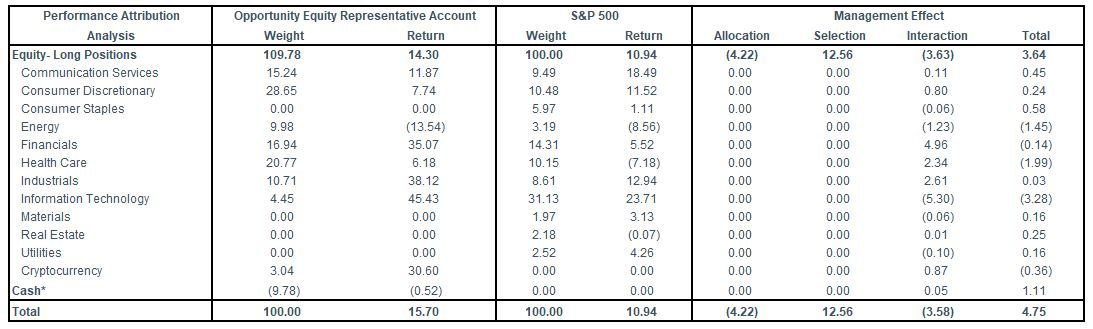
This chapter provides a detailed breakdown of the sources of excess returns for the Patient Capital Opportunity Equity strategy in the second quarter of 2025. Through attribution analysis, the report decomposes the portfolio's 4.4% excess return over the S&P 500 index into sector allocation effects, stock selection effects, and interaction effects, aiming to evaluate the fund manager's decision-making capabilities across different dimensions.
Core Viewpoint
The author's core judgment is that the portfolio's excess return primarily stems from stock selection (Selection Effect), rather than sector allocation (Allocation Effect). This validates the strategy's bottom-up, stock-picking investment philosophy. The report specifically notes that the calculation methodology of the attribution software may lead to counterintuitive results for the sector allocation effect during specific periods (especially over longer timeframes). For example, even if the portfolio overweights a sector that performs well, the software may still calculate a negative sector allocation effect.
Key Arguments and Data
- Overall Performance: Portfolio net return of 15.3%, S&P 500 index return of 10.9%, excess return of 4.4%.
- Attribution Breakdown: The vast majority of the excess return is contributed by the stock selection effect. The sector allocation effect and interaction effect are relatively small and may even be negative.
- Methodology Explanation: The report details the algorithm of the attribution software, noting that its calculated sector allocation effect can sometimes be counterintuitive. For instance, when the portfolio overall overweights a well-performing sector over a period, the software may yield a negative sector allocation effect due to changes in allocation weights in recent months. This implies that investors should not overinterpret single-period sector allocation attribution figures.
Companies/Assets Involved
This chapter does not mention specific companies, only providing the methodological framework for attribution analysis and overall data.
Investment Implications
- Focus on Stock Picking Ability, Not Market Timing: The portfolio's excess return is primarily driven by stock selection, indicating that the fund manager has an advantage in identifying undervalued individual stocks. Investors tracking this strategy should focus on evaluating the sustainability of its stock-picking logic, rather than its sector rotation capabilities.
- Interpret Attribution Data with Caution: The results of attribution analysis are heavily influenced by the calculation methodology, and the sector allocation effect in particular can be misleading. Investors should not judge the fund manager's sector allocation ability based solely on a single quarter's attribution data, but should instead combine longer-term cycles and qualitative analysis to understand the decision-making logic.