3Q24 Portfolio Activity and Attribution
Patient Capital Management is a Baltimore asset manager founded in 2020 by Samantha McLemore, CFA — Bill Miller's long-time co-manager (working together since 2002, running the flagship Opportunity Equity strategy since 2014). Continuing the Miller-school contrarian tradition, it practices "time arbitrage": exploiting behavioral mispricing to concentrate in controversial growth names (tech, healthcare, Bitcoin-related) at deep discounts to intrinsic value. Its site preserves Bill Miller's complete 1995-2022 market letters, alongside ongoing quarterly letters and webinars.
In plain words
This report explains how Patient Capital's fund performed in Q3 2024. They shifted to small-cap and value stocks, and made contrarian bets: buying Alibaba when China was out of favor, and energy stocks (like Kosmos Energy and Seadrill) when oil prices looked weak. For everyday investors, it shows that extreme pessimism can create opportunities, but these bets are risky—for example, their new holding QXO aims for $50 billion in revenue by 2034 but hasn't closed any deals yet. It's worth reading to see how patient investors think against the crowd.
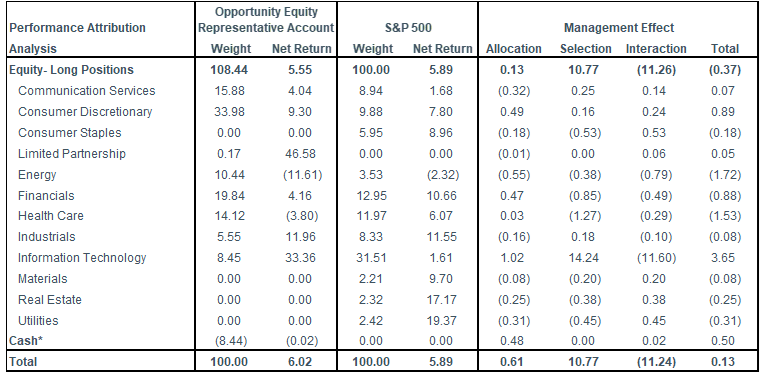
Patient Capital's Patient Opportunity Equity account delivered a net return of 5.58% in the third quarter of 2024, slightly below the S&P 500 index's 5.89%. Using a three-factor attribution model, the report indicates that allocation and stock selection effects were positive, while the interaction e
Theme and Background
This chapter reviews the performance and portfolio adjustments of the Patient Opportunity Equity account in the third quarter of 2024. The market environment experienced a clear style rotation, with small-cap and value stocks taking over leadership from large-cap stocks. The Fed's 50bps rate cut and China's most aggressive stimulus policies since the pandemic boosted cyclical stocks.
Core Views
The report argues that the shift in market leadership from large-cap to small-cap and value stocks benefits the portfolio, as the portfolio has consistently increased exposure to these two asset classes throughout the year. The author holds a contrarian view on the energy sector, believing the market is overly pessimistic about oil prices and sees long-term value in natural gas as a key transitional role in carbon neutrality.
Key Arguments and Data
- Performance: The portfolio generated a net return of 5.58%, slightly below the S&P 500's 5.89%. A three-factor attribution shows positive allocation and selection effects, with a negative interaction effect.
- Portfolio Concentration: The top ten holdings accounted for 49.4% (index: 34.2%), with an active share of approximately 96%, holding 38 stocks at quarter-end.
- Sector Allocation: Overweight in consumer discretionary, communication services, financials, energy, and healthcare; zero allocation to real estate, utilities, materials, and consumer staples.
- Contrarian Logic on Energy:
- The market expects supply to exceed demand by 1.3 million barrels per day in 2025 (even without considering OPEC additions), but the report argues that consensus in commodities is rarely correct.
- The firm's evaluation is based on full-cycle returns and normalized prices, not short-term supply and demand.
- QXO Investment Logic: Participated in a PIPE transaction at a cost of $9.14, when the stock price was approximately $80+, later falling to around $15. Management has set a target of approximately 25% IRR over ten years, aiming for annual revenue exceeding $50 billion within a decade.
- Dave & Buster's: Has repurchased 19% of its shares since 2023.
| Metric | Portfolio | S&P 500 |
|---|---|---|
| Q3 Net Return | 5.58% | 5.89% |
| Top 10 Holdings Weight | 49.4% | 34.2% |
| Active Share | ~96% | - |
| Top Contributors | Net Contribution (bps) | Top Detractors | Net Contribution (bps) |
|---|---|---|---|
| QXO Inc. | +279 | Kosmos Energy | -80 |
| Alibaba | +129 | Precigen | -68 |
| Expedia | +82 | Seadrill | -65 |
| IAC | +67 | Alphabet | -57 |
| Illumina | +61 | Biogen | -55 |
Companies/Assets Involved
- QXO Inc. (QXO) (Bullish): New position, led by serial entrepreneur Brad Jacobs, focusing on the $800 billion building materials distribution industry, with $5 billion+ in capital for consolidation. PIPE cost of $9.14, the largest contributor in Q3.
- Alibaba (BABA) (Bullish): Benefited from China's stimulus policies, rebounded quickly, contributing +129bps.
- Expedia (EXPE) (Bullish): Cyclical rebound, contributing +82bps.
- Energy Transfer (ET) (Bullish): Held since 2019, with a dividend yield of 10% during the period, bullish on long-term natural gas demand.
- Seadrill (SDRL) (Bullish): Benefiting from industry consolidation and supply-demand imbalances, believing offshore drilling as a marginal producer will secure better contract prices.
- Kosmos Energy (KOS) (Bullish): The market is overly focused on short-term dynamics; as production comes online and growth capex exits, free cash flow will improve significantly.
- Dave & Buster's (PLAY) (Bullish): New position, in a multi-year transformation phase; the macro environment is suppressing consumption, but the company continues to buy back shares.
- JPMorgan Chase (JPM) (Bearish/Closed): Profit-taking after strong performance, funds reallocated to new ideas.
- Everi Holdings (EVRI) (Closed): Acquired by Apollo at $14.25 (70% premium over Q2 closing price).
- Alphabet (GOOGL) (Detractor): Contributed -57bps.
- Biogen (BIIB) (Detractor): Contributed -55bps.
Investment Implications
- Focus on Style Rotation: Small-cap and value stocks took over leadership from large-caps in Q3. The portfolio's active share of 96% indicates high confidence in stock-picking alpha.
- Contrarian Opportunity in Energy: The market is broadly bearish on oil prices (expecting a supply surplus of 1.3 million bpd), but the report believes the consensus is wrong. It recommends focusing on Energy Transfer, Seadrill, and Kosmos, based on full-cycle returns and long-term natural gas demand.
- QXO is a High-Risk, High-Reward Consolidation Story: Brad Jacobs has a strong track record, but the company has yet to announce any transactions. The ten-year $50 billion revenue target is extremely aggressive. The stock has already fallen from its post-PIPE highs, and execution risk needs attention.
- Consumer Cyclical Stocks Benefit from Policy Stimulus in the Short Term: The rapid rebound of Alibaba and Expedia shows that rate cuts and China's stimulus policies have a significant boost to consumer discretionary, but sustainability depends on the macro environment.
Theme and Background
This chapter provides an in-depth analysis of the best and worst performers in the Patient Capital portfolio during Q3. The report argues that market sentiment—particularly pessimism toward Chinese assets and cyclical concerns over energy stocks—has created significant pricing errors, offering contrarian opportunities for long-term investors.
Core Thesis
The author’s core investment thesis is: Short-term negative market sentiment toward high-quality assets (such as the wholesale abandonment of Chinese companies or worries about energy prices) has driven their valuations well below intrinsic value, creating a "time arbitrage" opportunity for patient investors. The report highlights that the rebounds of Alibaba and Expedia demonstrate how undervalued assets can rapidly recover when the market narrative shifts. Meanwhile, the bullish stance on Kosmos Energy and Seadrill is counterintuitive, arguing that their value drivers—such as free cash flow inflection points and industry supply constraints—are independent of short-term oil price fluctuations.
Key Arguments and Data
- Alibaba (BABA): Surged +47% in Q3. The report notes that before China’s unexpected stimulus policies, the stock was trading at "fire-sale" prices as investors "completely abandoned Chinese companies." Fundamentals remain strong: the company repurchased 9% of its outstanding shares over the past 12 months and initiated a 0.9% dividend. Despite the rally, its valuation stands at just 12.4x next year’s expected earnings.
- Expedia (EXPE): Became one of the top contributors in Q3. The market had persistently pressured the stock due to "hard landing" fears, yet travel demand remained robust. The company has repurchased 20% of its outstanding shares since 2021. Its B2C business (excluding VRBO) contributes approximately 54% of corporate EBITDA, but the market has assigned it almost no valuation.
- Kosmos Energy (KOS): The report views this as a classic "time arbitrage" case. The market focuses on current high capital expenditure while ignoring the strong free cash flow ahead. Under the current commodity curve, the company is expected to generate free cash flow equal to its current market capitalization over the 2025–2028 period.
- Seadrill (SDRL): Benefits from extreme scarcity in deepwater drilling rig supply (nearly half of the global deepwater fleet has been scrapped over the past decade). Over the past 12 months, it has reduced 17% of its outstanding shares through buybacks and has committed to returning 50% of free cash flow to shareholders. As older contracts expire and new ones are signed at higher day rates, operating profit and free cash flow are expected to expand significantly.
- Precigen (PGEN): An early-stage biopharmaceutical company whose PRGN-2012 program has the potential to become the first "off-the-shelf" immunotherapy for recurrent respiratory papillomatosis (RRP). The company plans to submit a BLA application by year-end and launch in 2025. It raised $31 million through an equity offering in August, expected to sustain operations into early 2025.
Companies/Assets Involved
| Company/Asset | Role | Key Data | Bullish/Bearish |
|---|---|---|---|
| Alibaba (BABA) | One of the top contributors | Q3 +47%; 12.4x forward P/E; repurchased 9% of shares | Bullish (valuation discount, beneficiary of China recovery) |
| Expedia (EXPE) | One of the top contributors | Repurchased 20% of shares since 2021; B2C business contributes 54% of EBITDA | Bullish (new management, tech platform, market share growth) |
| Kosmos Energy (KOS) | One of the biggest drags | 2025–2028 FCF equals current market cap | Bullish (FCF inflection point, potential acquisition target) |
| Seadrill (SDRL) | One of the biggest drags | Repurchased 17% of shares; committed to returning 50% of FCF to shareholders | Bullish (industry supply constraints, rising day rates) |
| Precigen (PGEN) | One of the biggest drags | Raised $31 million; BLA application expected by year-end | Bullish (potential first-in-class therapy, 2025 launch) |
Investment Implications
1. Contrarian Allocation to Chinese Assets: The report suggests that when negative sentiment toward a country or sector reaches extremes (e.g., "completely abandoning Chinese companies"), it presents an opportunity to buy high-quality, undervalued assets. The Alibaba case shows that policy catalysts can quickly trigger value recovery.
2. Focus on "Time Arbitrage" Opportunities: For companies like Kosmos Energy, investors should look at the free cash flow inflection point over the next 2–3 years rather than the current high capex phase. When the market is myopic, patiently holding for cash flow release is an effective strategy.
3. Value Supply-Side Constraints: The Seadrill case demonstrates that in industries that have undergone prolonged capital depletion (e.g., massive rig scrapping), even a modest demand recovery can lead to significant pricing power and profit improvement. Such assets offer high leverage.
4. Beware of Overpricing "Hard Landing" Risks: Expedia’s rebound shows that when the market broadly fears an economic recession, sell-offs in cyclical consumer leaders (e.g., online travel) may be excessive. If economic data does not deteriorate as expected, these undervalued assets will recover.
Theme and Background
This section is the compliance and disclosure portion at the end of the report, primarily explaining the performance calculation methodology, fee deduction standards, sources of holdings data, and the methodology for contribution analysis. This content does not involve investment analysis or market judgments but rather supplements the performance data and holdings information provided earlier with legal and technical clarifications.
Core Viewpoint
None. This section does not contain any investment arguments or market judgments; it is solely intended to clarify the technical details and legal boundaries of the performance presentation.
Key Arguments and Data
- Performance data deducts a 1% annualized model investment management fee (paid quarterly), which is the highest fee rate for independent accounts under this strategy.
- Contribution analysis is based on a representative account and only calculates the contribution of a security during the period it was held within the quarter.
- Holdings data is as of a specific point in time and may change thereafter without notice.
Companies/Assets Involved
None. This section does not mention any specific companies or assets.
Investment Implications
None. This section does not provide any investment advice or directional judgments. Investors should focus solely on the performance and holdings analysis sections earlier in the report; this section is only intended to ensure data transparency and compliance.