Quarterly Market Review 3Q 2024
Patient Capital Management is a Baltimore asset manager founded in 2020 by Samantha McLemore, CFA — Bill Miller's long-time co-manager (working together since 2002, running the flagship Opportunity Equity strategy since 2014). Continuing the Miller-school contrarian tradition, it practices "time arbitrage": exploiting behavioral mispricing to concentrate in controversial growth names (tech, healthcare, Bitcoin-related) at deep discounts to intrinsic value. Its site preserves Bill Miller's complete 1995-2022 market letters, alongside ongoing quarterly letters and webinars.
In plain words
This report reviews US markets in the third quarter of 2024, noting a sharp 8.5% dip in August that recovered by quarter-end with 12 new all-time highs for the S&P 500. The big shift: small-cap and value stocks finally outperformed large-cap growth stocks for the first time this year. The Fed cut rates by 0.5% (a larger-than-usual move), boosting utilities and real estate. For ordinary investors, it suggests spreading investments beyond big tech into smaller companies and value stocks, and considering bonds as rates fall.
This report discusses market performance in the third quarter of 2024, with the core view that the market hit record highs but experienced significant volatility, and the Federal Reserve's rate cut drove asset rotation. Key conclusions: The S&P 500 posted a total return of 22.1% in the first three q
Theme and Background
This section reviews U.S. market performance in the third quarter of 2024, focusing on volatility during the market's record highs, asset rotation triggered by the Federal Reserve's rate cut, and the impact of changes in inflation and employment data on market sentiment.
Core Viewpoint
The author argues that the market did not rise in a straight line during the third quarter but experienced a notable correction (an 8.5% decline) before regaining strength. The key judgment is that market breadth improved, with small-cap and value stocks beginning to catch up to large-cap growth stocks—the first such rotation this year. The Fed's 50bps rate cut was a turning point, but the market's expectation of an additional 75bps cut by year-end is more aggressive than the Fed's own forecast of 50bps.
Key Arguments and Data
- Market Volatility: The S&P 500 set 12 new all-time highs in the third quarter but fell 8.5% from mid-July to early August, marking its second correction of more than 5% this year.
- Inflation and Employment: August CPI fell to 2.5% (the lowest since March 2021), and the three-month annualized PCE rate dropped to 2.1%; the unemployment rate rose to 4.3% in July before retreating to 4.2%, still 0.8% above the January 2023 low.
- Fed Action: A 50bps rate cut in September brought the rate to 4.75-5.00%, the first cut since 2020 and the first 50bps cut since 2008 (excluding the pandemic). The Fed forecasts another 50bps cut in 2024, while the market expects 75bps.
- Sector and Asset Performance: Utilities (+19.4%) and Real Estate (+17.2%) led gains, while Energy (-2.3%) was the only decliner. Small caps (Russell 2000 +9.3%) outperformed large caps (Russell 1000 +6.1%), and Value (+9.4%) significantly outperformed Growth (+3.2%). Bonds performed strongly, with the 10-year Treasury yield falling from 4.4% to 3.8% and long-term Treasuries rising 8.0%. The dollar fell 4.8%, gold rose 11.5%, WTI crude fell 16.4%, and Bitcoin rose 3.0% to $63,785.
Comparison Data Table:
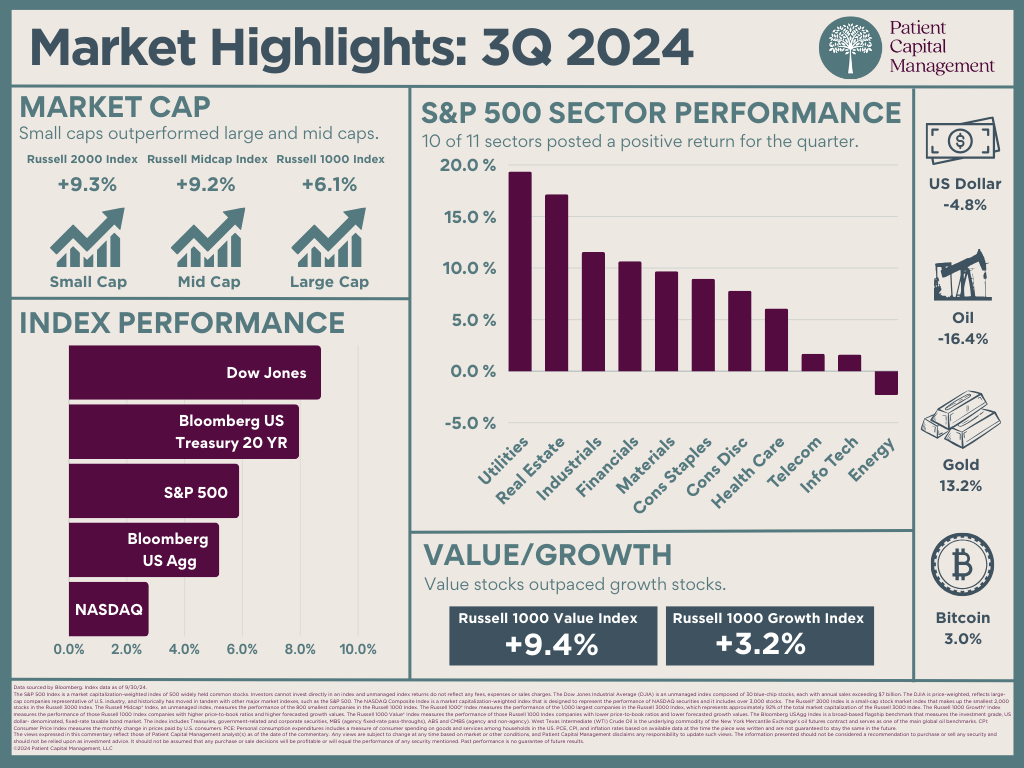
| Asset Class | Q3 Return | Key Change |
|---|---|---|
| Dow Jones Industrial Average | +8.7% | Led major indices |
| S&P 500 | +5.9% | Set 12 new highs |
| Nasdaq Composite | +2.8% | Underperformed |
| Russell 2000 (Small Cap) | +9.3% | Outperformed large caps |
| Russell 1000 Value | +9.4% | Significantly outperformed Growth (+3.2%) |
| Utilities Sector | +19.4% | Led all sectors |
| Real Estate Sector | +17.2% | Second strongest sector |
| Energy Sector | -2.3% | Only decliner |
| Long-Term U.S. Treasuries | +8.0% | Best among bonds |
| Gold | +11.5% | Benefited from weaker dollar |
| WTI Crude Oil | -16.4% | Down 24.9% year-over-year |
Companies/Assets Involved
- S&P 500 Index: As a market benchmark, returned +5.9% in Q3, with a year-to-date total return of +22.1%.
- Russell 2000 Index: Representing small caps, returned +9.3% in Q3, reversing its year-to-date weakness.
- Russell 1000 Value Index: +9.4%, outperforming the Growth Index (+3.2%) for the first time this year.
- Utilities and Real Estate Sectors: Led gains, benefiting from expectations of lower interest rates.
- Energy Sector: The only decliner, dragged down by the persistent drop in WTI crude oil prices (-16.4%).
- Bitcoin: Closed at $63,785, up +3.0% in Q3, but still below its March high.
Investment Implications
- Focus on Rotation Opportunities: Small caps and value stocks are beginning to outperform in a rate-cutting environment; investors should reduce excessive concentration in large-cap growth and increase allocations to small-cap and value styles.
- Benefit from Rate-Sensitive Sectors: Utilities and Real Estate have performed strongly in a declining rate cycle and can be held or overweighted.
- Beware of Energy Risks: Crude oil prices continue to fall (down 24.9% year-over-year), and Energy is the only sector with negative returns; it should be avoided or underweighted.
- Value of Bond Allocation Emerges: Long-term Treasury yields are declining, and bond returns are comparable to equities; in a rate-cutting cycle, bond allocations can provide stable income and capital appreciation.