1Q23 Small-Cap Fund Commentary
Southeastern Asset Management is a Memphis-based deep-value firm founded in 1975 by O. Mason Hawkins to exploit the bargains left by the 1973-74 bear market. Its flagship Longleaf Partners Funds (launched 1987) invest employees' own money alongside clients'. Following Graham's discipline and its "Business, People, Price" framework, it runs concentrated books of 15-25 undervalued stocks held for the long term — famously closing funds to new investors when opportunities were scarce. CEO and Head of Research Ross Glotzbach now leads the firm, which publishes quarterly Longleaf fund commentaries and Research Perspectives notes.
In plain words
This commentary explains how a small-cap fund performed in early 2023, when bank failures and a tech stock rally shook markets. The fund avoided banks and overpriced tech stocks, so it actually beat its benchmark. For regular investors, two takeaways: don't chase short-term fads like the tech rally (it may not last), and watch for company leaders whose pay is tied to stock performance—like Oscar Health's new CEO, whose bonus depends on hitting specific share prices. The report also notes that market turmoil can create bargains in quality small companies.
Longleaf Partners Small-Cap Fund returned 4.24% in the first quarter of 2023, outperforming the Russell 2000's 2.74%. The report's core view is that the market was dominated by two factors: the banking crisis triggered by the collapse of Silicon Valley Bank (SVB) and the short-term rebound in techno
Theme and Background
This chapter is the fund commentary for the Longleaf Partners Small-Cap Fund for the first quarter of 2023. The report notes that the market during the quarter was primarily driven by two factors: the banking crisis triggered by the collapse of Silicon Valley Bank (SVB) and the short-term rebound in technology/growth stocks. Due to the fund having no direct bank exposure and a lower weight in information technology stocks, its return drivers differed significantly from those of the index.
Core Thesis
The author's core investment thesis is that the market's short-term pricing of banks and technology stocks is flawed. By avoiding highly leveraged, low-transparency banks and overvalued technology stocks, the fund has achieved better risk-adjusted returns over the long term. Counterintuitive judgments include: 1) The technology stock rebound in the first quarter is likely a short-term phenomenon, with some large market darlings still overvalued; 2) Although the banking crisis has caused market turmoil, it will ultimately create attractive investment opportunities; 3) Stocks that had previously dragged on the fund's performance in prior years (e.g., Oscar Health) became the largest contributors in the quarter, and the author believes they still have significant upside.
Key Arguments and Data
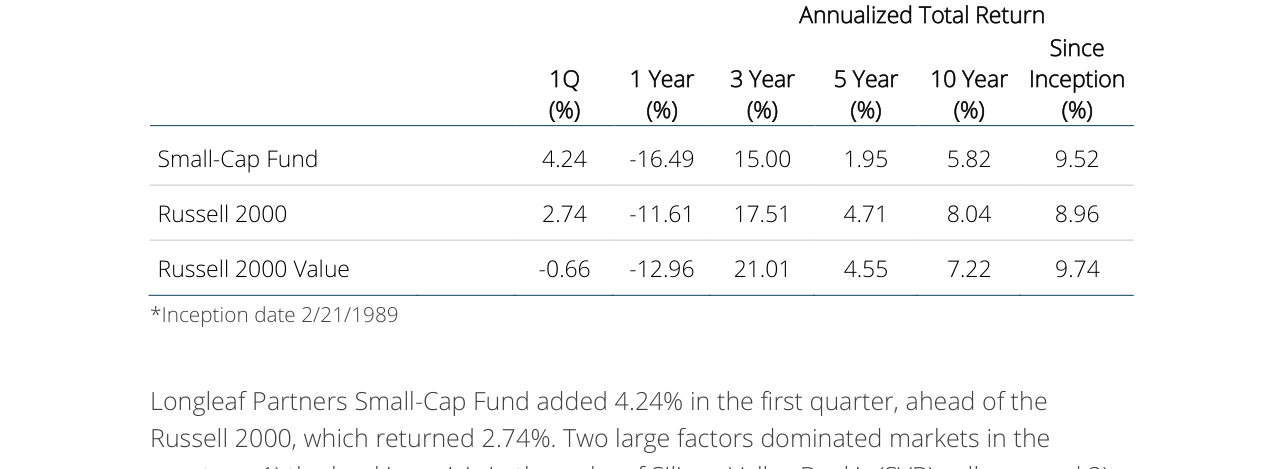
The Small-Cap Fund returned 4.24% in the first quarter, outperforming the Russell 2000's 2.74%, but its one-year return of -16.49% lagged the benchmark's -11.61%
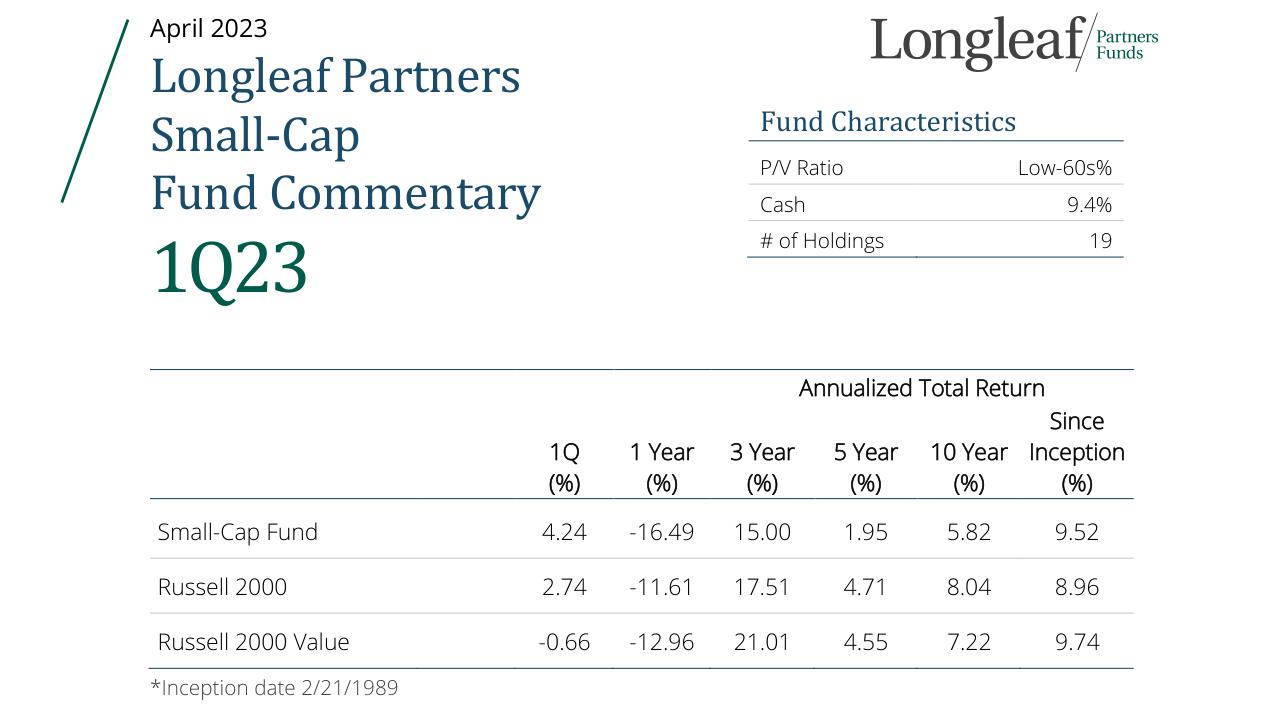
The fund's P/V ratio is in the low 60% range, with a cash position of 9.4% and a total of 19 holdings
- Fund Performance: The first-quarter return was 4.24%, outperforming the Russell 2000's 2.74% and the Russell 2000 Value's -0.66%.
- Index Composition: As of March 9 (the day before SVB's collapse), financials accounted for 27% of the Russell 2000 Value, with banks representing 17%.
- Valuation Level: The fund's P/V ratio is in the low 60% range, with a cash position of 9.4% and 19 holdings.
- Top Five Contributors:
| Company | Contribution to Return | Portfolio Weight |
|---|---|---|
| Oscar Health | 4.93% | 6.2% |
| Hyatt | 1.03% | 4.9% |
| GRUMA | 0.69% | 6.3% |
| Eastman Kodak | 0.61% | 6.3% |
| Masonite | 0.35% | 3.2% |
- Top Five Detractors:
| Company | Contribution to Return | Portfolio Weight |
|---|---|---|
| Lumen | -2.61% | 2.6% |
| Anywhere | -0.61% | 3.1% |
| Westrock Coffee | -0.46% | 6.1% |
| Empire State Realty | -0.28% | 4.7% |
| CNX Resources | -0.23% | 6.3% |
- Oscar Health: The stock rose over 150% in the quarter. The appointment of new CEO Mark Bertolini (former Aetna CEO, who sold Aetna to CVS for $69 billion) was the direct catalyst. His compensation package includes 10.3 million restricted shares, three-quarters of which vest only when the stock price reaches $11, $16, and $39. Even after the significant price increase, the stock remains below half of the $11 threshold.
- Lumen: Revenue was weak, with an additional $500 million guidance cut in the quarter. However, the company repaid over $600 million in unsecured debt through a new senior debt exchange. The fund has reduced its position.
- Portfolio Adjustments: The fund capped individual position sizes at 6.5% and used proceeds from reductions to buy a long-tracked, undisclosed consumer brand company and a high-quality defensive business previously held successfully.

Oscar Health, with a 169% quarterly gain and a 4.93% contribution, was the biggest contributor, followed by Hyatt with a 24% gain
Companies/Assets Involved
- Oscar Health (Bullish): A health insurance and software platform, the largest contributor for the quarter. The new CEO's appointment and compensation structure provide value validation and strong alignment with shareholder interests.
- Hyatt (Bullish): A global hotel franchisor and owner. With a focus on group business, it still has post-pandemic recovery potential; asset sales and buyback plans are catalysts.
- Lumen (Bearish/Reduced): A global fiber company, the largest detractor for the quarter. Revenue is weak and guidance was cut, but the strategic sale of the consumer business is key to value realization; the fund has reduced its position.
- Anywhere, Westrock Coffee, Empire State Realty, CNX Resources: These were detractors for the quarter, but the author did not provide detailed analysis.
- Undisclosed Company: A consumer brand company newly purchased by the fund, described as "one of the best consumer brands in the small-cap world," along with a high-quality defensive business previously held successfully.

Lumen, with a -49% quarterly decline and a -2.61% negative contribution, was the biggest detractor, followed by Anywhere with a -17% decline
Investment Implications
- Avoid High-Leverage and Low-Transparency Industries: Bank stocks, due to high leverage and lack of transparency, are difficult to understand and value over the long term and should be approached with caution. The current banking crisis may create opportunities, but strict discipline is required.
- Be Wary of the Sustainability of the Tech Rebound: The first-quarter tech rebound is likely a short-term phenomenon; some large-cap stocks remain overvalued and should not be chased.
- Focus on Management Changes and Alignment with Shareholder Interests: The Oscar Health case shows that the appointment of a new CEO and a compensation structure tied to the stock price are strong signals of value realization.
- Use Market Dislocations to Buy High-Quality Small-Cap Stocks: The fund's purchase of a long-tracked, high-quality consumer brand and a defensive business during price dislocations indicates attractive opportunities in the small-cap space.
- Position Sizing Discipline and Risk Management: The fund's reduction of the single-position cap to 6.5% and more cautious approach to leverage and holdings help optimize the portfolio's risk-return profile.