1Q23 Partners Fund Commentary
Southeastern Asset Management is a Memphis-based deep-value firm founded in 1975 by O. Mason Hawkins to exploit the bargains left by the 1973-74 bear market. Its flagship Longleaf Partners Funds (launched 1987) invest employees' own money alongside clients'. Following Graham's discipline and its "Business, People, Price" framework, it runs concentrated books of 15-25 undervalued stocks held for the long term — famously closing funds to new investors when opportunities were scarce. CEO and Head of Research Ross Glotzbach now leads the firm, which publishes quarterly Longleaf fund commentaries and Research Perspectives notes.
In plain words
This report covers how the Longleaf Partners Fund performed in early 2023, when bank failures and a tech stock bounce dominated markets. The fund avoided banks and owned few tech stocks, so its results differed from indexes. For everyday investors, the key takeaway: don't chase big tech like Apple or Microsoft—their rebound may be short-lived. Banks are risky because high debt makes them hard to value. Instead, look at beaten-down stocks like Warner Bros Discovery and FedEx, which the fund sees as undervalued. Worth reading for concrete examples of finding bargains during turmoil.
The Longleaf Partners Fund returned 11.67% in the first quarter of 2023, outperforming the S&P 500's 7.50%. The report notes that the market was dominated by two factors: the banking crisis triggered by the collapse of Silicon Valley Bank (SVB), and a short-term rebound in technology/growth stocks t
Theme and Background
This section discusses the performance of the Longleaf Partners Fund in the first quarter of 2023 and the prevailing market environment. The market was dominated by two major factors: the banking crisis triggered by the collapse of Silicon Valley Bank (SVB), and a short-term rebound in technology/growth stocks that had declined in 2022. The fund had no direct exposure to banks and limited holdings in technology stocks, resulting in a performance that diverged significantly from the indices.
Core Thesis
The author's core investment argument is that bank stocks are difficult to value over the long term due to high leverage and a lack of transparency, while certain large-cap technology stocks (such as Apple and Microsoft) remain overvalued, making their rebound potentially short-lived. The fund's top five contributors were mostly stocks that had been excessively punished in prior years, and the author believes these companies still have significant upside potential.
Key Arguments and Data
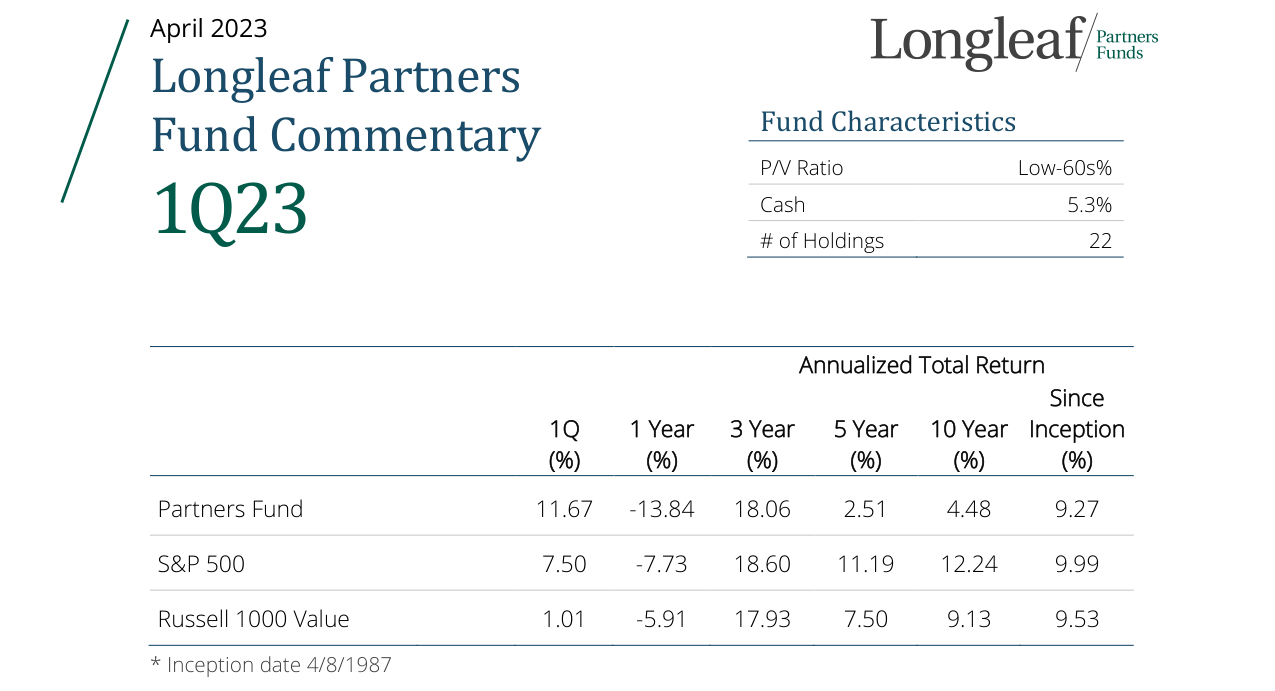
The fund's P/V ratio is in the low-60s%, with cash at 5.3% and a total of 22 holdings
- The fund returned 11.67% in the first quarter, outperforming the S&P 500's 7.50% and the Russell 1000 Value's 1.01%.
- As of March 9 (the day before the SVB collapse), financials represented 20% of the Russell 1000 Value, with banks accounting for 7%.
- The fund's P/V ratio is approximately 60%+, with cash at 5.3% and 22 holdings.
- Top five contributors: Warner Bros Discovery (+59%), General Electric (+48%), MGM Resorts (+33%), FedEx (+33%), PVH (+26%).
- Top five detractors: Lumen (-49%), AMG (-10%), Douglas Emmett (-28%), CNX Resources (-5%), CNH Industrial (-5%).
Comparative Data Table:
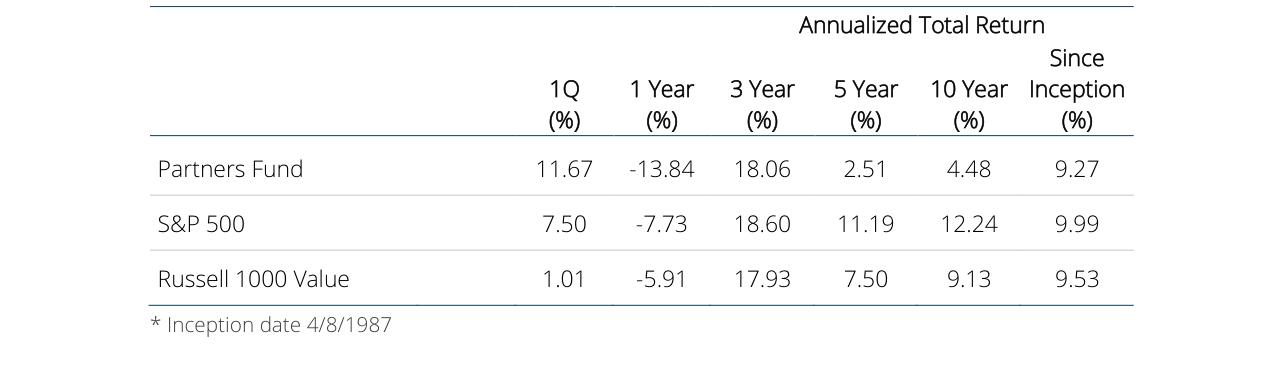
The Partners Fund returned 11.67% in Q1, outperforming the S&P 500's 7.50%, but its one-year return of -13.84% lagged the benchmark
| Metric | 1Q23 | 1 Year | 3 Year | 5 Year | 10 Year | Since Inception |
|---|---|---|---|---|---|---|
| Partners Fund | 11.67% | -13.84% | 18.06% | 2.51% | 4.48% | 9.27% |
| S&P 500 | 7.50% | -7.73% | 18.60% | 11.19% | 12.24% | 9.99% |
| Russell 1000 Value | 1.01% | -5.91% | 17.93% | 7.50% | 9.13% | 9.53% |
Companies/Assets Involved
- Warner Bros Discovery (WBD): Media conglomerate, largest contributor in Q1 (+59%). The management team has a track record of integrating assets and growing FCF per share. Net debt/EBITDA is expected to be below 4x by the end of 2023 and to fall to 3x or lower by the end of 2024. Bullish.
- General Electric (GE): Industrial conglomerate, contributed +48% in Q1. Plans to split into three companies, having already divested the Healthcare business. CEO Larry Culp is reducing leverage and cutting costs. Bullish (the remaining parts are still undervalued).
- MGM Resorts: Casino and online gaming company, contributed +33% in Q1. Las Vegas revenue grew at a double-digit rate, and the Macau business is experiencing a strong recovery. Repurchased 20% of its stock at a discount in 2022 and continues to buy back shares at a double-digit annualized pace in 2023. Bullish.
- FedEx: Global logistics company, contributed +33% in Q1. Despite weak revenue, pricing power is strong, and the Ground business significantly exceeded expectations due to cost control. Long-term EPS potential exceeds $20 (current estimate is $15-16). Bullish.
- PVH: Apparel company (Tommy Hilfiger, Calvin Klein), contributed +26% in Q1. CEO Stefan Larsson is streamlining the company, growing margins and FCF per share. Current FCF multiple is in the single digits. Bullish.
- Lumen: Global fiber company, largest detractor in Q1 (-49%). Revenue is weak, with an additional $500 million cut to guidance. New CEO Kate Johnson highlights the potential for improved enterprise sales, but increased SG&A investment is needed. Bearish (but believes strategic actions could unlock value).
- AMG: Asset management company, detractor -10%. No detailed explanation provided.
- Douglas Emmett: Real estate company, detractor -28%. No detailed explanation provided.
- CNX Resources: Natural gas company, detractor -5%. No detailed explanation provided.
- CNH Industrial: Industrial equipment company, detractor -5%. No detailed explanation provided.

Lumen was the largest detractor, weighing on the portfolio by 2.61%, followed by AMG at 0.63%
Investment Implications
- Avoid bank stocks: The author argues that bank stocks are difficult to value over the long term due to high leverage and a lack of transparency. Even if current market dislocations create opportunities, strict discipline is required.
- Be wary of large-cap tech rebounds: Stocks like Apple and Microsoft remain overvalued, and their rebounds may be short-lived. Investors should avoid chasing these names.
- Focus on excessively punished value stocks: Companies such as WBD, FedEx, and PVH have improving fundamentals and still offer significant upside potential in valuation.
- Emphasize management execution: Actions like GE's Culp, MGM's buybacks, and FedEx's DRIVE plan are key to unlocking value.