4Q25 Partners Fund Commentary
Southeastern Asset Management is a Memphis-based deep-value firm founded in 1975 by O. Mason Hawkins to exploit the bargains left by the 1973-74 bear market. Its flagship Longleaf Partners Funds (launched 1987) invest employees' own money alongside clients'. Following Graham's discipline and its "Business, People, Price" framework, it runs concentrated books of 15-25 undervalued stocks held for the long term — famously closing funds to new investors when opportunities were scarce. CEO and Head of Research Ross Glotzbach now leads the firm, which publishes quarterly Longleaf fund commentaries and Research Perspectives notes.
In plain words
This is a quarterly letter from the Longleaf Partners Fund to its investors. The fund underperformed in 2025 because it missed the hot stocks that soared. But the managers argue the market feels like past late-stage bull markets (1987, 1999) driven by momentum—risky and near a peak. They've shifted toward defensive stocks like consumer staples and timber, plus cash (9.5%), to cushion a potential downturn. They also highlight specific bets—Kraft Heinz with a new CEO, merger plays, and companies buying back shares—that they expect to deliver gains in 2026. Worth reading for a sober reminder to look past hype and focus on long-term value.
Southeastern (Longleaf Partners Fund) 2025 Annual Report The fund achieved a full-year return of 2.93%, significantly trailing the S&P 500's 17.88% and the Russell 1000 Value's 15.91%. The primary reason was a lack of big winners: over 35% of S&P 500 stocks rose more than 20% (with an average return
Theme and Background
This chapter reviews the performance of the Longleaf Partners Fund in 2025 and analyzes the similarities between the current market environment and the late stages of historical bull markets. The report notes that the fund's underperformance in 2025 was primarily due to a lack of sufficient "big winners," while the overall market was driven by momentum, which could signal that the bull market is nearing its end.
Core Thesis
The author's core investment thesis is that the current market closely resembles the late stages of bull markets in 1987, 1999, 2007, and 2021, and that momentum-driven rallies may signal risk. Although the fund has lagged in the short term, through targeted portfolio adjustments (e.g., increasing holdings in defensive growth stocks, reducing leverage), it is positioned for potential excess returns in 2026. The counterintuitive judgment is that the fund is not rushing to chase big winners in the late bull market but instead prioritizes portfolio resilience and long-term value.
Key Arguments and Data
- Market Performance Comparison: In 2025, over 35% of stocks in the S&P 500 rose more than 20% (average return over 50%), while only about 5% of stocks in the fund's portfolio rose more than 20% (average return 35%). This momentum-driven market characteristic historically (1987, 1999, 2007, 2021) has foreshadowed risk.
- Portfolio Adjustments: The fund's current P/V ratio is in the low 60% range, with a cash position of 9.5% and holdings in 21 stocks. Defensive growth stocks (e.g., consumer staples, timber companies) combined with cash account for approximately 45%, significantly higher than the roughly 20% in 2007 and 2021, and closer to the allocation level in 1999.
- Leverage Levels: The current spread between the weighted average bond/debt yield of the fund's holdings and the U.S. 10-year Treasury yield is approximately half the level seen in 2007 and 2021. This indicates that the bond market recognizes the resilience of the current portfolio.
- Specific Cases:
- Kraft Heinz: Underperformed in 2025, but the appointment of new CEO Steve Cahillane (who successfully led Kellogg's investment) at year-end is viewed favorably by the author.
- Rayonier and PotlatchDeltic: The merger is expected to close in Q1 2026, which will enhance the company's competitive position.
- Albertsons and CNX: Both are increasing per-share value through large-scale share buybacks, but the market has not yet fully reflected this.
- Rule Adjustment: The fund raised the position limit for its "overweight rule" from 6.5% to 8%. Reasons include: historical data showing no significant performance difference between 6% and 8% weights; increasing engagement to drive value creation; and improving tax efficiency.
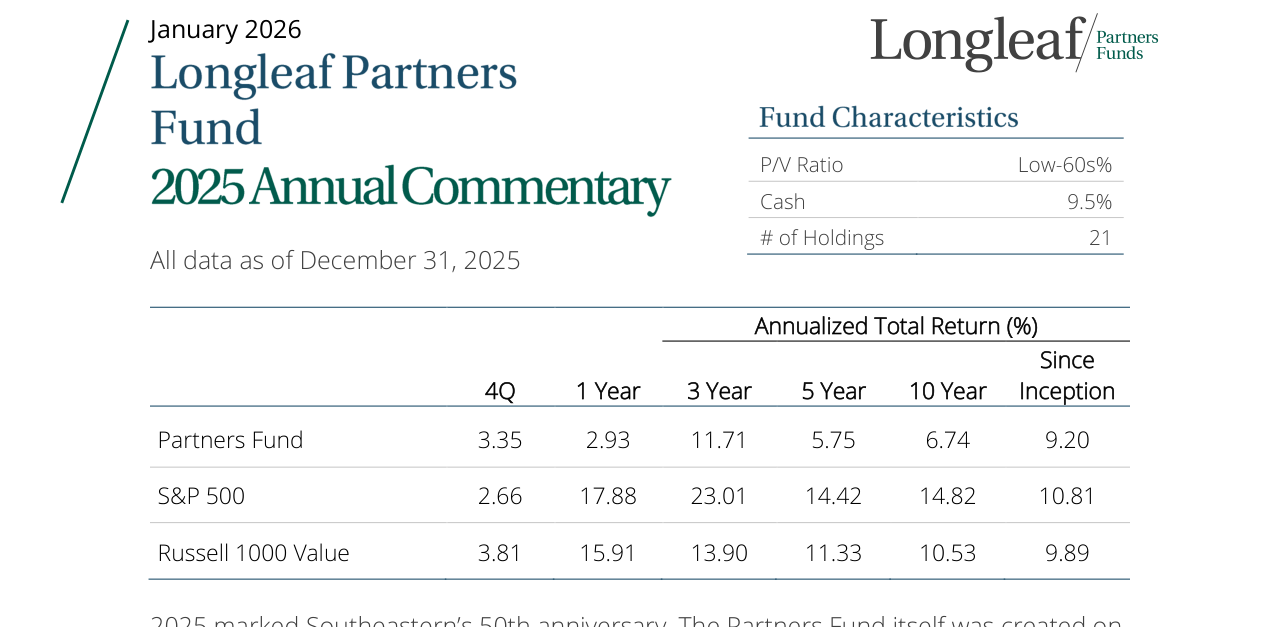
The Partners Fund has an annualized return of 9.20% since inception. In Q4 2025, it returned 3.35%, outperforming the S&P 500's 2.66%, but its 3-year, 5-year, and 10-year returns have significantly lagged the benchmark.
Companies/Assets Involved
| Company/Asset | Role and Key Data | Bullish/Bearish |
|---|---|---|
| Kraft Heinz | Underperformed in 2025, but appointed new CEO Steve Cahillane (from Kellogg's success story) at year-end | Bullish |
| Rayonier & PotlatchDeltic | Merger expected to close in Q1 2026, enhancing the company's offensive capabilities | Bullish |
| Albertsons | Increasing per-share value through large-scale buybacks, but market has not yet recognized this | Bullish |
| CNX | Increasing per-share value through large-scale buybacks, but market has not yet recognized this | Bullish |
| General Electric & Warner Bros. Discovery | Performed well in the market in 2025, but the fund did not hold them due to leverage rules | Neutral (not held) |
| UnitedHealth & Fiserv | Previously held by Longleaf (at low prices), experienced significant declines in 2025, illustrating the risk of market overreaction | Neutral (sold) |

Investment Implications
- Short-term Caution: The current momentum-driven market characteristics are similar to the late stages of historical bull markets. Investors should be wary of potential correction risks arising from the circular financing of AI companies and the wealth effect driven by the S&P 500.
- Focus on Defensive Allocation: The fund has significantly increased its holdings in defensive growth stocks such as consumer staples and timber companies, while maintaining a high cash position (9.5%). This provides a buffer against market downturns.
- Seize Individual Stock Opportunities: Companies like Kraft Heinz, Rayonier/PotlatchDeltic, Albertsons, and CNX, through management changes, mergers, or buybacks, are poised for value revaluation in 2026.
- Reduced Leverage Risk: The debt spread of the fund's holdings is significantly lower than historical highs, indicating greater resilience of the current portfolio in the interest rate environment. Investors can look for similar low-leverage targets.
New Analysis: Management Quality, Investment Cases, and Market Misjudgment
1. Management Quality as a Hidden Value Driver

- Argument: The letter emphasizes that "high-quality management partners" are a third, hard-to-quantify advantage, using specific cases (e.g., IAC's Barry Diller, Exor's John Elkann, Kraft Heinz's Steve Cahillane) to demonstrate the impact of management decisions on value creation.
- Data:
- IAC has driven its stock price closer to its estimated value through asset disposals (e.g., the Angi spin-off) and share buybacks. Chairman Diller focuses on narrowing the valuation gap; IAC has repurchased shares and increased its stake in MGM.
- Exor partially sold Ferrari at a historical high (approximately 40% above year-end levels) in 2025 and repurchased its own shares via a Dutch auction, using the holding company discount to enhance per-share intrinsic value.
- Kraft Heinz appointed Steve Cahillane as CEO. His past success at Kellanova/Kellogg's (described in the letter as a "successful investment") has increased market confidence in the spin-off plan (Global Taste Elevation Co. and North American Grocery).
- View: High-quality management can actively narrow the price-to-value (P/V) gap through capital allocation (e.g., buybacks, spin-offs, asset sales), and the market often underestimates this "active value creation" capability. For example, the contrast between Exor's stock price decline (underperformance in 2025) and its rising intrinsic value suggests an overreaction by the market to the holding company discount.
2. Investment Cases: Market Misjudgment and Contrarian Opportunities
- Argument: Several holdings (e.g., Regeneron, PayPal, PVH) have underperformed due to short-term market concerns (e.g., slowing product growth, quarterly volatility), but the letter argues that the market overlooks long-term value (e.g., pipeline potential, network effects, earnings recovery capability).
- Comparison Data:

| Company | Market Focus (Short-term) | Long-term Value Emphasized in the Letter | Key Metrics |
|---|---|---|---|
| Regeneron | EYLEA (retinal drug) accounts for <20% of company value | Allergy (DUPIXENT) and oncology (LIBTAYO) pipeline; net cash balance sheet; large-scale buybacks in 2025 | Pipeline value "almost not paid for" (letter's exact words) |
| PayPal | Branded checkout growth only mid-single digits (below the expected high single digits) | Two-sided network, hundreds of millions of user data, transaction-level data assets; accelerating FCF, buybacks | Stable transaction profits, margin expansion |
| PVH | Large quarterly earnings volatility | Long-term EPS > $10; brand resilience to price-sensitive consumers; margin improvement potential (>10%) | Large-scale buybacks in 2025, expected to continue in 2026 |
- Data Support:
- Regeneron: The letter explicitly states that "the market is overly focused on EYLEA," while DUPIXENT and LIBTAYO are core growth drivers. The company conducted large-scale share buybacks in 2025, and its net cash balance sheet provides a safety net.
- PayPal: Despite slowing Branded checkout growth (mid-single digits), transaction profits are stable, margins are expanding through cost discipline, and FCF is accelerating. The market's expectations for "accelerated growth" are too high, ignoring the long-term value of the network effect.
- PVH: CEO Stefan Larsson has a track record of brand turnarounds, but the process has taken longer than expected. The market doubts whether margins can break through 10%, but the letter believes the company has multiple levers (e.g., cost optimization, brand positioning) to achieve this goal.
3. Value Realization in Industry and Macro Context

- Argument: Some holdings (e.g., MGM Resorts, HF Sinclair) benefit from industry cycles or asset restructuring, while market narratives (e.g., "Las Vegas has peaked") have proven overly pessimistic.
- Data:
- MGM Resorts: Las Vegas operations were relatively weak in 2025 due to a high base, but BetMGM turned profitable, and regional assets and Macau operations were strong, stabilizing overall performance. IAC and the letter argue that "Las Vegas is irreplicable," and MGM, as a market leader, holds a unique position. Over the past five years, management has repurchased over 40% of shares at very low prices.
- HF Sinclair: The fund bought in when oil prices were weak and refining margins were below expectations. Subsequently, refining margins normalized, and non-refining assets (accounting for over 50% of estimated value) performed well. After the P/V gap narrowed, insider buying stopped, and the fund exited with a profit.
- View: The market overreacts to short-term volatility in cyclical industries (e.g., energy, gaming), while management releases capital through asset optimization (e.g., MGM selling low-quality assets, withdrawing from the New York casino bid), paving the way for long-term value creation.
4. Risks and Uncertainties
- Argument: Despite the overall optimistic tone of the letter, some holdings (e.g., Exor, Kraft Heinz) still face execution risks or market sentiment pressure.
- Data:
- Exor: The stock price fell in 2025, despite rising intrinsic value. Weak stock prices of Ferrari (tepid reaction at the November Capital Markets Day), Stellantis, and CNH dragged down Exor's valuation. The letter believes the holding company discount could narrow in 2026, but this depends on the progress of "self-help levers."
- Kraft Heinz: The spin-off plan (Global Taste Elevation Co.) requires market recognition. The current stock price is approximately $40/share (as estimated in the letter), but weak North American growth remains a short-term drag.
- View: These cases show that even with correct management actions, market sentiment and the macro environment (e.g., weak consumption, industry competition) can still lead to short-term underperformance. Investors need patience for value realization.

5. Summary: The Interaction of Management Quality and Market Misjudgment
- Core Thesis: Through multiple cases (Regeneron, PayPal, PVH), the letter demonstrates that the market's excessive focus on short-term data (e.g., slowing growth, quarterly volatility) often obscures management's long-term value creation capabilities (e.g., buybacks, spin-offs, asset optimization). High-quality management can actively narrow the P/V gap, and investors need to identify this "hidden value."
- Comparison Data:
| Company | Type of Market Misjudgment | Management Action | Source of Potential Return |
|---|---|---|---|
| Regeneron | Overly focused on EYLEA | Buybacks, pipeline advancement | Pipeline value release, net cash |
| PayPal | Overly focused on Branded checkout growth | Cost discipline, FCF acceleration | Network effect, data assets |
| PVH | Overly focused on quarterly volatility | Buybacks, margin improvement | Long-term EPS > $10 |
- Implications: Investors should focus on management's capital allocation capabilities (e.g., timing of buybacks, efficiency of asset disposals) and long-term strategies (e.g., spin-offs, brand turnarounds), rather than relying solely on short-term financial metrics. The "low P/V" and "management action" emphasized in the letter are core signals for contrarian investing.