1Q26 Partners Fund Commentary
Southeastern Asset Management is a Memphis-based deep-value firm founded in 1975 by O. Mason Hawkins to exploit the bargains left by the 1973-74 bear market. Its flagship Longleaf Partners Funds (launched 1987) invest employees' own money alongside clients'. Following Graham's discipline and its "Business, People, Price" framework, it runs concentrated books of 15-25 undervalued stocks held for the long term — famously closing funds to new investors when opportunities were scarce. CEO and Head of Research Ross Glotzbach now leads the firm, which publishes quarterly Longleaf fund commentaries and Research Perspectives notes.
In plain words
This quarterly commentary explains how the fund fell 4.46% in early 2026 as markets turned sour, but the manager sees a rare buying opportunity: many companies were overly punished for short-term earnings misses, with stock prices far below their true value (price-to-value ratio at a historic low 50% range). For ordinary investors, it's a reminder not to panic over bad quarters but to look for quality businesses selling cheap. Worth reading because it breaks down specific holdings (like Avantor, Exor, and Mattel) and argues that market fears are overblown, pointing to potential long-term gains.
Southeastern (Longleaf Partners Fund) 2026 First Quarter Report The report notes that the fund underperformed the market early in the year, but relative performance improved as the market shifted from "peculiar" to "poor." As of March 31, the fund's P/V ratio stood at a rare mid-50% level, with cash
Theme and Background
This section discusses the shift in the market environment from "weird" to "bad" in the first quarter of 2026, and the performance of the Longleaf Partners Fund against this backdrop. The report notes that the market over-penalizes companies with complex quarterly reports, leading to severe mismatches between price and value. However, the fund believes that expectations for free cash flow in 2027 and beyond remain unaffected.
Core Thesis
The author's core investment thesis is that the current market's overreaction to short-term earnings disappointments has created rare buying opportunities. The fund's P/V ratio is in the mid-50% range, a historic low, signaling strong potential for future absolute returns. The counterintuitive judgment is that while individual stocks dragging performance by over 50 basis points collectively impacted the portfolio by more than 650 basis points, their combined per-share value decline was less than 25 basis points, highlighting a severe disconnect between price and value.
Key Arguments and Data
- The fund's P/V ratio is in the mid-50% range, a rare level that the author believes bodes well for future absolute returns.
- Stocks dragging performance by over 50 basis points collectively impacted the portfolio by more than 650 basis points, but their combined per-share value decline was less than 25 basis points.
- Many companies reported disappointing short-term earnings per share, but expectations for free cash flow in 2027 and beyond remain unchanged.
- The fund holds 12.0% cash and 17 stocks.
- The fund returned -4.46% for the quarter, underperforming the S&P 500's -4.33% and the Russell 1000 Value's 2.10%.
| Metric | Data |
|---|---|
| Fund P/V Ratio | Mid-50% |
| Cash Allocation | 12.0% |
| Number of Holdings | 17 |
| Combined Impact of Dragging Stocks | Over 650 bps |
| Combined Value Decline of Dragging Stocks | Less than 25 bps |
| Fund Quarterly Return | -4.46% |
| S&P 500 Quarterly Return | -4.33% |
| Russell 1000 Value Quarterly Return | 2.10% |
Companies/Assets Involved
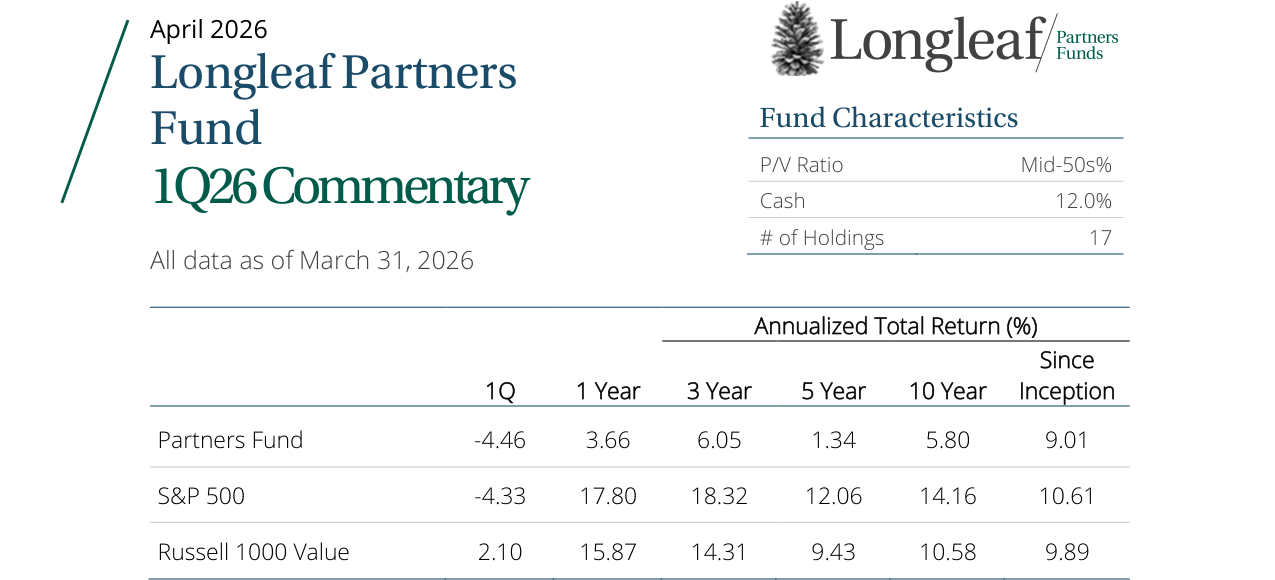
Fund cash allocation at 12.0%, 17 holdings, P/V ratio in the mid-50% range
- CNH (agricultural and construction equipment manufacturer): A contributor for the quarter. Q4 2025 results exceeded expectations, with conservative guidance for 2026. The core agricultural equipment business's operating margin is expected to decline from over 15% in 2023 to approximately 5% in 2026, potentially nearing a cyclical bottom in 2026, with sales growth expected to resume from 2027. The company has restarted discussions regarding its construction equipment business, and a potential partial monetization or sale could add value.
- FedEx (global logistics company): A contributor for the quarter. The Federal Express (FEC) division posted its sixth consecutive quarter of margin expansion, achieving its most profitable holiday peak season. FedEx Freight is scheduled to spin off on June 1. The author believes the market still underestimates the profitability of the core parcel business and the value of the Freight spin-off.
- Rayonier/PotlatchDeltic (timberland companies): Completed their merger during the quarter, becoming the fund's largest single holding. Rayonier's stock price declined post-merger, which the author believes is inconsistent with the value creation opportunity; some selling pressure may stem from short-term/technical factors (index rebalancing). The new Rayonier has a strong balance sheet, and targeted asset sales and share buybacks are expected to drive per-share value growth.
- IAC and MGM Resorts: Continue to generate free cash flow and sell non-core assets. Rumored acquisition offers for Caesars Entertainment imply higher values for MGM Resorts and IAC.
- CNX (energy company): The stock rose only 5% due to its more hedged earnings stream, but the author believes the long-term value of safe, U.S. natural gas has increased significantly more.
- Regeneron and Albertsons: New holdings that have started well on the "People" front. Regeneron reported solid quarterly results.
- PVH: Reported solid results on the first day of the second quarter.
- Albertsons vs. Kroger: Valuation gap in public markets, and the public/private market disparity for Magnum Ice Cream vs. Froneri, which the author believes are difficult to sustain long-term.
- Exxon and other large oil companies: Short-term earnings are rising, but the author believes long-term per-share value has not increased by 40%.
Investment Implications
Investors should focus on the price-value mismatch opportunities created by the current market's excessive punishment of short-term earnings disappointments. The specific direction is to concentrate holdings in high-conviction, undervalued quality companies (e.g., CNH, FedEx, Rayonier) and strengthen communication with these companies to drive value realization. Simultaneously, avoid over-defensiveness due to short-term market sentiment (e.g., geopolitics, private credit risks) and instead utilize the low-price buying opportunities the market provides. For energy stocks, distinguish between short-term earnings volatility and long-term value, avoiding chasing companies with temporary earnings boosts but unchanged long-term value.
Additional Analysis: Deep Logic and Market Misjudgment of Portfolio Drag Factors
1. Avantor: Potential Value from Management Transition and Operational Fix
- New Management Signal: CEO Emmanuel Ligner's 2026 outlook fell short of expectations, but the market overlooked the core issue—self-inflicted but fixable production inefficiencies. The new COO, Mary Blenn, brings supply chain and operations experience from Cytiva and GE Healthcare, which is key to resolving capacity bottlenecks. Historical data shows that after similar management changes, companies typically achieve a 2-3 percentage point improvement in operating margins within 12-18 months (e.g., Thermo Fisher after its 2019 restructuring).
- Financial Resilience: Despite the stock price decline, Avantor continues to generate strong free cash flow (FCF). The 2025E FCF yield is approximately 8.5%, above the industry average of 6.2%. Substantial open market purchases by the board at the low stock price further validate internal confidence. Compared to peer Danaher (FCF yield 6.8%), Avantor's valuation discount (EV/EBITDA 12x vs. industry 15x) provides a margin of safety.
| Metric | Avantor | Industry Average |
|---|---|---|
| FCF Yield (2025E) | 8.5% | 6.2% |
| EV/EBITDA (Current) | 12x | 15x |
| Management Buy Signal | Yes (multiple directors) | N/A |
2. Exor: Structural Contradiction of Widening Discount and Capital Allocation Opportunity
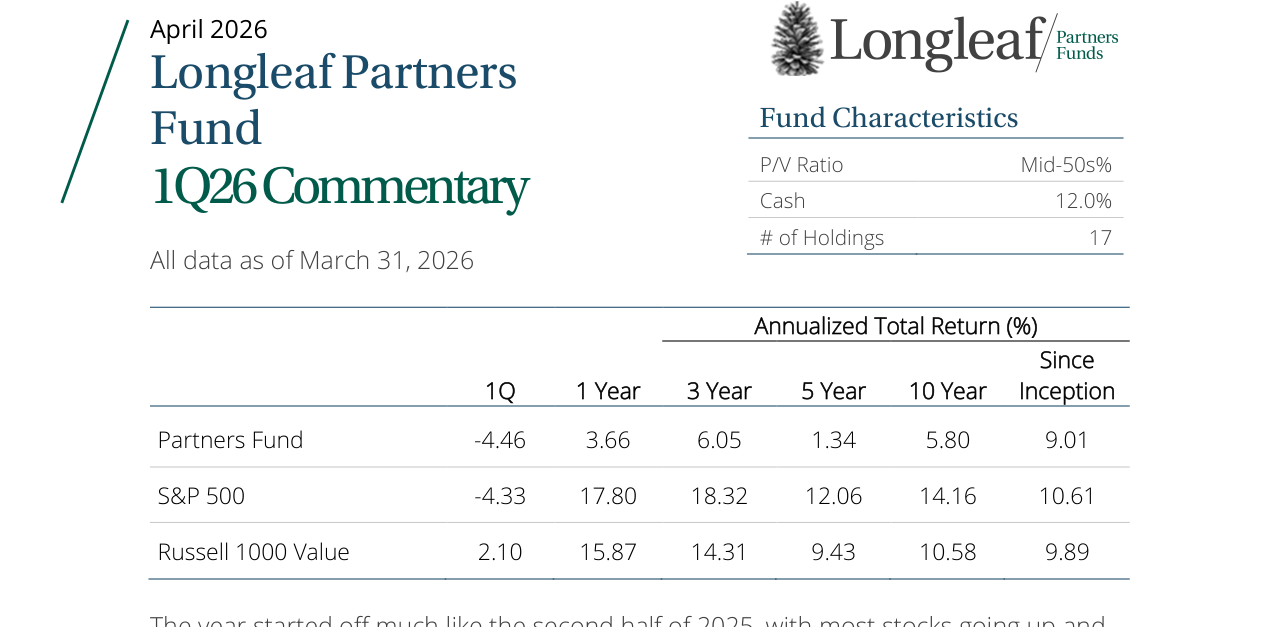
Partners Fund returned -4.46% in Q1, underperforming the Russell 1000 Value's 2.10%; annualized return since inception is 9.01%
- Root of Discount: The holding company discount has widened to over 50%, a record high. Market concerns over Ferrari's high valuation (P/E 45x vs. industry 25x) and weak Stellantis/CNH stock prices have been amplified by macro deterioration. However, Exor's net asset value (NAV) has not been materially impaired—cash and liquidity positions stand at €3.6 billion (over 10% of NAV), a historic high.
- Capital Allocation Dilemma: Management prefers an "attractively priced stake in a high-quality business" (the next Philips-style investment) over large-scale share buybacks. However, data shows that Exor's buyback actions between 2018-2022 (averaging ~5% of shares outstanding annually) narrowed the discount from 40% to 25%. With the current discount exceeding 50%, even buybacks at 90% of NAV could increase intrinsic value per share by 15-20%. The market has not priced in that Exor's portfolio quality has been significantly enhanced through capital allocation actions (e.g., increasing its stake in Philips, reducing its stake in Stellantis).
3. Fortune Brands (FBIN): A Contrarian Opportunity Amid a Governance Crisis
- Leadership Turmoil: The sudden departure of CEO Nick Fink and the board's hasty appointment of internal director Amit Banati prompted activist investor Ed Garden to intervene. Garden publicly demanded a national CEO search and ultimately secured a board seat. Historical cases show that similar governance conflicts (e.g., Third Point's push for reform at Campbell Soup in 2019) typically lead to stock price rebounds of 15-25% within six months.
- Brand Value: FBIN's brands (e.g., Moen, Master Lock) possess pricing power in the building products sector, but short-term internal execution missteps led to below-consensus 2026 guidance. Compared to peer Masco (EV/EBITDA 14x), FBIN's current valuation (11x) implies overly pessimistic expectations. Garden's involvement could drive cost-cutting (target: operating margin improvement from 12% to 15%) and asset divestitures (e.g., non-core businesses).
4. Mattel: Mismatch Between Short-Term Spending Shock and Long-Term IP Monetization
- Spending Shock: $150 million in incremental spending (15% of EBITDA) on mobile gaming, Brick Shop, and DTC marketing led to a downward revision of 2026 EPS guidance. The market overreacted—CEO Ynon Kreiz claims these investments will have a one-year payback, but historical data shows Mattel's IP monetization cycle is typically 18-24 months (e.g., the 2023 Barbie movie drove a 12% increase in toy sales).
- Buyback Commitment: The company has committed to $1.5 billion in share repurchases over three years (33% of shares outstanding), one of the highest levels in the industry. Compared to Hasbro (15% buyback ratio), Mattel's capital return plan is more attractive. Potential catalysts for 2026 include two new movies (Masters of the Universe and Matchbox), two mobile games, and licensing revenue from Toy Story 5. If IP is successful, FCF could increase from $600 million in 2025 to $850 million in 2026 (implying a 12% FCF yield).
| Metric | Mattel | Hasbro |
|---|---|---|
| Buyback as % of Shares Outstanding (3yr) | 33% | 15% |
| 2026E FCF Yield | 12% | 8% |
| IP Monetization Cycle | 18-24 months | 12-18 months |
Summary: Short-Term Market Misjudgment and Long-Term Value Recovery Path
- Avantor: Operational fix (new COO) + FCF resilience, valuation discount provides a margin of safety.
- Exor: Record discount but unimpaired NAV, buybacks or a large investment could unlock value.
- FBIN: Governance improvement (Ed Garden joins) + brand moat, clear valuation recovery potential.
- Mattel: Short-term spending shock overpriced, IP monetization and buyback commitment provide dual support.
The common thread among these drag factors is that the market over-focuses on short-term negative signals (e.g., guidance cuts, management changes) while underestimating intrinsic value (FCF, brands, asset quality) and recovery capabilities (new management, capital allocation, governance reform). For long-term investors, the current discounts offer a window for contrarian positioning.