4Q25 Global Fund Commentary
Southeastern Asset Management is a Memphis-based deep-value firm founded in 1975 by O. Mason Hawkins to exploit the bargains left by the 1973-74 bear market. Its flagship Longleaf Partners Funds (launched 1987) invest employees' own money alongside clients'. Following Graham's discipline and its "Business, People, Price" framework, it runs concentrated books of 15-25 undervalued stocks held for the long term — famously closing funds to new investors when opportunities were scarce. CEO and Head of Research Ross Glotzbach now leads the firm, which publishes quarterly Longleaf fund commentaries and Research Perspectives notes.
In plain words
This report from Southeastern's Longleaf Partners summarizes their 2025 fund performance. They earned 16.72%, below the global stock market's 21% but above their 'inflation + 10%' target. More importantly, they shifted to a safer portfolio: nearly half in defensive sectors (like consumer staples) and cash, far more cautious than in 2007 or 2021. They see the market as overheated, with AI companies constantly raising money as a warning sign, and warn of a possible big drop. Ordinary investors can learn: don't chase hot stocks at market peaks, keep some cash and defensive assets to survive downturns.
Southeastern (Longleaf Partners) 2025 Annual Commentary The Global Fund delivered a full-year return of 16.72%, underperforming the MSCI World Index's 21.09% and the MSCI World Value Index's 20.79%, but exceeded its absolute return target (inflation + 10%). The fund's price-to-value (P/V) ratio was
Theme and Background
This chapter is the introduction to Southeastern (Longleaf Partners)' 2025 Annual Commentary, primarily reviewing the Global Fund's performance in 2025, adjustments to investment strategy, and the current portfolio positioning within the prevailing market environment. The author focuses on discussing the reasons for the fund's underperformance relative to its benchmark, the strategic decision to merge the International Fund, and signs that the current market cycle is nearing its end.
Core Thesis
The author's core investment argument is that, although the fund underperformed the MSCI World Index in 2025, it outperformed its absolute return target (inflation + 10%). Furthermore, the current portfolio structure is more robust than in 2007 and 2021, and is more closely aligned with the favorable positioning of 1999. The author believes that parts of the market's "value index" are fully priced, and the phenomenon of circular financing among AI companies signals the market cycle is nearing its end. The wealth effect driven by the S&P 500 could lead to excessive downside in the future. The counterintuitive judgment is that the fund actively chose to underweight the financial sector and hold cash, considering this an acceptable strategy for the current market phase.
Key Arguments and Data
1. Fund Performance: The Global Fund returned 16.72% for the full year, underperforming the MSCI World's 21.09% and the MSCI World Value's 20.79%, but outperforming its absolute return target (inflation + 10%).
2. Reasons for Underperformance: Primarily due to an underweight position in the financial sector, holding cash, and a lack of exposure to late-cycle industrial stocks (especially European defense stocks).
3. Portfolio Adjustments: Following the merger of the International Fund, the target is to maintain a portfolio of approximately 20 stocks. However, the fund held 26 stocks at year-end, with plans to reduce some low-weight positions after the start of the year.
4. Market Cycle Signals: The circular financing phenomenon among AI companies provides a signal that the market cycle is nearing its end. The wealth effect driven by the S&P 500 could lead to excessive future declines, similar to the drops seen in "safe" stocks like UnitedHealth and Fiserv.
5. "3 Rules" Update:
- The leverage rule remains the most important, protecting the fund from leverage traps.
- The position limit rule was raised from 6.5% to 8%, for reasons including: no significant historical performance difference in the research team, enhanced engagement, and improved tax efficiency.
6. Current Portfolio vs. Historical Comparison:
| Metric | Current (End of 2025) | 2007 | 2021 | 1999 |
|---|---|---|---|---|
| Defensive sectors (Consumer Staples + Timberlands) & Cash allocation | ~45% | ~15% | ~15% | Similar to current |
| Portfolio weighted average bond/debt yield vs. US 10-Year Treasury spread | Approximately half of 2007/2021 | Higher | Higher | Limited data |
7. Management Quality: The author believes the quality of management for current holdings is higher than in the past, though this is difficult to quantify.
Companies/Assets Mentioned
- IAC/MGM Resorts: Mentioned as a related holding, no specific view provided.
- Rayonier/PotlatchDeltic: Mentioned as a related holding, no specific view provided.
- Exor/Philips: Mentioned as a related holding, no specific view provided.
- UnitedHealth: Mentioned as an example of a "safe" stock that declined; previously held by Longleaf but not currently held.
- Fiserv: Mentioned as an example of a "safe" stock that declined; previously held by Longleaf but not currently held.
- General Electric: Mentioned as an example of an economically sensitive, leveraged stock that rose in 2025 but was not held by the fund.
- Warner Bros. Discovery: Mentioned as an example of an economically sensitive, leveraged stock that rose in 2025 but was not held by the fund.
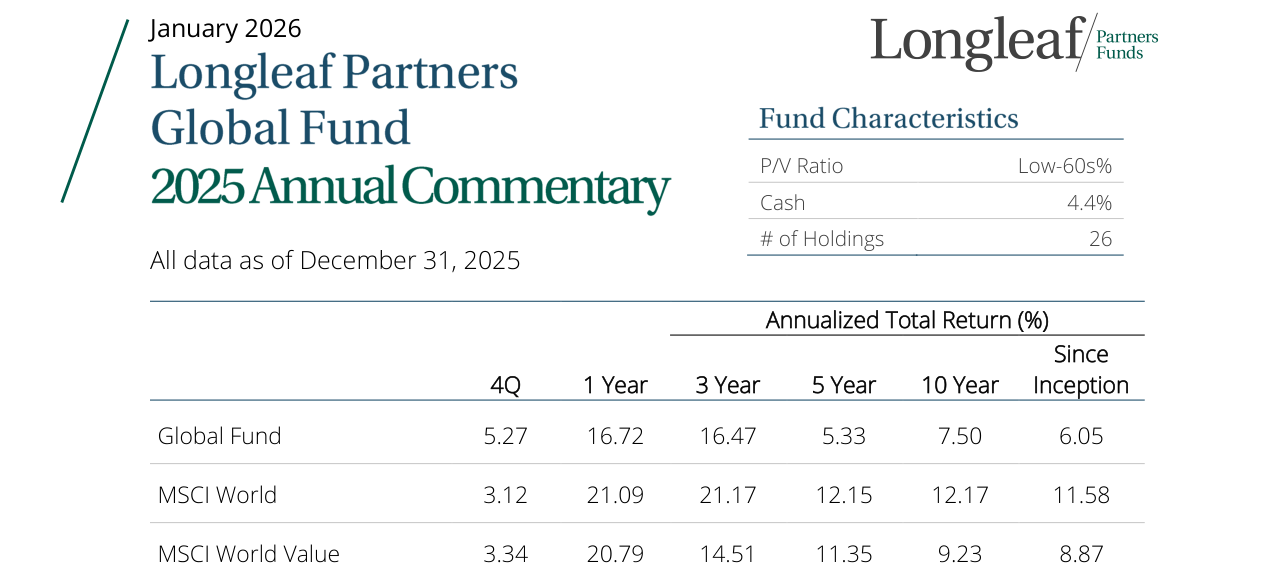
Fund P/V ratio in the Low-60s%, Cash at 4.4%, 26 holdings
Investment Implications
- Current Portfolio is More Defensive: Defensive sectors (Consumer Staples, Timberlands) and cash account for approximately 45%, significantly higher than the 15% in 2007 and 2021, indicating the fund is placing greater emphasis on risk control in the current high-valuation market environment.
- Lower Leverage Risk: The bond spread on holdings is only half of what it was in 2007/2021, with the bond market validating the portfolio's resilience.
- Market Cycle Nearing End: The circular financing among AI companies and the S&P 500 wealth effect are signals of market overheating. Investors should be wary of potential excessive future declines.
- Position Limit Increase: The increase from 6.5% to 8% may imply the fund will increase allocation to certain high-conviction holdings while reducing the need to sell quality stocks for tax reasons.
Additional Arguments, Data, and Views
1. Canal+'s Valuation Dilemma and Market Mispricing
- Data Comparison: Canal+ successfully renewed its exclusive Champions League broadcasting rights for the 2027–2031 cycle in 2025, with cost conditions better than market expectations. However, the stock price still fails to reflect its FCF improvement and strategic progress. The core issue is that, as a newly listed, undervalued French media company in London, it suffers from insufficient analyst coverage (underfollowed), leading to a persistent valuation discount.
- Key Insight: Although Canal+ has achieved scale expansion through the integration of its African platform (MultiChoice merger) and improved FCF visibility after resolving French tax issues, the market has not yet fully priced in its dual-engine model of "European legacy business + African emerging platform." This presents a potential value recovery opportunity for long-term investors.
2. Glanbia's Capital Allocation and Shareholder Return Optimization
- Data Comparison: In October 2025, Glanbia opportunistically repurchased approximately 3% of its shares at a discount through the Tirlán placement, reducing its largest shareholder's stake from 24% at the start of the year to 18% (previously higher). This operation not only alleviated long-standing overhang selling pressure but also directly boosted earnings per share.
- Strategic Progress: The company also advanced the sale of lower-margin assets like SlimFast and Body&Fit, focusing on its high-profit Performance Nutrition brands. Management has clearly indicated that more strategic steps (such as further divestitures of non-core assets or increased buybacks) may be taken in the near term to enhance capital returns.
3. Millicom's Value Convergence and Exit Logic
- Data Comparison: Millicom exceeded its FCF guidance after raising it twice in 2025, simultaneously achieving its 2.5x leverage target and increasing dividends and buybacks. Its dividend yield fell from double digits at the start of the year to single digits mid-year, converging with industry peers.
- Exit Decision: As the valuation discount largely closed and risk-adjusted upside became limited, the fund chose to exit in the third quarter. This operation demonstrates portfolio discipline: when the value gap closes, even if fundamentals remain strong, capital should be reallocated to more attractive opportunities.
4. Synergistic Value Release from IAC, MGM Resorts, and Angi
- IAC's Simplification Path: IAC plans to divest all assets except People Inc. and its ~25% stake in MGM. Chairman Barry Diller explicitly stated that the market has long failed to assign value to IAC's assets beyond MGM. The company has been narrowing the valuation gap through buybacks and increasing its MGM stake.
- Angi's Turnaround Validation: Angi's stock price was depressed post-spin-off, allowing the fund to increase its position opportunistically. As its multi-year turnaround plan gained traction, the stock reached the fund's appraisal value, leading to a full exit. This validated the effectiveness of the "distressed turnaround + value recovery" strategy.
- MGM's Moat and Capital Efficiency: Although Las Vegas operations were weaker due to high base effects, significant improvements in BetMGM, strong performance from non-Las Vegas regional properties and Macau operations stabilized overall results. Management repurchased over 40% of shares at very low prices over five years and released capital by selling low-quality assets (e.g., exiting the New York casino bid), further strengthening its position as the Las Vegas market leader.
5. Bio-Rad and Avantor's Struggles and Exits
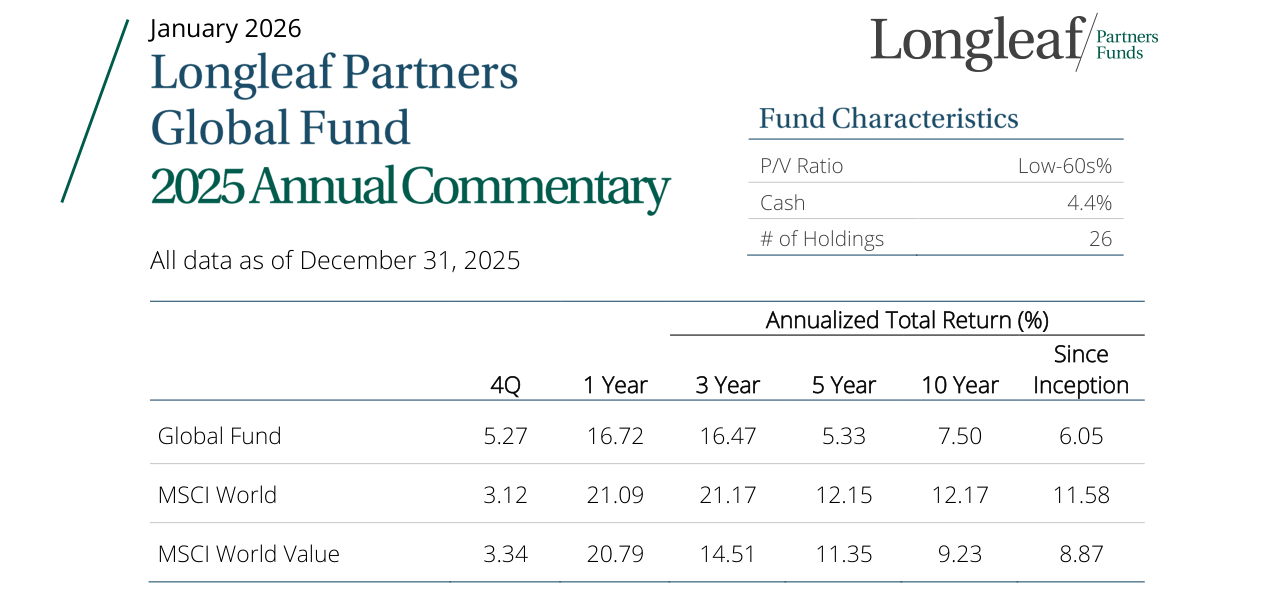
Global Fund 1-year return of 16.72% underperformed MSCI World's 21.09%; 3-year return of 16.47% outperformed MSCI World Value's 14.51%
- Bio-Rad's Short-Term Pain: Bio-Rad's performance was impacted by reduced US government research spending. Positive factors include: significant share buybacks in the first half of the year, avoidance of value-destructive M&A, and operational improvements expected to drive FCF growth in 2026.
- Avantor's Self-Correction: Following a leadership change and guidance downgrade at Avantor, the fund believed the worst might be over. However, for risk control, it chose to exit by year-end and realize the loss. This decision reflects a prudent approach to "self-inflicted downs."
6. Exor's Widening Discount and Potential Recovery
- Data Comparison: In 2025, Exor partially reduced its Ferrari stake at historically high levels (approximately 40% above year-end levels) and used the proceeds to repurchase its own shares via a Dutch auction at a significant holding company discount. Simultaneously, it increased its stake in Philips to approximately 19% (from 15% at the start of the year) and supported CNH's divestiture of two businesses from the Iveco Group.
- Market Misjudgment: Despite a significant increase in per-share intrinsic value from these actions, a tepid market reaction to Ferrari's Capital Markets Day, combined with weakness in Stellantis and CNH shares, led to a decline in Exor's stock price. The fund believes that as expectations for Ferrari reset and other self-help levers within the holding company's assets progress, the holding company discount could narrow significantly from its current high level in 2026.
7. Kraft Heinz's Split Value and Leadership Change
- Data Comparison: The market is overly focused on short-term growth weakness in the North American business, overlooking the value creation potential from the upcoming split into two companies:
- Global Taste Elevation Co. (including the Heinz brand): Expected to command an EBITDA multiple in the teens.
- North American Grocery Business: If it maintains the current overall Kraft valuation multiple, the combined stock price could exceed $40.
- Leadership Advantage: New CEO Steve Cahillane successfully led the transformation of Kellanova/Kellogg's. The fund believes he is the ideal person to lead Global Taste Elevation and assist in selecting the head of the North American business.
8. Portfolio Activity and Liquidity Management
- Merger Effect: Portfolio activity increased significantly following the fund merger. Some positions held at year-end were exited by the time the letter was written. Long-held International Fund positions (e.g., Gruma, Jollibee) were incorporated into the global strategy due to improved liquidity post-merger.
- Position Management: Some positions initiated or introduced via the merger in the fourth quarter have not yet reached full position size, reflecting a prudent building pace.
Summary Table of Comparative Data
| Company/Theme | Key Events | Market Reaction/Data | Fund Actions/Views |
|---|---|---|---|
| Canal+ | Champions League renewal, tax resolution, African platform integration | Stock price does not reflect FCF improvement; insufficient analyst coverage | Long-term value recovery opportunity |
| Glanbia | Discounted buyback of 3% shares, sale of SlimFast/Body&Fit | Largest shareholder's stake reduced from 24% to 18% | Bullish on further strategic steps |
| Millicom | FCF guidance exceeded, leverage target met, dividend and buyback increased | Dividend yield dropped from double digits to single digits | Exited after value gap closed |
| IAC/MGM/Angi | IAC asset divestiture, Angi turnaround post-spin-off, MGM buyback of 40%+ | Exited Angi after stock price reached valuation target | Validated distressed turnaround strategy |
| Bio-Rad/Avantor | R&D spending cuts, leadership changes | Bio-Rad buyback accelerated; Avantor exited by year-end | Risk control prioritized |
| Exor | Reduced Ferrari stake, buybacks, increased Philips stake | Holding company discount widened | Discount expected to narrow by 2026 |
| Kraft Heinz | Spin-off plan, new CEO appointed | Post-merger stock price target >$40 | Bullish on value release from spin-off |