2Q26 Global Fund Commentary
Southeastern Asset Management is a Memphis-based deep-value firm founded in 1975 by O. Mason Hawkins to exploit the bargains left by the 1973-74 bear market. Its flagship Longleaf Partners Funds (launched 1987) invest employees' own money alongside clients'. Following Graham's discipline and its "Business, People, Price" framework, it runs concentrated books of 15-25 undervalued stocks held for the long term — famously closing funds to new investors when opportunities were scarce. CEO and Head of Research Ross Glotzbach now leads the firm, which publishes quarterly Longleaf fund commentaries and Research Perspectives notes.
In plain words
Southeastern's Longleaf Partners fund fell behind the market in Q2 2026 because it avoided overpriced AI stocks. They argue that AI hyped companies now have lower free cash flow (actual profits) than in 2019, while valuations keep rising. For ordinary investors, this means don't chase hot stocks; instead, look for cheap, cash-generating businesses. The report uses clear examples and data to show why the current market is risky and why patience can pay off.
Southeastern (Longleaf Partners) Global Fund Q2 2026 Report The report notes heightened speculative sentiment in the market. The MSCI World Index rose 13.76% in the quarter, while the fund gained only 5.90%, with the relative underperformance primarily stemming from an underweight position in the in
Theme and Background
This section focuses on the performance and investment strategy of the Longleaf Partners Global Fund against the backdrop of heightened speculative sentiment in the equity market during the second quarter of 2026. The report notes that the MSCI World Index rose 13.76% for the quarter, while the Fund gained only 5.90%, with the relative underperformance primarily attributable to an underweight position in the Information Technology sector. The author argues that the valuations of currently popular AI-related stocks have become detached from actual earnings, while the Fund's holdings with low free cash flow (FCF) multiples faced relative pressure during the quarter.
Core Thesis
The author's core investment thesis is that the Fund's absolute and relative returns are merely delayed, not vanished, and come with lower future risk. The current environment calls for avoiding overheated stocks and adhering to value investing. Counter-intuitive judgments include:
- The "Hyperscalers" (Mag7 + Oracle, excluding semiconductor companies) have FCF levels below those of 2019, yet their valuations continue to climb.
- Even the MSCI World Value Index is increasingly driven by AI trends, meaning value stocks have not truly benefited.
- The author believes the market structure has entered a dangerous phase, but political and regulatory responses will lag.
Key Arguments and Data
1. Fund Performance Comparison (Q2 2026):
| Metric | Global Fund | MSCI World | MSCI World Value |
|---|---|---|---|
| 2Q (%) | 5.90 | 13.76 | 9.21 |
| YTD (%) | 1.21 | 9.69 | 10.50 |
| 1 Year (%) | 9.33 | 21.34 | 20.84 |
| 3 Year (%) | 10.49 | 19.24 | 16.85 |
| 5 Year (%) | 2.74 | 11.47 | 10.51 |
| 10 Year (%) | 7.56 | 13.14 | 10.16 |
| Since Inception (%) | 5.91 | 11.90 | 9.33 |
2. Reason for Underperformance: Over 100% of the relative underperformance stems from the underweight in the Information Technology sector. AI-related stocks (including those in sectors like Industrials) have driven the index higher, but actual earnings growth has not kept pace with valuation expansion.
3. FCF Comparison: The "Hyperscalers" (Mag7 + Oracle, excluding semiconductors) have FCF levels below those of 2019 (based on next twelve months data), yet the market still believes in a "perpetual motion machine" model—a cycle of hyperscalers, venture capital, equity, and debt financing driving revenue growth.
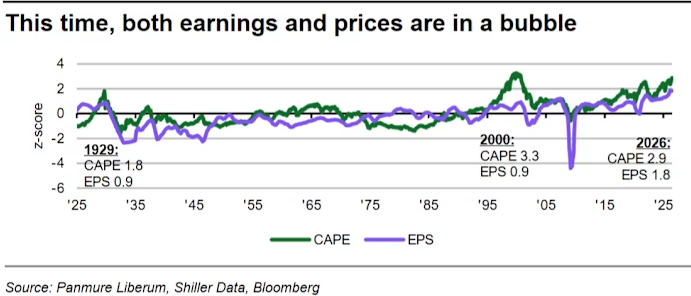
4. CAPE Valuation: The report cites the Cyclically Adjusted Price/Earnings (CAPE) multiple, noting that this is the first time in history that both earnings and multiples have deviated so significantly from their long-term averages, exposing the market to the risk of mean reversion in both multiples and earnings.
5. Market Signals:
- Microsoft publicly expressed "regret" over its OpenAI investment via the WSJ (driven by self-interest).
- Quantitative giant Jane Street proactively contacted the WSJ, hinting at limited room for profit growth.
- Short-term shocks like 2020 (COVID), 2022 (interest rates), and 2025/26 (Liberation Day/Iran war) have all been absorbed by loose monetary policy and the AI boom, allowing the market to continue climbing.
6. Fund Holdings: The Price-to-Value (P/V) ratio is in the mid-50% range, cash stands at 9.0%, and the portfolio holds 20 positions. Low FCF multiple stocks (e.g., Albertsons, Exor) faced relative pressure during the quarter.
Companies/Assets Involved
| Company/Asset | Role | Key Data/Event | Bullish/Bearish |
|---|---|---|---|
| Delivery Hero | Global food delivery platform | Uber increased stake to ~37%, expressed acquisition interest; DoorDash also showed interest; Fund exited after reaching valuation | Bullish (exited) |
| Canal+ | French pay-TV operator | Stock recovered from post-March earnings weakness; Fund took the opportunity to add to position | Bullish |
| Albertsons | Supermarket chain | Low FCF multiple, faced relative pressure during the quarter | Bullish (undervalued) |
| Exor | Investment holding company | Low FCF multiple, faced relative pressure during the quarter | Bullish (undervalued) |
| Microsoft | Tech giant | Expressed "regret" over OpenAI via WSJ | Neutral (implies AI investment overheating) |
| Jane Street | Quantitative trading firm | Proactively contacted WSJ, hinting at limited profit growth | Neutral (market structure warning) |
| Fortune Brands | Home & security products | New CEO appointed; Fund involved in behind-the-scenes communication | Bullish (positive change) |
| Mattel | Toy manufacturer | Fund published an open letter; subsequent communication was good but stock price hasn't reflected it | Bullish (awaiting value realization) |
| MGM/People Inc. | Casino/Human Resources | Management taking action on low valuation | Bullish |
| Empire State Realty Trust | Real estate | Management driving value realization | Bullish |
| SpaceX/Anthropic/OpenAI | Unlisted AI companies | Author's stance on their IPOs is consistent with last year's view on the Fermi IPO (unfavorable) | Bearish |
Investment Implications
1. Adhere to Value Investing: The current market chases AI-related stocks, but their actual FCF is below 2019 levels, and valuations have detached from fundamentals. Investors should avoid chasing highs and instead focus on stocks with low FCF multiples and P/V ratios in the mid-50% range.
2. Focus on Multiple Paths to Value Realization: The Fund can achieve returns through FCF growth, multiple expansion, and strategic actions (e.g., asset sales, acquisitions, management changes), rather than relying on an overall market rally.
3. Beware of Market Structure Risks: The CAPE multiple is at an historical extreme, exposing the market to the risk of mean reversion in both multiples and earnings. Regulatory and political intervention may lag but will eventually arrive; the current accommodative environment is unsustainable.
4. Specific Directions: Focus on low FCF multiple stocks like Albertsons and Exor, as well as holdings where value catalysts have emerged, such as Canal+ (Delivery Hero already exited). Avoid participating in IPOs of unlisted AI companies like SpaceX, Anthropic, and OpenAI.
The following is an analysis of the continuation of the "Introduction" section, maintaining the previous style and focusing on new arguments, data, and viewpoints. It avoids repeating already analyzed sections and outputs only the new content.
New Arguments and Data
- Fortune Brands (FBIN): Management change is a key catalyst. The addition of Jesse Singh (former AZEK CEO), under whose tenure AZEK achieved strong organic growth, margin improvement, share buybacks, and ultimately a sale to James Hardie at 20x EBITDA, combined with Dave Berry (interim CEO) staying on as COO, leveraging his CFO and operational experience, forms a powerful team. This highlights the direct impact of leadership transformation on value creation, rather than relying solely on short-term performance.
- Glanbia: FY26 earnings growth expectations were raised to the top end of prior guidance, driven by double-digit growth in Performance Nutrition and continued momentum in Health & Nutrition, indicating reduced drag from non-core brands following business simplification. Notably, the strategic optionality of Dairy Nutrition remains an additional support for the investment case, but the diminished valuation appeal led to our reduction, reflecting active risk management as the P/V margin of safety narrowed.
- Magnum: Following its spin-off from Unilever, the market initially reacted negatively due to a chaotic first quarterly earnings call and weak annual guidance. However, after improved May results, the market began to recognize its 3-5% revenue growth and margin improvement targets, along with FCF potential exceeding €1.50/share within two years. Additionally, reports of private equity acquisition interest (referencing the successful Froneri case) provide an extra upside catalyst.
- People Inc. & MGM Resorts: People Inc.'s controlling stake bid for MGM is the core event, aiming to achieve per-share value through synergistic growth. MGM's stock price fluctuated with the board's evaluation, while Las Vegas revenue grew for the first time in nearly two years (driven by a strong convention calendar). Meanwhile, the potential privatization of inferior peer Caesars could have multiple positive impacts on MGM, including an improved competitive landscape.
- IDP Education: Despite upgrading FY26 cost-cutting guidance, confirming EBIT targets, and announcing a share buyback program, the stock fell due to policy headwinds (Australia and UK) and passive selling from its removal from the ASX 200 index. However, amidst policy uncertainty, universities' increased demand for high-quality students paradoxically strengthens reliance on quality intermediaries like IDP. We expect IDP to gain market share and utilize levers such as pricing, cost cuts, and entry into the Chinese English testing market to offset volume declines.
- Regeneron: Disappointing pipeline drug trial results led to a stock price decline. Key points: Dupixent (representing over 50% of value) performed above expectations, and Eylea (representing less than 15% of value) has stabilized after initial issues. However, the pipeline success rate was 1/3 (below the expected 2/3), with the market focusing on short-term performance while ignoring the long-term track record. The company used the undervaluation opportunity for share buybacks, avoiding value-destructive M&A, demonstrating prudent capital allocation.
- Albertsons: Comparable store sales were slightly below expectations, with a competitive environment (Walmart and Aldi expansion). However, the defensive business still has room for FCF improvement. Post-quarter, Kroger's acquisition of inferior peer Giant Eagle confirmed our assessment of Albertsons' valuation. This highlights that the value of defensive assets may be underestimated in a sluggish market.
- Jollibee Group: Margin compression in the Philippines due to input cost inflation, combined with removal from the MSCI index, pressured the stock. However, management plans to restore Philippine margins to around 18%, and the international business restructuring may be masking underlying progress. A potential international business spin-off (by end of 2027) and evaluation of alternative listing venues could unlock value, allowing the market to separately value the stable Philippine business and the high-growth international platform.
- CNX Resources: Underperformed in Q2, but no specific data was provided. Focus should be on natural gas price volatility and the company's cost control measures.
Comparative Data Table
| Company | Key Catalyst | Market Reaction | Our Action |
|---|---|---|---|
| Fortune Brands | New CEO Jesse Singh (former AZEK CEO) | Stock price rose | Not mentioned |
| Glanbia | FY26 earnings growth expectations raised to top of guidance | Stock price rose | Reduced (due to narrowing P/V margin of safety) |
| Magnum | Improved May results + PE acquisition interest | Stock price rose | Not mentioned |
| IDP Education | Cost-cutting guidance + share buyback | Stock price fell (policy headwinds + index removal) | Increased |
| Regeneron | Disappointing pipeline trial results | Stock price fell | Reduced (previously reduced during market overheating) |
| Jollibee Group | Margin compression + index removal | Stock price fell | Increased |
| Albertsons | Intense competitive environment | Stock price fell | Not mentioned |
New Viewpoints
- Management Decisions and Long-Term Value: The heavier investment phase in 2026 is viewed by management as a necessary step to support subsequent strong FCF growth. Improving market sentiment suggests investors are beginning to recognize this strategy. This underscores the trade-off between short-term profit sacrifice and long-term value creation.
- Lagging Recognition of M&A Logic: The strategic logic, synergy opportunities, and emerging market exposure of the MultiChoice acquisition remain undervalued, but the market is gradually digesting them. This suggests investors should focus on M&A value that is not yet fully priced in.
- Revaluation of Defensive Assets: Defensive businesses like Albertsons and Jollibee have underperformed in a sluggish market, but transactions like Kroger's acquisition of Giant Eagle could trigger a sector revaluation. The FCF potential of defensive assets remains attractive even amidst heightened competition.
- Technical Impact of Index Removal: IDP Education and Jollibee experienced passive selling due to index removal, but their fundamentals have not deteriorated. This presents an opportunity for contrarian investors, especially if policy headwinds ease.
- Discipline in Capital Allocation: Regeneron's share buybacks during undervaluation, avoiding value-destructive M&A, exemplify capital allocation discipline. This contrasts with Jollibee's spin-off plan, which aims to unlock value through structural optimization.
Summary
The continuation further reinforces the themes of "active management" and "contrarian investing." Key new points include: management changes (Fortune Brands), lagging recognition of M&A logic (MultiChoice), revaluation of defensive assets (Albertsons), technical impact of index removal (IDP Education, Jollibee), and capital allocation discipline (Regeneron). These cases collectively demonstrate that short-term market sentiment can obscure long-term value, and active investors can generate excess returns through in-depth analysis and patient holding.