4Q22 International Commentary
Southeastern Asset Management is a Memphis-based deep-value firm founded in 1975 by O. Mason Hawkins to exploit the bargains left by the 1973-74 bear market. Its flagship Longleaf Partners Funds (launched 1987) invest employees' own money alongside clients'. Following Graham's discipline and its "Business, People, Price" framework, it runs concentrated books of 15-25 undervalued stocks held for the long term — famously closing funds to new investors when opportunities were scarce. CEO and Head of Research Ross Glotzbach now leads the firm, which publishes quarterly Longleaf fund commentaries and Research Perspectives notes.
In plain words
This report covers a fund that invests in non-U.S. stocks during the fourth quarter of 2022. Despite a tough year due to war, inflation, and a strong dollar, the fund rebounded 18.4% in Q4. The key idea: stocks in Europe and Asia are much cheaper than U.S. ones, making them a good buying opportunity. If the dollar weakens, holding European or Japanese stocks could bring extra gains. The report also highlights companies like GRUMA and Richemont that are boosting value through actions like selling assets or buying back shares. If you think U.S. stocks are overpriced, this is worth a look.
The Longleaf Partners International Fund rose 18.4% in the fourth quarter of 2022, outperforming the MSCI EAFE's 17.34%, but declined 18.69% for the full year, trailing the MSCI EAFE's -14.45%. The report argues that while short-term volatility may persist, Asian and European markets began an early-
Theme and Background
This chapter focuses on the performance of the Longleaf Partners International Fund in the fourth quarter of 2022 and the prevailing market environment. The report notes that despite multiple macro headwinds throughout 2022—including the Ukraine war, the energy crisis, surging inflation, a strong U.S. dollar, and China’s zero-COVID policy—early signs of a rebound appeared in Asian and European markets during the fourth quarter. The fund rose 18.4% in the quarter, outperforming the MSCI EAFE’s 17.34%.
Core Thesis
The author’s core investment argument is that non-U.S. markets are currently valued significantly below the U.S. market and enjoy more favorable macro tailwinds; the fund’s P/V ratio is at a historically low level (high 50% range), presenting a compelling opportunity for long-term allocation. Counterintuitive judgments include: 1) The U.S. dollar is overvalued; if conditions reverse, it could provide multi-year tailwinds for European and Asian currencies. 2) In the fourth quarter, the top ten contributors were mostly the largest detractors in the first three quarters, indicating that market sentiment and fundamentals are rapidly recovering. 3) The S&P 500 is overvalued, while non-U.S. markets are cheaper and more attractive.
Key Arguments and Data
- Fund Performance Comparison: The fund returned 18.4% in Q4, outperforming the MSCI EAFE’s 17.34% and the MSCI EAFE Value’s 19.64%. However, for the full year, the fund declined 18.69%, lagging behind the MSCI EAFE’s -14.45% and the MSCI EAFE Value’s -5.58%.
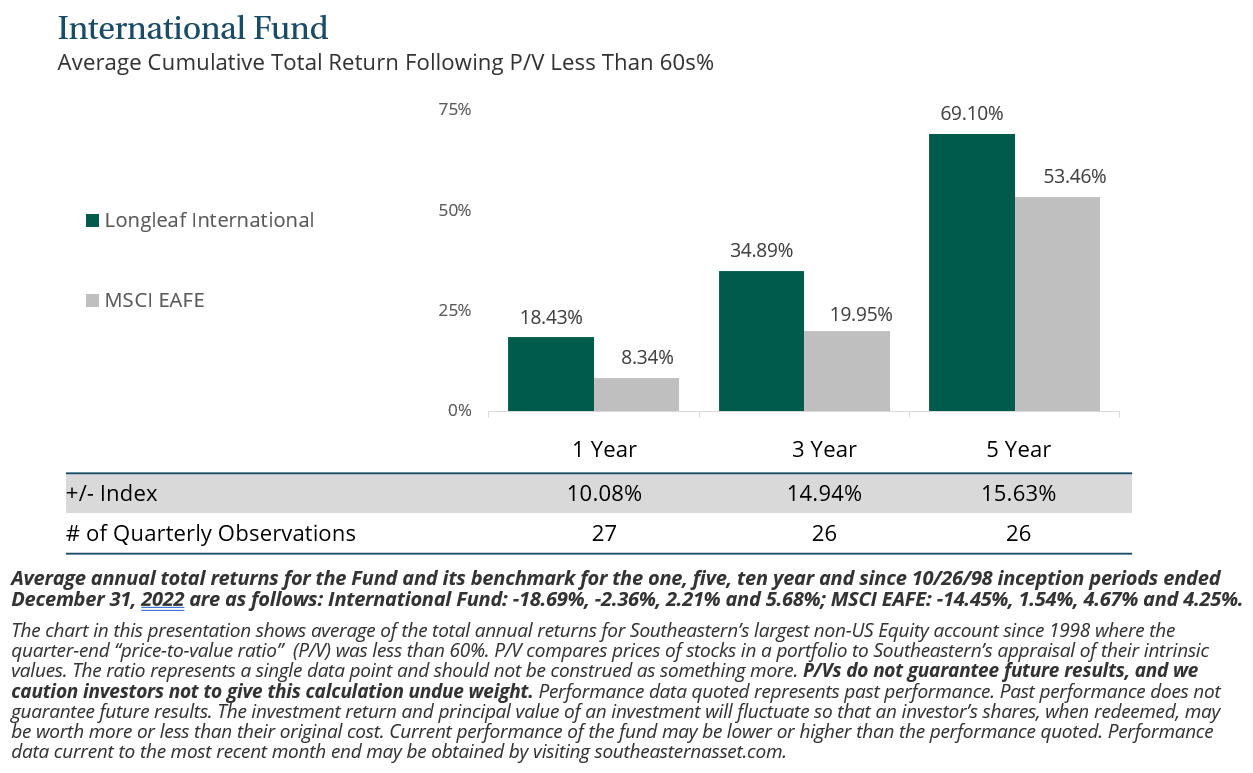
- Valuation Levels: The P/V ratio touched nearly historic lows of 51% in the second half of 2022 and recovered to the high 50% range by year-end. The author believes this has historically been a favorable entry point for investments.
- U.S. Dollar and Exchange Rates: The U.S. dollar depreciated approximately 10% against the Japanese yen in Q4. The author argues that the dollar is overvalued; if conditions reverse, European and Asian currencies could enjoy multi-year tailwinds.
- Macro Environment: China’s exit from its zero-COVID policy, policy support for the real estate and technology sectors, peaking inflation in Europe (October), stabilization of UK gilt yields and the British pound, the European Central Bank slowing rate hikes, and falling natural gas prices all provided support for the market rebound.
- Management Actions: Portfolio companies generally undertook actions such as divestitures, buying back discounted stocks, and mergers and acquisitions to narrow the gap between price and value.
Comparative Data Table:
| Metric | Q4 2022 | Full Year 2022 |
|---|---|---|
| Fund Return | +18.40% | -18.69% |
| MSCI EAFE | +17.34% | -14.45% |
| MSCI EAFE Value | +19.64% | -5.58% |
| USD/JPY Change | Yen appreciated ~10% | Dollar strong all year |
Companies/Assets Involved
- GRUMA (Mexican corn flour and tortilla manufacturer): Q4 return +41%, full year +6%, the largest contributor for both the year and the quarter. The author believes its valuation is lower than inferior peers due to its headquarters being in Mexico. The company published its first ESG report, making ethical and environmental commitments.
- Richemont (Swiss luxury goods company): Q4 return +39%, valuation upgraded by 10%. Benefited from China ending its zero-COVID policy, structural drivers in high-end jewelry (shift from unbranded to branded, emerging market middle-class growth, underpenetration in the U.S. market, and jewelry as an investment asset).
- flatexDEGIRO (German digital broker): Q4 return -20%, full year -70%, the largest detractor. Due to capitalization issues, the fund reduced its position in Q3 and fully exited in December, resulting in a permanent capital loss.
- Domino's Pizza Group (UK): Q4 return +43%, full year -41%. The stock rebounded after a CEO change. The new CEO, Elias Diaz (appointed with the fund’s assistance), brought industry experience and capital allocation discipline. The company increased buybacks and improved market share.
- Millicom (Latin American cable TV company): Full year return -45%, a top-five detractor. Due to a discounted rights offering to acquire the Guatemala business and competitive pressures. In Q4, French telecom investor Xavier Niel took a 7% stake; subsequently, Apollo Global Management and Marcelo Claure were reportedly considering an acquisition, sending the stock up 15% in a single day.
- LANXESS (German specialty chemicals company): Q4 return +39%, full year -34%. Declined in the first half due to the commodity cycle and Russian gas risk, then recovered after selling its DSM engineering materials business, forming a joint venture, raising margin targets, reducing capital expenditure and restructuring costs, leading to a substantial improvement in free cash flow.
Investment Implications
- Non-U.S. Markets Outperform U.S. Markets: The author explicitly believes the S&P 500 is overvalued, while non-U.S. markets (Europe, Asia) are cheaper and have stronger macro tailwinds. Investors should increase allocations to non-U.S. markets.
- Focus on Opportunities with Extreme Valuation Discounts: The fund’s P/V ratio is at historically low levels (high 50% range), which has historically been a good buying opportunity. Investors can position themselves amid current volatility.
- A Weaker Dollar May Provide Currency Tailwinds: If the U.S. dollar’s valuation normalizes, European and Asian currencies could benefit for multiple years. Investors holding non-dollar assets (e.g., European and Japanese stocks) could gain additional returns.
- Concentrate on Companies with Active Management Actions: Examples include GRUMA, Richemont, Domino's Pizza Group, etc. Their divestitures, buybacks, M&A activities are narrowing price-value gaps and are key to value realization.