2Q26 Small-Cap Fund Commentary
Southeastern Asset Management is a Memphis-based deep-value firm founded in 1975 by O. Mason Hawkins to exploit the bargains left by the 1973-74 bear market. Its flagship Longleaf Partners Funds (launched 1987) invest employees' own money alongside clients'. Following Graham's discipline and its "Business, People, Price" framework, it runs concentrated books of 15-25 undervalued stocks held for the long term — famously closing funds to new investors when opportunities were scarce. CEO and Head of Research Ross Glotzbach now leads the firm, which publishes quarterly Longleaf fund commentaries and Research Perspectives notes.
In plain words
This commentary explains how the U.S. small-cap stock market got super speculative in the second quarter of 2026, especially with AI and tech stocks. The fund’s strategy of buying cheap, solid companies caused it to lag behind the market. The author warns against chasing hot stocks and says the market will eventually return to normal. Real examples like Tripadvisor, which rose 29% after selling assets, show that patience pays off. Worth reading if you want to understand why staying calm during a bubble matters.
Southeastern (Longleaf Partners) Small-Cap Fund's Q2 2026 report indicates heightened market speculative sentiment, with the fund's P/V ratio in the mid-50% range, cash holdings at 11.7%, and a portfolio of 16 stocks. The fund posted a Q2 return of -2.47%, trailing the Russell 2000's 21.49% and the
Theme and Background
This chapter focuses on the intensifying speculative sentiment in the U.S. small-cap market during the second quarter of 2026. The report notes that market speculation has escalated further over the past 90 days, with the Russell 2000 Index surging 21.49% in a single quarter, yet fund returns stood at -2.47%, significantly underperforming the benchmark. The author argues that the current market has moved away from fundamental drivers and entered a speculative phase driven by sentiment and capital chasing.
Core Thesis
The author’s core judgment is: Absolute and relative returns are merely delayed, not vanished, and future risks are lower. The counterintuitive point is that while the market broadly chases hot sectors (especially AI-related), the author insists that now is not the time to chase already-risen names, but rather to openly acknowledge that the market has become irrational. The author explicitly states that mean reversion will not disappear, even though this cycle of deviation has persisted for a long time and tested patience.
Key Arguments and Data
1. Market returns are highly concentrated in a few sectors: In the Russell 2000’s second-quarter returns, Information Technology contributed 36%, Industrials 21%, Healthcare 19%, and Financials 13%. The Healthcare sector’s rise was primarily driven by loss-making biotechnology companies, as large pharmaceutical firms began paying excessive premiums for growth.
2. Valuation multiples have expanded sharply:
- The Industrials sector’s P/E ratio rose 10-15% in a single quarter.
- The Russell 2000 IT sector’s P/E ratio increased by over 25%.
- The Russell 2000 Value IT sector’s P/E ratio surged by more than 40%.
3. Volatility has increased significantly: The number of days where the fund’s daily relative return deviated by ±150 basis points from the index was typically only 5-10 days per year in normal years. However, in the second quarter of 2026 alone, there were 11 such days, totaling 21 days in the first half of the year, with a negative bias.
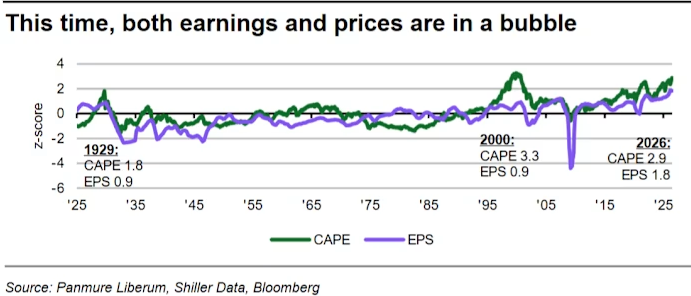
4. Historical valuation extremes: Citing Cyclically Adjusted Price/Earnings (CAPE) data, the report states that this is the first time in history where both earnings levels and valuation multiples have deviated significantly from their long-term averages simultaneously. This means index holders face dual risks: multiple regression and earnings regression.
| Indicator | Current Status | Historical Average/Normal Level |
|---|---|---|
| Russell 2000 IT P/E quarterly increase | >25% | Rare |
| Russell 2000 Value IT P/E quarterly increase | >40% | Rare |
| Industrials sector P/E quarterly increase | 10-15% | Rare |
| Days of daily relative volatility (±150bp) | 11 days/quarter (21 days in H1) | 5-10 days/year |
| CAPE and earnings deviation | First-ever dual deviation | Never occurred |
Companies/Assets Involved
- Microsoft: The author notes that Microsoft has shown signs of regret over its initial legalization of OpenAI (as reported by The Wall Street Journal), suggesting that large tech companies have begun to recognize the overheating risks in AI investment.
- Jane Street: This highly profitable quantitative fund proactively contacted The Wall Street Journal. The author believes this indicates it is struggling to find room for sustained profit growth, a dangerous signal for market structure.
- Liberty Capital (formerly GCI Liberty): The only significant drag on the fund in the second quarter, affected by sentiment around the SpaceX IPO, to be discussed later.
Investment Implications
1. Avoid strategies that chase hot trends: The current market is driven by speculation, not fundamentals. Chasing hot sectors like AI and IT carries extremely high risks, as valuation multiples have become extremely inflated and earnings may not be sustainable.
2. Stick to value investing and wait for mean reversion: The fund’s holdings are more attractive than the market on P/V and P/FCF metrics. Current underperformance is merely a delay, not a permanent loss. Market structure has entered a dangerous zone; once a correction is triggered, value stocks may rebound quickly.
3. Beware of tail risks in index and thematic ETFs: The simultaneous deviation of CAPE and earnings from historical averages means index holders face a double blow. Diversified investment in indices cannot avoid systemic valuation regression.
New Arguments and Data: Multiple Paths to Value Realization in the Portfolio
1. Unique Advantages of a Concentrated Portfolio
Southeastern, through its concentrated portfolio, focuses more on the market median and unweighted multiples (currently more attractive), thereby achieving excess returns across three dimensions:
- FCF per share growth: Even during an economic downturn, gains can be achieved through company-specific organic growth.
- Multiple expansion potential: Current valuation multiples still have upside potential.
- Strategic actions: Value realization is accelerated through active engagement.
Comparative Data: Sources of return for concentrated vs. diversified portfolios
| Source of Return | Concentrated Portfolio (Southeastern) | Diversified Portfolio (Market Average) |
|---|---|---|
| FCF per share growth | Core driver, reliant on stock selection | Dragged by macro, averaged out |
| Multiple expansion | Upside potential for undervalued stocks | Downside risk for overvalued stocks |
| Strategic actions | Active engagement (e.g., board reforms) | Passive waiting for market reversion |
2. Quarterly Repair of the Price-Value Gap
The “abnormal gap between price and value performance” mentioned in the previous quarter has improved this quarter. Typical examples:
- Tripadvisor: Board reforms drove asset sales (TheFork sold to American Express), with the stock rising +29% since the last letter. The transaction price far exceeded the market’s depressed expectations, approaching fair value. Post-sale, the company has a strong net cash position, providing room for strategic options.
- Fortune Brands (held by Partners and Global Fund): Through behind-the-scenes engagement, the company successfully hired a new CEO, and the stock rebounded by the end of the quarter.
Data Support: Tripadvisor stock performance vs. market expectations
| Indicator | Pre-Transaction Market Expectation | Actual Transaction Price | Stock Price Change |
|---|---|---|---|
| TheFork valuation | Depressed | Near fair value | +29% (since last letter) |
| Net cash position | Negative | Strongly positive | Enhanced strategic flexibility |
3. Active Value Realization by Partners
- People Inc./MGM and Empire State Realty Trust: Due to management dissatisfaction with low valuations, they proactively took actions (e.g., asset sales, lease signings).
- Delivery Hero (held by Global Fund): Value was passively realized due to a bidding war.
Comparative Data: Active vs. passive value realization cases
| Type | Case | Result |
|---|---|---|
| Active | Empire State Realty Trust | Asset sale implies remaining business value exceeds current stock price by 2x |
| Passive | Delivery Hero | Bidding war pushes up stock price |
4. Analysis of Key Contributors and Detractors
Contributors:
- Atlanta Braves Holdings: The revenue multiple from the Padres team sale suggests Braves’ value is underestimated, and Braves’ asset quality is superior (e.g., strong real estate operations at “The Battery”). Following the death of former owner Ted Turner, the market expects controlling person John Malone may sell the team, with the stock reacting positively.
- Alexander’s: The sale of non-core assets was completed, and a Target lease signing made the Queens shopping center fully leased. The market finds it hard to ignore its stable FCF and strong balance sheet.
- Empire State Realty Trust: Asset sale implies remaining business value exceeds current stock price by 2x.
Detractors:
- Liberty Capital Corp (formerly GCI Liberty): The market opposed the acquisition of Liberty Latin America voting rights, later resolved by John Malone buying them back at cost. The SpaceX IPO and exaggerated rhetoric dragged on broadband industry sentiment, but the company’s Alaska competitive environment is superior, and the LNG project (supported by 2/3 to 3/4 of Alaskans) provides upside. Current valuation is below 4x EBITDA, making buybacks a wise use of capital.
- Boston Beer: Short-term industry data fluctuations, but Sun Cruiser has entered large chain stores. Its innovation track record and sales team are attractive to potential acquirers. The company continues to repurchase shares at value-accretive prices.
- CNX Resources: Although it has not risen like its highly leveraged peers, its buyback history suggests that stock price pullbacks are buying opportunities. The company’s FCF per share and per-share value are steadily growing.
Data Comparison: Detractor valuations and buyback potential
| Company | Current Valuation | Buyback Action | Catalyst |
|---|---|---|---|
| Liberty Capital Corp | < 4x EBITDA | CEO personal purchases, company Q4 buyback | LNG project, Alaska competitive advantage |
| Boston Beer | Value-accretive price | Ongoing buybacks | Innovative products, potential acquisition |
| CNX Resources | Low valuation | Best buyback performer for years | FCF growth, energy sector rebound |
5. Portfolio Activity and Outlook
- No new buys or exits: Reflects the unique current market dynamics, but the investment pipeline is solid, with cash expected to be deployed after a market shift.
- Outlook: Despite disappointing relative performance over the past 12 months, confidence in the future portfolio is stronger. Multiple value realization paths (organic growth, multiple expansion, strategic actions) are being accelerated through collaboration with management.
Key Data: Weight of portfolio value realization paths
| Path | Expected Contribution | Current Progress |
|---|---|---|
| FCF per share growth | Core | Tripadvisor, Boston Beer, etc. |
| Multiple expansion | Moderate | Liberty Capital, CNX, etc. (low valuations) |
| Strategic actions | High | Tripadvisor asset sale, Fortune Brands CEO change |
Summary
Southeastern realizes value across multiple dimensions through concentrated investing and active engagement. This quarter, contributors (e.g., Tripadvisor, Alexander’s) narrowed the price-value gap via asset sales and operational improvements; detractors (e.g., Liberty Capital, Boston Beer), though affected by short-term sentiment, have safety nets from buybacks and innovation. The portfolio saw no new trades, but the investment pipeline is solid, and future confidence stems from diverse value realization paths.