2Q26 Portfolio Activity & Attribution
Patient Capital Management is a Baltimore asset manager founded in 2020 by Samantha McLemore, CFA — Bill Miller's long-time co-manager (working together since 2002, running the flagship Opportunity Equity strategy since 2014). Continuing the Miller-school contrarian tradition, it practices "time arbitrage": exploiting behavioral mispricing to concentrate in controversial growth names (tech, healthcare, Bitcoin-related) at deep discounts to intrinsic value. Its site preserves Bill Miller's complete 1995-2022 market letters, alongside ongoing quarterly letters and webinars.
In plain words
This report shows how a professional fund manager beat the stock market by 2% in the second quarter of 2026. His big wins came from healthcare stocks (UnitedHealth rose 54%, CVS 45%) and new bets on payment companies like Adyen and Global Payments, which he bought cheap because the market is too worried about competition. The key lesson: sometimes the best opportunities are where the crowd is most pessimistic.
In the second quarter of 2026, the Opportunity Equity Strategy posted a net return of 17.3%, outperforming the S&P 500 index (15.2%). Overweight allocations to sectors such as healthcare and financials, along with individual stocks including UnitedHealth Group (UNH), Precigen Inc. (PGEN), and CVS He
Key Points at a Glance
The author's market outlook is [bullish], believing the market bottom has appeared, that early positioning in the healthcare sector is key to excess returns, and continues to seek undervalued opportunities.
- Strategy net return of 17.3%, outperforming the S&P 500 (15.2%), with the interaction effect contributing the majority of excess returns.
- Healthcare sector surged: UNH up 54.4%, CVS up 45.2%, PGEN among the largest contributors.
- New positions in payments/fintech: Adyen (2027 P/E 16.4x), Global Payments (2027 P/E 6.0x, FCF yield 13%).
- QXO added to on pullback due to short-term construction pressure, targeting over $50 billion in revenue over ten years (current expectation $13.5 billion).
- Closed positions in Noble (exited after Q1 surge of 75.7%) and Dave & Buster's (exited for other opportunities).
Performance vs. Benchmark
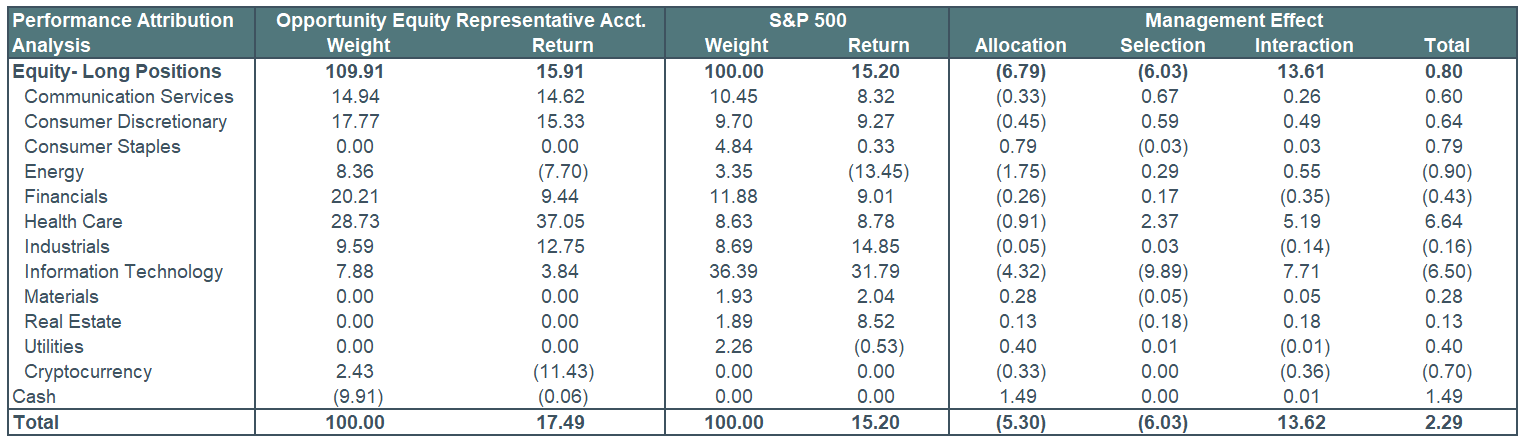
The strategy delivered a net return of 17.3% in Q2 2026, outperforming the S&P 500 index's 15.2%, driven by interaction effects, partially offset by allocation and selection effects.
- Strategy net return: 17.3%; benchmark (S&P 500 index) return: 15.2%.
- According to the three-factor attribution model, interaction effects were the primary source of excess returns, but allocation and selection effects partially offset the outperformance.
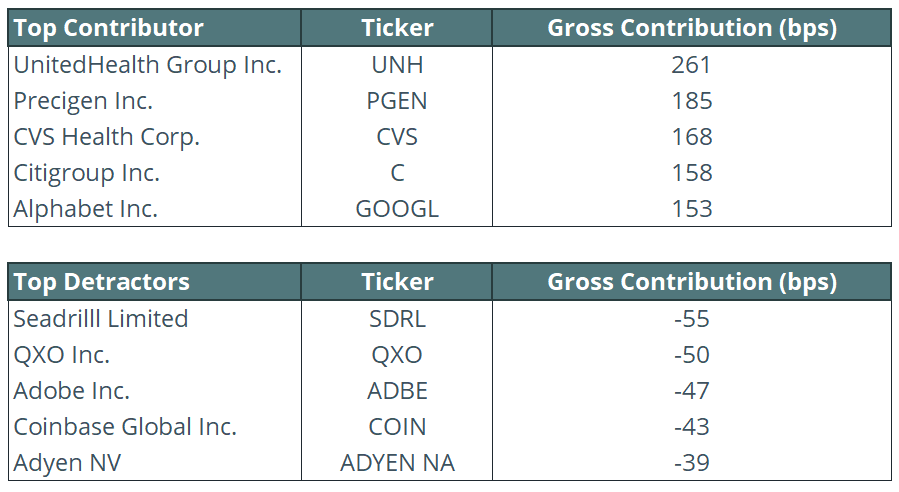
- Largest positive contributors: UnitedHealth Group (UNH), Precigen Inc. (PGEN), CVS Health Corp (CVS), Citigroup Inc. (C), Alphabet Inc. (GOOGL).
- Largest negative contributors: Seadrill Limited (SDRL), QXO Inc. (QXO), Adobe Inc. (ADBE), Coinbase Global Inc. (COIN), Adyen N.V. (ADYEN).
- Relative to the benchmark, the strategy overweighted Healthcare, Financials, Consumer Discretionary, Communication Services, Industrials, and Energy; had zero allocation to Consumer Staples, Materials, Utilities, and Real Estate; and underweighted Information Technology.
- At period end, the portfolio held 38 positions, with the top 10 holdings accounting for 54.8% of assets (benchmark: 36.4%), and an active share of approximately 94.6%.
Core Views
[Bullish] The author believes the market bottom is in, the AI theme has underperformed, an early position in Healthcare was key to outperformance, and they continue to seek undervalued opportunities.
- Market assessment: The author believes the market was near a bottom at the end of Q1, with a strong rebound in Q2 (S&P 500 quarterly gain of 15.2%), the strongest since Q2 2020. However, gains in the AI theme were dispersed, with the Magnificent 7 underperforming the market (up only 11.0% for the quarter), while semiconductor memory stocks (e.g., SK Hynix, Micron, Samsung) rose an average of 190%.
- Strategy view: The author emphasizes that building a position in Healthcare was a bet on the sector becoming attractive in the coming years. While it may be a short-term drag on performance, they believe it is a source of long-term excess returns.
- Difference from market consensus: The author does not chase the AI theme but instead positions early in Healthcare, believing the market is overly pessimistic about the outlook for payments and fintech.
Position Movements
| Instrument | Direction | Core Thesis (One Sentence) | Key Data |
|---|---|---|---|
| Adyen N.V. (ADYEN) | New Position | Market concerns over competition and market share have led to a valuation discount; the author sees it as a long-term compound growth company. | 2027 P/E of 16.4x (adjusted) |
| Fidelity Wise Origin Bitcoin Fund (FBTC) | New Position | Replaces IBIT to maintain long-term Bitcoin exposure. | Bitcoin market cap $1.3 trillion vs. Gold $28.6 trillion |
| Genius Sports Ltd. (GENI) | New Position | Sports data and technology company with exclusive data rights, benefiting from sports betting and advertising trends. | Forward P/E of 15x |
| Global Payments Inc. (GPN) | New Position | Market overly pessimistic on competitive risks; company has low valuation and strong cash flow. | 2027 P/E of 6.0x, free cash flow yield 13% |
| QXO, Inc. 4.75% Convertible Preferred (QXO) | New Position | Entered a convertible preferred position. | Coupon rate 4.75% |
| iShares Bitcoin Trust ETF (IBIT) | Liquidated | Replaced by FBTC. | Not specified |
| Dave & Buster's Entertainment Inc. (PLAY) | Liquidated | Reason not specified. | Not specified |
| Noble Corporation plc (NE) | Liquidated | Reason not specified. | Not specified |
Deep Dive into Key Stocks
UnitedHealth Group (UNH) / CVS Health Corp (CVS)
- Thesis: The author believes both companies have a clear path to improving underwriting margins. Although the earnings recovery is still early, their stock prices have already seen significant increases.
- Evidence: Both stocks fell sharply due to rising medical costs and execution challenges, leading to significant earnings revisions, primarily driven by their Medicare Advantage businesses. The author believes that as the industry raises prices and prioritizes profitability over member growth, the companies can improve underwriting margins.
- Risk: The original text mentions "We are early in the earnings recovery," meaning the earnings recovery is still in its early stages.
- Original Excerpt:
> "We entered UnitedHealth Group (UNH) and CVS Health (CVS) at different times, but for similar reasons. Both stocks sold off sharply as rising medical costs and broader execution challenges drove significant earnings revisions, with Medicare Advantage as a key source of weakness. We believed both companies had a clear path to improve underwriting margins as the industry raised prices and prioritized profitability over member growth. While we are early in the earnings recovery, both stocks have already seen sizable moves."
Precigen Inc. (PGEN)
- Thesis: The author believes the market underestimates the near-term opportunity of its lead RRP drug and the value of its broader pipeline. Despite the stock's rise, the market still undervalues its full potential.
- Evidence: The author led a PIPE investment in the company at the end of December 2024. The company has continued to execute, receiving a J-code in April 2026, orphan drug exclusivity in May, and demonstrating a strong early launch curve.
- Risk: Not explicitly stated, but implied in "early execution" — commercialization uncertainties remain.
- Original Excerpt:
> "Precigen Inc. (PGEN) remains a compelling idiosyncratic biotech names. We led a PIPE investment in the company at the end of December 2024 because we believed the market was underappreciating both the near-term opportunity in its lead RRP (recurrent respiratory papilomatosis) drug and the value of its broader pipeline. Since then, the company has continued to execute, receiving its J-code in April, orphan exclusivity in May, and delivering a strong early launch curve in 2026. Despite the progress, we continue to believe the market is undervaluing the full potential of the RRP asset and the broader platform."
Adyen N.V. (ADYEN) / Global Payments Inc. (GPN)
- Thesis: The author believes market concerns over competitive risks are excessive, leading to a valuation discount and creating a buying opportunity.
- Evidence:
- Adyen: Fell due to competition and market share concerns; adjusted 2027 P/E is only 16.4x. The author views it as a market leader, and negative sentiment provides an opportunity to buy a long-term compounder.
- Global Payments: Competitive risks are overstated; the payments industry remains highly fragmented, and legacy businesses have high stickiness. 2027 P/E is only 6.0x, free cash flow yield 13%, dividend yield 1.3%, and share repurchases reduced shares outstanding by 5.2% in the first half.
- Risk: Not explicitly stated, but implied in "competitive risks" and "market debate."
- Original Excerpt:
> "Global Payments trades at just 6.0x 2027 earnings with a free cash flow yield of 13%. While the market continues to debate its future, the company offers a 1.3% dividend yield and continues to repurchase shares, reducing shares outstanding by 5.2% in the first half of the year."
Outlook and Warnings
The author continues to search for the next undervalued opportunity and has established positions in the payments and fintech space, but does not explicitly mention risk warnings for the next phase.
- Author's expectation: Continuing to look for "the next undervalued opportunity" and has established positions in payments and fintech companies (e.g., Adyen, Global Payments, Chime Financial), believing market expectations are overly pessimistic.
- Risk warning: The original text does not provide explicit risk warnings for the next phase of the market or the overall portfolio.
Performance vs. Market
This period's main detractors are QXO and Seadrill, but the manager maintains high conviction in QXO's long-term return potential and used the pullback to add to the position.
- Detractors: QXO fell 10.9%, Seadrill fell 16.9%, Adobe fell 15.1%.
- Positive contributors: UnitedHealth Group (UNH) rose 54.4%, CVS Health (CVS) rose 45.2%, Precigen Inc. (PGEN) was the main contributor.
- Attribution: QXO's decline stemmed from market concerns over near-term construction activity pressure; Seadrill's decline was due to the pullback in energy prices; Adobe came under pressure from "SaaS-pocalypse" sentiment and AI concerns, which the manager believes do not fully reflect the company's fundamentals.
Core Views
[Optimistic] The manager believes that QXO's long-term value creation opportunity (targeting over $50 billion in revenue within a decade) is not fully reflected in the stock price and used the pullback to add to the position.
- Difference from market consensus: The market is overly concerned about near-term pressure on QXO's construction activity, while the manager focuses on Brad Jacobs' integration strategy and long-term returns.
- On Seadrill: Despite near-term headwinds, the manager is bullish on the offshore drilling market over the long term, believing that industry consolidation and supply constraints will create opportunities.
Position Movements
| Position | Direction | Core Thesis (One Sentence) | Key Data |
|---|---|---|---|
| QXO Inc. (QXO) | New/Add | Participated via a PIPE transaction, betting on Brad Jacobs' integration strategy, believing the market undervalues its long-term return potential. | Conversion price $23.25, dividend 4.75%; acquisitions of Kodiak ($2.25 billion) and TopBuild ($17 billion); target over $50 billion in revenue. |
| Noble Corporation plc (NE) | Closed | Exited after the stock surged 75.7% on the Iran war and Strait of Hormuz closure. | Up 75.7% in Q1. |
| Dave & Buster's Entertainment Inc. (PLAY) | Closed | Exited to invest in other opportunities with better risk-reward profiles. | No specific data provided. |
| Adobe Inc. (ADBE) | Add | Used the Q2 pullback to add, believing AI concerns are overblown and valuation is attractive. | Down 15.1%; free cash flow yield 12%; net repurchased 18% of shares over the past five years. |
Deep Dive on Key Names
QXO Inc. (QXO)
- Thesis: The market underestimates the long-term value creation potential of Brad Jacobs' integration strategy in the highly fragmented building products distribution industry.
- Evidence: Participated in a PIPE in January 2026, receiving convertible preferred securities (dividend 4.75%, conversion price $23.25); QXO used the proceeds to complete acquisitions of Kodiak ($2.25 billion) and TopBuild ($17 billion); target annual revenue exceeding $50 billion within a decade (expected $13.5 billion this year).
- Risks: Near-term construction activity faces pressure.
- Original Excerpt:
> "We continue to view QXO as an attractive investment led by serial entrepreneur Brad Jacobs, who is applying the same playbook he successfully used at previous companies."
> "While near-term construction activity remains under pressure, our conviction in the long-term value-creation opportunity remains intact."
Seadrill Limited (SDRL)
- Thesis: Although under near-term pressure from the energy price pullback, the long-term offshore drilling market is attractive, and industry consolidation and supply constraints will benefit Seadrill.
- Evidence: Down 16.9% in Q2 (after rising 31.5% in Q1); the US reached an interim agreement with Iran and the Strait of Hormuz reopened, shifting market concerns toward oversupply; Seadrill is the third-largest independent offshore drilling company with a clean balance sheet (post-bankruptcy restructuring in 2022); nearly half of all deepwater rigs have been scrapped over the past decade, with limited current capital investment.
- Risks: Near-term energy price volatility and oversupply concerns.
- Original Excerpt:
> "We continue to view the offshore drilling market as attractive over the long term, particularly as growth in land-based oil production slows."
> "At the same time, nearly half of all deepwater rigs have been scrapped over the past decade, and with limited current capital investment, supply growth is likely to remain constrained for years."
Adobe Inc. (ADBE)
- Thesis: The threat of AI to the core creative tools business is exaggerated; valuation is attractive (FCF yield 12%); used the pullback to add.
- Evidence: Down 15.1% in Q2; the manager viewed the "SaaS-pocalypse" trade as an entry opportunity, though entry was too early; Document Cloud and Experience Cloud generate high-margin, low-risk recurring revenue; the company integrates and monetizes AI via the Firefly platform; net repurchased 18% of shares over the past five years.
- Risks: Persistent market concerns over AI disruption.
- Original Excerpt:
> "The stock has been pressured by concerns that AI could disrupt its core creative tools business, but we believe these fears are overblown and that the bar for attractive upside remains low."
Precigen Inc. (PGEN)
- Thesis: The market underestimates the commercialization potential of Papziemos post-approval; the company's valuation is below the value of this single asset.
- Evidence: Received convertible preferred shares and warrants via a PIPE in December 2024; Papziemos was approved in August 2025 (first immunotherapy for recurrent respiratory papillomatosis); obtained a J-code in April 2026 (enabling standard reimbursement path), and orphan drug designation in May (7-year exclusivity); the company expects to be self-sustaining by year-end; market cap is only $2 billion, below the value of Papziemos alone.
- Risks: Consensus revenue estimates underestimate the currently strong launch trajectory.
- Original Excerpt:
> "At today's valuation, the company trades below the value of Papziemos alone, let alone the rest of its pipeline, which continues to advance into pivotal trials."
Outlook and Warnings
- Outlook: The manager expects the market to gradually recognize the value of Papziemos as deliveries remain strong; QXO's long-term integration strategy will continue to advance, targeting over $50 billion in revenue within a decade; Seadrill will benefit from industry consolidation and supply constraints.
- Risk Warnings: Near-term construction activity pressure may continue to affect QXO; energy price volatility may continue to impact Seadrill; AI-related concerns for Adobe may not yet be fully priced in.