Quarterly Market Review 2024
Patient Capital Management is a Baltimore asset manager founded in 2020 by Samantha McLemore, CFA — Bill Miller's long-time co-manager (working together since 2002, running the flagship Opportunity Equity strategy since 2014). Continuing the Miller-school contrarian tradition, it practices "time arbitrage": exploiting behavioral mispricing to concentrate in controversial growth names (tech, healthcare, Bitcoin-related) at deep discounts to intrinsic value. Its site preserves Bill Miller's complete 1995-2022 market letters, alongside ongoing quarterly letters and webinars.
In plain words
This report reviews 2024 U.S. stock market performance. Stocks rose 25% for the second year in a row, driven mainly by the Magnificent Seven (Apple, Microsoft, Amazon, and others) which averaged 60% gains. The Federal Reserve cut interest rates, but long-term bond yields actually went up, showing investors still worry about inflation and government debt. Investor sentiment cooled from extreme optimism to neutral, which is a good starting point for 2025. For ordinary investors, the lesson is not to put all your money in tech stocks, and to prefer short-term bonds over long-term ones.
The U.S. stock market performed strongly in 2024, with the S&P 500 rising 25.0% for the full year, marking two consecutive years of returns exceeding 25% (the first since 1997–1998). The Mag 7 (GOOGL, AMZN, AAPL, META, MSFT, NVDA, TSLA) delivered an average return of 60.6%, with their weight in the
Theme and Background
This chapter reviews the full-year performance of the U.S. stock market and major asset classes in 2024. The report notes that the market achieved returns exceeding 25% for two consecutive years, driven by both earnings growth and valuation expansion—the first such occurrence since 1997–1998. Meanwhile, inflation moderated and the Federal Reserve began cutting interest rates, but long-term rates rose instead, and market expectations for rate cuts in 2025 have narrowed significantly.
Core Thesis
The author’s central judgment is that the market performed strongly in 2024, but structural divergence remained pronounced. The Mag 7 (seven mega-cap tech giants) continued to dominate gains, though market breadth improved after the election. Investor sentiment retreated to neutral levels by year-end, creating a favorable starting point for 2025. A counterintuitive observation: despite the Fed cutting rates by 100 basis points, the 10-year Treasury yield rose from 3.9% to 4.6%, and the 30-year mortgage rate increased from 6.6% to 6.9%, indicating that market concerns over long-term inflation and fiscal outlooks have not subsided.
Key Arguments and Data
- Overall Market Performance: The S&P 500 rose 25.0% for the year, experiencing at least two corrections of 5% or more but setting 57 new all-time highs.
- Mag 7 Dominance: Average return of 60.6% in 2024 (vs. 111.6% in 2023), with index weight rising from 27% to 31.7%.
- Inflation and Employment: CPI fell from 3.4% in December 2023 to 2.7% in November 2024 (touching a low of 2.4% in September); the unemployment rate rose to 4.2% but remained historically low; Q3 real GDP grew 2.7%.
- Fed Policy: A total of 100 basis points in rate cuts for the year, bringing the rate to 4.25–4.50%, but the market only expects an additional 50 basis points of cuts in 2025.
- Investor Sentiment: The Bank of America Bull & Bear Indicator rose to 7 (on a 10-point scale) in October before retreating to a neutral 3.4 at year-end.
2024 Major Index and Asset Returns Comparison
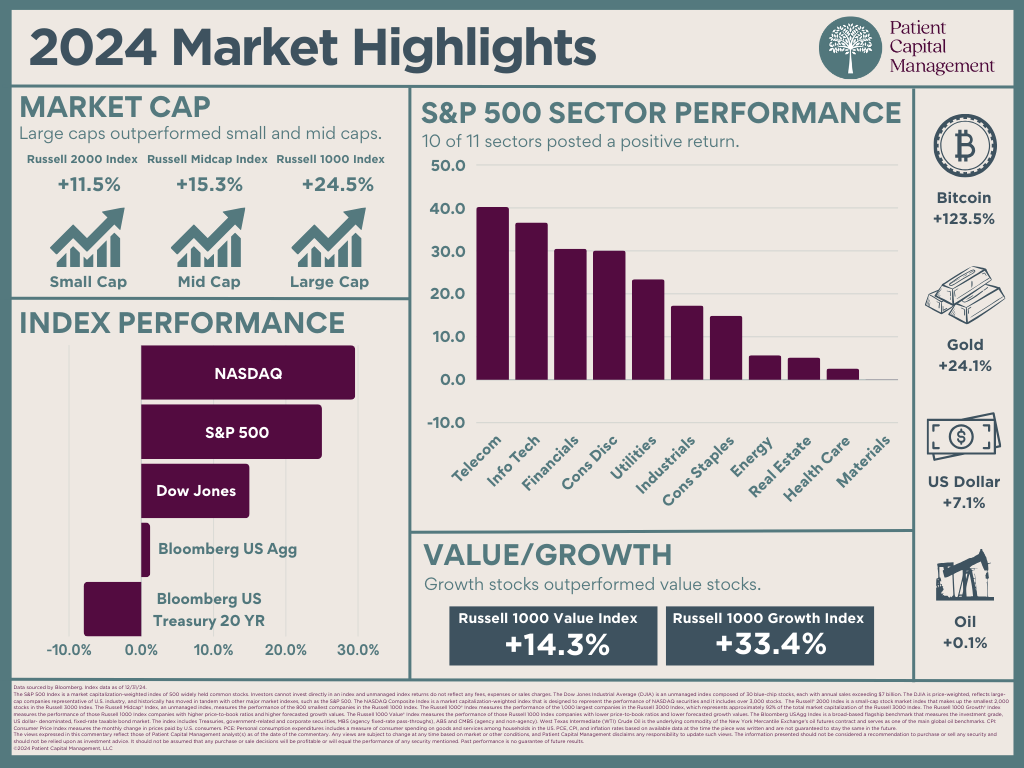
| Asset/Index | 2024 Return |
|---|---|
| Nasdaq Composite Index | +29.6% |
| S&P 500 | +25.0% |
| Dow Jones Industrial Average | +15.0% |
| Russell 1000 (Large-Cap) | +24.5% |
| Russell 2000 (Small-Cap) | +11.5% |
| Russell 1000 Growth | +33.4% |
| Russell 1000 Value | +14.3% |
| Gold | +24.1% |
| U.S. Dollar Index | +7.1% |
| Bitcoin | Year-end $93,714 (hit a record $106,000 in December) |
| 20+ Year U.S. Treasury Bonds | -8.0% |
| Bloomberg Commodity Index | +0.1% |
Companies/Assets Involved
- Mag 7 (GOOGL, AMZN, AAPL, META, MSFT, NVDA, TSLA): Core driving force, with an average return of 60.6% in 2024 and a weight of 31.7%. The report implies a bullish stance.
- Bitcoin: Benefited from post-election momentum, hitting an all-time high of $106,000 in December and closing the year at $93,714. The report does not explicitly take a bullish or bearish view but treats it as a sentiment indicator for risk assets.
- U.S. Treasury Bonds (20+ Year): Fell 8.0% for the year, significantly underperforming corporate bonds (Bloomberg Aggregate Bond Index +1.3%). The report implies a bearish view on long-term Treasuries.
Investment Implications
- Large-cap growth stocks remain a core allocation, but investors should be wary of concentration risk from the Mag 7’s high weight. Market breadth is improving but has not yet fully reversed large-cap dominance.
- Bond allocations should favor short duration or corporate bonds, as long-term Treasuries underperform in a rising rate environment. The Fed’s rate cuts have not lowered long-end yields; market pricing of inflation and fiscal deficits is more critical.
- The retreat in investor sentiment to neutral is a positive signal, offering potential upside for 2025. If sentiment overheats again, caution on correction risks is warranted.