4Q24 Portfolio Activity and Attribution
Patient Capital Management is a Baltimore asset manager founded in 2020 by Samantha McLemore, CFA — Bill Miller's long-time co-manager (working together since 2002, running the flagship Opportunity Equity strategy since 2014). Continuing the Miller-school contrarian tradition, it practices "time arbitrage": exploiting behavioral mispricing to concentrate in controversial growth names (tech, healthcare, Bitcoin-related) at deep discounts to intrinsic value. Its site preserves Bill Miller's complete 1995-2022 market letters, alongside ongoing quarterly letters and webinars.
In plain words
This report covers Patient Capital's investment moves in Q4 2024. Their portfolio returned 8.2%, beating the S&P 500's 2.4%. They bet big on travel stocks (like United Airlines) and fintech (like SoFi), believing these companies still have room to grow. They also bought beaten-down healthcare and energy stocks (like Biogen and CVS) at ten-year lows, and added a Bitcoin ETF, viewing Bitcoin as 'digital gold' with limited supply and rising demand. For ordinary investors, it's worth a look because it shows how they use data to make contrarian bets.
Patient Capital's fourth-quarter 2024 report shows that the Patient Opportunity Equity Strategy delivered a net return of 8.2%, outperforming the S&P 500 index's 2.4%. The core view is that the market continued the soft landing expectations from 2023, with Trump's election driving growth policies. T
Theme and Background
This chapter focuses on the portfolio adjustments, performance attribution, and core investment logic of the Patient Opportunity Equity Strategy in the fourth quarter of 2024. The market environment continued the soft-landing expectations from 2023, and Trump's election further reinforced growth-oriented policy expectations, driving the financial and travel sectors to lead the market.
Core Views
The author believes that market skepticism about the sustainability of travel demand is fading, and high-quality travel stocks (such as DAL, UAL, EXPE, NCLH) will benefit from mean reversion. Meanwhile, fintech companies like SOFI and COIN are in their early life cycles with massive TAM, and their volatility can be actively managed. Additionally, the author has reallocated some profits to lagging stocks in the healthcare and energy sectors (such as BIIB, CVS, RPRX), which are seen as being at decade lows, offering attractive entry points.
Contrarian Judgments:
- Although global air passenger traffic has reached an all-time high, it remains below the implied pre-pandemic trendline, suggesting growth potential is not fully priced in.
- Bitcoin is viewed as digital gold, with a market cap ($1.9T) far below that of gold ($17.9T), and the supply-demand imbalance (limited supply of 21M vs. growing demand) forms a long-term bullish thesis.
Key Arguments and Data
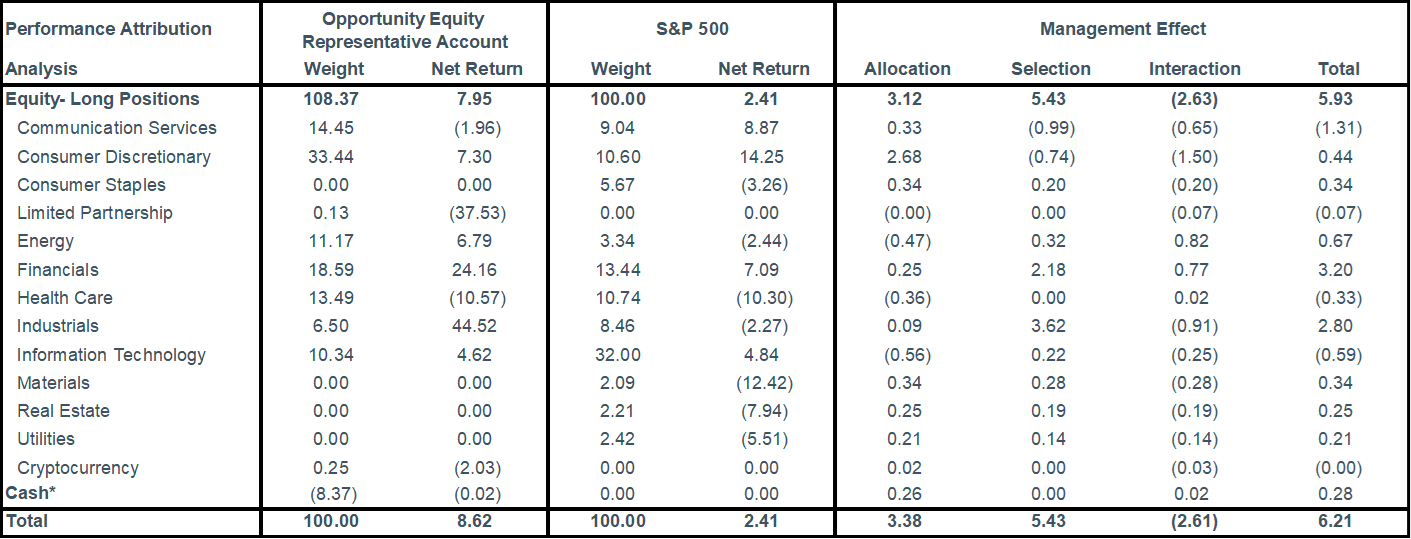
- Performance: The portfolio delivered a net return of 8.2%, outperforming the S&P 500's 2.4%. Three-factor attribution shows that stock selection and allocation effects contributed to excess returns, partially offset by interaction effects.
- Sector Overweight/Underweight: Overweight in Consumer Discretionary, Communication Services, Financials, Energy, and Health Care; zero weight in Real Estate, Utilities, Materials, and Consumer Staples; underweight in IT and Industrials.
- Portfolio Concentration: 37 holdings at quarter-end, with the top 10 accounting for 48.6% (index: 37.3%), and an active share of 94.2%.
- SOFI: Added positions near $6, with the stock rising over 180% from its low, benefiting from rate cuts, customer growth, and the third-party loan platform business (a fee-for-service model with no credit risk).
- UAL: Quarterly gain of 70.2%, driven by demand exceeding expectations and the first post-pandemic share buyback. UAL accounts for approximately 30% of industry profits, and the author expects its share to expand.
- Bitcoin vs Gold: Bitcoin market cap of $1.9T vs. Gold's $17.9T, with a supply cap of 21M and demand growing as accessibility improves.
Comparative Data Table:
| Metric | Portfolio | S&P 500 Index |
|---|---|---|
| 2024Q4 Net Return | 8.2% | 2.4% |
| Top 10 Holdings Weight | 48.6% | 37.3% |
| Active Share | 94.2% | - |
| Asset | Market Cap | Supply Characteristics |
|---|---|---|
| Bitcoin | $1.9T | Cap of 21M |
| Gold | $17.9T | Finite but no hard cap |
Companies/Assets Involved
- SOFI (Bullish): Early-stage fintech company with massive TAM, proven management capability, driven by rate cuts, earnings inflection, and the third-party loan platform. Quarterly contribution of 225 bps.
- UAL (Bullish): Travel demand remains strong, improved customer experience boosts NPS, profit share of approximately 30% with potential to grow. Quarterly contribution of 194 bps.
- COIN (Bullish): Building a crypto ecosystem platform, with progress in wallets, Base, USDC, etc., potentially triggering an adoption tipping point, with a moat widened through continuous innovation.
- DAL, EXPE, NCLH (Bullish): High-quality travel stocks benefiting from demand resilience and mean reversion.
- BIIB, CVS (Bullish): At decade lows, offering attractive risk-reward ratios. Quarterly drag of -68 bps and -94 bps, respectively.
- RPRX (Bullish): Defensive high-quality stock, with a sideways price providing an opportunity to add positions.
- PGEN (New Addition): Early-stage biopharma company, with PRGN-2012 (for RRP indication) potentially becoming a first-in-class immunotherapy. BLA has been submitted, with a priority review decision expected by mid-2025. PIPE transaction secured convertible preferred shares and warrants.
- FBTC (New Addition): Bitcoin ETF, used as a portfolio diversification tool, with a long-term bullish thesis based on supply-demand imbalance.
- Liquidated: FI, PRTC LN, TNL, WAL, with proceeds reallocated to new ideas.
Investment Implications
- Overweight Travel and Financials: Continue holding and adding to travel stocks (DAL, UAL, EXPE, NCLH) and fintech (SOFI, COIN), using volatility to add at lower levels.
- Contrarian Allocation to Healthcare/Energy Laggards: Use profit-taking opportunities to increase exposure to BIIB, CVS, etc., at decade lows, while adding RPRX as a defensive complement.
- Bitcoin as a Long-Term Diversification Tool: Consider allocating a small position via ETFs like FBTC, betting on the digital gold narrative and supply-demand imbalance.
- Monitor PGEN Catalysts: The BLA review decision for PRGN-2012 (mid-2025) is a key event; if approved, it could open the orphan drug market, but note the high volatility of early-stage biotech.
Theme and Background
This section focuses on analyzing the top five positive and negative contributors to the Patient Opportunity Equity Strategy in the fourth quarter of 2024. The report details the underlying fundamental changes in each stock's company, management adjustments, and the author's assessment of its long-term value, aiming to illustrate the logic behind the portfolio's holdings and future outlook.
Core Thesis
The author's core investment thesis is: Short-term market volatility (e.g., CVS's Medicare business issues, Crocs' sub-brand struggles) should not obscure a company's long-term asset value and path to improvement. The author generally takes a contrarian bullish stance on the "problem stocks" in the portfolio, believing the market is overly pessimistic and underestimating the value release potential from management adjustments, business transformations, and asset spin-offs.
Key Arguments and Data
- Peloton (PTON): Rose 85.8% in Q4 and 202.1% from its August low. The company shifted from a growth-oriented focus to a profit and cash flow orientation, successfully turning EBITDA positive, improving inventory, and completing debt refinancing. A third CEO was appointed in October. The author believes its value lies in its high-margin, high-retention subscription business.
- CVS Health (CVS): Under pressure throughout the year due to issues in its Medicare Advantage business. The author believes the problems are well understood, plans for 2025 have begun to adjust, and margin improvements are expected across business segments in 2025. Management upgrades include David Joyner as CEO and former UnitedHealth executive Steven Nelson overseeing the managed care business. The author is bullish long-term on the transition of its asset portfolio (Aetna, Caremark, Signify Health, Oak Street Health) toward a value-based care model. Current dividend yield is 5.8%.
- IAC Inc. (IAC): Declined due to considerations of divesting its remaining stake in Angi Inc. (ANGI). The company's strategy is to slim down and accumulate cash for M&A. The author notes its valuation is highly attractive: its holdings in ANGI, MGM Resorts (MGM) equity, and the company's cash balance together account for 107% of its current market capitalization, meaning its private assets such as Meredith, Vivian Health, Care.com, and Turo are valued at zero by the market. The author believes IAC has a history of spinning off assets and creating value for shareholders.
- Crocs Inc. (CROX): Fell due to lower-than-expected Q4 growth guidance for the Heydudes brand. Since acquiring the brand in 2022, the company has faced issues of market saturation and insufficient brand awareness. In April, former Stanley executive Terence Reilly was appointed to lead the brand, with hopes of replicating his success in revitalizing Stanley. The core Crocs brand continues to grow at a high single-digit rate with margin expansion. The author views the core Crocs product as a consumer staple, with its durability being underestimated. The company's buyback plan is equivalent to 8.5% of its outstanding shares.
Companies/Assets Involved
| Company/Asset | Role | Key Data | Bullish/Bearish |
|---|---|---|---|
| Peloton Interactive (PTON) | Top 5 Positive Contributor | Q4 up 85.8%, up 202.1% from August low; EBITDA turned positive | Bullish, subscription business value is undervalued |
| CVS Health (CVS) | Top 5 Negative Contributor | Dividend yield 5.8%; management upgrades | Bullish, short-term issues are clear, margins expected to improve in 2025 |
| IAC Inc. (IAC) | Top 5 Negative Contributor | Public holdings + cash equal 107% of market cap; private assets valued at zero | Bullish, history of asset spin-offs will continue, value is severely undervalued |
| Crocs Inc. (CROX) | Top 5 Negative Contributor | Core brand growing at high single digits; buyback plan equals 8.5% of float | Bullish, core brand has consumer staple characteristics, Heydudes turnaround possible under new management |
Investment Implications
- Contrarian Opportunities: The report suggests that market pricing for CVS, IAC, and Crocs may be overly negative. Investors can monitor value re-rating opportunities from management changes, business restructuring, or asset spin-offs at these companies.
- Focus on "Hidden Assets": The IAC case illustrates that valuation discounts for conglomerates can create opportunities. Investors should carefully calculate the value of public holdings and cash to determine if private assets are being given away for free.
- Distinguish "Core" from "Drag": For Crocs, the report advises distinguishing between the core brand (a consumer staple with steady growth) and the acquired brand (Heydudes, still in transition). The resilience of the core business serves as a foundation for the stock price, while improvement in the acquired brand represents a potential catalyst.
Theme & Background
This chapter focuses on the specific investment logic and latest developments of certain holdings in the Patient Capital portfolio, covering multiple industries including fintech, aviation, consumer, energy, and healthcare. By analyzing each company’s recent performance, management guidance, and industry trends, the author verifies whether long-term investment hypotheses hold and assesses potential risks.
Core Thesis
The author believes that most core holdings in the portfolio validated early investment logic in the fourth quarter of 2024, particularly companies such as Sofi Technologies (SOFI) and United Airlines (UAL), whose fundamental business improvements far exceeded market expectations. The counterintuitive judgment is that despite market pessimism toward Peloton (PTON) and CVS Health (CVS), the author argues these companies are at inflection points of business transformation or value reassessment, with significant upside potential.
Key Arguments & Data
- Sofi Technologies (SOFI): Added over 1 million new members in Q4 2024, with total members surpassing 10 million; adjusted EBITDA grew over 100% year-over-year, and management issued full-year 2025 profitability guidance for the first time. The author believes its “flywheel effect” (member growth → low-cost capital → loan expansion) is accelerating.
- United Airlines (UAL): Full-year 2024 revenue exceeded $57 billion, a record high; adjusted EPS of $11.80 far exceeded the initial management guidance range of $9-$11. The company expects 2025 adjusted EPS of $11.50-$13.50, indicating sustained growth.
- Peloton (PTON): Achieved positive adjusted EBITDA in Q4 2024 (approximately $20 million), with free cash flow turning positive for the first time (approximately $10 million). Subscriber churn rate fell to a historic low of 1.1%, and management announced its first share repurchase program ($200 million).
- CVS Health (CVS): The medical loss ratio (MLR) for the healthcare benefits segment (Aetna) in Q4 2024 was 85.2%, below the market expectation of 86.5%; however, the company lowered its 2025 adjusted EPS guidance to $5.50-$5.80 (from $6.00+), primarily due to Medicare Advantage cost pressures.
- Energy Transfer (ET): Q4 2024 adjusted EBITDA was $3.8 billion, up 12% year-over-year; capital expenditures were reduced to $1.8 billion (from $2.2 billion in 2023), with a free cash flow yield exceeding 10%.
| Company | Key Metric | Q4 2024 Data | YoY/QoQ Change | Author’s View |
|---|---|---|---|---|
| SOFI | New Members | 1M+ | QoQ +15% | Bullish, flywheel effect accelerating |
| UAL | Adjusted EPS | $11.80 | YoY +40% | Bullish, strong demand |
| PTON | Adjusted EBITDA | $20M | YoY turned positive | Bullish, inflection point in transformation |
| CVS | Medical Loss Ratio (MLR) | 85.2% | Below expectation of 86.5% | Cautiously bullish, near-term pressure |
| ET | Free Cash Flow Yield | 10%+ | YoY +2pct | Bullish, high dividend potential |
Companies/Assets Involved
- Sofi Technologies (SOFI): Core holding, bullish. Member growth exceeded expectations, loan business expanding, clear 2025 profitability guidance.
- United Airlines (UAL): Core holding, bullish. Revenue hit a record high, management raised 2025 guidance, aviation demand remains strong.
- Peloton (PTON): Holding, bullish. Adjusted EBITDA and free cash flow turned positive, subscription business stable, buyback program boosts confidence.
- CVS Health (CVS): Holding, cautiously bullish. MLR in the healthcare benefits segment improved, but Medicare Advantage cost pressures led to a downward revision in 2025 EPS guidance; near-term pressure may persist.
- Energy Transfer (ET): Holding, bullish. High free cash flow yield, declining capital expenditures, strong potential for dividends and buybacks.
- Coinbase (COIN): Holding, bullish. Benefiting from crypto market recovery, Q4 2024 trading volume grew over 50% quarter-over-quarter.
- Amazon (AMZN): Holding, bullish. AWS growth accelerated (Q4 revenue up 19% year-over-year), advertising business continues to expand.
Investment Implications
- Increase exposure to fintech and aviation: The fundamental improvements at SOFI and UAL are sustainable, and current valuations remain below historical averages; recommend adding positions on pullbacks.
- Focus on Peloton’s transformation opportunity: PTON has reached a profitability inflection point, with the subscription business providing stable cash flow. If the stock declines due to market pessimism, it presents a contrarian buying opportunity.
- Be patient with CVS but stay vigilant: Near-term Medicare Advantage pressures may persist for 1-2 quarters, but long-term value (pharmacy + insurance synergy) remains intact; recommend holding and waiting for MLR improvement.
- Energy infrastructure ETF alternative: ET’s high free cash flow yield (10%+) is attractive in a declining interest rate environment and can be considered as a defensive allocation within the energy sector.