Sovereign Contingent Bonds
GMO is a Boston asset manager co-founded in 1977 by Jeremy Grantham with Richard Mayo and Eyk Van Otterloo, known for valuation-driven dynamic asset allocation built on long-horizon mean reversion. Grantham is famous for calling historic bubbles, warning publicly ahead of both the 2000 dot-com crash and the 2008 financial crisis. Flagship publications include the GMO Quarterly Letter (now written by Asset Allocation co-heads Ben Inker and John Pease), Grantham's Viewpoints essays and the 7-Year Asset Class Forecast.
In plain words
This report proposes a new type of bond for emerging countries like Pakistan. Normally, bonds require fixed interest payments. But when a crisis hits (like a flood), the country may default (fail to pay). The idea is to let the country decide to delay payments without triggering a default, saving costly legal fees. For example, Pakistan could use the $600 million it would have paid to help flood victims instead. For ordinary investors, this means future bonds may include such flexible terms. They could reduce default risk but also change how you value the bond. Worth reading because it could reshape how sovereign bonds work.
GMO Research Report: Sovereign Contingent Bonds – Still Practical Two Years On The GMO research report, Sovereign Contingent Bonds: Still Practical Two Years On, discusses the concept of Sovereign Contingent Bonds, which aim to provide emerging nations with debt flexibility during crises. The core a
Theme and Background
This chapter revisits the concept of "Sovereign Contingent Bonds" proposed by GMO in August 2020, which embeds flexible deferral payment clauses in bond agreements to help emerging countries avoid defaults during crises. The report argues that although the concept was not adopted by the market at the time, its value remains significant in the current context of multiple sovereign defaults, particularly for countries like Pakistan that suffer from sudden shocks.
Core Thesis
The author's core investment thesis is that sovereign bonds should introduce discretionary PIK (payment-in-kind) and toggle options, allowing a country to unilaterally defer or capitalize coupon payments in the event of any type of shock without triggering a default. This design is simpler than existing mechanisms (e.g., Barbados' specific event triggers) and saves time and resources for policymakers and bondholders. The counterintuitive aspect is that the author advocates eliminating all preset trigger conditions (such as CDS spreads or natural disaster parameters), leaving the decision to use the deferral option entirely to the issuing country, arguing that market discipline (reputational risk) is sufficient to prevent abuse.
Key Arguments and Data
- Pakistan Case: If its bonds included a PIK clause, it could defer nearly $600 million in debt service over the next year, using the funds for flood relief and avoiding a full default along with associated financial and reputational losses.
- Historical Precedent: Belize recently capitalized short-term coupons via a "consent solicitation," a process involving costly legal and financial advisory fees; the proposed clause would directly eliminate this step.
- Market Mechanism: The PIK option allows skipping only two consecutive coupon payments once over the bond's life, limiting abuse risk—if a government uses it in a non-crisis year, it would expose itself as an irresponsible fiscal manager, leading to higher bond spreads.
- Comparison with Existing Instruments:
| Instrument Type | Trigger Mechanism | Flexibility | Cost |
|---|---|---|---|
| Traditional PIK/toggle bonds (high-yield market) | Issuer discretion | High, but with harsh terms (significant future rate increases) | Substantially increases future debt service burden |
| Contingent convertible bonds (bank cocos) | Regulatory trigger (e.g., capital adequacy ratio) | Moderate, allows coupon skipping without bankruptcy | Complex design |
| Author's proposed "sovereign coco" | Fully discretionary | Highest, limited to one two-coupon deferral | No net present value loss (assuming no additional risk discount), minimal impact on initial issuance yield |

Companies/Assets Involved
- Pakistan: Current case, hit by floods; adopting a PIK clause could defer $600 million in debt service. The author does not explicitly take a bullish or bearish stance but argues the clause could prevent default.
- Belize: Recently capitalized coupons via consent solicitation, demonstrating the high cost of existing processes; the author uses this to argue for the value of simplified clauses.
- Ecuador: Mentioned as a case where a PIK clause might have avoided its 2020 default (by providing sufficient liquidity relief).
- Lebanon, Argentina: Explicitly excluded—Lebanon's debt was already unsustainable before the crisis, and Argentina's willingness to pay is questionable, with domestic politics viewing bondholders as adversaries. The author believes PIK clauses would be ineffective for such countries.
Investment Implications
- For Emerging Market Bond Investors: Focus on whether future debt restructurings include PIK/toggle clauses. Current defaults in multiple countries (e.g., Sri Lanka, Zambia) offer a "reset" opportunity; new bonds may incorporate such flexibility, and investors need to assess its impact on cash flows and risk premiums.
- For Sovereign Issuers: Recommend proactively including a PIK option at initial issuance, trading a low cost (barely increasing issuance yield) for a liquidity buffer during crises. The author emphasizes that this clause is most effective for short-term liquidity crises (not long-term debt unsustainability).
- For Policymakers: This proposal could resolve the "free-rider" dispute between official creditors (e.g., DSSI) and private bondholders—bondholders provide relief voluntarily through PIK clauses, rather than relying on official sector bailouts.
Theme and Background
This section discusses the "most extreme" end of the sovereign contingent bond spectrum—the pure debt forgiveness option (Forgiveness Option). The author positions it opposite the PIK (payment-in-kind) option, analyzing the cost-benefit trade-offs for both the issuing country and investors. The context is that emerging nations require more flexible debt instruments during crises, but different clauses have significantly varying impacts on credit risk.

Core Argument
The author argues that the Forgiveness Option is the most costly debt flexibility clause, as it requires investors to completely forfeit recovery rights (no PIK, no capitalization) after the issuer skips coupon payments. This design is essentially "pure debt forgiveness," so the issuer must pay a significantly higher coupon premium to attract investors. This judgment runs counter to market consensus: the market typically views "flexibility clauses" as favorable to issuers, but the author points out that extreme flexibility (such as full forgiveness) sharply increases financing costs due to a steep rise in credit risk.
Key Arguments and Data
- Clause Design: Allows skipping two consecutive semi-annual coupons (i.e., no interest payment for one year), with no recovery mechanism for bondholders (no conversion to principal, no interest accrual).
- Cost Comparison: Compared to the PIK option (which allows interest capitalization), the Forgiveness Option imposes a higher additional yield cost on the issuer, as investors bear a greater risk of principal loss.
- Market Logic: Investors demand compensation for "certain losses"—skipping coupons without recovery is equivalent to directly reducing the bond's expected cash flows, so it must be priced through an initial issuance premium.
| Clause Type | Treatment After Skipped Coupons | Risk to Investors | Cost to Issuer |
|---|---|---|---|
| PIK Option | Interest capitalized, increasing principal | Delayed payment, but no principal loss | Moderate (requires PIK premium) |
| Forgiveness Option | Interest fully forgiven, no recovery | Direct loss of coupon income | Highest (requires significantly higher coupon) |
Companies/Assets Involved
This section does not mention specific companies or sovereign bond issuers, focusing instead on a general analysis of bond clause design. However, the implicit reference is emerging market sovereign bonds (e.g., countries like Pakistan and Sri Lanka that have experienced debt crises). If these countries adopt the Forgiveness Option, they must weigh the trade-off between "short-term liquidity relief" and "a surge in long-term financing costs."
Investment Implications

- For Issuers (Emerging Nations): The Forgiveness Option should be avoided unless facing an extreme liquidity crisis with no other financing channels. Its high coupon cost may offset the short-term benefits of debt relief and could even lead to a closure of future financing markets.
- For Investors: If encountering bonds with a Forgiveness Option, investors should demand a yield significantly above market averages (e.g., 200–300 basis points higher than comparable PIK bonds) to compensate for the certain risk of coupon loss. Such bonds are more suitable for high-risk-tolerant, yield-seeking hedge funds rather than traditional fixed-income investors.
- Policy Recommendations: In debt restructuring, the PIK option is preferable to the Forgiveness Option—it provides flexibility without completely undermining the bond's credit foundation. The author implies that the current market should promote PIK clauses over extreme forgiveness clauses.
Theme and Background
This chapter focuses on the design and pricing of the "Deferral Option" in sovereign contingent bonds. This option allows the issuing country to defer coupon payments for any two consecutive semi-annual periods, with a lump-sum repayment at maturity. The author positions it as a compromise between the "Capitalization Option" and the "Forgiveness Option," quantifying the additional yield premium that issuers must pay to obtain this flexibility.
Core Argument
The author's central judgment is that the "insurance premium" for the deferral option is significantly lower than that for the forgiveness option, making it more feasible for sovereigns with medium credit quality (e.g., single-B rated). For issuers with high credit ratings (4% coupon), the additional cost of this option (0.1% per annum) is low enough to be attractive during natural disasters or fiscal shocks. For issuers with low credit ratings (8% coupon), the 0.6% premium, though higher than the capitalization option, may still be acceptable. The author believes that while the capitalization option is the most cost-effective, the deferral option strikes a balance between flexibility and cost.
Key Arguments and Data
The author uses a simple cash flow model, assuming three scenarios (short-term, medium-term, long-term) to estimate the timing of when issuers utilize coupon relief. Investors tend to demand a premium based on the worst-case scenario (i.e., immediate use in the first year). The core data is presented in the table below:
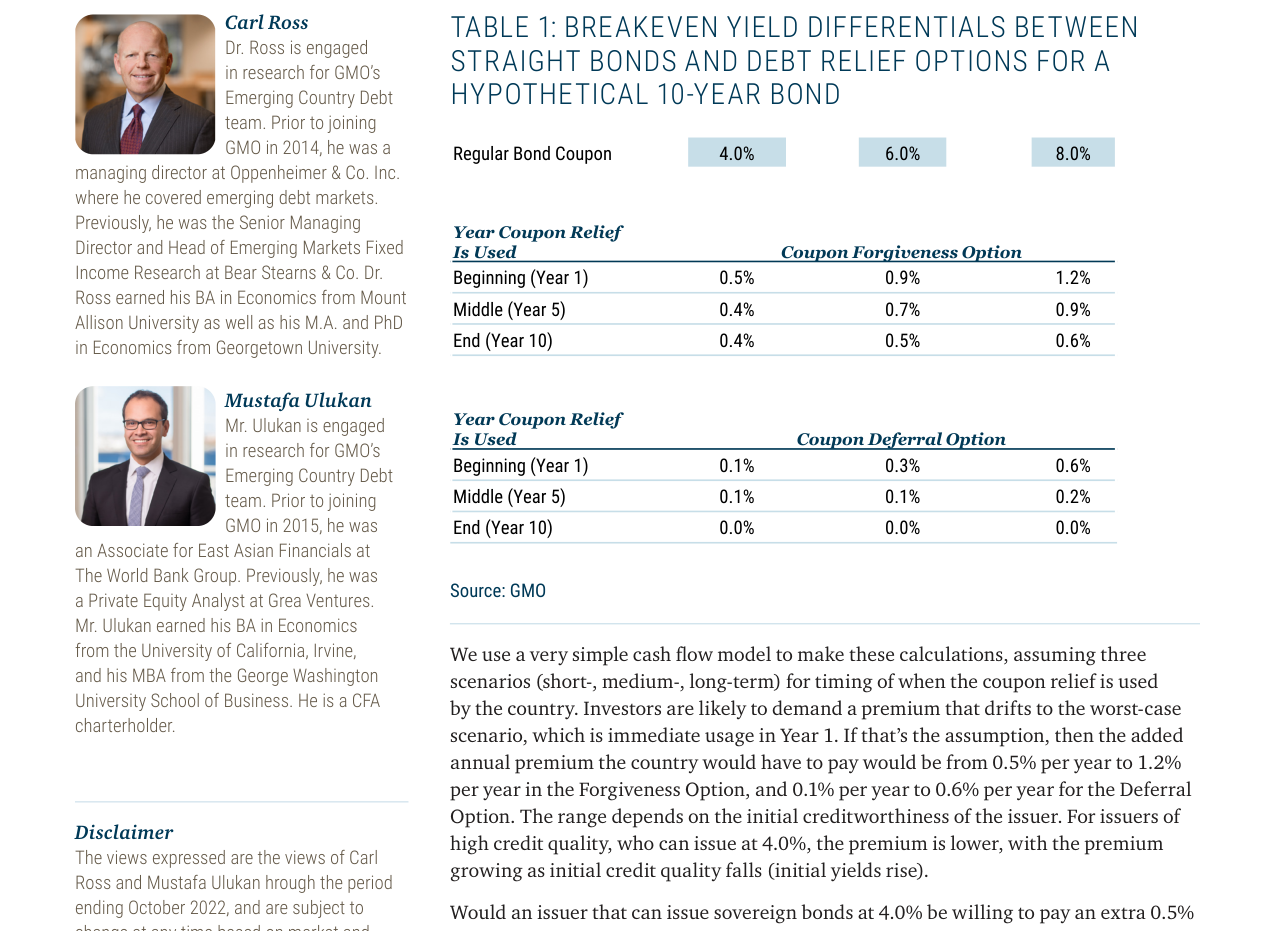
The table compares breakeven yield differentials between straight bonds with coupon rates of 4.0%, 6.0%, and 8.0% and two debt relief options, showing that the coupon forgiveness option requires an additional yield premium of 0.5%-1.2%, while the coupon deferral option requires only 0.0%-0.6%
| Bond Type | Straight Coupon | Forgiveness Option Premium (First-Year Use) | Deferral Option Premium (First-Year Use) |
|---|---|---|---|
| High Credit Quality | 4.0% | 0.5% | 0.1% |
| Medium Credit Quality | 6.0% | 0.9% | 0.3% |
| Low Credit Quality | 8.0% | 1.2% | 0.6% |
- Premium Range: The additional annualized premium for the forgiveness option ranges from 0.5% to 1.2%, and for the deferral option from 0.1% to 0.6%. The premium increases as initial credit quality declines (initial yield rises).
- Scenario Sensitivity: If the use is delayed to the 5th or 10th year, the premium further decreases. For example, the deferral option premium for an 8% coupon bond drops to 0.0% in the 10th year.
- Cost Comparison: The cost of the deferral option is lower than that of the forgiveness option (as it involves no principal reduction) but higher than the capitalization option (which adds almost no extra premium).
Companies/Assets Involved
This chapter does not mention specific companies or sovereign bond issuers. Instead, it uses hypothetical "4.0% coupon issuers" (investment grade) and "8.0% coupon issuers" (single-B rated) as analytical subjects. The author implies that in 2022, many countries with market access (e.g., those affected by natural disasters, such as Pakistan) could benefit from the deferral option.
Investment Implications
- For Investors in High-Rated Sovereign Bonds: The premium for the deferral option (0.1%/year) is extremely low and can be viewed as cheap insurance. Investors should accept such terms to provide issuers with financial flexibility during extreme events, thereby avoiding disorderly defaults.
- For Investors in Low-Rated Sovereign Bonds: Although the 0.6% premium is higher than the capitalization option, it still offers a cost advantage over the forgiveness option (1.2%). Investors can demand that issuers prioritize the deferral option over direct debt forgiveness to reduce the risk of principal loss.
- For Bond Designers: The deferral option offers the best compromise between cost and flexibility, making it particularly suitable as a "reset" tool to be incorporated into new bond agreements during periods of high default frequency (e.g., the multi-country debt restructuring in 2022).