Bonsai Partners Q4 2023 Letter
Bonsai Partners is a one-person boutique partnership founded in 2018 by Andrew Rosenblum (ex-Matrix Capital) near San Diego, California. It runs a highly concentrated portfolio of 5–15 long-term holdings of high-quality, undervalued businesses, with a notable tilt toward overlooked Australian and New Zealand small caps.
In plain words
This is Bonsai Partners Fund's Q4 2023 letter. The big change: the manager barely traded this year. He raised the bar for new investments, making it harder to swap stocks, so the portfolio stayed stable. The fund returned 21.5% in 2023, lagging the S&P 500's 26.3%, but the manager says stability is the real win. He also built automated tools to reduce constant checking. For regular investors, this means the fund is entering a 'steady phase' with lower turnover, letting the manager focus on deep research. Worth reading because it challenges the idea that short-term underperformance is bad—it can be a sign of getting better.
This report discusses the performance of the Bonsai Partners Fund in the fourth quarter of 2023 and for the full year. The core view is that the portfolio has stabilized, turnover has significantly decreased, and the "leaky bucket" problem has been successfully addressed. Key conclusions: In Q4 2023
Theme and Background
This chapter serves as the introductory section of the Bonsai Partners Fund Q4 2023 investor letter, focusing on the fund's overall performance and portfolio changes throughout 2023. The report notes that 2023 marked the first time the portfolio remained relatively stable, contrasting sharply with the significant repositioning in prior years. It discusses efforts to reduce turnover and address the "leaky bucket" problem.
Core Thesis
The author's core investment argument is: by continuously improving investment quality and proactively raising the "opportunity cost" of rebalancing, portfolio turnover naturally declines, converging toward a long-term holding goal. A counterintuitive conclusion is that although the fund's full-year net return of 21.5% underperformed the S&P 500's 26.3% in 2023, the author believes improved portfolio stability is the most important advancement, offering greater long-term value than short-term excess returns.
Key Arguments and Data
- Quarterly and annual performance comparison: Q4 net return of 12.3% (slightly above the S&P 500's 11.7%); full-year 2023 net return of 21.5% (below the S&P 500's 26.3%); however, since inception (October 2018), the annualized net return stands at 26.3%, significantly exceeding the S&P 500's 13.1%.
- Portfolio stability changes: 2023 was the first year since the fund's inception that the year-end portfolio closely resembled the beginning-of-year portfolio. In the prior four years, multiple portfolio shifts occurred due to discovering new ideas, correcting mistakes, navigating macroeconomic conditions, and improving capabilities.
- "Leaky bucket" problem improvement: By raising investment quality and setting a higher hurdle rate, the fund reduced the drain of time and energy caused by inefficient rebalancing.
- Tool/system development:
- Updated the watchlist system (approximately 100 stocks), using JavaScript and market data sources to automatically alert when internal return thresholds are met, replacing manual frequent checks.
- Created a portfolio monitoring tool that automatically alerts when significant price changes occur in holdings, reducing the distraction of checking stocks multiple times daily.
Historical performance comparison table (data from the original text):
| Year/Period | Bonsai Net Return | S&P 500 Total Return |
|---|---|---|
| 2023 | 21.5% | 26.3% |
| 2022 | -27.3% | -18.1% |
| 2021 | -14.8% | 28.7% |
| 2020 | 247.9% | 18.4% |
| 2019 | 56.1% | 31.5% |
| 2018 (partial) | -17.7% | -8.6% |
| Since inception (Oct 2018) annualized | 26.3% | 13.1% |
Companies/Assets Involved
This chapter does not mention any specific listed companies or investment targets. The only external system referenced is Bloomberg, but this is a tool citation, not an investment object. The report focuses entirely on the fund's own portfolio management behavior and performance disclosures.
Investment Implications
For current or potential investors in Bonsai Partners Fund, this means: the fund has entered a "stabilization phase," where turnover will be significantly lower than in the previous four years, allowing the manager to devote more energy to deep research rather than frequent rebalancing. Investors should focus on the sustainability of the fund's long-term excess return capability (annualized 26.3% since inception vs. the S&P 500's 13.1%) and accept the potential cost of short-term underperformance relative to the market. Meanwhile, the author's investment in system development (e.g., automated watchlists) improves efficiency, which may indirectly support future stock selection quality. Short-term underperformance is not a sign of strategy failure, but rather a normal part of the portfolio quality upgrade process.
Theme and Background
This chapter discusses the upgrade of the Bonsai Partners Fund's portfolio management framework. The report notes that, in addition to the existing portfolio monitoring tools, the fund has introduced three new institutional constraints: a new underwriting framework, additional position exposure limits, and updated thinking on buying pace. The aim is to stabilize the investment decision-making process and reduce emotional trading through stricter discipline.
Core Thesis
The author's core judgment is that these "guardrails" will significantly improve the quality of future decisions and ensure the portfolio always operates in the right direction. The implicit contrarian view is that actively managed funds should not rely excessively on flexible position adjustments, but should instead constrain their own behavior through preset rules in exchange for long-term compounding effects.
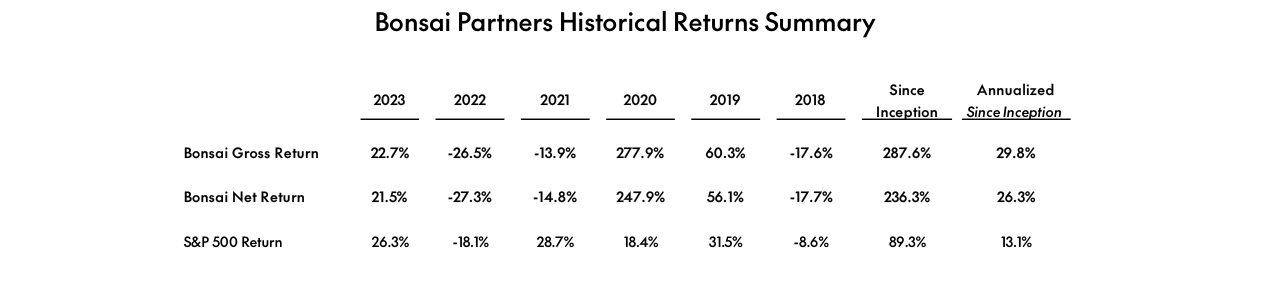
Bonsai Partners Fund: 2023 net return of 21.5%, gross return of 22.7%; since inception, annualized net return of 26.3%, cumulative return of 236.3%; over the same period, the S&P 500 annualized return was 13.1%
Key Arguments and Data
This chapter does not provide specific numbers or comparative tables, focusing instead on framework descriptions. The core data support comes from results mentioned earlier: Q4 2023 net return of 12.3% vs. the S&P 500's 11.7%; full-year net return of 21.5% vs. 26.3%; since inception annualized return of 26.3% vs. 13.1%. These results validate the need for framework adjustments. The new framework elements covered in this section include:
- Underwriting Framework: Each new investment target must pass a standardized risk assessment model.
- Exposure Limits: Hard caps on single positions, sectors, or themes.
- Buying Pace: Defined minimum time span and price gradients for position building, to avoid chasing rallies.
Companies/Assets Involved
This chapter does not mention any specific companies or assets.
Investment Implications
The implication for investors is that the core strength of a top fund manager lies not only in stock selection, but also in building a self-correcting system. Investors should focus on whether managers have a clear investment discipline framework (e.g., exposure limits, buying pace), rather than just short-term rankings. Specific direction: prioritize actively managed funds that have quantitative constraint mechanisms and a steadily declining turnover rate.
Theme and Background
This chapter focuses on the evolution of investment discipline at Bonsai Partners Fund, particularly through the establishment of a "Decision Journal" to strengthen accountability when buying, selling, or abandoning an idea. The core case is the fund's liquidation of its long-held Elastic stock, not because of deteriorating business fundamentals, but due to a shift in the fund manager's own investment philosophy—making this the chapter's most important thought experiment.
Core Thesis
The author Andrew Rosenblum's central judgment is: The strongest reason to sell a stock is not that the company has deteriorated, but that the investor has become more mature, and the old position no longer fits the new framework.
The counterintuitive conclusion is: Making money on Elastic does not mean the investment was correct. Even if the original investment thesis still holds and the company's outlook remains positive, as long as the asset no longer aligns with the "aperture" of the current investment framework, it should be firmly liquidated.
Key Arguments and Data
The report uses "narrow aperture vs. wide aperture" as an analytical framework to measure an investment's ability to adapt to various possible future outcomes.
| Comparison Item | Elastic (Narrow Aperture) | Ideal Position (Wide Aperture) |
|---|---|---|
| Adaptability to Technological Environment | Weak—relies on the current search technology landscape remaining unchanged | Strong—can adapt to any direction of technological waves |
| Number of Future Paths | Few—only succeeds if the future looks like today | Many—can capture any future outcome |
| Example | Hard-to-change product architecture, heavily impacted by AI | Companies like Nagarro can naturally adapt to the winning technology |
The report points out that the rise of AI is a clear signal: the search technology landscape may shift rapidly. Although Elastic can still benefit from AI trends in the near term, the author judges that the probability of "correctly guessing the next technological wave" is too low to be worth betting on. In practice, the fund sold about one-third of its position at the beginning of Q4, and after the stock rose following the company's early-December earnings release, it liquidated the remainder. The author views this as luck—using a profitable position to correct a "mismatched" holding.
Companies/Assets Involved
- Elastic (ESTC)—Liquidated. The author acknowledges that the company's current state is no different from when the initial investment was made, and the original thesis (open-source network effects, longevity of database software) still holds. However, its product architecture's high vulnerability to technological change no longer fits the new "wide aperture" preference. Role: Liquidated target. Bearish but not negative.
- Nagarro (NA9.DE / not directly mentioned in the report but cited as a comparative benchmark)—Cited as a positive contrast case, representing a company that can adapt regardless of which technology ultimately wins. Role: Benchmark. Bullish.
Investment Insights
For investors, the true takeaway from this section is: Check whether your holdings are of the "narrow aperture" type. If you hold such a company, even if the current logic still holds and the stock price is still rising, you should consider reassessing the allocation and examine the position against the standard of "can I make money even if I cannot correctly predict the future?" More specifically, for investors holding Elastic or similar software companies that depend on a specific technology path, the author essentially warns that they may be at a disadvantage in the next round of AI or search technology reshuffling, and the current rally may mask this structural risk. Liquidating is the rational choice that aligns with one's own evolution.