Passive’s Massive AI Gamble (June 2026)
The Capital Cycle is the official podcast that Marathon Asset Management (the London firm founded in 1986) launched in 2024, hosted by financial historian Edward Chancellor, who interviews Marathon's investors about each Global Investment Review letter — applying the firm's long-term, contrarian "capital cycle" supply-side approach.
In plain words
This report argues that passive investing (like index funds) isn't neutral—it actually pushes up prices of the biggest stocks, especially tech giants, because index funds must buy them in proportion to their size. For ordinary investors, this means owning an index fund might be riskier than it seems: everyone holds the same stocks, so if the AI craze fades, those giants could crash hardest. Worth reading because it suggests looking beyond popular indexes to find overlooked, solid companies that aren't part of the hype.
The Capital Cycle report examines the issue of index tracking error in passive investing. Its core argument is that index funds are not innocuous "free riders"; their capital flows create larger price impacts on large-cap stocks, forming a self-reinforcing cycle. Data shows that 16 of the 20 largest
Theme and Background
This chapter challenges the core assumption of passive investing—that index funds are merely "free riders" on price discovery and do not participate in pricing. The author argues that capital flows into passive funds have materially affected prices, particularly creating a disproportionate price impact on the largest market-cap companies in the index, forming a self-reinforcing cycle.
Core Arguments
- Passive investing is not neutral: Inflows/outflows from index funds have a greater price impact on large-cap stocks than on small-cap stocks, causing index weights to be determined by liquidity and fund flows rather than the fundamental value of the companies.
- Pricing power has shifted away from traditional active investors: Passive funds, retail investors, market makers, and high-frequency traders have become the dominant pricing forces, with only 6% of trading volume coming from long-only institutional investors (Q3 2025).
- Concentration risk is underestimated: The top 9 companies in the index (37% weight) are all involved in the semiconductor business, and all investors hold the same portfolio, facing highly synchronized selling pressure in the event of a downturn.
Key Arguments and Data
1. Liquidity Paradox: In the MSCI US Index, 16 of the top 20 companies have daily liquidity (as a percentage of free float market cap) lower than the index average. This means an equal amount of index flows has a greater price impact on the largest companies.
2. Passive vs. Active Fund Comparison (Data from Morningstar):
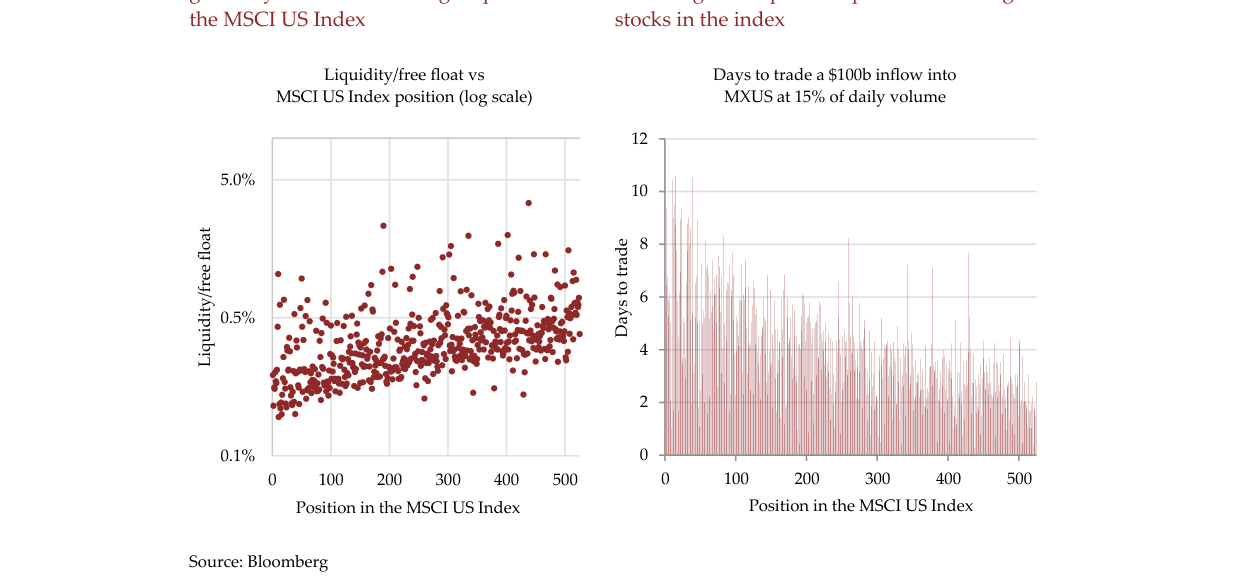
Liquidity as a percentage of free float for MSCI US Index constituents declines significantly as position ranking increases (large caps), with the scatter showing large-cap liquidity generally below 0.5%
| Metric | Passive Managed Funds | Active Managed Funds |
|---|---|---|
| Current Size (Trillions USD) | 19.4 | 16.0 |
| Cumulative Net Inflows over Past 10 Years | +6.4 | -2.4 |
3. Active Funds Underweight Tech Giants: Goldman Sachs estimates that in Q1 2026, large-cap mutual funds on average underweighted the "Magnificent Seven" by 723 basis points (relative to index weight).
4. Rising Retail Trading Share: Jefferies data shows retail's share of U.S. stock trading rose from 10% in 2010 to 20% in Q3 2025, while traditional institutional (long-only + hedge funds) share fell from 23% to 15%. Long-only institutions accounted for only 6%.
5. Potential Impact of Index Investing on Trading Volume: Michael Green of Simplify Asset Management believes up to 80% of trading volume could ultimately be related to index investing.
6. SPACEX Listing Case: Nasdaq changed its rules to allow SpaceX to be included in the Nasdaq 100 Index just 15 trading days after its listing, with a weight three times its free float market cap, significantly amplifying the buying effect of index funds.
7. Concentration Risk: The top 9 companies in the MSCI US Index (NVIDIA, Apple, Microsoft, Amazon.com, Alphabet, Broadcom, Meta, Tesla, Micron Technology) have a combined weight of 37%, and all are involved in semiconductor design.
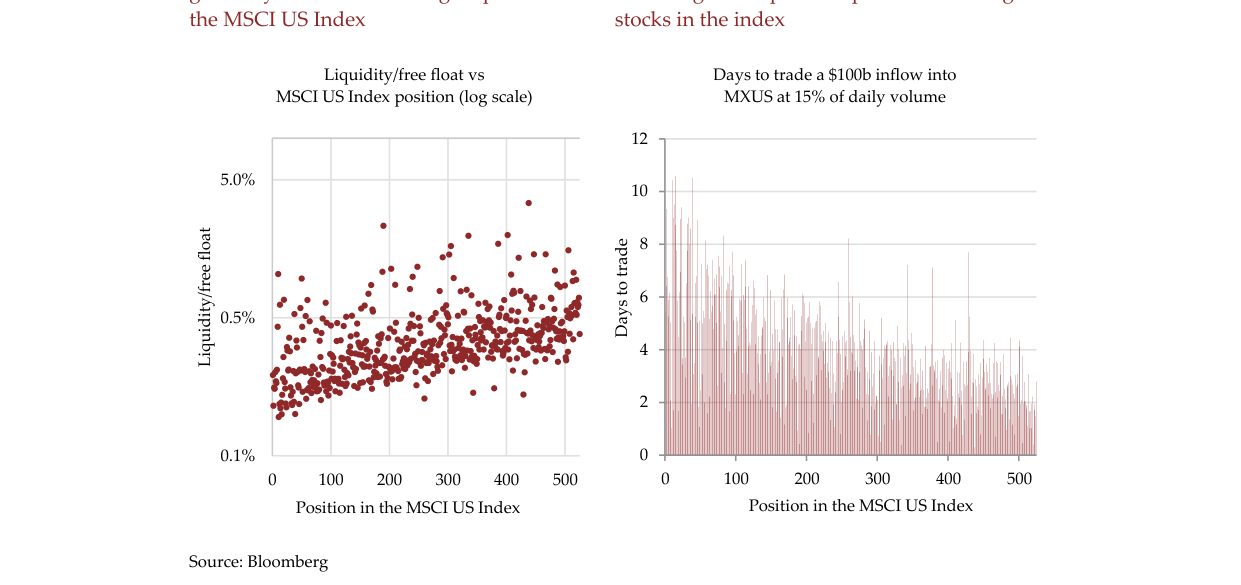
When $100 billion is injected into the MSCI US Index, the number of trading days required for large caps is significantly higher than for small caps (peaking above 10 days), indicating fund flows have a greater price impact on large caps
Companies/Assets Involved
- Magnificent Seven: Heavily underweighted by active funds (723bps); the author argues that continued index fund inflows are pushing up their valuations.
- SpaceX: As a case of index rule changes, passive funds will be forced to over-buy.
- TransUnion, Envista Holdings: Small-cap stocks heavily held by Marathon, overlooked by the market, with capital cycle investment logic.
- Visa, CME Group: Large-cap stocks held by Marathon with high-quality business models but attractive valuations, undervalued because they do not fit the current AI narrative.
Investment Implications
- Beware of Index Concentration Risk: In a market currently dominated by passive flows, holding the index may carry higher risk than active management, because all investors hold the same portfolio. Once the AI theme fades, the most liquid large caps will face the most severe selling.
- Focus on Liquidity's Impact on Weights: Index weights are not a signal of value but a product of fund flows and liquidity. Investors should avoid blindly following index weight allocations.
- Dig for Overlooked Quality Companies: Marathon's approach provides a counterexample—underweighting tech giants and overweighting assets undervalued due to being outside the prevailing market narrative (e.g., TransUnion, Envista Holdings, Visa, CME Group). These companies trade at multi-year lows and offer a margin of safety.
- Redefine Risk: Tracking error does not equal risk; in a market of homogeneous index holdings, deviating from the index may actually reduce real risk.