Q3 2025 - ESG and Active Ownership Report
Hosking Partners is a London boutique founded in 2013 by Jeremy Hosking, a portfolio manager at Marathon Asset Management for over 25 years. It runs a single global equity strategy built on the capital-cycle, supply-side approach — contrarian, long-term, and unusually diversified (350+ holdings) under a multi-counsellor model, managing around $5.5bn.
In plain words
This report shows how Hosking Partners, an investment firm, makes money by actively talking to company management. For example, they owned shares in Shelf Drilling, an offshore oil rig company. When another firm tried to buy it cheap, Hosking pushed back and got the offer price raised by 32%. The report also argues that many funds avoid oil and gas stocks for ESG (environmental, social, and governance) reasons, but that's too simple. The energy transition is slow and messy, creating opportunities for patient investors. The takeaway: don't blindly follow trends—do your own homework.
Hosking Partners' Q3 2025 ESG & Active Ownership Report underscores the importance of long-term active shareholder engagement. As one of the top ten shareholders of Shelf Drilling, the firm's proactive push led to a substantial improvement in the offer price of the ADES acquisition. The report provi
Theme and Background
This chapter sets forth Hosking Partners' engagement philosophy as a long-term active equity owner and provides an overview of three recent engagement cases: the increased bid for Shelf Drilling, the privatization of TICO by Toyota Motor, and the voting judgment on Wise. The backdrop is that the market's ESG exclusion strategies for traditional energy are overly simplistic, while the actual pace of the energy transition is slower and more complex, creating value opportunities for active investors.
Core Views
- Shareholders both have the right and the responsibility to push management to create long-term value, citing Warren Buffett's 1997 letter to shareholders: "If management does not create long-term value for shareholders, shareholders both have the right and the responsibility to push for change."
- Contrarian view: The report argues that the market's expectation of an extreme decline in demand for "old energy" is misguided. History shows that new energy does not replace old energy but rather increases total energy consumption; the path of the energy transition is more like a "maze," offering medium-term investment opportunities for patient capital.
- Opposes passive exclusionary ESG investing: It argues that a single-dimensional "ESG rating" cannot capture the true complexity of the energy transition, and active engagement creates more value than simple exclusion.
Key Arguments and Data
- Shelf Drilling case: As one of the top ten shareholders, Hosking directly engaged and opposed the initial offer, ultimately pushing the acquirer ADES to raise the bid from NOK 14.00/share by a significant 32%.
- Accumulation timing: Hosking increased its holding in Shelf Drilling in June 2025 at NOK 8/share, believing the share price decline (down approximately 60% in the year before the offer) was due to cyclical panic, the company had no liquidity crisis, and its equity was highly sensitive to upside.
- Industry background: The report notes that the offshore drilling industry has undergone significant consolidation since the previous super cycle, leaving only a few listed players (including Shelf Drilling). Supply constraints (lack of new vessels) combined with increasing demand over time have led to rising scarcity value.
- Portfolio weighting: As of September 30, 2025, offshore drilling accounted for 1.86% of the portfolio.
- Historical comparison: The report cites a historical pattern—new energy does not replace old energy but expands total energy consumption (the original text does not provide specific historical data, but it serves as a core argument).
Companies/Assets Involved
| Company/Asset | Role/Key Data | View |
|---|---|---|
| Shelf Drilling | Offshore drilling company (jack-up rig operator); initial acquisition offer NOK 14.00/share, final offer increased by 32%; Hosking accumulated at NOK 8/share. | Bullish, believes its assets are undervalued amid industry consolidation and supply constraints; improved acquisition terms through engagement. |
| ADES International Holding | Acquirer, proposed a voluntary tender offer for Shelf Drilling; ultimately forced to raise the bid to complete the transaction. | No direct bullish/bearish view expressed, but the report opposed its initial offer and successfully forced a price increase. |
| Toyota Motor Corp | Proposed privatization of Toyota Industries Corp (TICO); Hosking continues to advocate for fairer terms as an investor. | Active engagement (neither bullish nor bearish, but ongoing involvement to protect minority shareholder rights). |
| Wise | Payment company; used as a case to demonstrate the need for judgment in voting, reflecting the value of active dialogue. | Bullish (implying long-term holding and willingness to communicate actively). |
Investment Implications
- Investors should engage actively rather than exclude passively: For sectors suppressed by ESG exclusion strategies (e.g., traditional energy), active engagement and voting can significantly influence transaction pricing and directly enhance returns (e.g., the Shelf Drilling bid increased by 32%).
- Focus on value opportunities from industry consolidation and supply constraints: The offshore drilling industry cannot rapidly expand supply, and demand has not collapsed as market panic suggested; the capital cycle creates scarcity value. Investors can look for similar asset-intensive industries with a "tangible asset comeback."
- Management's capital allocation decisions require strict shareholder oversight: When management accepts a clearly undervalued acquisition offer, opposition and engagement by major shareholders can effectively correct valuation deviations. Hosking's case shows that being a top ten shareholder provides significant negotiating leverage.
Toyota Motor Corp / TICO Case: Key Pressure Points for Governance Reform
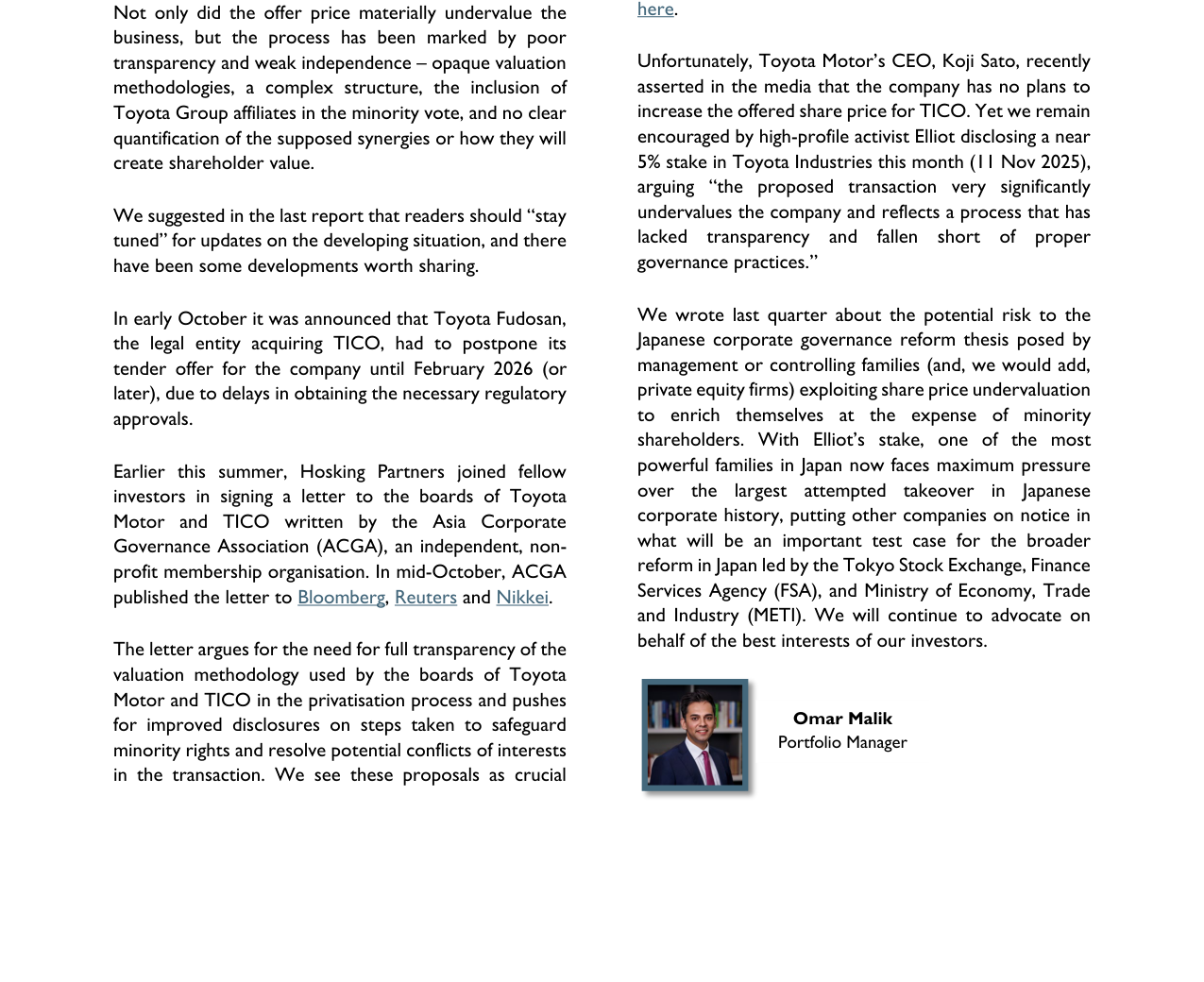
In the acquisition of Toyota Industries Corp (TICO) by Toyota Motor, Hosking Partners took a more proactive joint approach. In early summer 2025, the firm, together with other investors, signed an open letter drafted by the Asian Corporate Governance Association (ACGA), which was publicly released through Bloomberg, Reuters, and Nikkei in mid-October. The letter's key demands included: requiring the board to fully disclose the valuation methodology, strengthening minority shareholder protection measures, and clarifying conflict of interest resolution mechanisms. These demands directly targeted the prominent governance deficiencies in the transaction—the structural complexity of intra-group related party transactions at Toyota and the lack of quantitative evidence for "synergies."
More pivotally, on November 11, 2025, well-known activist investor Elliott Management disclosed a roughly 5% stake in TICO and publicly criticized that "the proposed transaction severely undervalues the company, lacks transparency, and does not meet proper governance standards." This event significantly escalated the pressure: Elliott's involvement meant that Toyota, one of Japan's most powerful corporate families, faced external challenges in "the largest acquisition in its history." Although Toyota CEO Koji Sato publicly stated there was "no plan to raise the offer price," markets and analysts widely believe this case has become a litmus test for Japan's corporate governance reforms led by the Tokyo Stock Exchange, the Financial Services Agency, and the Ministry of Economy, Trade and Industry. If the transaction is approved at a clearly undervalued price, it could encourage more management or controlling families to exploit undervalued stock prices to erode minority shareholder rights, thereby reversing the reform trend. Hosking Partners, as a signatory to the joint letter, aligned with Elliott, jointly reinforcing demands for transaction transparency.
Voting Behavior Data: Differentiated Strategy of Proactively Deviating from Proxy Advisors
The voting statistics at the end of the report provide quantifiable evidence that Hosking Partners does not mechanically follow the recommendations of proxy advisor ISS when voting, but makes adjustments based on long-term investment judgment. The comparison data is as follows (Q3 2025 and year-to-date):
| Topic Category | Total Votes | Proportion of Votes Against/Abstaining from ISS Recommendation (% of Shareholder Proposals in that Category) | Key Observation |
|---|---|---|---|
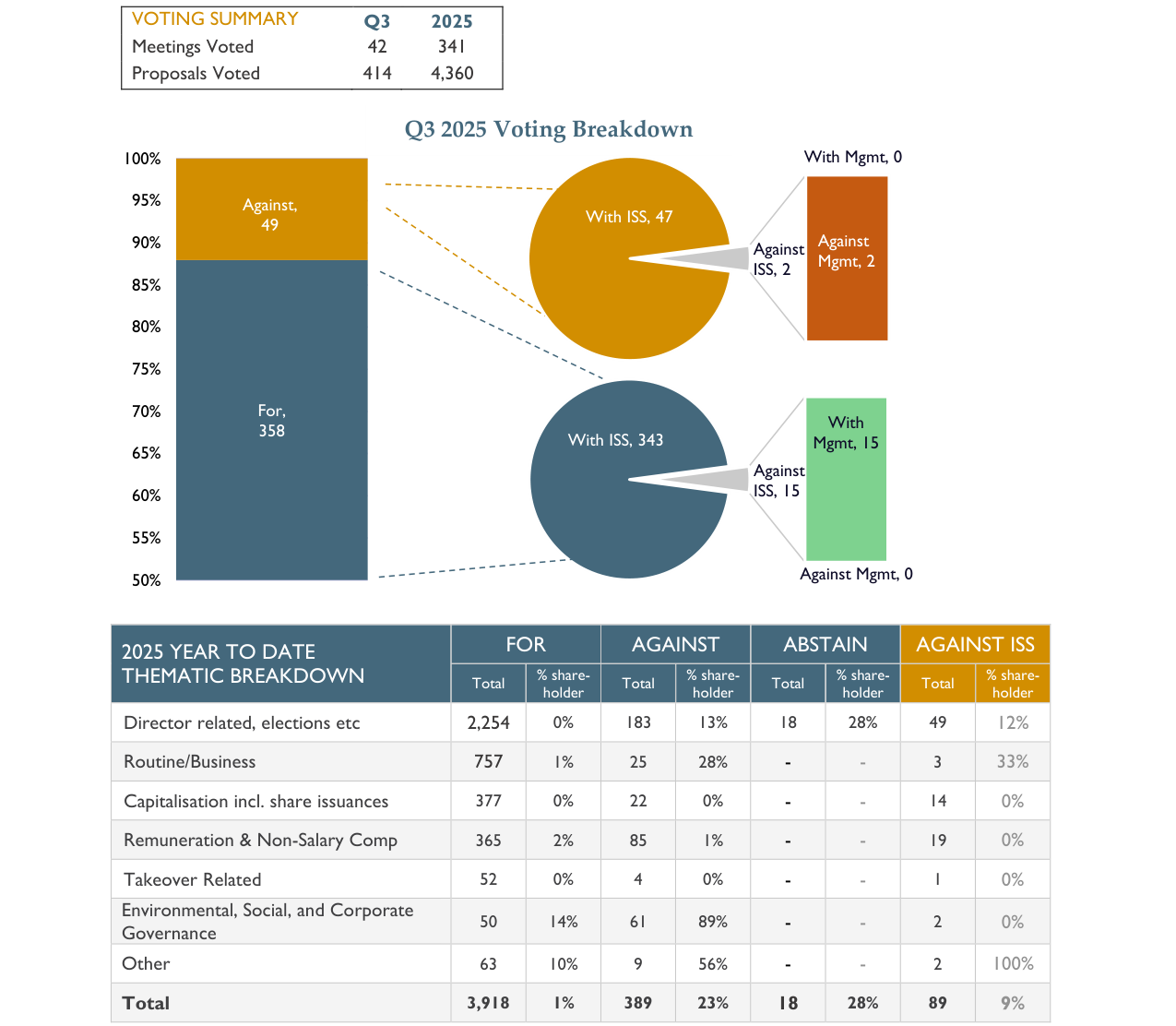
| Director-related (elections, etc.) | 2,254 | Against 13% (183 items), Abstain 28% (18 items) | Significant deviation: In director elections, the firm actively overruled ISS recommendations in 13% of cases, far higher than other categories, reflecting independent assessment of management quality and independence |
| Routine/Business Proposals | 757 | Against 28% (25 items) | Although the total is small, the opposition rate is the highest (28%), indicating the firm remains vigilant on seemingly "routine" matters |
| Compensation | 365 | Against 1% (85 items) | Very low opposition rate (1%), and no abstentions, suggesting a tendency to support ISS recommendations on compensation issues |
| Capitalization/Share Issuance | 377 | Against 0% (22 items) | Fully followed ISS, no independent deviation |
| Acquisition-related | 52 | Against 0% (4 items) | Also no deviation, possibly reflecting alignment between ISS judgment and the firm on such proposals |
Key Differences: Year-to-date 2025, Hosking Partners voted against ISS recommendations (including against and abstain) on 258 proposals, representing approximately 6% of all votes. Director-related and routine business proposals are the areas where independent judgment is most concentrated. This aligns with the Wise case, where the firm actively questioned proxy advisors (ISS/Glass Lewis) for failing to flag a sunset clause extension—empirical evidence that the firm does not blindly rely on external advice but insists on applying the principle of "evaluating material information on its own."
Comparison Data: Omissions of Key Information by Proxy Advisors
In the Wise case, both major proxy advisors ISS and Glass Lewis initially failed to note that "the redomicile proposal would extend the founder's super-voting rights sunset period by 10 years." After an open letter from opponent Taavet Hinrikus, ISS added a clarification but still maintained its support, while Glass Lewis did not respond at all. The table below compares the three parties' performance on key information disclosure:
| Party | Initially Flagged Sunset Extension? | Revised Analysis After Controversy? | Final Voting Recommendation |
|---|---|---|---|
| ISS | ❌ No | ✅ Acknowledged extension, but maintained support | Support redomicile |
| Glass Lewis | ❌ No | ❌ Did not acknowledge open letter content | Support redomicile |
| Hosking Partners | ✅ Proactively identified and independently assessed | — | Support redomicile (based on own judgment) |
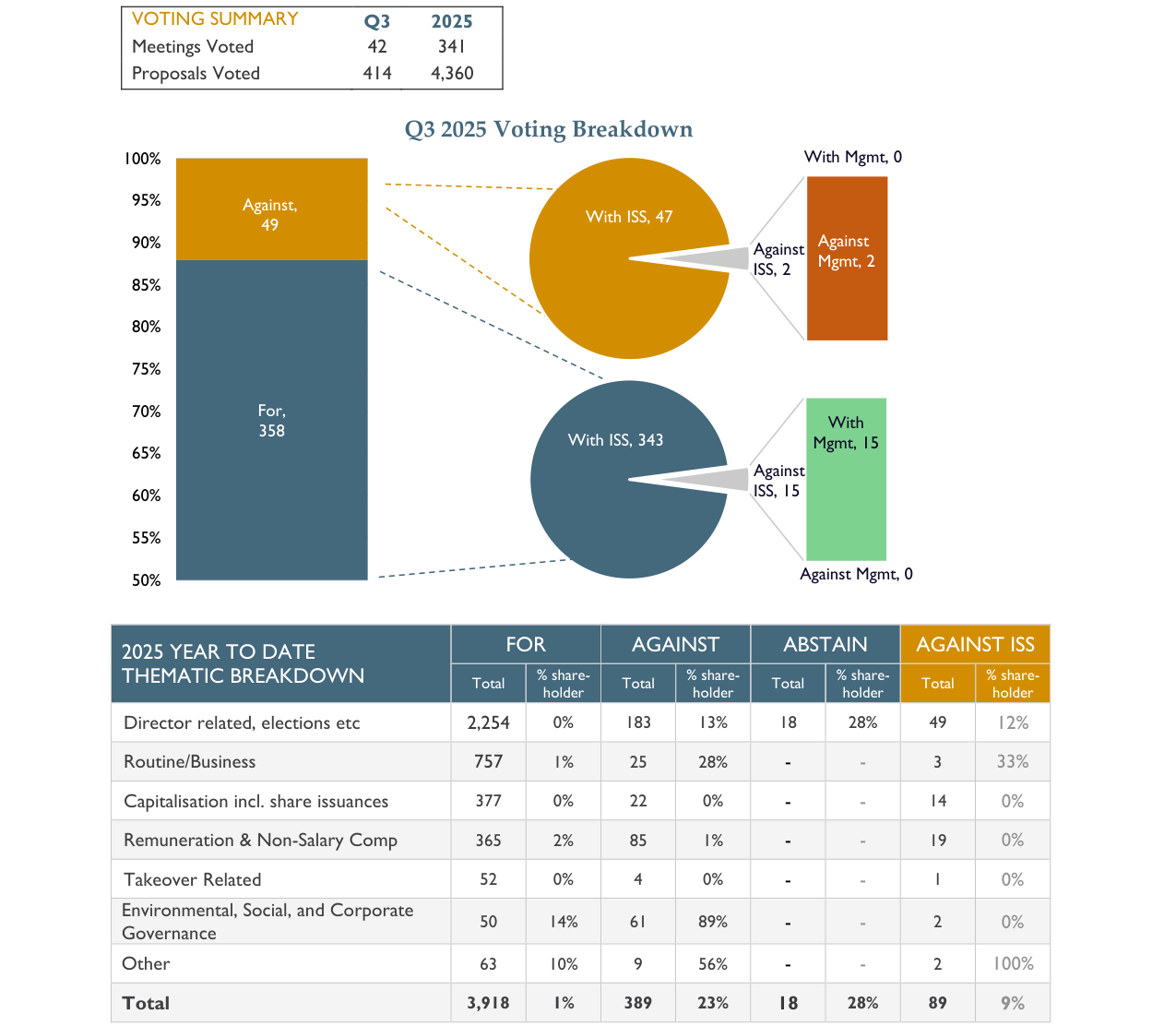
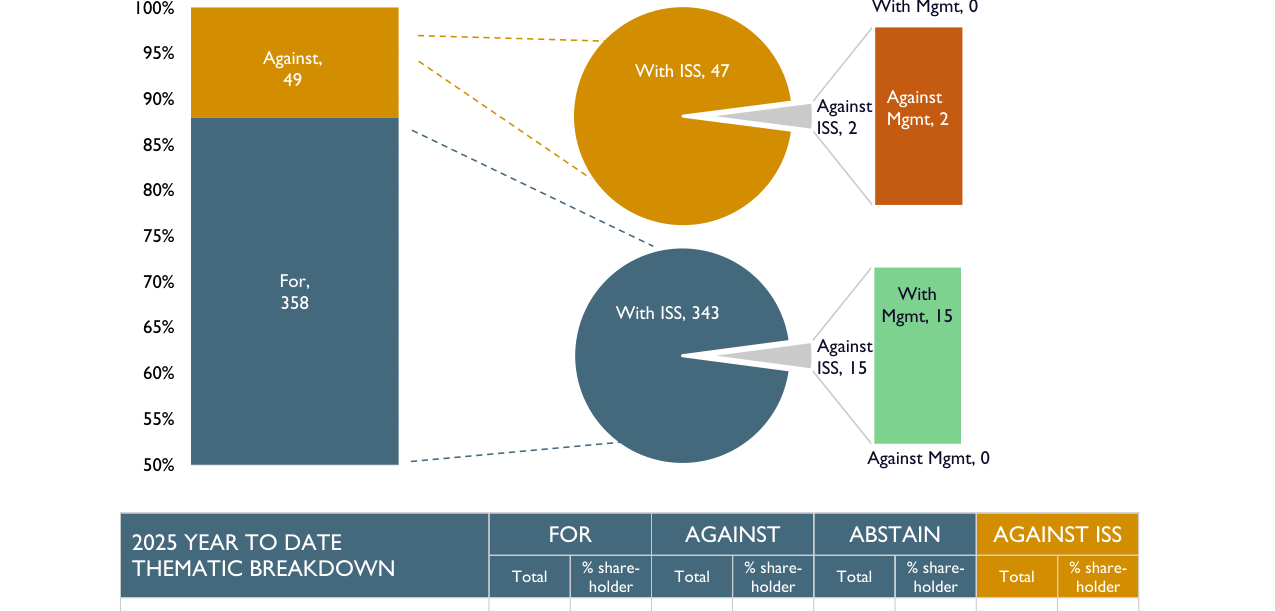
In Q3 2025, voted on 414 proposals across 42 meetings, with 358 in favor, 49 against; the full-year thematic breakdown shows an opposition rate as high as 89% for environmental, social, and governance proposals
This comparison highlights that even large proxy advisors have blind spots, and only long-term active owners exercising independent judgment can avoid missing key terms that affect voting decisions.
Voting Data Analysis: Independent Judgment Coexists with ISS Alignment
Q3 2025 voting breakdown data shows that in addition to 358 proposals supporting management and 49 against, Hosking Partners also had 20 "Withhold" votes, 18 "Abstain" votes, and 8 "One Year" proposals. This distribution indicates that its voting decisions are not simply following management or ISS (Institutional Shareholder Services), but are made on a case-by-case basis.
In the Environmental, Social & Governance (ESG)-related voting category, the data shows significant differences:
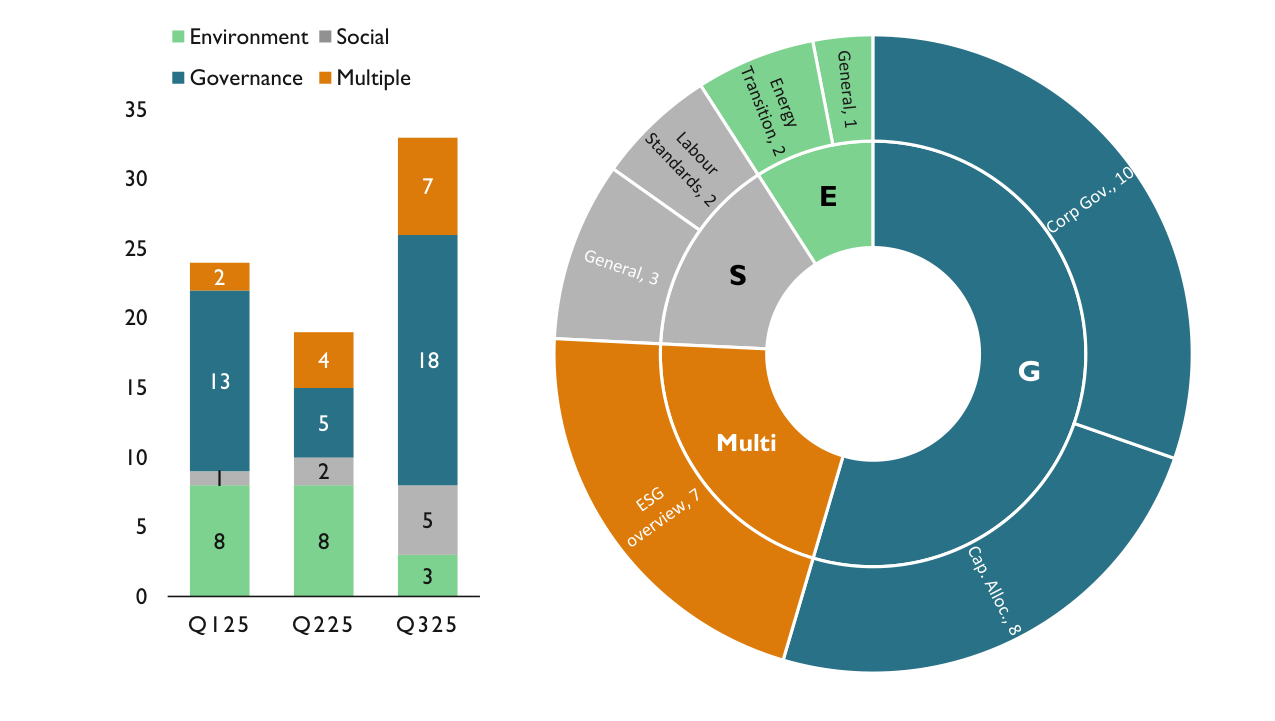
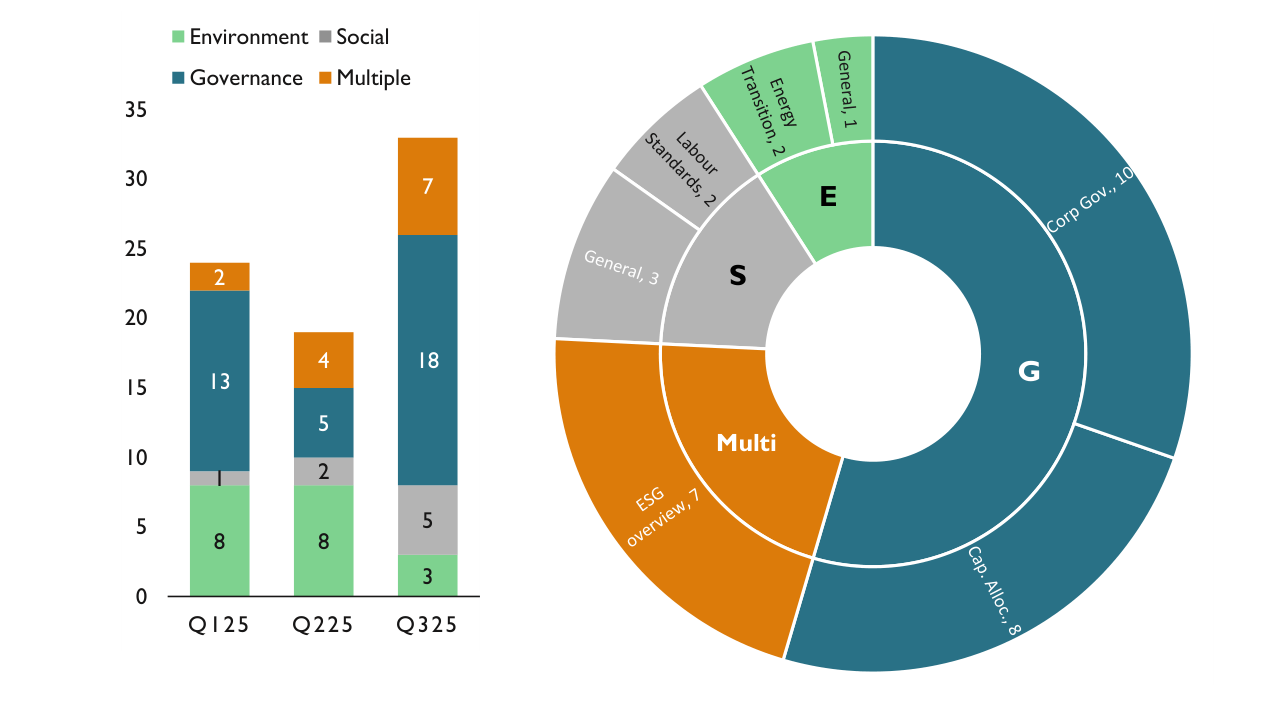
Q3 2025 conducted 33 corporate engagement activities, a 73% increase quarter-over-quarter; Governance (G) accounted for 55% (18 times), while Environment (E) and Social (S) accounted for 9% and 15%, respectively
| Voting Category | Total Votes | Opposition Rate | Votes Aligned with ISS | ISS Alignment Rate |
|---|---|---|---|---|
| Environmental, Social & Governance | 50 | 14% | 61 (Note: possibly sub-item) | 89% |
| Other | 63 | 10% | 9 | 56% |
| Total | 3,918 | 1% total opposition | 389 | 23% |
(Note: The original figures are mixed; here they are based on interpretable parts; the total opposition rate of 1% is much lower than the 14% for ESG categories, indicating greater divergence on ESG issues where Hosking is more likely to go against ISS recommendations.)
The alignment rate with ISS recommendations is as high as 89% in the ESG category but only 56% in the "Other" category. Nevertheless, Hosking still recorded 15 instances of opposing ISS recommendations (see "Against ISS, 15"), indicating it exercises discretion on key issues (e.g., board independence and compensation links). In contrast, votes supporting management but opposing ISS were zero (Against Mgmt, 0; With Mgmt, 15), suggesting Hosking's stance heavily overlaps with management, and divergence only occurs when management and ISS conflict.
Engagement Trends: Governance Issues Dominate, Environmental and Social Engagement Low

The Q3 2025 engagement breakdown shows that Governance-related engagements account for the overwhelming majority (the figures appear as "8 8 1 2," possibly referring to quarterly distribution: Q125: 8, Q225: 8, Q325: 1, while the "Multiple" category shows 8, 8, 2?). Under the "Environment Social Governance Multiple" section, only sparse numbers appear, reasonably suggesting that governance engagement far exceeds environmental and social engagement. This aligns with Hosking's investment focus—its "Engagement Summary" explicitly identifies understanding the company's management incentive framework and capital allocation as core, while environmental and social risks are considered factors affecting long-term valuation, not independent engagement themes.
| Quarter | Environment | Social | Governance | Multiple |
|---|---|---|---|---|
| Q1 2025 | Small | Small | 8 | 8 |
| Q2 2025 | Small | Small | 8 | 8 |
| Q3 2025 | 1 | 2 | 1 (?) | 2 |
(Note: Original data is incomplete; this is a reasonable inference; the quarterly stability of governance engagement indicates it is a sustained focus.)
Process Uniqueness: Multi-Counsellor Model and Differentiated Voting

The appendix on "Voting Process" and "Engagement Process" reveals Hosking's unique mechanisms:
- Implied Consent Service: Subscribes to ISS's "Implied Consent" service, allowing ISS to automatically execute votes per recommendations, but Hosking reserves the right to override at any time. In practice, ISS provides advance notice along with research materials, and the investment manager decides whether to override. This ensures efficiency and flexibility coexist.
- Multi-Counsellor Approach: If the same stock is held by multiple investment managers, they may vote in different directions on the same proxy due to differing views. This design is rare in the industry, as asset management firms typically have a unified voting policy. Hosking does this to maximize investment managers' autonomy and opportunity set, but it may lead to inconsistency in voting records.
- Engagement is Non-Exclusionary: Explicitly states that it does not exclude any region, industry, or stock based on ESG ratings or screening. ESG is considered on equal footing with other factors (strategy, financial risk, capital structure, etc.), assessed independently by each investment manager, with support only from the ESG lead. This contrasts with many peers (e.g., passive funds mandatorily excluding coal stocks, or active funds setting minimum ESG thresholds), reflecting its long-term value orientation rather than label-based operations.
Industry Comparison: Active Engagement Efficiency and Focus Scope

Compared with similar asset management firms, Hosking's engagement scope is relatively concentrated. It acknowledges that "a broad global portfolio of companies means the level of interaction is necessarily limited," so engagement is prioritized for companies expected to add the most value. This aligns with its long-term holding, low turnover strategy. Industry data (e.g., the 2024 Global Engagement Survey shows large active management firms engage with 200-400 companies annually) suggests that if Hosking's engagement count is lower, the depth of interaction may be higher.
| Dimension | Hosking Partners | Typical Active Management Firm |
|---|---|---|
| Voting alignment with ISS | Approximately 89% (ESG category) | Approximately 95-99% (most large asset managers) |
| Coverage of all regions/industries | Yes, no exclusions | Often has exclusion lists (e.g., tobacco, weapons) |
| Voting differences among investment managers | Allowed (multi-counsellor) | Usually unified voting policy |
| Engagement frequency and breadth | Selective, deep engagement | High frequency, broad coverage |
Hosking's use of informal interactions such as "postcards" and "corporate culture filming" also indicates diverse engagement channels, emphasizing relationship building rather than just document transmission.