PGM update
Hosking Partners is a London boutique founded in 2013 by Jeremy Hosking, a portfolio manager at Marathon Asset Management for over 25 years. It runs a single global equity strategy built on the capital-cycle, supply-side approach — contrarian, long-term, and unusually diversified (350+ holdings) under a multi-counsellor model, managing around $5.5bn.
In plain words
This report is about platinum group metals (PGMs), rare metals used in car exhaust systems and jewelry. The author argues that despite big price gains this year, the real super-cycle is just beginning. Why? Because mines have underinvested for a decade, supply is shrinking, and even if they tried to ramp up now, it would take years or even a decade. That means prices could keep rising. For regular investors, this suggests PGM mining stocks might have more upside, but be careful—these are volatile and not for short-term trading.
In its October 2025 PGM update report, Hosking Partners reiterated its investment view: platinum group metals (PGM) remain in the early stages of the cycle and may usher in a multi-year upcycle lasting up to a decade. South African platinum production has fallen from a peak of 5.4 million ounces in
Theme and Background
This chapter is an updated PGM report from Hosking Partners, published in October 2025, one year after its team personally visited South African platinum mines. The report reviews and reiterates its core investment thesis: the platinum group metals (PGM) market remains in the early stages of its cycle, and given a decade of underinvestment, the supply deficit is locked in, potentially ushering in a decade-long upcycle.
Core Thesis
The author's core investment thesis is: The PGM supercycle has only just begun, not reached its end. This is a highly contrarian view — even though platinum (Pt) and palladium (Pd) have risen approximately 80% and 50% year-to-date, respectively, and the market appears to have already priced in gains, the author believes this is merely the start of a major cycle.
The author points out a key counterintuitive fact: the sharp price increase has failed to stimulate new supply. The high price inelasticity on the supply side is the core logic supporting sustained price appreciation over the next several years.
Key Arguments and Data
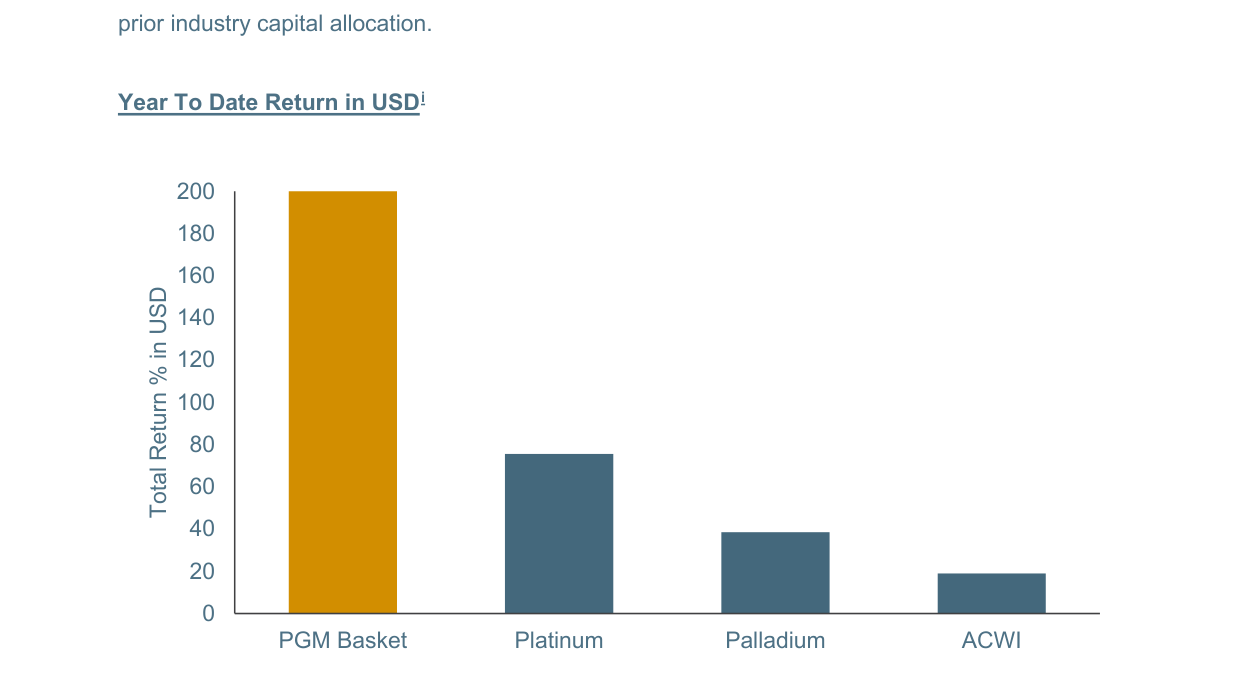
The PGM basket year-to-date return is approximately 200%, significantly higher than Platinum (≈75%), Palladium (≈38%), and ACWI (≈18%)
The report uses executive meetings and industry data to demonstrate the deepening supply-side crisis:
1. Continuous supply contraction: South African platinum production fell from a peak of 5.4 million ounces in 2006 to 3.7 million ounces in 2025 (a 25-year low). Valterra Platinum explicitly forecasts that global primary PGM supply will decline by another 20% by 2030.
2. Extremely high incentive prices for new supply:
- The expansion incentive price for the global key "swing mine" Mogalakwena needs to reach $2,500/oz (the current PGM basket price is only about $1,500), implying enormous upward price pressure.
- Even if development is approved, transitioning from open-pit to underground mining requires substantial capital expenditure, and Northam Platinum management notes that achieving full production could take 10 years.
3. Supply deficit continues to widen:
- The annual platinum deficit has expanded from 300,000–400,000 ounces in the initial report to roughly 1 million ounces currently.
- Chinese platinum jewelry/bar demand has become a key variable, with this year's demand estimated at 250,000 ounces.
4. Historical cycle comparison:
The current PGM basket price is less than 50% of the gold price (compared to 2 times the gold price in the late 1990s to early 2000s), indicating severe undervaluation.
Historical performance comparison (using Implats as example):
| Cycle | Asset | Total Shareholder Return (USD) | Total Shareholder Return (ZAR) |
|---|---|---|---|
| 1998–2008 | Impala Platinum | 75x | 100x |
Companies/Assets Involved
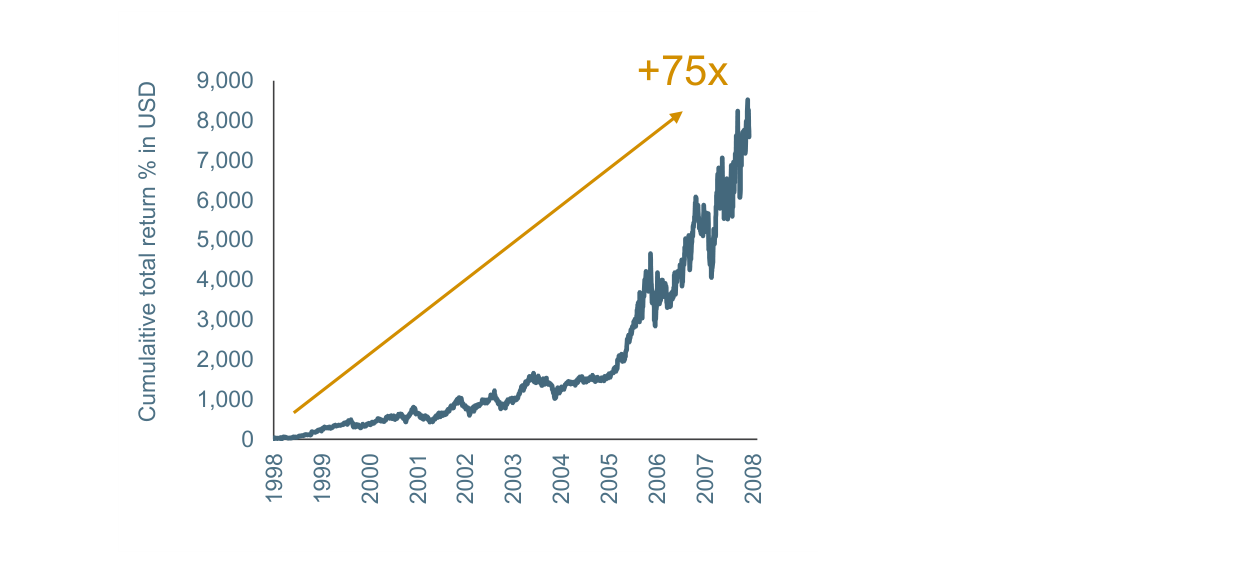
Impala Platinum delivered a cumulative total shareholder return of 75x (in USD) from 1998 to 2008
The report mentions the following key companies, all of which are part of the author's positions (long):
- Sibanye Stillwater, Valterra Platinum, Impala Platinum, Northam Platinum, Sylvania Platinum: The author has met with the CEOs of these five PGM companies and holds them firmly in the portfolio.
- Valterra Platinum: As the world's largest PGM producer recently spun off from Anglo American, its pessimistic supply guidance (a further 20% decline in production) and its estimate of high incentive prices are key signals.
- Northam Platinum: Management confirmed the enormous time cost (10 years) to bring a new mine into production.
- Ivanhoe's Platreef: The only major new project, with Phase 1 adding only 100,000 ounces of production; Phase 2 requires billions of dollars in investment, and the project trigger threshold is very high.
Investment Implications
The implications for investors are very clear:
1. Continue to overweight PGM mining stocks. The author believes "history will rhyme," and current PGM stock prices still have "multiple times" upside potential.
2. Do not overstate demand concerns (EV impact). The author leans toward the view that a "hybrid-first" transition will support or even increase PGM demand, and jewelry demand in China and emerging markets has already been triggered.
3. Shift in asset allocation logic. The author compares platinum to bitcoin, noting that bitcoin supply can rise while primary platinum supply is set to decline over the medium term, making it a more scarce store of wealth.