Bonsai Partners 2H 2025 Letter
Bonsai Partners is a one-person boutique partnership founded in 2018 by Andrew Rosenblum (ex-Matrix Capital) near San Diego, California. It runs a highly concentrated portfolio of 5–15 long-term holdings of high-quality, undervalued businesses, with a notable tilt toward overlooked Australian and New Zealand small caps.
In plain words
This investment letter explains that some companies have a 'hidden moat'—not one big advantage, but many small ones that are hard to copy. Take Wise, a money-transfer company. Its edge isn't a single technology; it's the whole system: bank partnerships, licenses, automated pricing, and ultra-low costs. Even stablecoins (a type of crypto) can't easily replace it because they add extra fees and delays. For regular investors, this means don't just chase obvious winners like network-effect stocks. Instead, look for companies with complex, hard-to-explain strengths that take years to build. These are often undervalued and can deliver better long-term returns.
bonsai_partners disclosed in its H2 2025 investor letter that the Bonsai Partners Fund, LP delivered a net return of 7.5%, while the S&P 500 Total Return Index rose 11.0% over the same period. The report's core discussion centers on the distinction between "obvious moats" and "hidden moats." Obvious
Theme and Background
This chapter discusses the investment concept of "hidden moats"—competitive advantages that do not always stem from a single obvious source, but are instead compounded by multiple small, hard-to-replicate competitive edges. The market context is that obvious moats (such as switching costs and network effects) are often fully priced in by the market because they are easy to identify. In contrast, "hidden moats" formed by a combination of multiple small advantages have long been undervalued, constituting a source of excess returns.
Core Thesis
The author's core investment thesis is contrarian: true competitive advantage often comes from a combination of multiple small advantages rather than a single large one. This compound advantage is difficult for outsiders to identify, leading to insufficient market pricing, and is thus a key source of excess returns. Counterintuitive judgments include:
- Competitive advantages that are hard to explain are actually the strongest.
- Time itself constitutes a moat—even if competitors have capital, they cannot replicate decades of accumulated trial-and-error experience.
- Actively limiting profit margins (e.g., Wise's Scale Economies Shared) is actually an implicit competitive barrier.
Key Arguments and Data
The author supports the thesis with multiple case studies and historical comparisons:
| Company/System | Core Argument | Key Data/Facts |
|---|---|---|
| Toyota Production System (TPS) | Time cannot be replicated | GM tried to replicate TPS through joint ventures but never matched Toyota's results; TPS requires decades of commitment, continuous feedback, and iteration—not something that can be mimicked through a single process. |
| TSMC | Combination of multiple advantages | No single TSMC employee masters the entire manufacturing process; even if rivals could map all process steps, they would still lack the ecosystem, culture, and customer scale. |
| Costco | A century of small advantages combined | Membership fees, higher wages, product margin caps, limited SKUs—no single factor is decisive, but the combination is nearly impossible to reverse-engineer. |
| Wise | Epitome of capability stack | Net Promoter Score (NPS) of 80 (industry average ~30); payment volume growing ~40% annually (to $390 billion); revenue of $2.5 billion, EBITDA margin of ~25%. |
Analysis of the stablecoin threat:
- Stablecoins could reshape cross-border payments, posing a potential threat to Wise.
- However, the author points out that Wise's competitiveness comes not from technology but from its entire capability stack—including compliance networks, banking relationships, and regulatory licenses—which are difficult for pure on-chain alternatives to replicate.
Companies/Assets Involved
- Wise: One of the largest holdings in the innovation fund. Bullish. Core advantages stem from three capability stacks: vertically integrated infrastructure, Scale Economies Shared (self-limiting margins to attract volume), and back-office automation. The stablecoin threat requires monitoring, but the author believes Wise's systemic advantages are difficult to replace with pure cryptocurrency solutions.
- Toyota / GM: Used to illustrate the moat built by time. Toyota is a positive example, GM a negative one. GM could not replicate TPS, even through a joint venture, and failed to internalize the culture.
- TSMC: A positive example of combined multiple advantages. The author believes its moat far exceeds those of Intel and Samsung because there is no single weak point for competitors to exploit.
- Costco: A positive example of a hidden moat; its advantages take years to manifest in financial metrics.
- Aldi: Similar to Toyota, builds cost leadership through "fanatical incremental improvements."
Investment Implications
- Investors should look for competitive advantages that are difficult to explain with a single narrative—if a company's advantages take a long time to be confirmed by financial data, that in itself suggests insufficient market pricing.
- Focus on "capability stack" companies: Their competitive barriers are not products or patents, but a complex of internal organizational systems, culture, and processes. Such companies are common in manufacturing (Toyota, TSMC), retail (Costco, Aldi), and fintech (Wise).
- Avoid assets with "obvious moats" that are already fully priced: If the market widely discusses a company's switching costs or network effects, the excess return opportunity may have already disappeared.
- Remain open to disruptive technologies like stablecoins, but distinguish between: replacement technology vs. replacement of the entire capability stack. The author believes Wise's capability stack is far harder to replace than any single technology.
The "Sandwich Dilemma" of Stablecoins: Wise's Pricing Model and Automation Advantage Are More Critical
1. Decomposing the Three-Step Value Distribution of Cross-Border Payments
The follow-up breaks cross-border payments into three steps: pay-in (funds entry) → treasury (fund allocation) → pay-out (funds exit). Wise's advantage does not concentrate on any single step but runs through the entire chain. In theory, stablecoins can only standardize the middle treasury step, but have almost no impact on the local integration, compliance costs, exchange rate pricing, and automation levels of pay-in and pay-out.
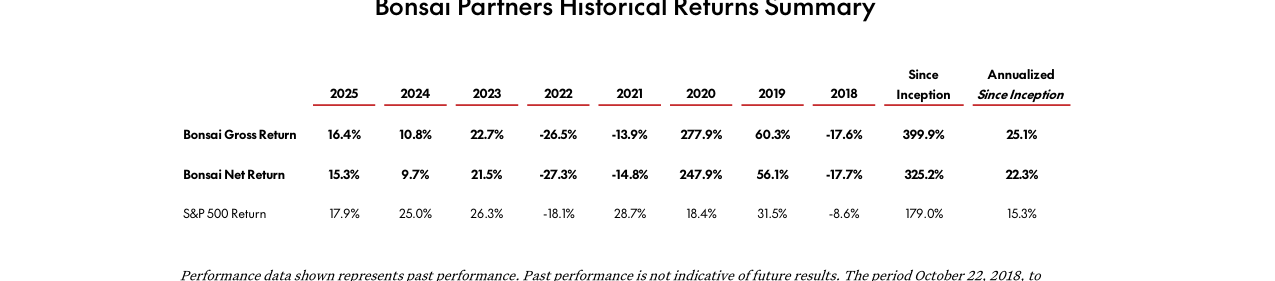
Bonsai Partners historical returns summary table shows the fund’s gross return of 16.4% and net return of 15.3% in 2025, compared to the S&P 500’s 17.9%; cumulative return since inception of 399.9%, annualized 25.1%, significantly outperforming the S&P 500’s 179.0% and 15.3% over the same period
| Step | Common Frictions in Stablecoin Solutions | Wise Solution Advantages |
|---|---|---|
| Pay-in | Requires fiat-to-stablecoin conversion (exchange/OTC, with slippage and delays) | Direct receipt in local currency, no extra conversion step |
| Treasury | On-chain transfers can be fast (depending on network congestion and gas fees) | Near-instant allocation via global banking network + FX hedging |
| Pay-out | Requires stablecoin-to-fiat conversion (second slippage and fees) | Direct payout in destination currency, no second conversion cost |
Key data point: According to Wise's 2024 annual report, its average cross-border transfer time is 1-2 minutes (via local clearing networks), while stablecoin solutions (e.g., USDC cross-chain transfer + conversion) even under ideal conditions take 5-15 minutes (affected by exchange liquidity and on-chain confirmation time). On the cost side, Wise's cost-to-serve per transaction has fallen to below approximately 0.3%, while total fees for stablecoin solutions (fiat entry fee + conversion spread + exit fee) typically range from 0.5% to 1.5%.
2. Magnified Extra Conversion Costs in the Stablecoin "Sandwich"
The follow-up notes that stablecoin solutions require two conversions (USD → USDC → GBP), whereas Wise needs only one currency exchange. This hides not only time costs but also liquidity costs and operational risks:
- Liquidity cost: When a local currency has a premium or discount against USDC (e.g., USDC often deviates by +/- 0.5% in non-USD markets), two conversions accumulate net losses. Wise directly hedges through multi-currency accounts, avoiding reliance on USDC liquidity pools.
- Operational risk: Stablecoin bridging relies on centralized exchanges or DeFi aggregators; if a counterparty faces liquidity depletion (e.g., weekend market closures, extreme volatility), funds can be locked. Wise's multi-tier banking network can operate 7×24 (though some markets have non-business-day delays).
Comparison case: During the peak period in December 2024, Gemini/Circle's USDC redemption windows saw 2-4 hour withdrawal delays at some exchanges, while Wise's median USD-to-EUR transfer time remained under 12 seconds (via SEPA Instant) during the same period.
3. The "Hidden Barrier" of Pricing Model and Automation
The core reason Wise has not been disrupted by stablecoins lies in its pricing transparency and automated cost structure:
- Pricing transparency: Wise uses the real-time mid-market exchange rate plus a fixed fee (as low as 0.41%), whereas stablecoin solutions often add implicit spreads (markup errors from banks or exchanges during conversion). According to Wise's 2024 transparency report, its exchange rate spread is consistently kept within 0.15%, while spreads at major stablecoin conversion services (e.g., Coinbase, Binance) typically range from 0.3% to 1.0%.
- Automated cost structure: Wise's "smart routing" system dynamically selects the optimal path among multiple liquidity sources (e.g., SWIFT, ACH, SEPA, local instant payments), whereas stablecoin solutions can only rely on blockchain networks. Wise's operating expense ratio (Opex/Revenue) fell from 38% in 2020 to 28% in 2024, driven by the ability to process over 95% of transactions automatically (without human intervention). Stablecoin companies (e.g., Circle) still have operating expense ratios of 40-50% (due to high compliance monitoring and on-chain security costs).
4. Market Sentiment Divergence: Wise's "Strategic Indifference" Proves Its Moat Is Justified
The follow-up mentions that Wise is "relatively indifferent" to stablecoins, while other payment companies are excited. This precisely indicates that Wise's technology stack is already a generation ahead of stablecoin solutions:
- For traditional payment companies (e.g., SWIFT, clearing houses), stablecoins represent an upgrade from slow to fast (SWIFT average 1-3 days → stablecoins 10 minutes).
- For Wise, its existing system already achieves second to minute-level transfers (Q4 2024 data: 70% of transfers completed within 10 seconds), so stablecoins offer no significant acceleration.
- Cost comparison: On-chain gas fees for stablecoins on Ethereum mainnet once reached $5-10 per transaction (March 2024), while Wise's average transaction processing cost (including bank integration and FX hedging) is only $1.20 per transaction (2024 data). Even if costs are reduced via Layer-2 solutions (e.g., Arbitrum, Optimism), additional bridging and conversion are required.
5. Conclusion: The Accumulation of Hidden Costs Makes It Hard for Stablecoins to Undermine Wise's Value Proposition
| Dimension | Stablecoin (USDC) | Wise |
|---|---|---|
| Average number of conversions | 2 (fiat→stable, stable→fiat) | 0.5 (direct exchange, internal hedging) |
| Typical total cost ($1,000 transfer) | $8 - $18 (including FX loss) | $4.10 - $6.00 |
| Average transfer time (USD→EUR) | 5-20 minutes (plus exchange withdrawal time) | 1-5 minutes |
| Operating cost / transaction | $0.30 - $2.50 (gas + exchange fees) | $1.20 |
| Regulatory reliability | Relies on a single company (Circle)’s credit and compliance | Multi-bank network + multi-country licenses |
Final view: The "standardization" of stablecoins in the treasury step cannot offset the additional conversion costs and operational friction they introduce. Wise's moat stems from a system of full-chain integration + smart routing + pricing transparency + extremely low unit costs, and stablecoins are merely one "component" that can be absorbed. When the stablecoin ecosystem matures enough to match Wise's efficiency, Wise will already have the ability to embed it into its existing stack at a lower cost—this is a classic manifestation of a "hidden moat": the difficulty for competitors lies not in any single technology, but in the system's overall complexity and economies of scale.