Research Perspectives – February 2026
Southeastern Asset Management is a Memphis-based deep-value firm founded in 1975 by O. Mason Hawkins to exploit the bargains left by the 1973-74 bear market. Its flagship Longleaf Partners Funds (launched 1987) invest employees' own money alongside clients'. Following Graham's discipline and its "Business, People, Price" framework, it runs concentrated books of 15-25 undervalued stocks held for the long term — famously closing funds to new investors when opportunities were scarce. CEO and Head of Research Ross Glotzbach now leads the firm, which publishes quarterly Longleaf fund commentaries and Research Perspectives notes.
In plain words
This report explains why most mergers and acquisitions (when one company buys another) actually hurt the buying company's shareholders. For everyday investors, the key is to spot bad deals—like overpaying in a bidding war or buying unrelated businesses—versus good ones that are complex, have few bidders, and are done by managers who think like long-term owners. It also highlights a few companies currently fixing past bad deals, like Kraft Heinz and Jollibee. Worth reading to avoid firms that destroy value through flashy takeovers.
This report examines the risks and opportunities of mergers and acquisitions (M&A) from the perspective of Southeastern (Longleaf Partners). The core argument is that most M&A deals are detrimental to the buyer, stemming from irrational decision-making driven by the "institutional imperative." The r
Theme & Background
This chapter focuses on the risks and opportunities of mergers and acquisitions (M&A) for acquirer-side investors. The author notes that global M&A activity was robust in 2025, particularly with "cross-border bank transactions in the EU hitting a new high since 2008," which is typically a signal of market overheating. The core task of the report is to distinguish between "good M&A" and "bad M&A," emphasizing that most M&A is detrimental to the acquirer.
Core Thesis
The author's core investment thesis is: Most M&A is harmful to the acquirer, stemming from irrational decision-making driven by the "institutional imperative." The counterintuitive judgment is that good M&A often occurs when the transaction is complex, there are few bidders, and management acts like long-term owners, rather than during market optimism with high-leverage bidding. The author also believes that post-M&A strategic shifts (diworsification) expose a company's concerns about its core business and are a red flag.
Key Arguments & Data
- Two Types of Bad M&A:
1. Outbidding competitors during market optimism with excessive leverage financing.
2. Strategic shifts (diworsification), such as the 2025 "EU cross-border bank transaction" case, indicating a lack of confidence in the core business.
- Four Criteria for Good M&A:
1. Management and the board act like long-term owners.
2. The acquired assets align with the existing strategy.
3. The transaction process is complex, reducing the number of bidders.
4. Post-transaction leverage is moderate.
- Historical Cases:
- Vail Resorts (early 2010s): Acquired a large Utah resort through a two-step transaction, stemming from the asset owner forgetting to pay a rent check. The author notes that after this success, Vail made "less good deals" over the following 5-10 years.
- Liberty Media (2016): Acquired Formula One for $8 billion, now valued at $35 billion. At the time of the author's investment, Liberty Media held significant cash and a 30% stake in Live Nation.
- Turnaround Cases in Current Portfolio:
- Kraft Heinz: The mid-2010s merger was "a mistake that should not have happened" (a rare error acknowledged by Buffett). Current CEO Steve Cahillane (from Kellogg/Kellanova) has paused the company's spin-off plans, focusing on the "Taste Elevation" business (Heinz, Philadelphia Cream Cheese, etc., potentially worth a dozen times EBITDA) and asset sales.
- Delivery Hero: Shifting from excessive M&A to asset sales, including an IPO of its Middle East business and a sale of its Taiwan business to Uber (blocked by regulators).
- Jollibee: Decided to split assets that were confusing the market into two companies, with core brands performing strongly in the Philippines and globally.
- Positive Case:
- Rayonier + PotlatchDeltic: The recent merger is a "win-win," creating a stronger asset base and reducing redundant costs. The combined company owns over 4 million acres of timberland, with increased geographic diversification adding optionality (e.g., letting trees grow when regional timber prices are low). CEO Mark McHray (Rayonier) and Executive Chairman Eric Cremers (PotlatchDeltic) understand per-share value, having resumed offense after pausing buybacks. The author believes the market currently undervalues timberland assets due to short-term pulp prices and housing trends, while Weyerhaeuser (lower quality) is the only other publicly traded timber REIT, causing confusion among sellers and institutional investors.
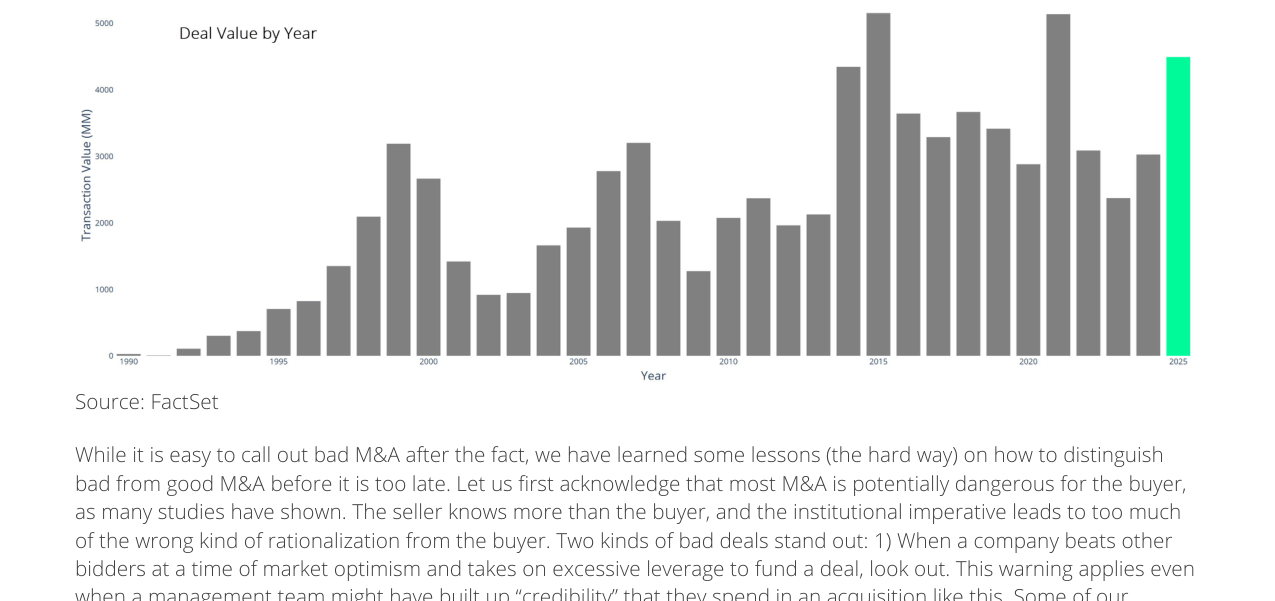
Global M&A transaction value surged to approximately $4.5 trillion in 2025, hitting a new high since 2008 and approaching historical peaks in 2015 and 2021
Companies/Assets Involved
| Company/Asset | Role | Key Data | Bullish/Bearish |
|---|---|---|---|
| Vail Resorts | Historical Case | Acquired Utah resort in early 2010s; deals deteriorated over the next 5-10 years | Neutral (early success, later failure) |
| Liberty Media | Historical Case | Acquired Formula One for $8 billion in 2016, now valued at $35 billion | Bullish |
| Kraft Heinz | Current Holding | Mid-2010s merger failed; now paused spin-off, focusing on "Taste Elevation" business (dozen times EBITDA) | Bullish (in turnaround) |
| Delivery Hero | Current Holding | Shifting from excessive M&A to sales; Middle East IPO and Taiwan sale blocked | Bullish (needs more action) |
| Jollibee | Current Holding | Splitting assets; core brands strong | Bullish |
| Rayonier + PotlatchDeltic | Current Holding | Combined 4 million+ acres of timberland; CEOs Mark McHray and Eric Cremers | Bullish (valuation significantly below intrinsic value) |
| Weyerhaeuser | Comparison Object | Lower quality; only other publicly traded timber REIT | Bearish (relative) |
Investment Implications
- Avoid Bad M&A: Be wary of high-leverage bidding during market optimism and strategic shifts (e.g., cross-border bank transactions). Investors should focus on whether management acts like long-term owners, rather than pursuing short-term "credibility."
- Seek Good M&A: Look for cases with complex transactions, few bidders, and assets that fit the existing strategy, such as Liberty Media's acquisition of Formula One.
- Turnaround Opportunities: In the current portfolio, Kraft Heinz, Delivery Hero, and Jollibee are correcting past M&A mistakes. Investors should monitor asset sales, spin-offs, and operational improvements.
- Timberland Undervaluation: Following the Rayonier + PotlatchDeltic merger, the market overlooks long-term value (geographic diversification, increased land use optionality) due to short-term factors (pulp prices, housing trends). The author believes this asset may be better suited for privatization or could become an "environmental" acquisition target for tech companies.