Research Perspectives – February 2025
Southeastern Asset Management is a Memphis-based deep-value firm founded in 1975 by O. Mason Hawkins to exploit the bargains left by the 1973-74 bear market. Its flagship Longleaf Partners Funds (launched 1987) invest employees' own money alongside clients'. Following Graham's discipline and its "Business, People, Price" framework, it runs concentrated books of 15-25 undervalued stocks held for the long term — famously closing funds to new investors when opportunities were scarce. CEO and Head of Research Ross Glotzbach now leads the firm, which publishes quarterly Longleaf fund commentaries and Research Perspectives notes.
In plain words
This report says many popular US tech stocks are too expensive and risky. Instead, it suggests looking for cheap, ignored companies with room to improve profits—like Gruma (a Mexican tortilla maker) or FedEx (splitting up its business). The idea: avoid hype, be patient, and find hidden value where others aren't looking.
Southeastern (Longleaf Partners) February 2025 Report The report notes a coexistence of "over-selection" and "under-selection" in the current market: U.S. large-cap growth stocks carry elevated risks due to excessive valuations (the S&P 500's price-to-sales ratio is at historical highs), and high-mu
Theme and Background
This chapter explores the current market paradox where "excessive stock-picking" and "insufficient stock-picking" coexist. The report points out that large-cap U.S. growth stocks are accumulating risks due to excessive valuations (the S&P 500 price-to-sales ratio is at historical highs), while value investing, being overlooked, offers long-term return opportunities.
Core Thesis
The author's core investment argument is: Low-multiple, unoptimized-margin companies are effective over the long term, but require patience. Counterintuitive judgments include:
- High-multiple, high-margin strategies are ineffective over the long term, even if they may appear safe in the short term.
- The current market's neglect of value investing stands in stark contrast to the "stock-picking frenzy" seen at historical market peaks (e.g., 2000, 1929).
- Most global equity markets are "under-picked," presenting an opportunity to find cheap, high-quality targets.
Key Arguments and Data
- Valuation Comparison: The S&P 500's LTM Price/Sales ratio is at a historical high, while the overall free cash flow (FCF) multiple of the report's portfolio is only in the high single digits to low double digits, less than half the implied level of the S&P 500.
- Historical Examples:
- During the 2000 dot-com bubble and before the 1929 Great Depression, the market broadly ignored valuations, believing "stock-picking is easy, everyone is doing it."
- In the spring of 2023, Kellogg (market cap over $30 billion) had only two investor visits post-pandemic; this "loneliness" represented an opportunity for value investing. Ultimately, its snack business was sold to Mars at a high price.
- Current Market Sentiment: The report cites a former employee who said in a conversation, "I'm more bullish on NVIDIA," rather than a company whose stock had fallen 50% but had solid fundamentals, reflecting the market's excessive enthusiasm for growth stocks.
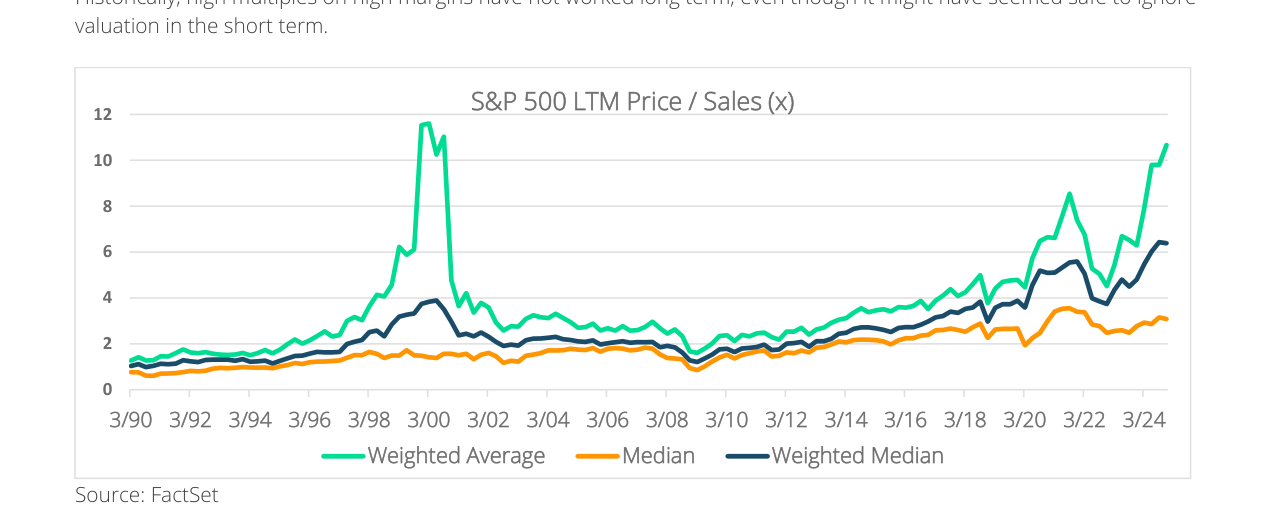
The weighted average S&P 500 price-to-sales ratio rose to approximately 10.5x in 2024-2025, close to the 12x peak during the 2000 dot-com bubble and significantly above the historical median level (around 3x)
Companies/Assets Involved
| Company | Role | Key Data | Bullish/Bearish |
|---|---|---|---|
| Gruma | Global leader in tortillas and corn flour | U.S. operations account for over 75% of company value; Gonzalez family holds approximately 50% stake; per-share FCF has steadily grown since initial holding in 2019 | Bullish (undervalued due to Mexico listing, tariff concerns, GLP-1 drug impact) |
| IAC | Slimming-down conglomerate | Owns 100% of Dotdash Meredith (DDM) and over 20% of MGM Resorts; DDM cash flow growing at double digits; IAC valued below $0.50 per dollar, trading at less than 5x DDM+MGM FCF | Bullish (most undervalued holding; Barry Diller more actively involved, potential buybacks or M&A) |
| FedEx | Logistics company | Has announced the spin-off of its Freight business; tariffs are a clear headwind but already partially reflected in the stock price | Bullish (spin-off will bring clarity and accountability, similar to historical spin-off cases) |
Investment Implications
- Direction: The current focus should be on low-multiple, unoptimized-margin companies, especially those overlooked by the market (e.g., Mexico-listed, food sector pressured by GLP-1) or undergoing spin-offs/restructurings (e.g., IAC, FedEx).
- Risk Warning: Be cautious of valuation bubbles in large-cap U.S. growth stocks and avoid chasing high-multiple, high-margin strategies.
- Catalysts: Company-specific value growth (e.g., Gruma), asset spin-offs (e.g., FedEx Freight), and proactive management actions (e.g., IAC buybacks) can all serve as sources of returns.