Research Perspectives – May 2026
Southeastern Asset Management is a Memphis-based deep-value firm founded in 1975 by O. Mason Hawkins to exploit the bargains left by the 1973-74 bear market. Its flagship Longleaf Partners Funds (launched 1987) invest employees' own money alongside clients'. Following Graham's discipline and its "Business, People, Price" framework, it runs concentrated books of 15-25 undervalued stocks held for the long term — famously closing funds to new investors when opportunities were scarce. CEO and Head of Research Ross Glotzbach now leads the firm, which publishes quarterly Longleaf fund commentaries and Research Perspectives notes.
In plain words
This report explains why a value fund called Longleaf Partners made money but lagged behind the market. The reason: today's value indexes are packed with expensive AI, bank, and oil stocks that are no longer cheap. The real bargains are in boring sectors like consumer goods, healthcare, and building materials. The fund manager warns against chasing hot stocks and instead recommends buying companies with solid cash flows at reasonable prices, like Albertsons and Gruma. The message: don't follow the crowd into overpriced stocks; be patient and buy what's truly undervalued.
The report notes that as of April 30, 2026, Longleaf Partners' absolute returns increased but lagged behind value indices. The core argument is that current value indices (such as the Russell 1000 Value) do not represent true value investing, as their recent performance has been primarily driven by
Theme and Background
This chapter discusses the phenomenon that, although the Longleaf Partners Fund achieved positive absolute returns in the year ending April 30, 2026, it significantly lagged behind value indices. The report’s core argument is that current value indices (such as the Russell 1000 Value) are no longer true value investments, as their recent performance has been primarily driven by AI-related stocks and speculative assets, rather than fundamentally undervalued stocks.
Core Thesis
The report argues that the recent rally in value indices is unsustainable, as its drivers (AI-related stocks, banks, and oil stocks) have valuations far exceeding reasonable value ranges (8-15x FCF), reaching mid-20x P/E or higher. Conversely, truly undervalued sectors (such as Consumer Staples, Healthcare, and Building Products/Real Estate) have underperformed, creating more attractive buying opportunities for investors adhering to the “Business, People, Price” framework. The report explicitly warns against chasing the best-performing components within the index, calling it dangerous.
Key Arguments and Data
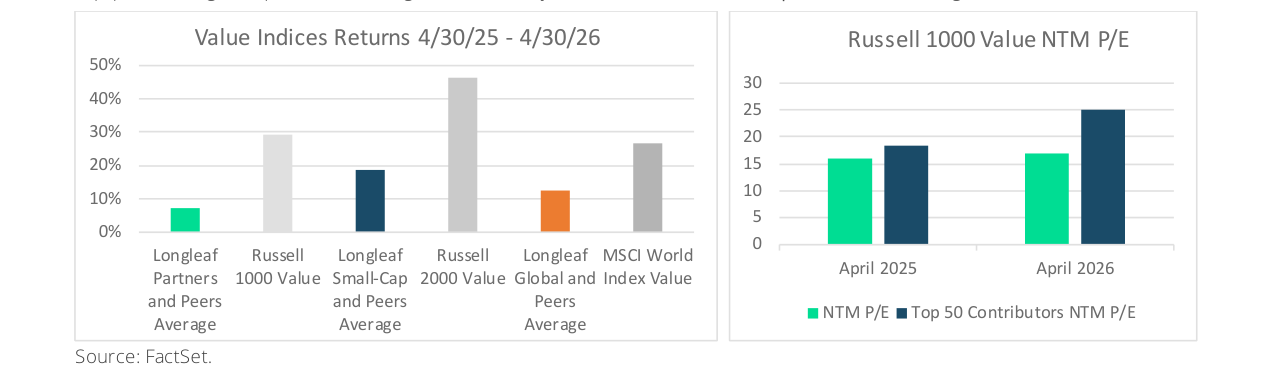
Value index returns show significant divergence: the Russell 2000 Value led with approximately 45% gains, the Russell 1000 Value rose about 30%, while Longleaf Partners and Peers gained only about 7%
- Distortion in the Russell 1000 Value (R1KV): The top 50 contributors accounted for over 70% of the gains, with more than 80% coming from AI-related, bank, and oil stocks. These stocks had NTM P/E in the high teens as of April 30, 2025, which rose to the mid-20s by April 30, 2026, far outside the value range.
- Speculative Nature of the Russell 2000 Value (R2KV): Among the top 200 contributors, approximately 25% of companies had no earnings. Five of the top ten contributors showed “N/A” (no earnings data) on FactSet. The report cites EchoStar and TTM Technologies as examples of stocks that have overshot their long-term value.
- Underperforming Sectors: Consumer Staples, Healthcare, and Building Products/Real Estate are lagging sectors, but the report believes they possess “enduring value.”
- Peer Comparison: The report tracks 10 concentrated value funds (holding 30 or fewer stocks), which on average underperformed the value benchmark by 20-25 percentage points.
- Individual Stock Cases:
- FedEx: Annualized absolute return +52%, relative to the value index +33%. FCF per share grew, and the spin-off of the freight business represents option value.
- IAC: Adjusted return +20%, relative to the index +1%. Core assets (People Inc. and MGM) are performing well, and the company continues to repurchase shares.
- Canal+: Absolute return +21%, relative to the index -1%. Long-term FCF per share remained unchanged; the recent share price decline due to merger delays makes the current price as attractive as last year.
- Gruma: Absolute return -1%, relative to the index -26%. Impacted by ICE enforcement and competitor pressure, but has regained market share and trades at 10-11x FCF; the report is optimistic about future FCF per share growth.
- Albertsons: Absolute return -20%, relative to the index -43%. Trades at a single-digit FCF multiple; the report believes that if it reaches Kroger’s 12x FCF valuation, the stock price could nearly double.
Companies/Assets Involved
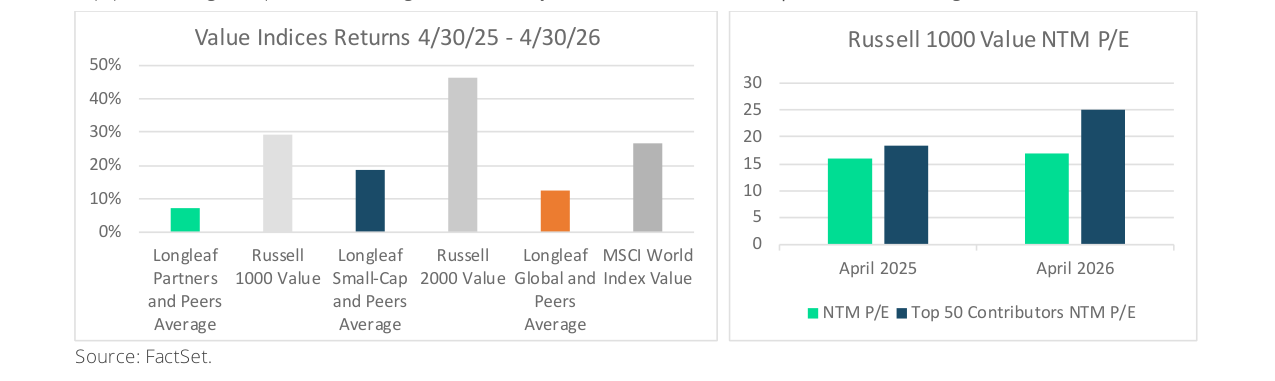
The NTM P/E of the Russell 1000 Value index rose from approximately 16x in April 2025 to about 25x in April 2026, with the top 50 contributors’ valuations increasing from about 19x to roughly 25x
| Company/Asset | Role | Key Data | Bullish/Bearish |
|---|---|---|---|
| FedEx | Top-performing holding | Annualized return +52%, relative to index +33% | Bullish |
| IAC | Neutral-performing holding | Adjusted return +20%, relative to index +1% | Bullish |
| Canal+ | Volatile holding | Absolute return +21%, relative to index -1% | Bullish (added after recent pullback) |
| Gruma | Underperforming holding | Absolute return -1%, relative to index -26%, trades at 10-11x FCF | Bullish |
| Albertsons | Underperforming holding | Absolute return -20%, relative to index -43%, trades at single-digit FCF | Bullish (if reaches 12x FCF, stock doubles) |
| EchoStar | Speculative representative in index | One of the largest contributors to R2KV; the report believes it has overshot | Bearish |
| TTM Technologies | Speculative representative in index | One of the largest contributors to R2KV; the report believes it has overshot | Bearish |
| Berkshire Hathaway | Worst-performing component in index | Ranked last in R1KV contribution | Neutral (as a symbol of “original value stocks”) |
Investment Implications
- Avoid high-valuation components in current value indices: Especially AI-related stocks (Micron, Alphabet, AMD, Cisco, Intel) and banks and oil stocks benefiting from AI infrastructure buildout. Their valuations (mid-20x P/E or higher) have left the value range, posing high long-term return risks.
- Contrarian positioning in overlooked sectors: Sectors such as Consumer Staples, Healthcare, and Building Products/Real Estate offer “enduring value.” Short-term headwinds (e.g., ICE enforcement, competitor pressure) have eased or are improving, and current valuations provide a margin of safety.
- Focus on FCF growth and buybacks: The report emphasizes that true value investing should center on FCF per share growth and management’s ability to create value through share repurchases (e.g., Albertsons, Gruma). The current portfolio’s valuation (8-15x FCF) sits at the core of the target range and will benefit from a return to rational investing.