3Q24 Partners Fund Commentary
Southeastern Asset Management is a Memphis-based deep-value firm founded in 1975 by O. Mason Hawkins to exploit the bargains left by the 1973-74 bear market. Its flagship Longleaf Partners Funds (launched 1987) invest employees' own money alongside clients'. Following Graham's discipline and its "Business, People, Price" framework, it runs concentrated books of 15-25 undervalued stocks held for the long term — famously closing funds to new investors when opportunities were scarce. CEO and Head of Research Ross Glotzbach now leads the firm, which publishes quarterly Longleaf fund commentaries and Research Perspectives notes.
In plain words
This report covers how Longleaf Partners Fund performed in Q3 2024. It earned 10.42% (beating major indexes) but deliberately trimmed some winners (like Kellanova, bought out by Mars) and raised cash to 22.6%. The manager thinks stocks are still undervalued but sees risk ahead, so they keep a bigger safety cushion. For regular investors, this is worth reading because it shows how professionals stay disciplined even after good returns, and why focusing on free cash flow and stock buybacks matters more than chasing hot stocks.
Longleaf Partners Fund Q3 2024 Returned 10.42%, Outperforming the S&P 500 (5.89%) and Russell 1000 Value (9.43%), with Half of Holdings Delivering Double-Digit Returns The core view is that the market is beginning to recognize the value of its holdings, but the fund raised its cash position to 22.6%
Theme and Background
This section summarizes the performance, portfolio adjustments, and core investment logic of the Longleaf Partners Fund in the third quarter of 2024. In terms of market environment, the fund outperformed major indices but raised its cash position to 22.6%—above normal levels—by reducing holdings in strong-performing stocks, thereby increasing the portfolio's margin of safety.
Core Thesis
The author's core investment argument is that the market is beginning to recognize the value of the fund's holdings, but the fund actively reduced positions in strong performers and maintained a high cash position to address the historic valuation gap between the index and its holdings. The counterintuitive judgment is that despite the fund's strong performance, the author is not fully bullish but instead emphasizes maintaining defensiveness through position reductions and cash reserves, believing that signs of market "rationality" are just emerging.
Key Arguments and Data
- Performance: The fund returned 10.42% in the third quarter, outperforming the S&P 500 (5.89%) and the Russell 1000 Value (9.43%), with half of its holdings achieving double-digit returns.
- Cash Position: The cash ratio rose to 22.6% (above normal levels), with the P/V ratio in the low 70% range.
- Portfolio Adjustments: Cash was increased by reducing holdings in strong performers (e.g., Kellanova), while retaining positions in companies with durable competitive advantages and financial strength.
- Valuation Gap: The author remains optimistic about the historic valuation gap between the fund's holdings and the index, believing that signs of market "rationality" (such as value stock performance) are emerging.
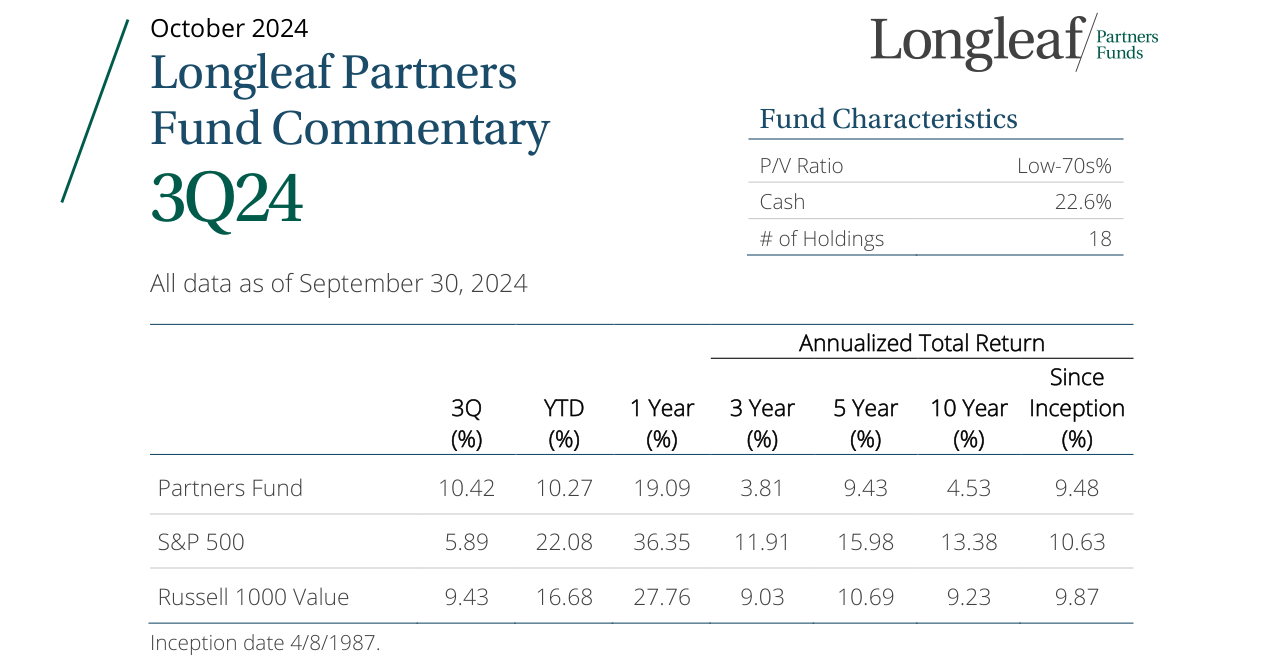
Fund P/V ratio in the low-70s%, cash position at 22.6%, and 18 holdings
| Metric | Fund | S&P 500 | Russell 1000 Value |
|---|---|---|---|
| 3Q Return | 10.42% | 5.89% | 9.43% |
| YTD Return | 10.27% | 22.08% | 16.68% |
| 1-Year Return | 19.09% | 36.35% | 27.76% |
| 3-Year Annualized Return | 3.81% | 11.91% | 9.03% |
| 5-Year Annualized Return | 9.43% | 15.98% | 10.69% |
| 10-Year Annualized Return | 4.53% | 13.38% | 9.23% |
| Since Inception Annualized Return | 9.48% | 10.63% | 9.87% |
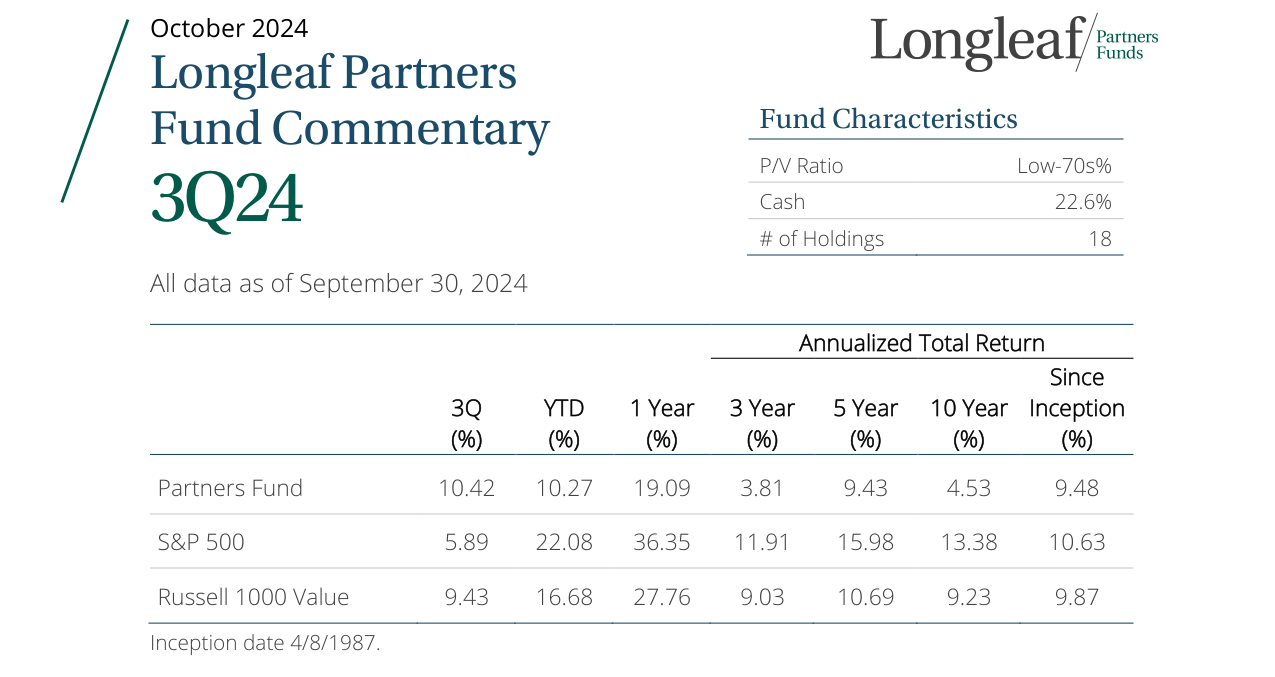
Partners Fund returned 10.42% in the third quarter, outperforming the S&P 500's 5.89% and the Russell 1000 Value's 9.43%; since inception, the Partners Fund has an annualized return of 9.48%
Companies/Assets Involved
- Kellanova (Packaged Foods): Largest contributor in the third quarter (+39%), acquired by Mars at a premium; the fund exited when the price was strong. Bullish, but position closed.
- CNX Resources (Natural Gas): Second-largest contributor (+34%), with low costs and hedging strategies supporting free cash flow used for buybacks. Bullish.
- PayPal (Digital Payments): Third-largest contributor (+34%), with gross profit growing 8%, double-digit free cash flow growth, and annualized buybacks of nearly 10% of shares. Bullish.
- MGM Resorts (Hotels/Gaming): Largest detractor (-12%), but the author believes long-term earnings potential remains unchanged, with strong free cash flow and active buybacks. Bullish.
- FedEx (Global Logistics): Detractor (-8%), facing a challenging revenue environment and the expiration of the USPS contract, but the author believes cost savings and the potential spin-off of FedEx Freight could unlock value. Bullish.
- PVH (Apparel): Detractor (-5%), not analyzed in detail. Bullish (implied).
- Affiliated Managers Group (Asset Management): Fourth-largest contributor (+14%), not analyzed in detail. Bullish.
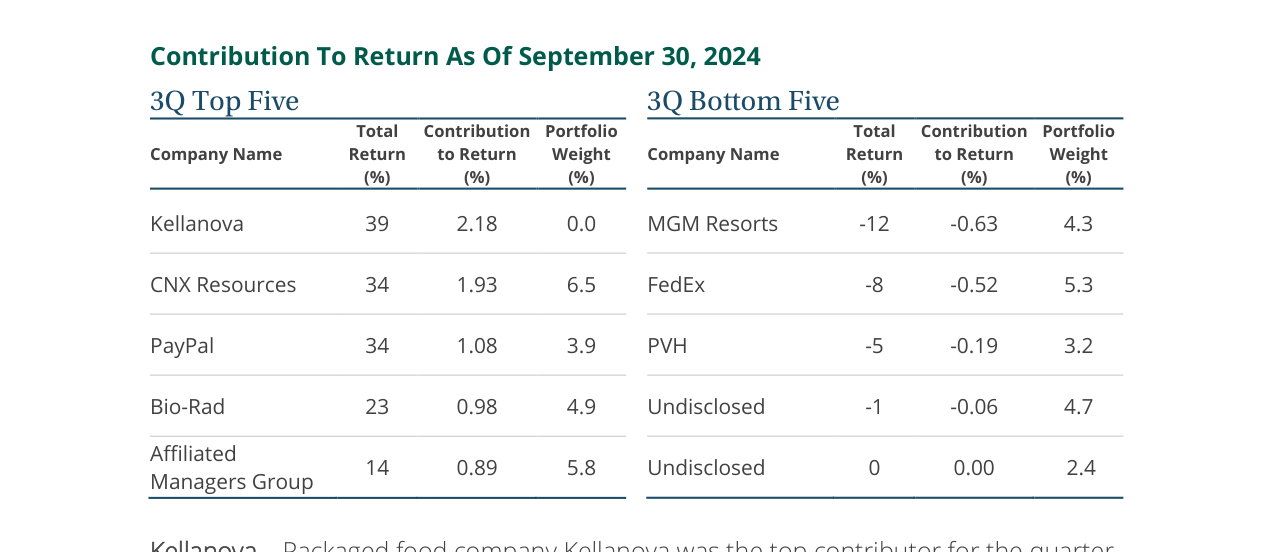
In the third quarter, Kellanova led with a 2.18% return contribution, followed by CNX Resources at 1.93%; MGM Resorts was the worst performer with a -0.63% return contribution, and FedEx contributed -0.52%
Investment Implications
- Reducing Strong Performers to Increase Cash: Investors should focus on the defensive significance of the fund's high cash position (22.6%) rather than simply chasing short-term returns. This suggests the author believes the market valuation gap may persist, requiring a margin of safety.
- Focus on Free Cash Flow and Buybacks: Cases like PayPal and CNX demonstrate that free cash flow growth and aggressive buybacks are key drivers of value realization. Investors should prioritize screening for such companies.
- Spin-off/M&A Opportunities: The spin-off of FedEx Freight could unlock value (compared to the high valuations of Old Dominion and Saia), and the acquisition of Kellanova validates the exit path when brand assets are undervalued. Investors can watch for similar potential event-driven opportunities.
- Long-Term Holding Amid Industry Volatility: MGM's quarterly volatility did not shake the author's confidence, suggesting that in cyclical industries like gaming, investors must tolerate short-term fluctuations and focus on free cash flow and buyback capacity.