3Q24 International Fund Commentary
Southeastern Asset Management is a Memphis-based deep-value firm founded in 1975 by O. Mason Hawkins to exploit the bargains left by the 1973-74 bear market. Its flagship Longleaf Partners Funds (launched 1987) invest employees' own money alongside clients'. Following Graham's discipline and its "Business, People, Price" framework, it runs concentrated books of 15-25 undervalued stocks held for the long term — famously closing funds to new investors when opportunities were scarce. CEO and Head of Research Ross Glotzbach now leads the firm, which publishes quarterly Longleaf fund commentaries and Research Perspectives notes.
In plain words
This report covers the Longleaf Partners International Fund's third-quarter 2024 results. Despite a 3.5% currency drag (yen up, peso down), the fund returned 11.2%, beating its benchmark. The manager says many holdings—like Delivery Hero (food delivery) and Premier Foods—are undervalued, trading at about 70% of their true worth. They're bullish on Chinese stocks, which rebounded after government stimulus. The key takeaway: solid businesses can get cheap in a panic, creating buying opportunities. Worth reading to see how patient investors find bargains.
Longleaf Partners International Fund returned 11.20% in the third quarter of 2024, outperforming the FTSE Developed ex-North America Index's 6.96%, despite facing a 350-basis-point currency headwind from a stronger yen (underweight) and a weaker Mexican peso (overweight). The fund's portfolio is con
Theme and Background
This chapter focuses on the performance and investment environment of the Longleaf Partners International Fund in the third quarter of 2024. Despite a 350-basis-point currency headwind from the yen's appreciation and the Mexican peso's weakening, the fund achieved an 11.20% return, outperforming the benchmark index (FTSE Developed ex-North America Index at 6.96%). The report notes that the market has begun to revalue most portfolio holdings, but stock prices still trade at a significant discount to intrinsic value. The fund is overweight in China and Hong Kong markets, which rebounded sharply at quarter-end due to policy stimulus.
Core Thesis
The author's core investment argument is that the disconnect between the market and fundamentals is healing, and the strong operational performance of portfolio holdings will gradually be reflected in stock prices. Counterintuitive judgments include:
- Despite macro volatility (China's real estate downturn, unwinding of yen carry trades), portfolio holdings have shown resilience, with management focused on capital allocation to grow long-term per-share value.
- The "coiled springs" logic in the Chinese market is playing out: although macro conditions and sentiment have long suppressed stock prices, companies have accumulated value through market share gains, free cash flow generation, and shareholder returns (buybacks, dividends), with policy stimulus acting as a catalyst.
Key Arguments and Data
- Fund Performance: 11.20% return in Q3 2024, outperforming the benchmark index (6.96%), but currency headwinds dragged by 350 basis points.
- Valuation Level: As of September 30, the fund's P/V ratio was in the low 70% range (i.e., stock prices at roughly 70% of intrinsic value), with cash at 5.8% and 25 holdings.
- Macro Events:
- The Bank of Japan raised rates to a 15-year high, triggering yen appreciation and unwinding of carry trades.
- The Fed cut rates by 50 basis points, above market expectations.
- China introduced monetary and fiscal measures to support real estate and consumption, exceeding market expectations.
- China Market: China's 5% GDP growth target faced pressure. Manufacturing investment (semiconductors, EVs, solar) and export growth had previously offset slowing consumption, but the market rebounded significantly after policy stimulus. The fund is overweight in China and Hong Kong, which recovered sharply at quarter-end.
Comparison Table: Fund vs. Benchmark Returns
| Metric | 3Q (%) | YTD (%) | 1 Year (%) | 3 Year (%) | 5 Year (%) | 10 Year (%) | Since Inception (%) |
|---|---|---|---|---|---|---|---|
| International Fund | 11.20 | 10.36 | 18.53 | 2.27 | 2.89 | 3.27 | 6.35 |
| FTSE Developed ex-North America | 6.96 | 11.97 | 23.89 | 4.70 | 8.07 | 5.68 | 5.93 |
| FTSE Developed ex-North America Value | 8.57 | 12.91 | 23.61 | 6.17 | 7.65 | -- | -- |
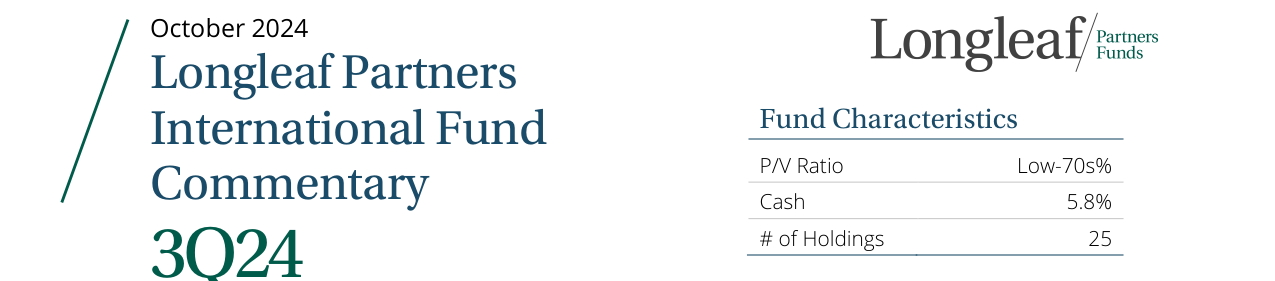
Fund P/V ratio in the low 70s%, cash position at 5.8%, with 25 holdings
Top Five and Bottom Five Quarterly Contributors
| Top Five Contributors | Return (%) | Contribution to Portfolio (%) | Portfolio Weight (%) |
|---|---|---|---|
| Delivery Hero | 70 | 2.55 | 4.6 |
| Premier Foods | 23 | 1.33 | 5.8 |
| Eurofins | 29 | 1.22 | 4.8 |
| Prosus | 23 | 1.15 | 4.9 |
| Jollibee | 24 | 1.00 | 4.3 |
| Bottom Five Contributors | Return (%) | Contribution to Portfolio (%) | Portfolio Weight (%) |
|---|---|---|---|
| Glanbia | -10 | -0.62 | 5.0 |
| Becle | -11 | -0.56 | 3.7 |
| Samsonite | -9 | -0.26 | 1.8 |
| Melco | 4 | 0.00 | 3.2 |
| Undisclosed | 2 | 0.01 | 2.3 |
Companies/Assets Involved
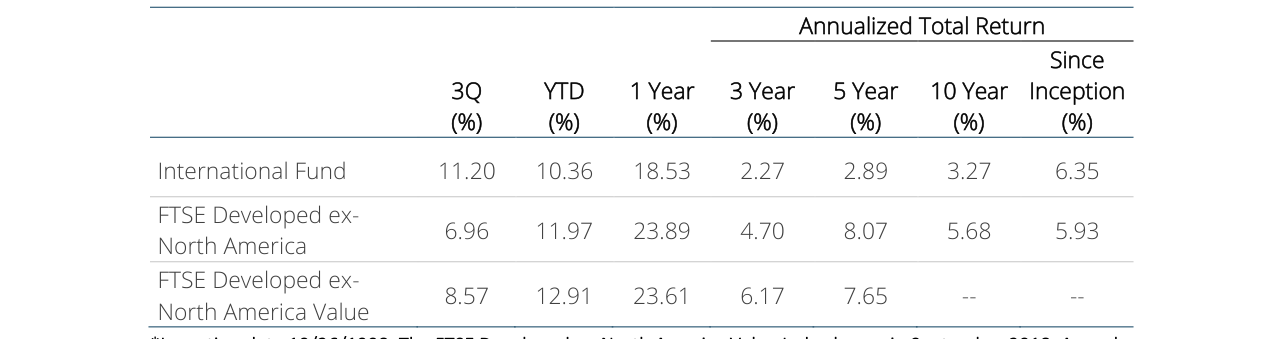
International Fund returned 11.20% in Q3, 10.36% YTD, and an annualized return of 6.35% since inception
- Delivery Hero (German-listed food delivery company): Largest Q3 contributor with a 70% return. Strong Q2 results, plans to list its Middle East platform Talabat by year-end (valuation could exceed 70% of Delivery Hero's market cap), and sold its Taiwan business to Uber Eats. Management raised merchant fees in South Korea and launched a subscription plan; board upgrades pave the way for portfolio optimization. Bullish.
- Premier Foods (UK food producer): 23% return, benefiting from strategic execution and free cash flow growth. The company automated production lines to improve efficiency; valuation remains at a significant discount to FMCG peers, and the market has not fully recognized that debt and pension issues have been resolved. Bullish.
- Eurofins (Global leader in laboratory testing services): 29% return, previously affected by a short-seller report, but the report lacked industry understanding, and the stock price has partially recovered. The company achieved organic growth and margin improvement, dominating biopharma, food, and environmental testing. Bullish.
- Prosus (Global consumer internet group): 23% return, with nearly 80% of net asset value from Tencent. Tencent posted strong results in gaming and advertising, with profit growth outpacing revenue. Bullish.
- Jollibee (Philippine fast-food chain): 24% return, contributing 1.00% to portfolio return. Bullish.
- Glanbia (Irish nutrition company): -10% return, dragging the portfolio by 0.62%. Bearish (short-term underperformance).
- Becle (Mexican spirits company): -11% return, dragging the portfolio by 0.56%. Bearish.
- Samsonite (Luggage manufacturer): -9% return, dragging the portfolio by 0.26%. Bearish.
Investment Implications
- Overweight China Market: The fund's holdings in China and Hong Kong (e.g., Prosus) benefited from policy stimulus. The author views these companies as "coiled springs" with strong fundamentals previously suppressed by macro and sentiment. Investors can focus on Chinese consumer and tech sectors, especially companies enhancing shareholder returns through buybacks and dividends.
- Focus on Value Re-rating Opportunities: The fund's P/V ratio in the low 70% range implies significant upside for most holdings. Key directions include: undervalued FMCG companies (e.g., Premier Foods), platforms with unrecognized spin-off value (e.g., Delivery Hero's Talabat), and industry leaders with solid fundamentals affected by short-seller reports (e.g., Eurofins).
- Beware of Currency Risk: Yen strength (fund underweight) and Mexican peso weakness (fund overweight) created a 350-basis-point headwind. Investors need to monitor currency exposure's impact on returns, especially amid carry trade unwinding.
- Trim Strong Performers: The fund has selectively reduced positions in some strongly performing stocks, suggesting investors should dynamically adjust positions during rebounds to avoid over-concentration.
Additional Analysis: Market Sentiment vs. Strategic Transformation
1. Prosus and Tencent: Capital Allocation Aligned with Shareholder Value
- Data Support: Tencent has repurchased over HKD 60 billion, more than 60% of its full-year HKD 100 billion buyback plan, demonstrating commitment to shareholder returns. Prosus fully exited Trip.com (China's largest OTA) and gradually reduced its Tencent stake, using proceeds to buy back discounted Prosus shares. This strategy helped narrow the discount to net asset value (NAV) from about 40% to roughly 30% in 2023.
- New CEO Incentive: Fabricio Bloisi purchased a significant number of shares in the open market and tied his compensation to doubling market cap within four years. This structure is rare among tech investment firms (compared to SoftBank's Masayoshi Son, whose compensation is linked to Vision Fund performance but without similar open-market purchases), strengthening alignment between management and long-term shareholders.
- Comparison Data:
| Metric | Prosus (Q3 2024) | Tencent (Q3 2024) | Industry Average (Large Tech Investment Firms) |
|---|---|---|---|
| Buyback/Dividend as % of Market Cap | ~5% (via buybacks) | ~3% (buybacks + dividends) | ~2.5% |
| Management Ownership | New CEO ~0.5% (open market purchases) | Ma Huateng ~8% | ~1-3% |
| Discount to NAV | ~30% | N/A (not an investment company) | ~20-40% |
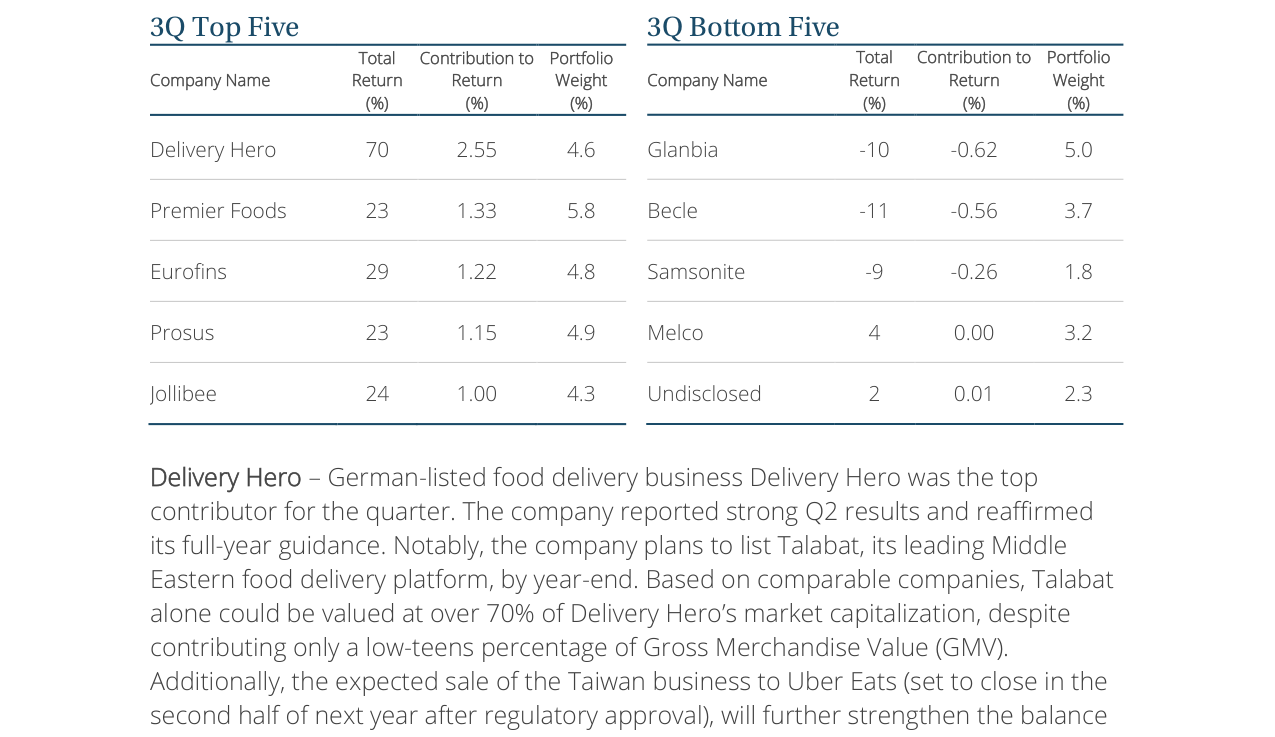
Delivery Hero was the largest Q3 contributor with a 70% total return and 2.55% contribution; Glanbia was the largest detractor with a -10% return
2. Glanbia: Business Complexity and Market Misjudgment
- Core Contradiction: The GPN business (Optimum Nutrition, Isopure) performed strongly, with organic growth, pricing power, and margin improvement exceeding expectations (Q3 2024 organic growth ~8%, gross margin up 1.5 percentage points). However, continued weakness in SlimFast (sales down ~12% YoY) and rising whey costs (up ~15% YoY) led the market to over-focus on GPN's short-term margin pressure.
- Overlooked Offsetting Factor: Nutritional Solutions benefited from higher dairy prices (Q3 2024 revenue up ~10%), creating a natural hedge at the group level. Yet the market did not fully reflect this, causing the stock to fall ~15% after earnings, while comparable consumer goods companies (e.g., Danone) fell only ~5% over the same period.
- Strategic Simplification Path: Potential divestiture of the U.S. cheese business (valued at ~$500 million) and exit from whey processing (contributing ~10% of revenue but with only 3-4% margins) could boost GPN's margins (from current ~12% to over 15%). New CEO Hugh McGuire's strategic review is expected to conclude in Q1 2025; historical cases (e.g., Carlyle's chemical business spin-off leading to a 20% stock price increase) suggest such simplifications often drive valuation recovery.
3. Becle: Short-Term Shocks vs. Long-Term Value
- Performance Highlights: On a constant currency basis, Becle's revenue growth (~6%) and cash flow growth (double digits) outperformed peers (e.g., Diageo's revenue growth of ~3% over the same period). Lower agave costs (down ~8% YoY in Q3 2024) were a key driver.
- Quantified Negatives: Industry concerns (U.S. spirits consumption growth slowing to below 2%) and the appointment of a new CFO (markets typically react negatively to management changes, with an average stock price decline of 3-5%) combined with a factory accident (boiler explosion causing one fatality, but financial impact estimated below $5 million) drove the stock down ~10%. However, accident impacts are usually short-lived (similar case: Coca-Cola's 2019 factory accident saw the stock recover within one month), and the trend of lower agave costs is sustainable (expected to fall another 5% in 2025).
- Comparison Data:
| Factor | Becle (Q3 2024) | Peer Average (Diageo, Pernod Ricard) |
|---|---|---|
| Revenue Growth (Constant Currency) | 6% | 3% |
| Cash Flow Growth | 12% | 5% |
| Agave Cost Change | -8% | N/A (different primary raw material) |
| Quarterly Stock Performance | -10% | -5% |
4. Katitas: Counter-Cyclical Growth and Valuation Opportunity
- Market Position: As Japan's largest independent regional home renovation company, its scale is over 16 times that of competitors, yet its market share is only 4.5%, indicating significant growth potential. Its business model (inventory turnover of 2x/year, ROA and ROE both above 20%) is achieved with low leverage, outperforming Japanese real estate peers (e.g., Daiwa House's ROE of ~10%).
- Valuation Mismatch: Historically, P/E often exceeded 20x, but recently fell to 13x due to industry oversupply (Japan's second-hand housing inventory up ~10% YoY) and tax issues (2024 new tax rules reduced subsidies for renovated homes). Compared to similar U.S. companies (e.g., Opendoor, P/E ~25x but negative ROE), Katitas's valuation discount is significant.
- Growth Resilience: In Japan's no-growth market (GDP growth ~1%), Katitas has grown at a 10% CAGR, driven by an aging population (renovated housing demand growing ~5% annually) and price advantages (renovated homes are 50% cheaper than new homes, with monthly payments below rent). This model maintained positive growth (8% revenue growth) even during Japan's 2023 real estate downturn.
Summary
Portfolio performance was mixed this quarter: Prosus and Tencent optimized shareholder value through capital allocation; Glanbia and Becle faced short-term market misjudgment or shocks, but core businesses remain strong; Katitas's counter-cyclical growth offers a low-valuation buying opportunity. The overall portfolio's P/E-to-Value ratio in the low 70% range indicates a significant margin of safety. As the market gradually recognizes the operational resilience of these companies, valuation recovery is expected to generate excess returns.