2Q24 Partners Fund Commentary
Southeastern Asset Management is a Memphis-based deep-value firm founded in 1975 by O. Mason Hawkins to exploit the bargains left by the 1973-74 bear market. Its flagship Longleaf Partners Funds (launched 1987) invest employees' own money alongside clients'. Following Graham's discipline and its "Business, People, Price" framework, it runs concentrated books of 15-25 undervalued stocks held for the long term — famously closing funds to new investors when opportunities were scarce. CEO and Head of Research Ross Glotzbach now leads the firm, which publishes quarterly Longleaf fund commentaries and Research Perspectives notes.
In plain words
This report is from the Longleaf Partners Fund, which fell 6% last quarter while the S&P 500 rose 4%. The manager warns that the overall market is dangerously overvalued: profit margins for big companies are at historic highs, and if they return to normal, stocks could drop over 30%. But their own holdings trade at just 10 times free cash flow (the actual cash a business generates) and have room to improve profits, so they can still deliver good returns even if the economy slows. For regular investors, it’s a reminder to avoid expensive stocks and look for cheap ones with improving fundamentals.
The Longleaf Partners Fund declined 6.31% in the second quarter of 2024, underperforming the S&P 500 (+4.28%) and the Russell 1000 Value (-2.17%), primarily due to a lack of significant winners and an increase in the number of individual stocks with declines exceeding 10%, while the cash position ro
Theme and Background
This chapter is the opening of the Longleaf Partners Fund's second-quarter 2024 investment report. Against the backdrop of the fund declining 6.31% in a single quarter, significantly underperforming the S&P 500 (+4.28%), the author issues a warning about overall market valuation risks while emphasizing the margin of safety in portfolio holdings and their potential for fundamental improvement.
Core Views
- The short-term decline is an overreaction: The per-share value performance of the fund's holdings has outperformed their stock price movements, with the price decline attributed to irrational selling.
- The overall market faces significant downside risk: The weighted median net profit margin of the S&P 500 (ex-Financials) is at an historically extreme high. If margins revert to the pre-late-2010s peak of 15% and the price-to-earnings ratio falls back to the long-term average of 16-17x, the market could decline by more than 30%.
- The fund's holdings offer a relative advantage: Portfolio companies trade at approximately 10x free cash flow (FCF) with room for margin improvement. Even in a deteriorating economic environment, they can achieve growth and are on track to meet the double-digit return target of inflation plus 10%.
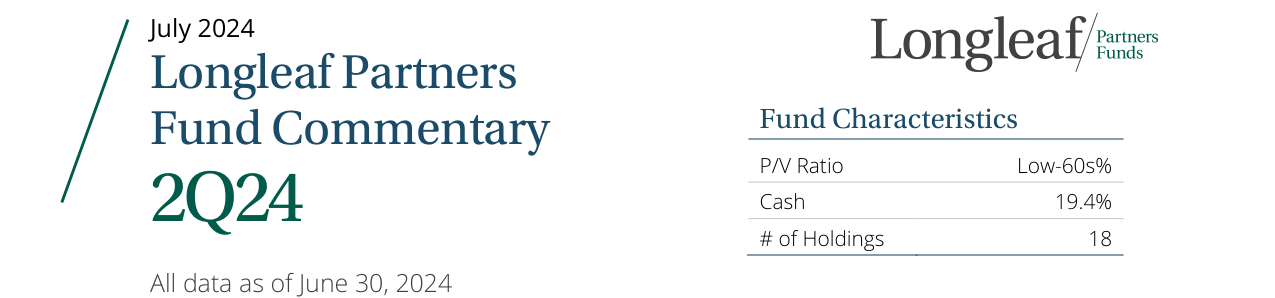
Fund P/V ratio in the Low-60s%, cash position at 19.4%, with 18 holdings
Key Arguments and Data
1. Market Margin Risk:
- The weighted median net profit margin of the S&P 500 (ex-Financials) has historically fluctuated in the "high single digits to low double digits" range since 1990, but it has now broken out of this range for several years, reaching "unprecedented" levels.
- If margins revert from current levels to 15% (the historical peak before the late 2010s) and the P/E ratio falls to 16-17x (similar to current levels for global non-mega-cap growth stocks), the market would face a decline of more than 30%.
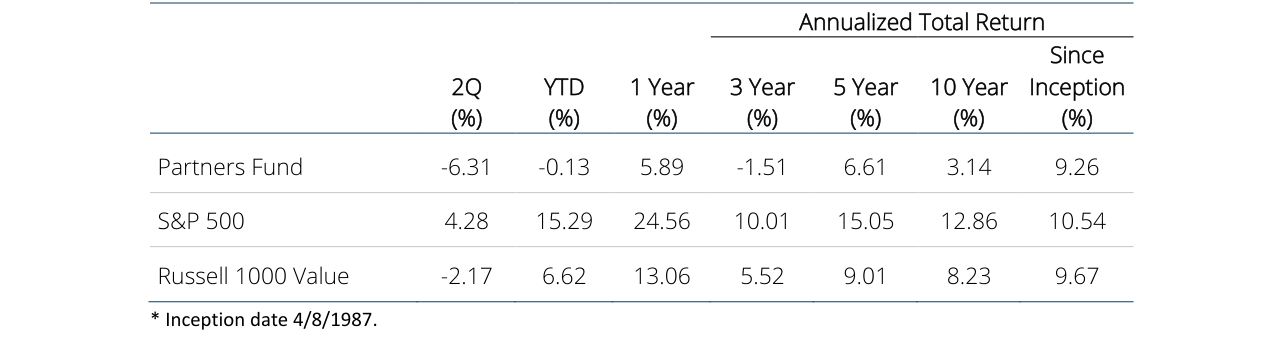
The Partners Fund returned -6.31% in the second quarter, underperforming the S&P 500's 4.28% and the Russell 1000 Value's -2.17%
2. Valuation Advantage of Fund Holdings:
- The S&P 500 trades at over 20x "peak potential" FCF, while the fund's holdings trade at approximately 10x FCF, with room for margin improvement.
- If the profitability of portfolio companies materializes in 2025 and they trade at low-teens P/E multiples (assuming a discount due to their value stock characteristics), returns would exceed the target of inflation plus 10%.
3. Fundamentals of Portfolio Companies:
- FedEx: EPS grew 19% year-over-year, and declining capital expenditure narrowed the gap between EPS and FCF, making the company a significant share repurchaser. A strategic review of the Freight division could unlock value (compared to higher valuations for peers like Old Dominion).
- Bio-Rad: Growth in the life sciences business has been delayed but not derailed. Current margins are below peers, and a strong balance sheet supports buybacks. The value of its stake in Sartorius is underestimated.
- CNH Industrial: The global agricultural equipment market has underperformed expectations due to weak commodity prices and high interest rates. The CEO's departure for personal reasons creates short-term management transition pressure. However, the company has pricing power, market share growth, and margin improvement, trading at 7x P/E with a commitment to return 100% of FCF to shareholders.
- Mattel: 2024 guidance has been confirmed, and the share repurchase program has been increased. The market has overlooked the potential upside from media and entertainment revenue streams.
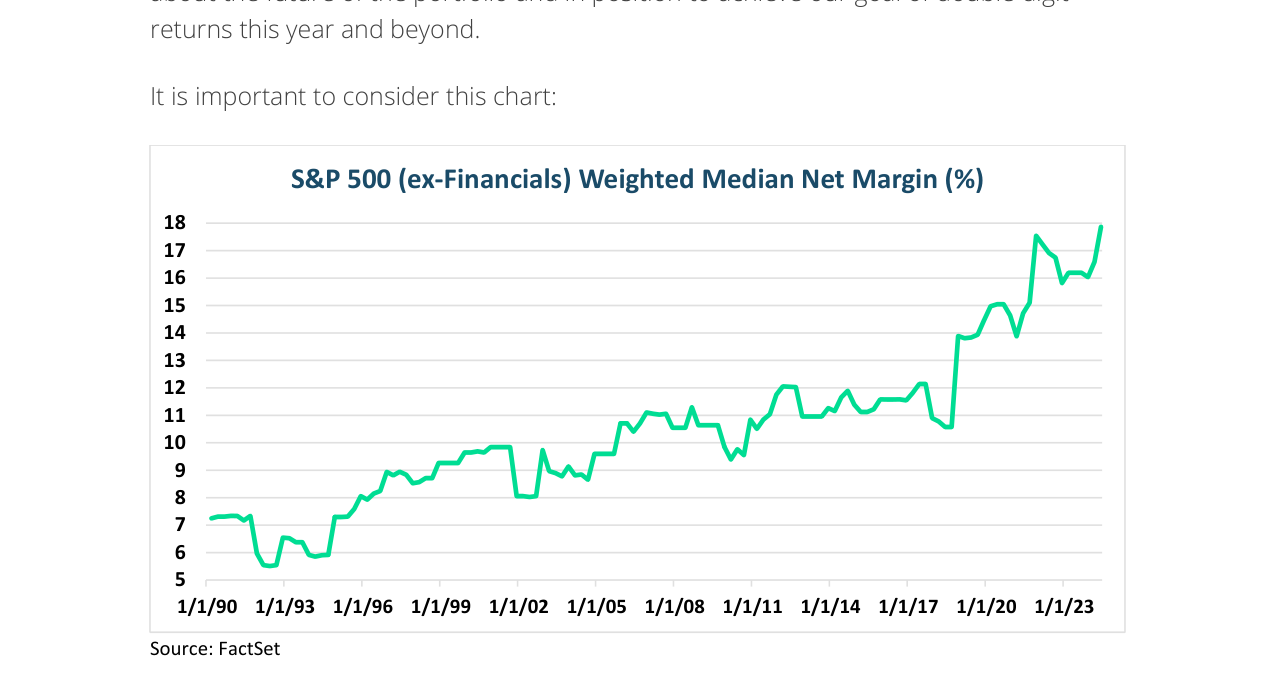
The weighted median net profit margin of the S&P 500 (ex-Financials) rose from approximately 7% in 1990 to about 18% in 2023, reaching an all-time high
Comparative Data Table:
| Metric | S&P 500 (ex-Financials) | Fund Holdings |
|---|---|---|
| Current FCF Multiple | >20x | ~10x |
| Margin Level | Historically extreme high | Room for improvement |
| Assuming margins revert to 15% + P/E 16-17x | Decline >30% | — |
| Assuming low-teens P/E + profitability materializes | — | Return > inflation + 10% |
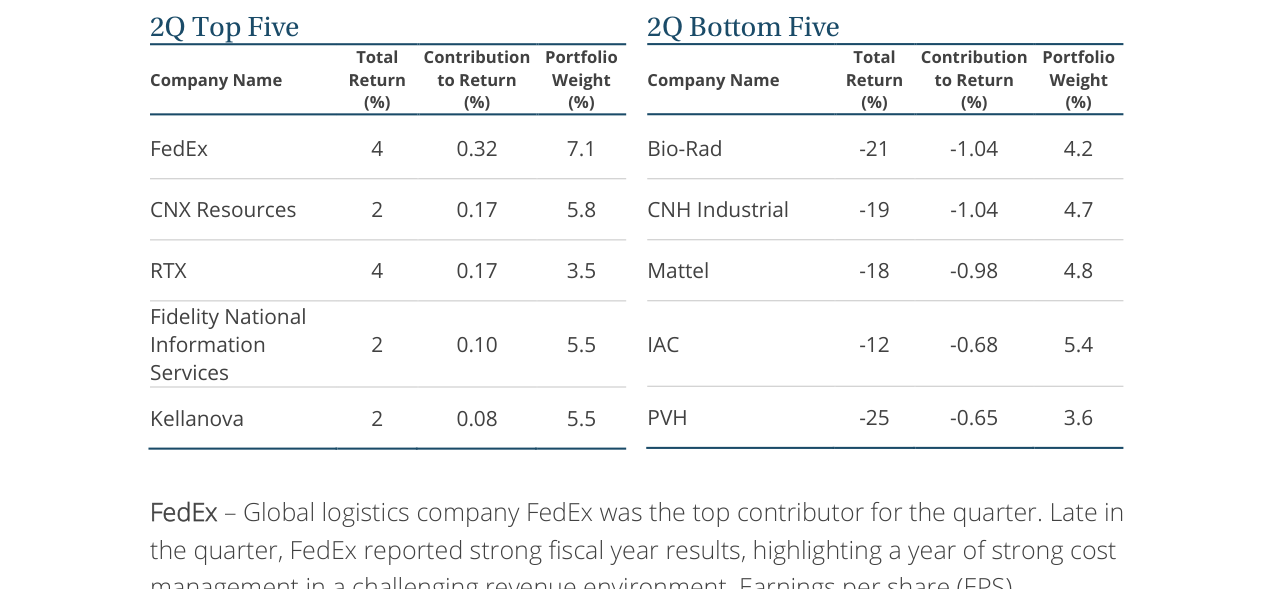
Among the top five contributors in the second quarter, FedEx, with a 7.1% weight, contributed 0.32% to returns
Companies/Assets Involved
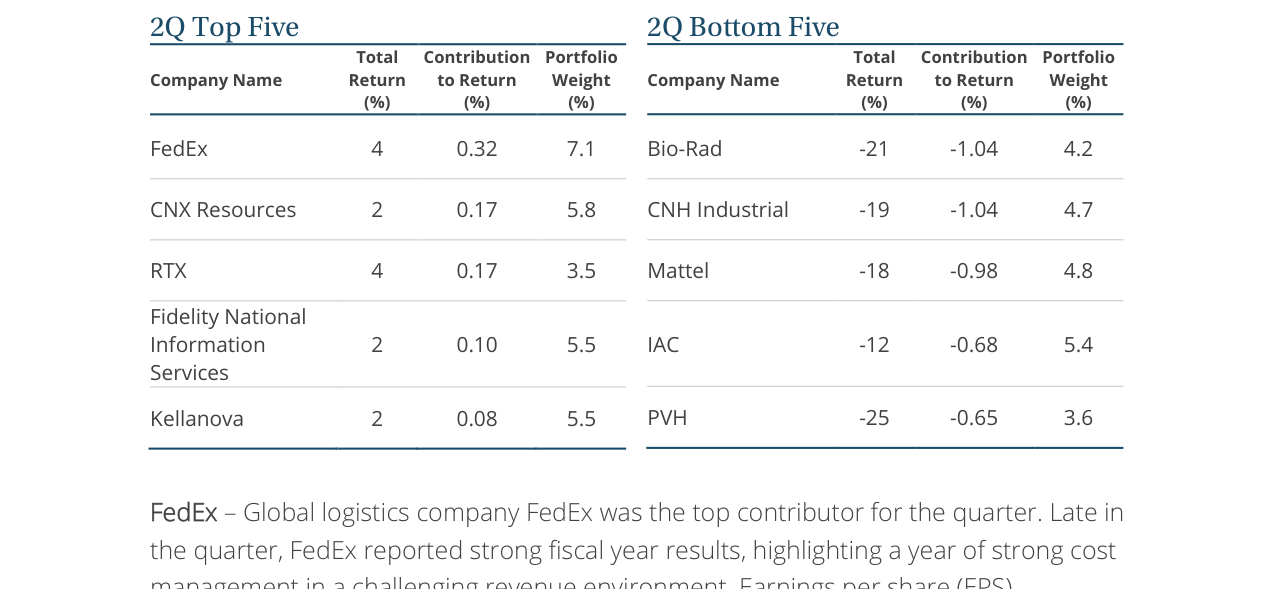
Among the top five detractors in the second quarter, PVH fell 25%, detracting 0.65 percentage points from returns
- FedEx (Bullish): A global logistics company and the largest positive contributor for the quarter (+4%, contributing 0.32%). EPS grew 19%, and improved FCF drove buybacks. A strategic review of the Freight division could unlock value.
- Bio-Rad (Bullish): A life sciences company and the largest negative contributor for the quarter (-21%, contributing -1.04%). Growth has been delayed but not derailed. Margins are below peers, and the Sartorius stake is undervalued.
- CNH Industrial (Bullish): An agricultural machinery company (-19%, contributing -1.04%). Short-term headwinds include industry weakness and CEO departure, but long-term strengths include pricing power, market share growth, trading at 7x P/E, and FCF returned to shareholders.
- Mattel (Bullish): A global toy and media company (-18%, contributing -0.98%). The market is focused on consumer weakness, but the potential from media and entertainment revenue is not priced in.
- Liberty Broadband (Exited): Due to a misjudgment of competition (fiber and wireless broadband), Charter Communications was forced to adjust capital expenditure, and its pricing power came under question.
Investment Implications
- Beware of overall market risk: The current S&P 500 margin is at an historically extreme high. Combined with elevated P/E ratios, a reversion to the mean could trigger a market decline of more than 30%. Investors should avoid chasing stocks with high valuations and high margin expectations.
- Focus on low-valuation stocks with room for margin improvement: The fund's holdings trade at approximately 10x FCF with potential for margin expansion, allowing them to achieve relative growth even in an economic slowdown. Such assets offer a significant margin of safety in the current market environment.
- Monitor corporate governance and capital allocation: FedEx's strategic review of its Freight division, CNH's commitment to FCF return, and Bio-Rad and Mattel's share buybacks all indicate that management is actively enhancing shareholder value.