2Q24 International Fund Commentary
Southeastern Asset Management is a Memphis-based deep-value firm founded in 1975 by O. Mason Hawkins to exploit the bargains left by the 1973-74 bear market. Its flagship Longleaf Partners Funds (launched 1987) invest employees' own money alongside clients'. Following Graham's discipline and its "Business, People, Price" framework, it runs concentrated books of 15-25 undervalued stocks held for the long term — famously closing funds to new investors when opportunities were scarce. CEO and Head of Research Ross Glotzbach now leads the firm, which publishes quarterly Longleaf fund commentaries and Research Perspectives notes.
In plain words
This is the quarterly update from a global fund run by Southeastern Asset Management. The fund lost 4.24% last quarter, missing its benchmark, mainly due to election fears in Mexico, France, and the UK, plus a short-seller report (a bet that a stock will fall) on one of its holdings, Eurofins. The manager argues this is temporary: the companies they own—like tequila maker Becle or Indian bank HDFC—are strong, earn most of their revenues outside their home countries, and trade below their true value. Worth a read if you want to see how patient investors think during market noise.
Longleaf Partners International Fund declined 4.24% in the second quarter of 2024, underperforming its benchmark, the FTSE Developed ex-North America Index, which fell 0.75%. The report notes that despite strong first-quarter earnings and solid value growth for most portfolio holdings, stock prices
Theme and Background
This section primarily discusses the performance and portfolio adjustments of the Longleaf Partners International Fund in the second quarter of 2024. The report notes that despite strong earnings for most companies in the first quarter, stock prices were dragged down by macroeconomic concerns and election cycles in Mexico, the UK, and France, causing the fund to decline by 4.24%, underperforming its benchmark index. The fund managers believe these headwinds are temporary, and the held companies demonstrate resilience due to their non-essential consumer goods attributes, strong brands, and diversified market presence.
Core Views
- The author explicitly judges: The current market volatility driven by election cycles is temporary. The held companies have strong fundamentals and are expected to regain market attention during the H1 earnings season.
- Counterintuitive judgment: Although the fund is overweight in France and Mexico, the value growth of these companies primarily stems from overseas markets rather than domestic political risks. For example, the depreciation of the Mexican peso could instead create margin tailwinds for export-oriented companies (such as Becle).
- Response to short-term short-seller reports: Eurofins saw its stock price plummet over 20% after being targeted by Muddy Waters. However, the author believes the issues raised in the report were already covered in pre-investment analysis, and the company may unlock value through management buybacks and resolving historical related-party transactions.
Key Arguments and Data
- Performance Comparison: The fund fell 4.24% in Q2 2024, while the benchmark fell 0.75%; year-to-date, the fund is down 0.75%, while the benchmark is up 4.68%.
- Portfolio Concentration: Data on the top five detractors and contributors is as follows:
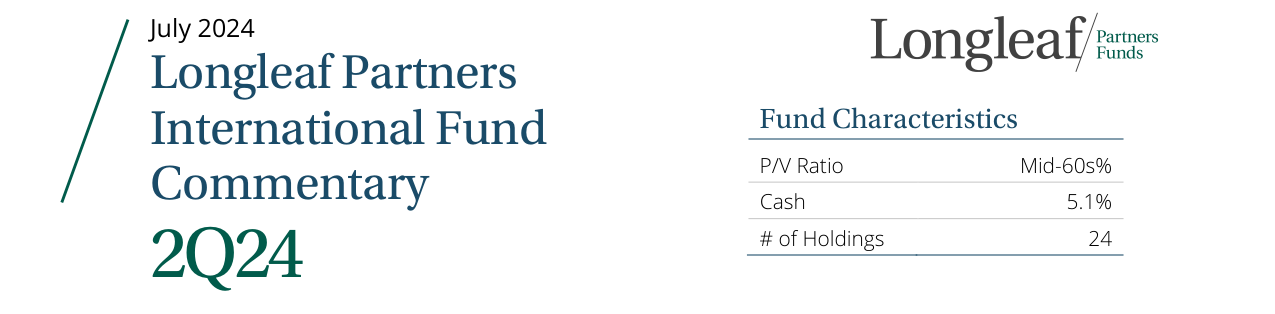
Fund P/V ratio in the mid-60% range, cash at 5.1%, holding a total of 24 stocks
| Top 5 Detractors | Contribution to Total Portfolio Return | Portfolio Weight | Top 5 Contributors | Contribution to Total Portfolio Return | Portfolio Weight |
|---|---|---|---|---|---|
| Becle | -1.09% | 4.6% | Millicom | 0.72% | 4.3% |
| Eurofins | -0.87% | 3.9% | HDFC Bank | 0.71% | 5.2% |
| Delivery Hero | -0.76% | 3.6% | Prosus | 0.60% | 5.0% |
| Accor | -0.57% | 5.9% | Premier Foods | 0.44% | 5.8% |
| Jollibee | -0.57% | 3.8% | Melco International | 0.29% | 3.5% |
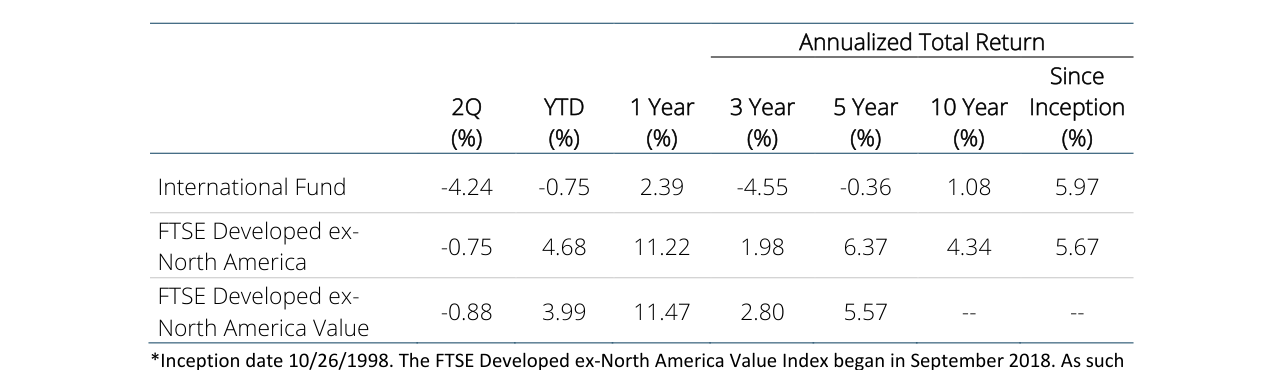
International Fund Q2 2024 return -4.24%, year-to-date -0.75%, annualized return since inception 5.97%
- Key Data Support:
- Millicom: Organic revenue growth of approximately 4%, total costs down about 3.5%, adjusted EBITDA growth exceeding 20%; Iliad proposed an acquisition at $24 per share (close to the market price but far below the author's valuation).
- HDFC Bank: Improved loan-to-deposit ratio, enhanced net interest margin, deposit growth exceeding expectations, and credit quality remaining excellent.
- Prosus: 80% of NAV comes from its Tencent stake; Tencent plans to repurchase HKD 100 billion in shares this fiscal year; Prosus has repurchased 22% of its outstanding shares over the past two years.
- Becle: Over two-thirds of revenue comes from outside Mexico; falling agave prices create margin tailwinds; FCF reached a multi-year high.
- Delivery Hero: Sold its Taiwan business to Uber for $950 million, a transaction price equivalent to 3% of GMV for 8% of EV; activist investors have taken stakes and joined the board.
Companies/Assets Involved
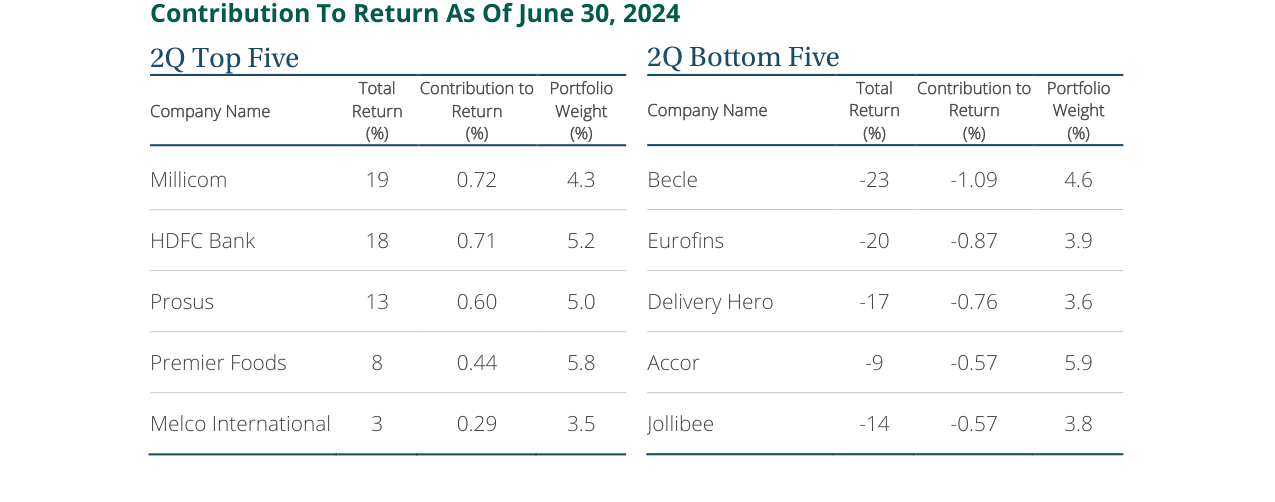
Millicom topped Q2 with a contribution of 0.72%, while Becle was the worst performer with a contribution of -1.09%
- Millicom (Latin American Telecom): Bullish. Operational improvements driving FCF growth, but Iliad's acquisition offer price ($24/share) is below the author's valuation; regulatory progress needs monitoring.
- HDFC Bank (India's largest private bank): Bullish. Clear trends in deposit growth, net interest margin improvement, and declining cost-to-income ratio, although the pace of improvement is slow due to scale.
- Prosus (Global consumer internet group): Bullish. Tencent stake contributes the majority of NAV; buybacks significantly enhance NAV per share; e-commerce business turned profitable for the first time.
- Becle (Mexican tequila producer): Bullish. Short-term drag from elections and industry weakness, but export orientation, falling agave costs, and FCF improvement constitute long-term positives.
- Eurofins (Global laboratory testing leader): Bullish. Muddy Waters' short-seller report triggered a short-term decline, but the company has refuted the claims; management may repurchase shares and resolve historical related-party transactions.
- Delivery Hero (German food delivery platform): Bullish. Concerns over Korean competition are exaggerated, and the Taiwan sale transaction is undervalued; board updates and Prosus's involvement may drive value realization.
- Kering (French luxury goods group): Bearish. Position closed due to difficulties in Gucci's turnaround and a weak luxury market.
- Alibaba (Chinese e-commerce): Position closed (the original text does not provide detailed reasons).
Investment Implications
- Short-term volatility is a buying opportunity: Current election cycles and short-selling events causing stock price declines offer long-term investors opportunities to buy high-quality companies below intrinsic value. For example, valuations for Eurofins and Becle already reflect short-term pessimistic expectations, but the trend of fundamental improvement remains unchanged.
- Focus on companies with high overseas revenue exposure: In markets with higher political risk (e.g., Mexico, France), priority should be given to companies with diversified revenue sources, whose value growth is not affected by domestic elections.
- Capital allocation shifting toward shareholder returns: Buybacks and asset sales by Prosus and Delivery Hero indicate management is shifting from a "growth-first" to a "returns-first" approach, which is typically a signal of value realization.
- Be wary of short-seller reports but conduct independent verification: Although Muddy Waters' short-selling of Eurofins triggered a sharp decline, the author believes the core issues were already covered in pre-investment analysis. Investors should distinguish between "substantive issues" and "noise" and monitor the company's subsequent responses (e.g., buybacks, resolving related-party transactions).