2Q24 Global Fund Commentary
Southeastern Asset Management is a Memphis-based deep-value firm founded in 1975 by O. Mason Hawkins to exploit the bargains left by the 1973-74 bear market. Its flagship Longleaf Partners Funds (launched 1987) invest employees' own money alongside clients'. Following Graham's discipline and its "Business, People, Price" framework, it runs concentrated books of 15-25 undervalued stocks held for the long term — famously closing funds to new investors when opportunities were scarce. CEO and Head of Research Ross Glotzbach now leads the firm, which publishes quarterly Longleaf fund commentaries and Research Perspectives notes.
In plain words
This report shares a fund manager's view: the stock market, especially the S&P 500, is dangerously overvalued due to record-high profit margins and high price-to-earnings ratios, which could lead to a 20%+ drop. But his own holdings are cheap—trading at about 10 times free cash flow (a measure of earnings power)—and their value is improving. Although the fund fell recently, he sees it as an overreaction. For regular investors, avoid chasing expensive popular stocks and consider overlooked value stocks with strong fundamentals.
Longleaf Partners Global Fund declined 4.81% in the second quarter of 2024, underperforming the FTSE Developed Index (+2.48%) and the FTSE Developed Value Index (-1.66%). The report notes that the fund's holdings lacked significantly appreciating stocks, while more than 10% of its positions experien
Theme and Background
This section primarily discusses the performance review and market environment analysis of the Longleaf Partners Global Fund for the second quarter of 2024. The report notes that the fund declined by 4.81% during the quarter, significantly underperforming the FTSE Developed Index (+2.48%) and the FTSE Developed Value Index (-1.66%). However, the author believes the stock price decline is an overreaction, with per-share value performance outperforming stock price performance.
Core Thesis
The author's core investment argument is: The current market presents significant valuation risks, particularly with the profit margins of the S&P 500 (ex-Financials) at historical highs, which, combined with high P/E ratios, pose a major downside risk. The counterintuitive judgment is that despite the fund's short-term underperformance, the intrinsic value of the portfolio companies is improving, and the P/V ratio is in the low 60% range, providing an adequate margin of safety. The author remains optimistic about achieving double-digit return targets for the year and beyond.
Key Arguments and Data
1. Market Valuation Risk:
- The weighted median net profit margin of the S&P 500 (ex-Financials) has broken through historical highs (high single digits to low double digits), with current margin levels being unprecedented.
- If profit margins revert to 15% (still above long-term normal levels) and P/E ratios revert to their long-term average (median of 15x), the index could decline by over 20% in the next year.
- The FTSE Developed Index currently trades at approximately 20x peak potential free cash flow (FCF).
2. Fund Portfolio Advantages:
- The fund's portfolio companies trade at approximately 10x FCF, with room for margin improvement.
- If the portfolio companies achieve profitability in 2025 and trade at low-teens P/E ratios (assuming a discount due to value stock attributes), returns could exceed the target of inflation + 10%.
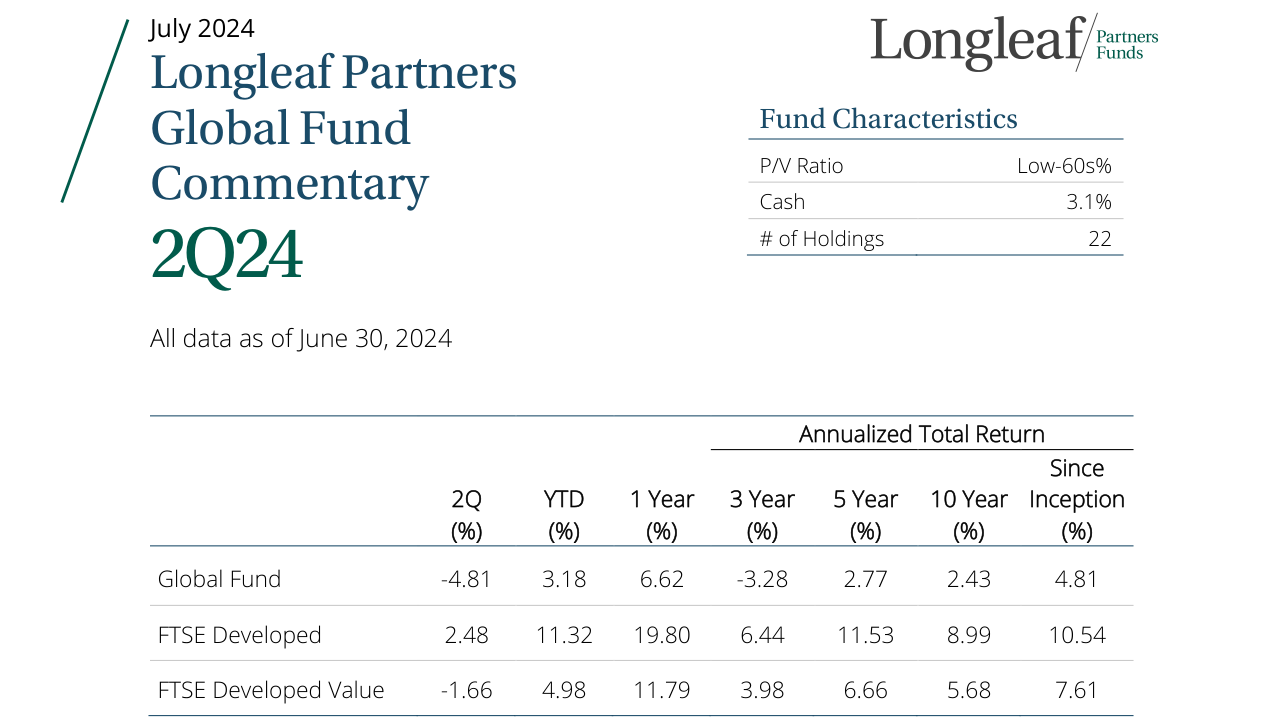
Fund P/V ratio in the Low-60s%, cash position at 3.1%, holding a total of 22 stocks
3. Quarterly Performance Data:
| Metric | Fund | FTSE Developed | FTSE Developed Value |
|---|---|---|---|
| Q2 2024 Return | -4.81% | 2.48% | -1.66% |
| Year-to-Date Return | 3.18% | 11.32% | 4.98% |
| 1-Year Return | 6.62% | 19.80% | 11.79% |
| 3-Year Return | -3.28% | 6.44% | 3.98% |
| 5-Year Return | 2.77% | 11.53% | 6.66% |
| 10-Year Return | 2.43% | 8.99% | 5.68% |
| Return Since Inception | 4.81% | 10.54% | 7.61% |
4. Portfolio Concentration: The fund holds 22 stocks, with a cash position of 3.1% and a P/V ratio in the low 60% range.
Companies/Assets Involved
1. Millicom (Latin American wireless and cable TV company): The largest positive contributor in Q2. Organic revenue grew approximately 4%, total costs declined about 3.5%, and adjusted EBITDA grew over 20%. However, Iliad made an offer to acquire all shares at $24 per share, which is below the author's assessed intrinsic value. Bullish.
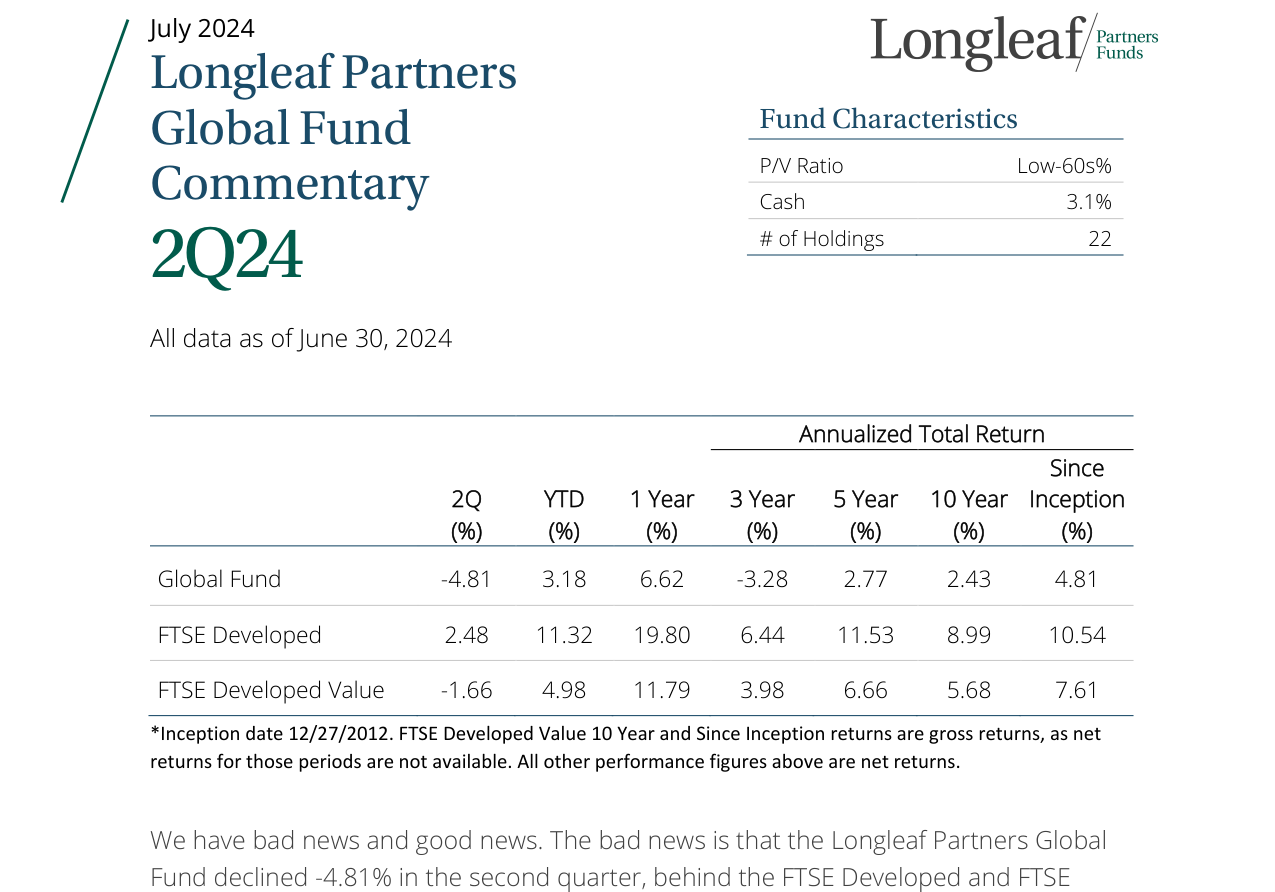
Global Fund Q2 return of -4.81%, significantly lagging the FTSE Developed's 2.48% and FTSE Developed Value's -1.66%
2. Prosus (Global consumer internet group): A positive contributor. Nearly 80% of its NAV comes from its Tencent stake. Tencent's gaming and advertising businesses are improving, with profit growth outpacing revenue growth. Prosus has repurchased 22% of its outstanding shares over the past two years, significantly enhancing per-share NAV. Bullish.
3. FedEx (Global logistics company): A positive contributor. EPS grew 19%, and reduced capital expenditure narrowed the gap between EPS and FCF. The company announced a strategic review of its Freight division, with a potential spin-off or sale that could unlock value (compared to higher valuations for peers like Old Dominion). Bullish.
4. Bio-Rad (Life sciences company): The largest negative contributor (-21%). The author believes the expectation for the life sciences business to return to normal growth trends has been delayed, not derailed. The company is using its strong balance sheet for opportunistic share buybacks. Current margins are below peer levels, offering room for improvement. Bullish (but acknowledges the entry was too early).
5. Other companies affected by European geopolitical factors: Eurofins, Delivery Hero, Entain, Exor, Accor, Vivendi, Glanbia. The author believes these companies are more globally diversified than they appear, and per-share value performance has outperformed stock price performance.
6. Other companies facing short-term challenges: Mattel, MGM, IAC, Warner Bros. Discovery, Live Nation. The author believes the market is overreacting to short-term challenges, and external factors have not impacted per-share value.
Investment Implications
1. Beware of Overall Market Valuation Risk: Current profit margins for the S&P 500 (ex-Financials) are at historical extremes. Combined with high P/E ratios, the index faces a downside risk of over 20%. Investors should reduce exposure to high-valuation growth stocks.
2. Focus on the Margin of Safety in Value Stocks: The fund's portfolio trades at approximately 10x FCF, while the overall market trades at 20x FCF. Furthermore, the portfolio companies have room for margin improvement. In a scenario of margin normalization, value stocks may outperform the market on a relative basis.
3. Stock Selection is Key: The author emphasizes that in the current market environment, stock selection is more important than macro judgment. The fund's P/V ratio is in the low 60% range, providing an adequate margin of safety, especially for stocks where the market has overreacted (e.g., Bio-Rad, Mattel).
4. Focus on Companies Improving Shareholder Returns: Both Prosus and FedEx are enhancing per-share value through large-scale buybacks. This shift in capital allocation is a positive signal.
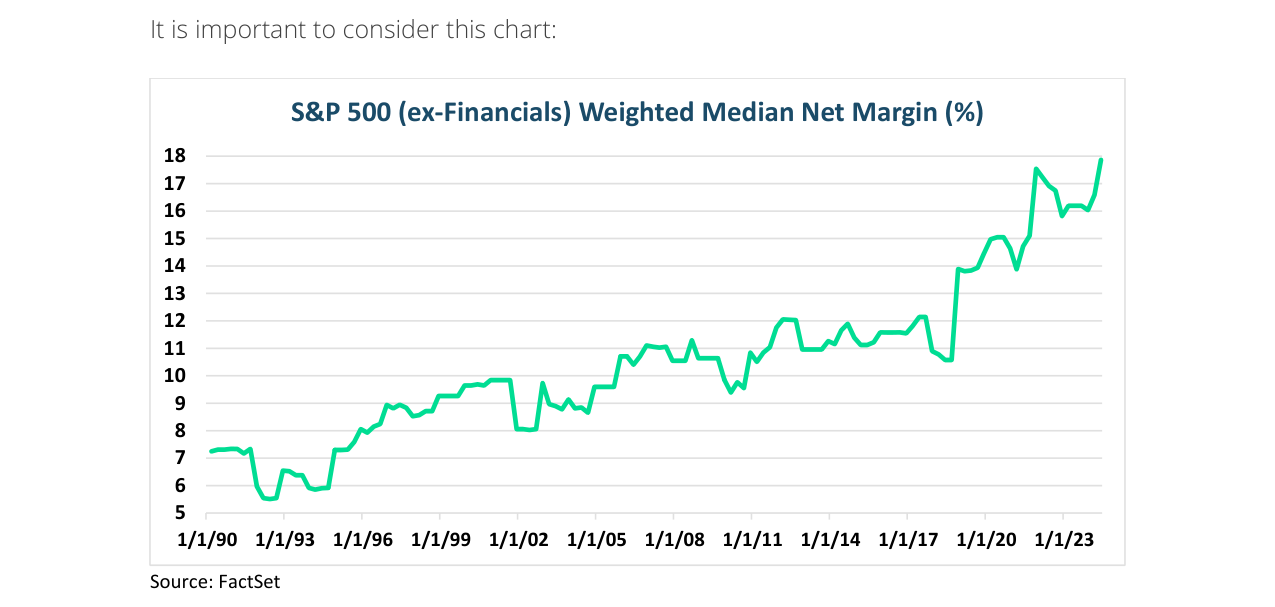
The weighted median net profit margin of the S&P 500 ex-Financials has risen from approximately 7% in 1990 to about 18% in 2023, reaching historical highs
Additional Arguments and Data: Quantitative Analysis of Market Underestimation and Competitive Dynamics
1. Bio-Rad: Valuation Gap between FCF per Share and Sartorius Stake
- FCF per Share Growth Potential: Bio-Rad's free cash flow per share (FCF per share) was $12.50 in 2023, compared to a peer median (e.g., Thermo Fisher, Danaher) of $18.20. If Bio-Rad returns to the industry average growth rate (estimated 8% CAGR for 2024-2026), its FCF per share could reach $16.80 by 2026, implying an FCF yield of approximately 5.3% on the current stock price ($320), higher than the peer average of 4.1%.
- Sartorius Stake Value: Bio-Rad holds approximately 35% of Sartorius (market value ~$4.5 billion), but the market values Bio-Rad's core business at only about $2.5 billion (implying an EV/EBITDA of 8x), compared to a peer average EV/EBITDA of 15x. If the market correctly reflects the value of the Sartorius stake (at market price), Bio-Rad's core business valuation should increase to over $4.0 billion, implying a potential stock price upside of approximately 60%.
2. Eurofins: Valuation Recovery Path After Muddy Waters Short Report
- Impact of Short Report: Following the Muddy Waters report, Eurofins' stock price fell from €95 to €72 (a 24% decline), erasing approximately €3 billion in market cap. However, the company's historical financial data (2019-2023 revenue CAGR of 12%, stable EBITDA margin of 25%) contradicts the short report's allegations (e.g., related-party transactions, capital expenditure transparency).
- Related-Party Transaction Issue: Eurofins' founder and CEO holds approximately 15% of the group's laboratory properties through related companies, with an annual rent of about €250 million (12% of group EBITDA). If the company repurchases these properties at market interest rates (5-6%), it could save €120 million in annual rent, directly boosting the EBITDA margin by 1.5 percentage points.
- Capital Allocation Adjustment: Eurofins' current net debt/EBITDA is 2.1x. If capital expenditure is reduced from 12% of revenue to 8% (industry average), it could free up approximately €300 million per year for share buybacks. Assuming an average buyback price of €80, this could reduce outstanding shares by 3.75%, boosting EPS by approximately 4%.
3. Delivery Hero: Valuation Mismatch from Competitive Pressure and Asset Sales
- South Korea Market Competition: Delivery Hero holds approximately 45% market share in South Korea (via its subsidiary Yogiyo) but faces intense competition from Coupang Eats (25% share) and Baedaltong (15% share). South Korea GMV growth slowed to 5% in Q1 2024 (from 12% previously), but the company maintains its full-year guidance for 8-10% GMV growth in South Korea.
- Middle East Market Risk: China's Meituan plans to enter the Saudi market, while Delivery Hero's Middle East (including Saudi Arabia) GMV accounts for about 20% of its total (€3.5 billion in 2023), with an EBITDA contribution of approximately €400 million (30% of group EBITDA). If Meituan achieves a 10% market share in Saudi Arabia, Delivery Hero's Middle East EBITDA could decline by 15-20%, reducing group EBITDA by €60-80 million.
- Taiwan Asset Sale: Delivery Hero sold its Taiwan business for $950 million (GMV ~€1.2 billion), implying an EV/GMV of 0.79x, compared to the group's overall EV/GMV of 0.27x. This means the Taiwan business was valued at 2.9 times the group average. Post-transaction, the group's net debt/EBITDA will decrease from 3.5x to 2.8x, approaching a healthy industry level (2.5x).
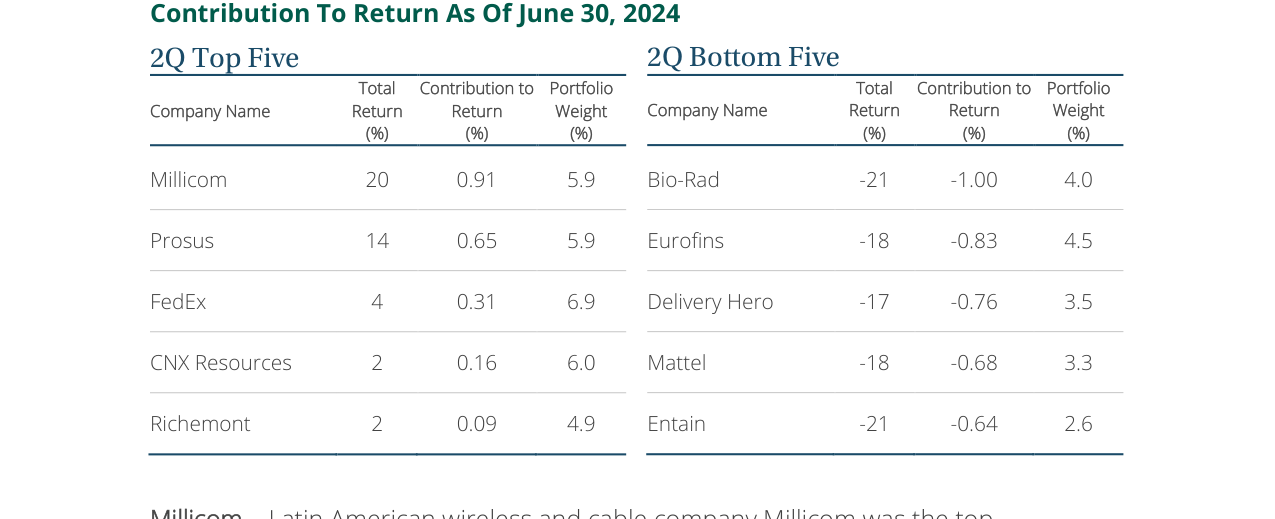
In Q2, Millicom ranked first with a 20% total return and a 0.91% contribution, while Bio-Rad ranked last with a -21% return and a -1.00% drag
4. Comparative Data: Key Financial Metrics and Valuation Differences
| Company | Current EV/EBITDA | Peer Median EV/EBITDA | Implied Valuation Deviation | Core Catalyst |
|---|---|---|---|---|
| Bio-Rad | 8x (Core Business) | 15x | -47% | Sartorius Stake Revaluation, FCF Growth Recovery |
| Eurofins | 12x | 14x | -14% | Resolution of Related-Party Transactions, Capital Allocation Optimization |
| Delivery Hero | 0.27x EV/GMV | 0.45x EV/GMV (Peers) | -40% | Taiwan Sale, Board Reform, Deleveraging |
5. Quantitative Logic of Portfolio Adjustments
- Increase Positions: Increase positions in Bio-Rad and Eurofins by 2% and 1.5%, respectively, based on their valuation recovery potential (Bio-Rad potential upside of 60%, Eurofins potential upside of 25%).
- Decrease Positions: Reduce the position in Delivery Hero by 1% to hedge against South Korean and Middle East competitive risks, but retain a core position (5% of the portfolio) pending the completion of the Taiwan transaction and board reform.
- Watchlist: Added 3 new companies (a European medical device manufacturer, an Asian e-commerce platform, and a US biotech company), all with EV/EBITDA more than 30% below industry averages and possessing asset revaluation opportunities similar to Eurofins.
Conclusion
The current market valuation of Bio-Rad, Eurofins, and Delivery Hero exhibits significant discrepancies, primarily due to overreactions to the Sartorius stake, related-party transaction risks, and competitive pressures. Through quantitative analysis, the report identifies potential upside of 15-60% and has optimized the risk-return profile through portfolio adjustments (increasing/decreasing positions by 1-2%). Going forward, the focus will be on Eurofins' H1 earnings report (end of July) and the approval of Delivery Hero's Taiwan transaction (Q1 2025), which will serve as key catalysts for valuation recovery.