Robotti & Company Advisors Q2 2014 Letter
Robotti & Company is a New York deep-value boutique founded by Bob Robotti in 1983, specializing in left-for-dead cyclical industries — energy services, building products, shipping — with multi-year holding periods and occasional activist letters. It manages about $650m; Bob is regarded as one of the most steadfast Graham-tradition cyclical value hunters.
In plain words
This is a letter from investment firm Robotti to its clients, explaining how they make money through 'contrarian investing'—buying stocks that most people hate and are cheap, instead of chasing 'perfect' companies everyone loves. For regular investors, the key takeaway is to think independently and be patient: they hold stocks for 3 to 5 years. They give examples like Skechers, which they bought when everyone was negative, then sold gradually after the stock rose over 200%. Worth reading because it shows how to avoid buying high and selling low.
Robotti's research report discusses the performance of its value stock portfolio in the second quarter of 2014, along with the core tenets of its contrarian investment strategy. As of June 30, 2014, the portfolio's 10-year annualized return was 10.96%, outperforming the benchmark (Russell 2500 Value
Theme & Background
This chapter opens Robotti's Q2 2014 client letter, primarily articulating the core philosophy of contrarian investing and reviewing the portfolio's performance for the quarter. The author notes that while "contrarian investing" has become a popular market label, most self-proclaimed contrarian investors are still chasing "holy grail" companies (high returns on capital, strong balance sheets, consistent earnings growth). True contrarian investing is the opposite.
Core Views
- True contrarian investing does not chase the "holy grail": The author argues that companies simultaneously possessing high returns on capital, strong balance sheets, consistent earnings growth and free cash flow, along with excellent management, are extremely rare and typically not cheap. The core of contrarian investing is buying assets that are broadly out of favor and priced cheaply.
- The market's definition of "long-term" is shrinking: The author adheres to a 3-5 year holding period, while the market's time horizon is shortening. By developing a "variant view" through research that differs from the consensus, the author profits from valuation discrepancies when the market eventually agrees with that judgment.
- Contrarian investing is an art, not a science: There is no fixed set of rules to guarantee success; it requires accumulated wisdom and time.
Key Arguments & Data
- Portfolio Performance Comparison: As of June 30, 2014, the portfolio's 10-year annualized return was 10.96%, outperforming the benchmark (Russell 2500 Value Index) at 9.07%; the 20-year annualized return was 12.23%, also outperforming the benchmark's 9.99%. However, in the short term (Q2 2014 and YTD), the portfolio underperformed the benchmark.
| Time Period | Portfolio (Net) | Benchmark (Russell 2500 Value) |
|---|---|---|
| Q2 2014 | 0.47% | 4.20% |
| Year to Date | 4.77% | 7.87% |
| 3 Years (Annualized) | 9.33% | 15.85% |
| 5 Years (Annualized) | 15.88% | 21.02% |
| 10 Years (Annualized) | 10.96% | 9.07% |
| 20 Years (Annualized) | 12.23% | 9.99% |
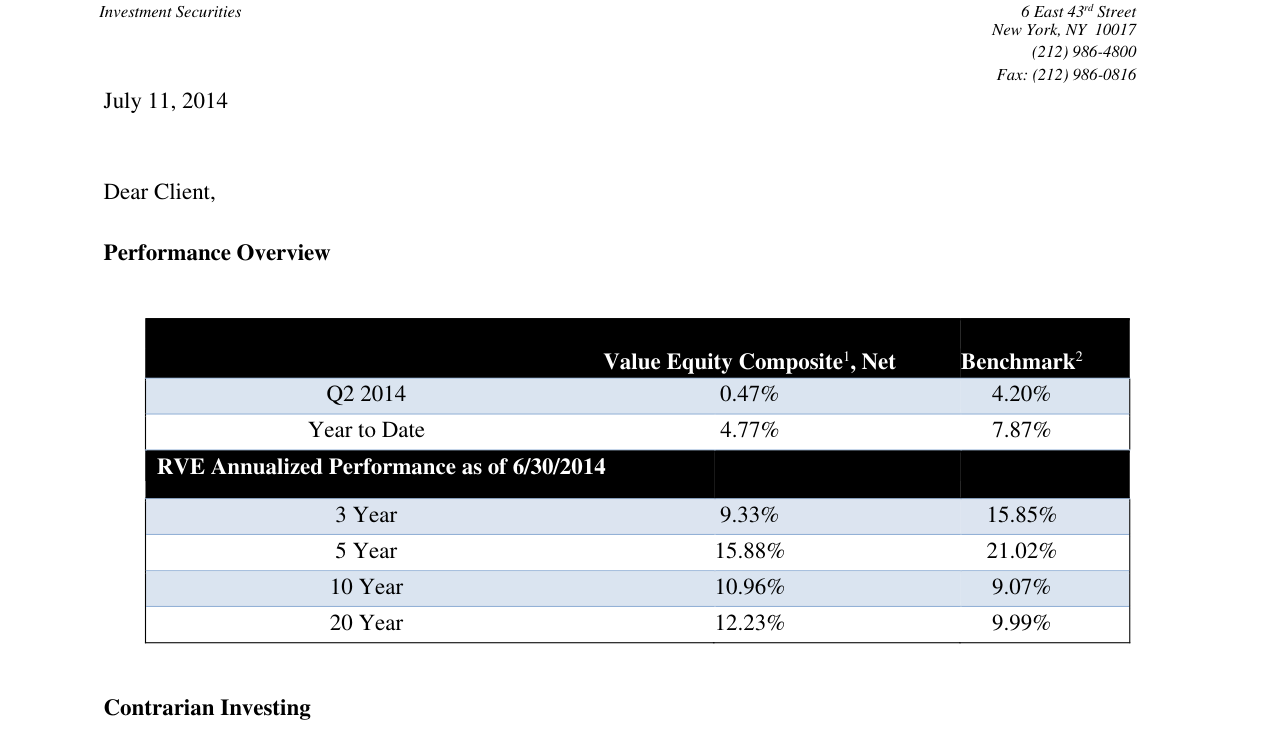
The Value Equity Composite returned 0.47% in Q2 2014, lagging the Benchmark's 4.20%, but its 20-year annualized return of 12.23% surpassed the Benchmark's 9.99%
- Skechers (SKX) Case: The author bought when the market was broadly pessimistic and nearly unanimous in its bearish view. As the company resolved its inventory issues, the market turned uniformly bullish, and the stock rose over 200% from its low. This led to a declining margin of safety, prompting the author to continuously reduce the position.
- Ainsworth Lumber (ANS) Case: The author bought in Q3 2013. Less than a month later, the company announced it would be acquired by Louisiana Pacific at a price nearly 20% above the purchase price. However, on May 14, 2014, the deal fell through due to regulatory issues, and the stock price fell from near the acquisition price of $3.76 back to the initial purchase price. The author believes the original investment thesis (benefiting from the US housing recovery) remains intact.
- LSB Industries (LXU) Case: After an activist investor publicly wrote to management, the company adopted suggestions, reduced the board size, added three new members with industry experience, and established a special committee. The stock rose over 11% during the quarter.
- Energy Sector Performance: Enerflex (EFX), Calfrac (CFW), and Helmerich & Payne (HP) were the three best-performing stocks in the portfolio for Q2. The author views them all as strong, disciplined capital allocators. Enerflex has been held in the portfolio for nearly a decade and recently expanded its compression business and international footprint through acquisitions. Calfrac opportunistically added horsepower in both the US and Canada.
Companies/Assets Involved
- Skechers (NYSE:SKX): A contrarian investment case. The author bought when the market was uniformly bearish. After the stock rose over 200% from its low, the author continuously reduced the position. Bullish (position reduced).
- Ainsworth Lumber Co. Ltd. (TSX:ANS): A low-cost Canadian OSB producer. The stock fell after the acquisition deal collapsed, but the author believes its thesis of benefiting from the US housing recovery remains unchanged. Bullish.
- LSB Industries Inc. (NYSE:LXU): A leader in chemical and climate control businesses. The founding family holds nearly 14% of shares. Governance improvements were driven by an activist investor, and the stock rose over 11% in Q2. Bullish.
- Enerflex Ltd. (TSX:EFX): An energy services company held in the portfolio for nearly a decade. It recently expanded its international business through acquisitions. Bullish.
- Calfrac Well Services (TSX:CFW): An energy services company emphasizing disciplined capital management, opportunistically adding capacity in the US and Canada. Bullish.
- Helmerich & Payne, Inc. (NYSE:HP): An energy services company viewed as a strong, disciplined capital allocator. Bullish.
- Stolt Nielsen (OB:SNI): One of the three worst-performing holdings YTD. No clear judgment.
- Leucadia National (NYSE:LUK): One of the three worst-performing holdings YTD. No clear judgment.
Investment Insights
- Contrarian investing requires patience and independent judgment: Investors should avoid chasing market-favored "holy grail" companies and instead focus on assets that are broadly out of favor and cheap, adhering to a 3-5 year holding period.
- Focus on the "variant view": Develop conclusions through in-depth research that differ from the market consensus. Profits are realized when the market eventually validates that view.
- Beware of risks after "uniformly bullish" sentiment: When a stock shifts from being uniformly bearish to uniformly bullish and its price has risen significantly, the margin of safety declines, and position reduction should be considered (e.g., Skechers).
- Value management's capital allocation ability: The author repeatedly emphasizes that the common trait of companies like Enerflex, Calfrac, and HP is being "strong, disciplined capital allocators," which is a key basis for long-term holding.